This guide gives MAKEXCAR buyers a car AC condenser fitment checklist centered on ports and mounting points. It does not assign a MAKEXCAR SKU to a vehicle, specify refrigerant-service procedures or claim that an unverified condenser will interchange with an OE unit. Those decisions require the vehicle application, part-specific documentation and trained service personnel.
Identify the exact condenser application
Collect the vehicle market, make, model, production period, engine, air-conditioning equipment and OE condenser reference. A model name can cover different front-end modules or line layouts. Ask whether the original part number has been superseded and obtain the current catalog entry for the offered replacement. The full manufacturer part number matters; a shortened stock code or marketplace title may omit the detail that separates two similar condensers.
Record whether the condenser is supplied as a bare heat exchanger or with a receiver-drier, mounting frame, seals or other accessories. Valeo notes that some condenser designs integrate a receiver-drier. Four Seasons also documents vehicle applications with an integrated filter-drier. The supply scope can therefore affect fit and the purchase order, not merely service convenience. The exact offered unit must be checked rather than assuming every condenser in the family has the same assembly.
Save the OE drawing or catalog page, the supplier's current drawing, and photos of the removed unit showing both sides and connection blocks. Date each source. If a supplier proposes an alternative construction, request its application statement and a drawing revision. A description such as “for the same model” is not a substitute for the exact equipment configuration.
Compare port type, position and orientation
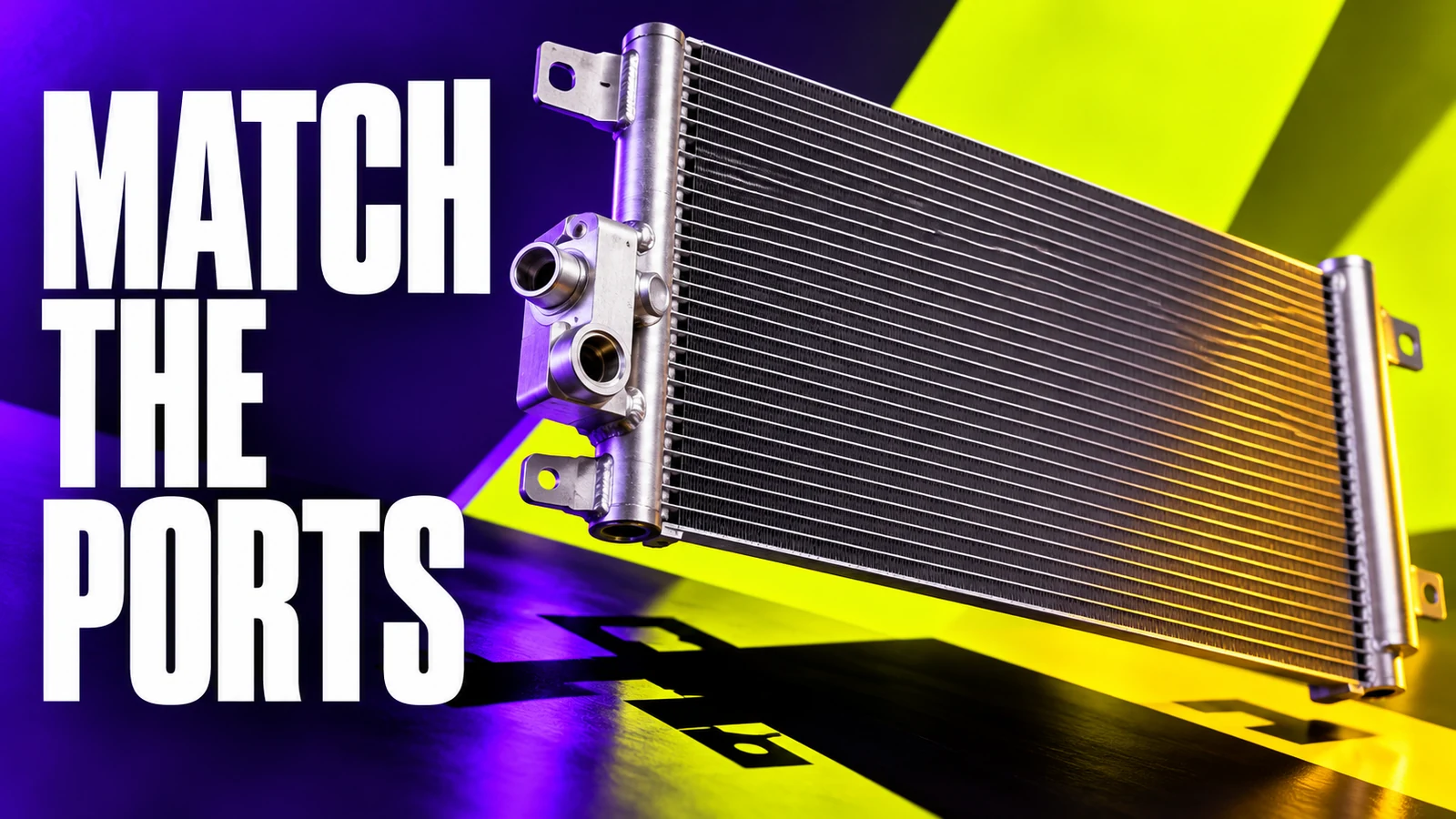
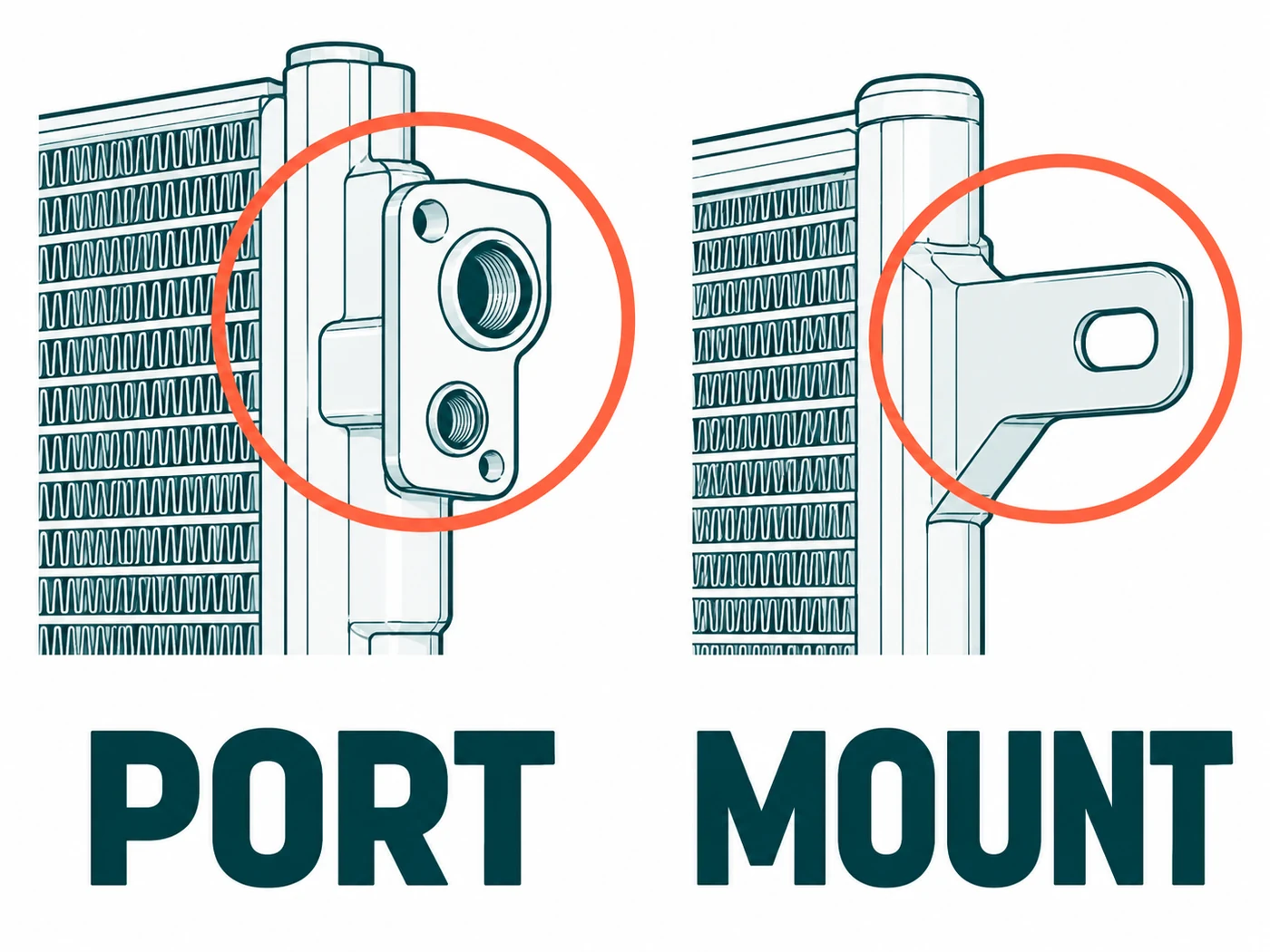
Locate each refrigerant line connection on the original condenser and the offered part. Compare which side of the core carries the ports, the height and fore-aft position, connection block shape, mating face, attachment method and line approach angle. A hose or metal line may have only limited movement. Forcing it to reach a nearby port can stress the fitting or seal even if the threads or bolt appear to engage.
Four Seasons' hose-assembly technical material illustrates the problem of a line design that does not match the OE layout and is torqued into position, creating stress at the connection. That example is application-specific, but the procurement lesson is broad: physical reach alone is not an approval. Ask for the exact port geometry and mating line reference. If the offered condenser has a different port block, determine whether the maker explicitly approves an adapter for that vehicle.
Do not infer the high- and low-side arrangement from a generic graphic. Identify the ports using the product maker's description and the vehicle service information. Check protective caps and supplied seals as separate fields. A cap present for storage does not prove that the connection style or O-ring specification matches the vehicle. Leave refrigerant-circuit opening, evacuation and charging to qualified service personnel following applicable rules and manufacturer instructions.
What a useful port drawing should show
The drawing should identify the part number and revision, give controlled views of both connection faces, and define the feature positions relative to a clear datum. It should state the connection designation or mating component reference used by the maker. If a dimension is missing from a sales image, ask for the technical drawing rather than measuring pixels. A side view is often necessary to understand a connection that looks aligned in a frontal photograph.
Map every mounting point and adjoining part
Nissens describes condensers at the front of the vehicle, often attached near other heat exchangers such as the radiator or intercooler. This position makes bracket layout and front-module packaging part of fitment. Count upper and lower tabs, locate side mounts, and note any clip, boss or rail that attaches to the radiator, fan shroud, carrier or air guide. Do not treat a pair of similar-looking corners as proof of matching hole positions.
Compare not only the mounting hole pattern but also bracket offset and orientation. A tab can have the right hole shape but sit on the wrong plane, changing clearance to the bumper reinforcement or adjacent cooler. Request front, rear, side and top views of the offered condenser. Where brackets are removable, determine whether they are included, transferred or separately ordered. Four Seasons specifically highlights condenser bracket design as a product feature, illustrating that it is part of the component rather than an incidental accessory.
Check the connection between the condenser and the rest of the module. Valeo's radiator removal guidance shows condenser fasteners being released as the radiator assembly is separated in one service configuration. That example does not define every vehicle, but it illustrates why a condenser's attachment to the radiator can matter during a replacement. The supplier's exact assembly drawing should establish those relationships for the target application.
Check the front-end space and heat-exchanger arrangement
A condenser lives in a crowded region. Compare its overall envelope, core depth, header position and port projection with the original assembly and the available space. The part must not interfere with the radiator, fan, intercooler, bumper structure or air guides. Valeo describes condenser design as depending on the vehicle's space allowance at the front, reinforcing that a similar face size can hide a packaging mismatch.
Ask whether a receiver-drier is integrated, separately mounted or included as a supplied accessory. Its location may change the outline of the unit or the service connections. Check whether the offered design includes a removable cartridge or protective plug and whether the vehicle application calls for a specific arrangement. A catalog photo of a bare core should not override a part-specific packing list.
Distinguish envelope fit from cooling performance. A condenser that physically occupies the space still needs an approved application and adequate system design, but this article does not assign a thermal rating from appearance. If a supplier claims a performance improvement, request the test conditions and an exact part comparison. Do not use that claim to skip the connection and mount checks.

Build a controlled side-by-side record
A small comparison sheet can stop a visual match from becoming an undocumented substitution. Use the original assembly and proposed part in parallel columns, with a source and revision for each field. If a field is blank or the two sources disagree, hold the fit decision and ask for clarification. The table below is a procurement checklist, not a dimensioned drawing for any MAKEXCAR product.
| Check | OE evidence | Offered-part evidence |
|---|---|---|
| Vehicle application | Market, build period, equipment and OE reference | Current maker listing or approved supersession |
| Connection block | Port count, position, face and line approach | Drawing and mating-line reference |
| Sealing parts | Connector and seal arrangement | Supplied seals/caps and maker instructions |
| Mounting | Tabs, clips, offsets and adjoining components | Front/rear/side views and packing list |
| Space | Module envelope and neighboring clearances | Core and overall dimensions from drawing |
| Drier arrangement | Integrated or separate configuration | Exact supplied assembly and service note |
| Document control | OE source and revision | Offered part number, drawing revision and approval |
Photographs remain useful for highlighting visible differences, especially port location and mounting tabs. Take them from comparable angles and label the source unit. Avoid placing one maker's photo next to another maker's drawing and calling unmeasured alignment exact. If a sample is available, compare it with the approved drawing and the removed assembly, then record any unresolved feature before installation.
Separate fit approval from service handling
Condenser selection and refrigerant service are related but different tasks. The buyer can verify part identity, connection style, supplied seals and protective caps. The service technician must follow the vehicle and component instructions for safe handling, contamination control, opening the refrigerant circuit and system completion. Valeo advises capping disconnected lines to limit moisture and dust entry during replacement; that is a service consideration, not a reason to claim every supplied condenser is already clean or ready to install.
Do not use a correct-looking fitting to justify forcing a line into place. If an installed line needs excessive movement, stop and resolve the part number or bracket alignment. Stress at a connection can create a later complaint that appears to be a product defect. Similarly, do not remove protective caps at receiving solely to compare an opening visually; ask for the drawing and preserve the product until qualified inspection.
At receipt, compare the carton label and part marking with the approved reference, then inspect for bent fins, damaged brackets and missing accessories without contaminating the open circuit. A substituted part number should come with written interchange evidence. An unopened, clearly identified assembly is easier to review than a damaged sample whose original condition can no longer be established.
Frequently asked buyer questions
Does the same core size mean two condensers are interchangeable?
No. Port geometry, connection blocks, bracket offsets, integrated drier arrangement and front-module clearance can differ even when the core face looks similar. Require the exact application listing and controlled drawing for the offered unit.
Can a refrigerant line be bent to reach a close port?
A buying decision should not depend on improvised line movement. If the line does not approach the port as specified, verify the condenser part number and the vehicle configuration. Any approved modification must come from the maker or a qualified application engineer, not a generic blog rule.
Are caps and O-rings always included?
Supply scope varies by part. Ask for the current packing list and installation note. The presence of a storage cap does not establish the correct seal or connection type. Identify which items are included, reused or separately ordered before the purchase order is finalized.
Send a condenser inquiry with the interface evidence
For a MAKEXCAR condenser quote, provide the vehicle market, build period, engine, A/C equipment and OE part number, plus quantity and destination. Include front, rear and side views of the original unit and note the port block, mounting tabs and drier arrangement. Request the exact offered part number, current application listing, interface drawing and supplied-parts list. Browse the published Condensers category for the product family, then contact MAKEXCAR with the specific fit questions. A documented match is stronger than a close-looking core.