Identify the HVAC configuration before comparing parts
Begin with the vehicle market, model, production interval and applicable identification details. Record the current OE evaporator reference and the location being replaced. If the vehicle has front and rear air conditioning, identify the required unit explicitly. Preserve any catalog distinction for HVAC equipment or vehicle configuration instead of shortening the application to a familiar model name.
A distributor needs the source behind the supplier's application list. Ask for the catalog version, OE mapping and offered SKU. When a reference has been superseded, request the documented chain and any configuration notes. A seller's list of multiple OE numbers is a starting point for checking evidence, not permission to treat every listed component as interchangeable.
Keep the original part's label and configuration photos when available. They can help clarify a disputed connection layout or supply scope, but a used component is not a complete manufacturing specification. If the original part is unavailable, ask for the appropriate catalog and drawing information rather than estimating missing features from a similar vehicle.
Understand why the core and its surroundings both matter
Nissens describes the evaporator as a heat exchanger on the low-pressure side of the AC system, typically inside the HVAC module behind the dashboard. Its role includes cooling and dehumidifying the air that passes over it. This general system description explains why physical accommodation and air-side interfaces belong in the fitment review.
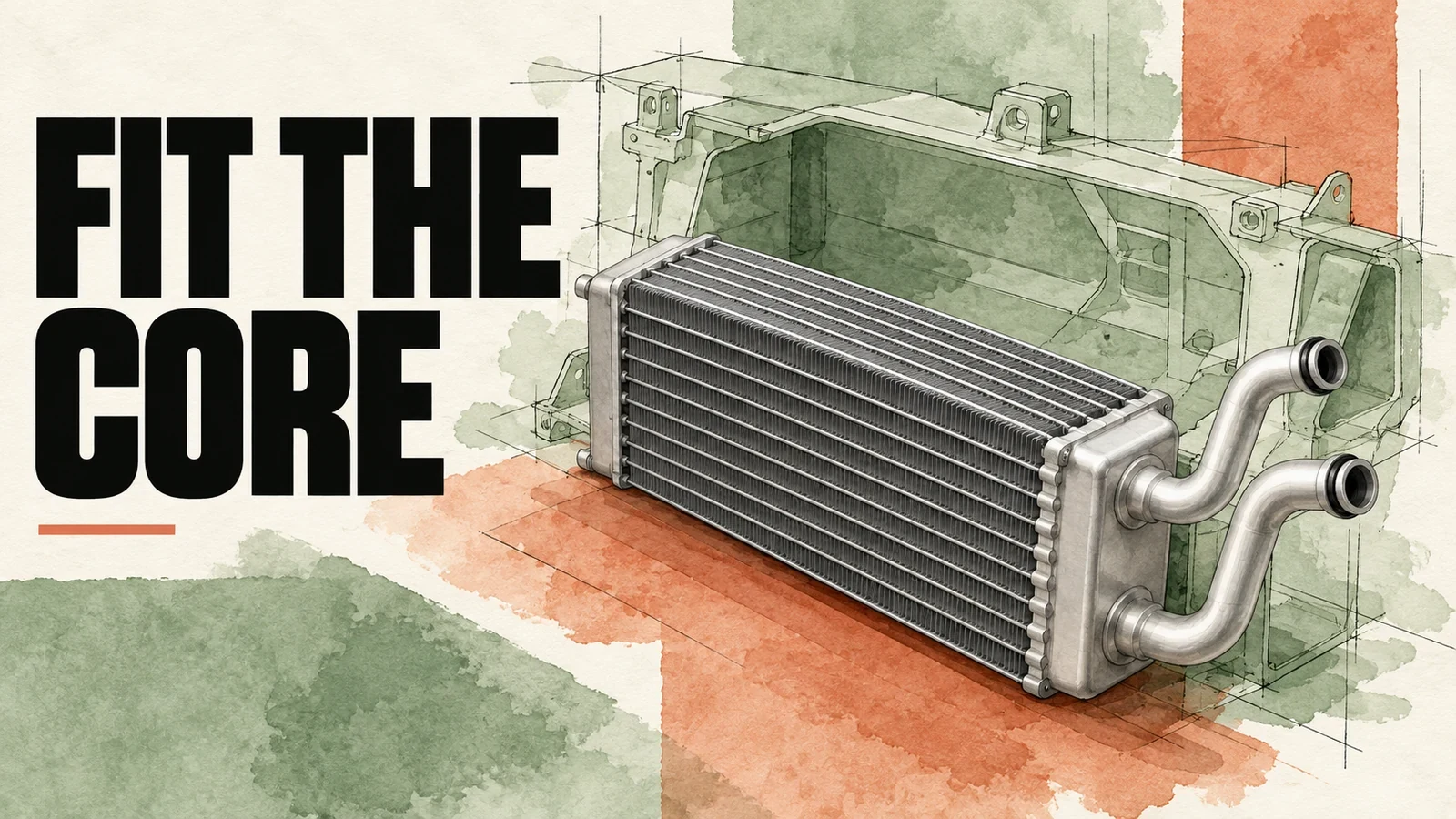
The rectangular finned section is only one part of the comparison. The assembly can also have tanks or manifolds, pipe exits, protective features and other interfaces. Ask whether the supplied drawing describes the finned core, the complete envelope or the shipping dimensions. Those measurements answer different questions and should not be merged into one “size” field.
Compare the drawing against the applicable HVAC case requirement. Identify the locating features and any specified interface for a sensor or surrounding seal. Do not assume an accessory exists on every evaporator design. The point is to document the exact offered configuration and required interfaces, not to invent a standard feature list for all vehicles.
Measure a defined core envelope
Request the dimensions used to locate the part in the HVAC case, with a clear drawing datum and measurement points. Record width, height and thickness as the drawing defines them, along with relevant protrusions. A nominal core dimension can conceal a manifold or pipe feature that extends beyond the space available for the assembly.
Use the agreed drawing tolerances for sample evaluation. A measurement from an old part can help establish the general configuration, but it should not become an acceptance tolerance without technical approval. Photograph the measuring locations so that a supplier can understand a discrepancy rather than arguing about two differently taken measurements.
Also ask which foam pieces, brackets or locating items belong to the offered assembly. Describe the required function and scope using actual documentation. If an image shows foam around the core, confirm whether it is included, separately supplied or purely illustrative. Procurement should preserve this distinction in both the quotation and sample approval record.
Compare pipe positions and connection geometry
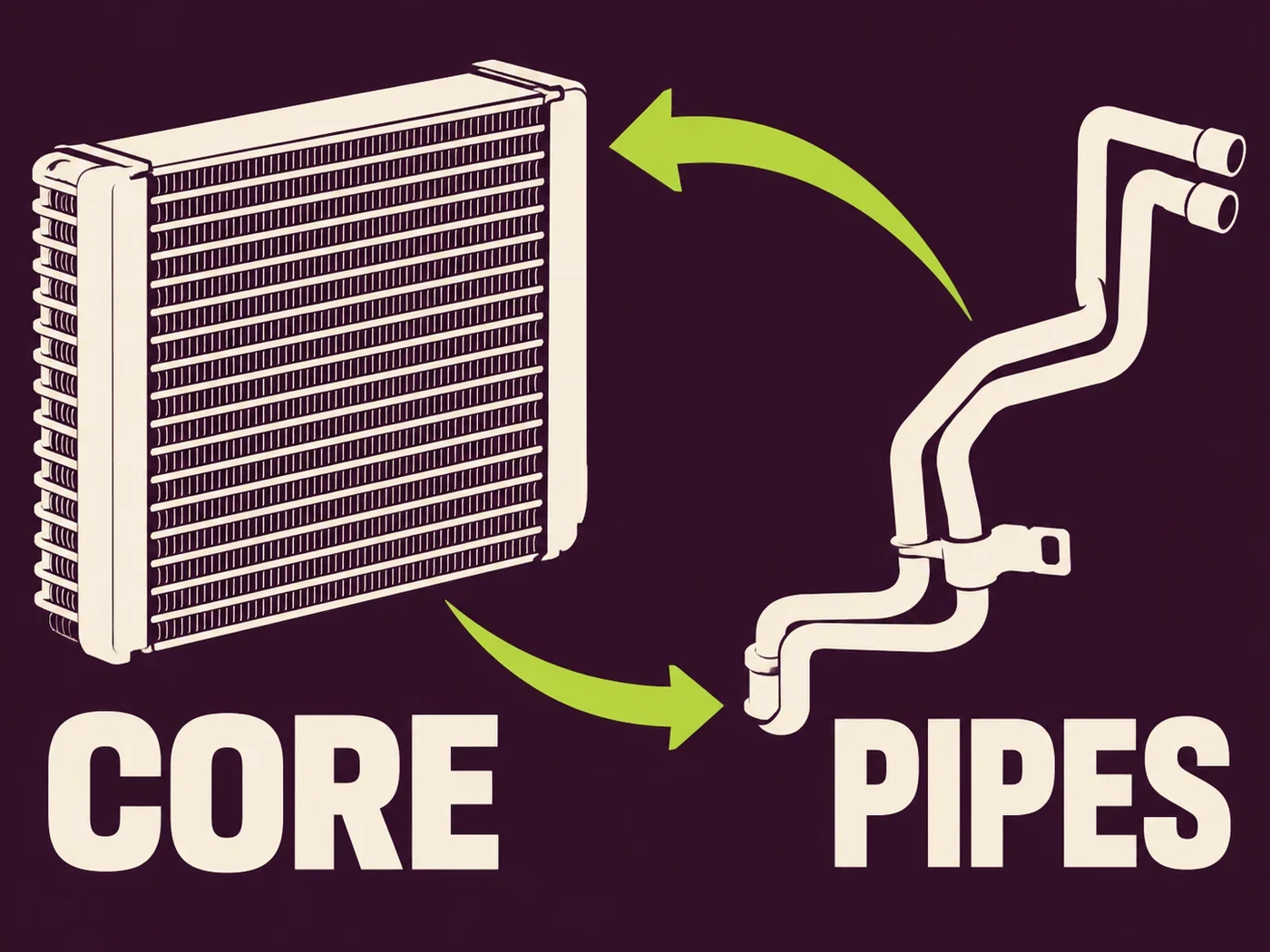
The pipe exit location, bend path and final connection position need their own comparison. Request views that identify the orientation relative to the core rather than an isolated photograph of the ends. Two cores may share a similar envelope while their pipes reach different locations. Do not treat a close-looking bend as proof of a correct interface.
Ask for the connection type and the relevant mating details on the offered drawing. Where a flange is used, record its orientation and applicable fixing arrangement. Where the part uses another connection design, use that design's documented interface. Avoid filling missing information with a universal flange pattern or a measurement from a different application.
For the sample, photograph the core and connection ends together in a consistent orientation. Compare the agreed drawing points and record any difference. A purchasing inspection should not rely on bending or adapting pipes to make an unapproved candidate appear compatible. Resolve the part identity or drawing discrepancy before accepting the sample.
Check the expansion-device interface separately
Nissens explains that a thermal expansion valve meters refrigerant entering the evaporator and is commonly located around the evaporator couplings and HVAC module. The valve has its own operating requirement. Physical connection similarity does not establish the correct metering characteristic for a vehicle application.
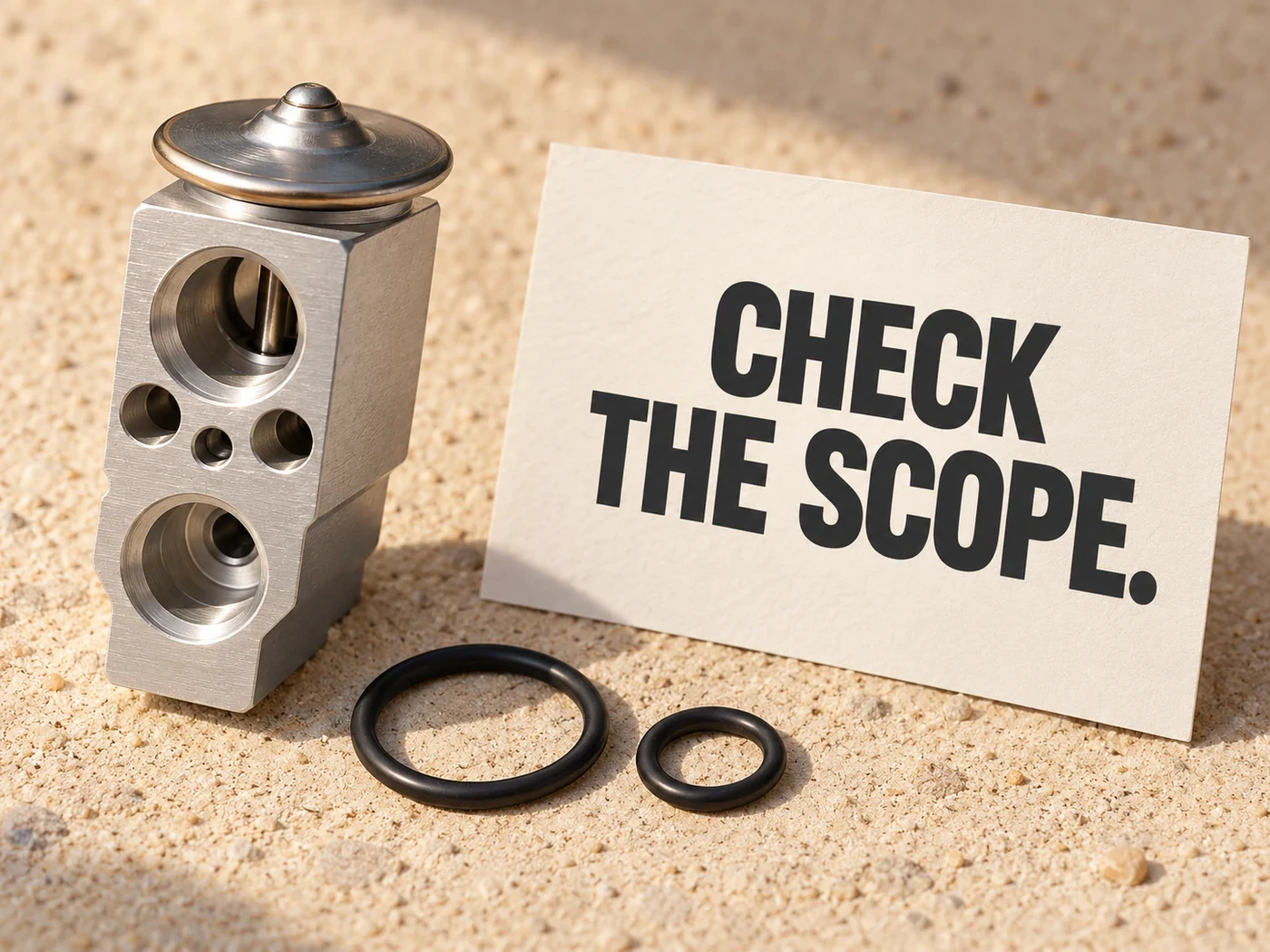
Identify which expansion-device design the application uses. If a block valve mounts at the evaporator, verify the offered assembly's mating arrangement and the correct valve reference separately. Do not assume every evaporator uses the same block valve, and do not attach an apparently matching valve solely because its holes align.
Ask whether the valve is included, separately ordered or retained according to the applicable service plan. Nissens describes bolts and O-rings within its own expansion-valve offering; that is not evidence of the supply scope of a MAKEXCAR evaporator. Require an itemized answer from the actual supplier for the offered part.
Document seals and accessory scope
For each connection, obtain the applicable seal identification and supply quantity. A bag of loose O-rings with no part mapping is not enough to approve the required joint. The supplier should identify which seal belongs to which interface and provide the relevant specification or catalog record.
Do not infer refrigerant compatibility or seal material from color alone. The required material and suitability belong to the application and component documentation. This article provides no generic seal substitution, lubrication quantity or assembly torque. Those details should come from the correct part and service information.
Write the delivery scope explicitly: core assembly, pipes, valve, seals, brackets and other identified items, as applicable. Mark exclusions clearly. This protects the distributor from approving one photographed configuration and receiving a different box contents later. Keep the sample approval linked to the exact quoted itemization.
| Fitment field | Evidence to request | Approval question |
|---|---|---|
| Vehicle and HVAC identity | Market, production interval and configuration | Which application and unit location? |
| OE reference | Current catalog record and supersession notes | Is the cross-reference supported? |
| Core envelope | Drawing dimensions, datum and tolerances | Does the specified assembly occupy the required space? |
| Locating interfaces | Case, sensor or seal interfaces as applicable | Are required surrounding features identified? |
| Pipe geometry | Exit positions, bends and connection views | Do the pipes reach the specified mating interfaces? |
| Expansion device | Correct reference and mating arrangement | Is the intended valve configuration documented? |
| Seal and accessory scope | Itemized included and excluded parts | What will actually be supplied? |
Keep fitment approval distinct from performance evidence
A successful dimensional comparison does not prove leak tightness, cooling performance or durability. The sample may match the required interfaces while still needing separate quality evidence. Request those records under their own approval questions, with sample identity and the appropriate acceptance criteria.
Nissens discusses evaporator performance as part of the complete air-conditioning system, including airflow over the core. That context should discourage a blanket performance promise based on appearance. A catalog feature or another manufacturer's test claim does not establish the performance of the specific MAKEXCAR component being offered.
If a candidate does not match the drawing, document the difference first. It may be the wrong configuration, an outdated reference or a changed assembly scope. If the dimensions match but a service complaint remains, do not label it a fitment failure without the relevant evidence. Keep the decision aligned with what was actually checked.
Resolve differences without inventing an adaptation
Equal core dimensions conceal different pipe endpoints
For a hypothetical drawing comparison, both candidate cores are labelled 240 mm wide, but one pipe endpoint is located 35 mm from the stated side datum and the other 50 mm from that same datum and viewing direction. The numerical difference is 50 − 35 = 15 mm at that defined coordinate. These invented values illustrate why equal core width does not make the pipe layouts identical; they are not MAKEXCAR dimensions, a vehicle clearance or an allowed deviation.
The purchasing decision is to identify which endpoint position the applicable assembly drawing requires and obtain the offered reference's corresponding evidence. The example does not prove which candidate fits: the required interface, other coordinates and tolerances remain unknown. Do not solve the discrepancy by proposing a bend or adjustment. Keep the observation as a documented geometry question for the responsible reviewer.
A combined model listing leaves front or rear location unresolved
If the supplier's application line names a vehicle model but the inquiry concerns one of multiple HVAC locations, the model match is incomplete evidence. Request the relevant unit location, equipment configuration and OE mapping. A photograph resembling the removed component can support identification, but it cannot replace the missing catalogue distinction.
Where the mapping confirms only the front unit, do not extend the approved reference to the rear unit to simplify the stock list. If it supports both under defined conditions, retain those conditions rather than publishing a broader statement. The useful outcome is a location-specific order line and evidence record, not an assumed universal evaporator for that model.
The valve fits the visible holes but its reference is unconfirmed
An apparent mechanical match can advance the interface review without completing the valve selection. Keep the valve identity and applicable functional information separate from the evaporator's flange geometry. The supplier needs to explain the offered combination through the appropriate reference-specific documents; this article does not establish a metering requirement from a photograph.
If the offer excludes the valve, the order must state that exclusion and the technical reviewer must determine the correct supply arrangement. If it includes a different valve reference, leave that proposed combination visible until reviewed. A bag containing a valve and seals answers part of the contents question, not every question about the intended HVAC system.
A sample matches an old drawing but the quotation names a revision
Compare the sample identifier, drawing version and quoted reference before declaring a dimensional pass. If the drawing used for the check predates a pipe or locating-feature revision, the observation can describe that older definition but may not settle the current offer. Preserve the measured record and identify the version difference precisely.
Request the current drawing or a documented explanation of unchanged applicable interfaces, then have the affected fields reviewed. An administrative file-date change is different from a changed pipe endpoint, so ask what changed rather than automatically rejecting or accepting the candidate. The release record should identify the actual drawing and sample configuration used for the decision.
Prepare an evaporator fitment enquiry
Review the MAKEXCAR evaporator category, then send an enquiry with the vehicle market, production interval, HVAC configuration, unit location and current OE reference. Include available photos showing the core and complete pipe layout. Ask for the offered SKU, drawing revision, expansion-device interface and itemized seal and accessory scope.
The goal is a traceable match between the vehicle requirement and the supplied assembly. No specific MAKEXCAR evaporator is declared compatible with a vehicle in this article. Final approval needs the actual application record and evidence for the offered part.
Application identity: market/model/production interval [ ]; HVAC equipment [ ]; front/rear or other unit location [ ]; current OE reference and supersession source [ ]; requested reference [ ]; responsible technical reviewer [ ]. Resolve the configuration before broadening an application list.
Geometry and interfaces: offered SKU/drawing version [ ]; core versus complete-envelope definition [ ]; measurement datums/views [ ]; locating features [ ]; pipe endpoints and connection geometry [ ]; expansion-device reference/interface [ ]; seal/accessory declaration [ ]. Attach the complete oriented view rather than only close-ups of the connection ends.
Sample decision: assessed sample ID [ ]; required drawing points and tolerances [ ]; observed differences [ ]; open location/valve/scope questions [ ]; reviewer decision and limitations [ ]; accepted drawing/contents version [ ]. Send this record with the enquiry so the supplier can answer the specific gap; dimensional review remains separate from leak and performance approval.