Automotive Belts & Hoses Wholesale Guide: Timing Belt, Serpentine Belt & Rubber Hose Sourcing for Distributors (2026)
Complete timing belt, serpentine belt & rubber hose wholesale guide. Compare HNBR vs EPDM materials, Gates alternatives, and bulk sourcing from certified manufacturers.
博客
2/23/2026
The global automotive belts and hoses market reached $47.2 billion in 2025, with timing belts, serpentine belts, and rubber hoses representing critical maintenance components requiring regular replacement across diverse vehicle applications. For wholesale distributors, auto parts retailers, and bulk purchasers, understanding the technical specifications, material differences, and sourcing strategies for belt and hose systems is essential to capturing market share in both the replacement parts segment and the performance upgrade market.
This comprehensive guide synthesizes technical expertise, material science fundamentals, and practical sourcing intelligence to help you make informed wholesale purchasing decisions. Whether you're evaluating EPDM versus neoprene rubber compounds, sourcing alternatives to premium brands like Gates and Continental, or navigating quality certifications, this manual provides the actionable insights necessary for success in the competitive automotive belt and hose wholesale market.
Understanding Timing Belt Technology and Specifications
Timing belts serve as the critical synchronization component in interference engines, coordinating crankshaft and camshaft rotation to ensure precise valve timing. Understanding timing belt construction, materials, and replacement intervals is fundamental to wholesale product selection and customer consultation.
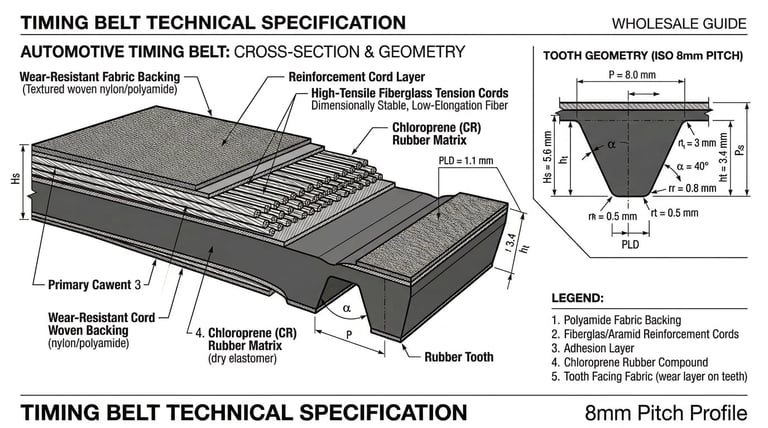
Timing Belt Construction and Components
A timing belt consists of multiple engineered layers working together to provide strength, flexibility, and precise tooth engagement:
Core Components:
Tooth profile: Trapezoidal or curvilinear teeth that mesh with sprocket grooves
Tensile cords: High-strength fiberglass or aramid fiber reinforcement
Rubber compound: HNBR (Hydrogenated Nitrile Butadiene Rubber) or chloroprene base material
Fabric facing: Nylon or polyester tooth facing for reduced friction and wear
Back surface: Optional fabric backing for reverse-bend applications
Critical Specifications:Pitch: Distance between tooth centers (common: 8mm, 9.525mm/3/8", 12.7mm/1/2")
Width: Belt width in millimeters (common range: 19mm to 30mm)
Length: Measured in teeth count or millimeters (e.g., 123 teeth, 984mm)
Tooth profile: HTD (High Torque Drive), STD (Super Torque Drive), or trapezoidal
Temperature range: Typically -40°C to +130°C continuous operation
Timing Belt Material Technology
Modern timing belts have evolved from simple neoprene constructions to sophisticated engineered compounds offering extended service intervals and improved performance.
HNBR (Hydrogenated Nitrile Butadiene Rubber)
HNBR represents the current industry standard for automotive timing belts, offering superior performance characteristics compared to traditional materials.
Technical Characteristics:
Temperature resistance: -40°C to +150°C (superior to chloroprene's +120°C limit)
Ozone resistance: Excellent resistance to atmospheric ozone degradation
Oil resistance: Superior resistance to engine oil contamination
Tensile strength: 18-25 MPa (compared to 15-20 MPa for chloroprene)
Service life: 100,000-150,000 km (60,000-90,000 miles) typical replacement interval
Performance Advantages:
HNBR timing belts maintain flexibility and strength across extreme temperature variations, making them ideal for modern high-performance engines operating at elevated temperatures. The material's resistance to oil contamination prevents premature degradation from oil leaks, a common failure mode in older belt materials.
Wholesale Considerations:Unit cost: $8.00-$18.00 per belt (bulk pricing, 500+ units, varies by application)
Market positioning: Premium replacement and OEM-equivalent segment
Customer profile: Quality-conscious repair shops, dealerships, fleet operators
Competitive advantage: Extended service life justifies premium pricing
Application Recommendations:Modern interference engines (2000+ vehicles)
High-performance and turbocharged applications
Vehicles with extended service intervals (100,000+ km)
Hot climate regions where heat resistance is critical
Chloroprene (Neoprene) Timing Belts
Chloroprene represents the traditional timing belt material, still used in some applications and offering cost advantages for specific market segments.
Technical Characteristics:
Temperature resistance: -40°C to +120°C (adequate for most applications)
Ozone resistance: Good but inferior to HNBR
Oil resistance: Moderate; degrades faster with oil contamination
Service life: 60,000-100,000 km (40,000-60,000 miles) typical replacement interval
Wholesale Considerations:Unit cost: $5.00-$12.00 per belt (bulk pricing, 500+ units)
Market positioning: Economy replacement segment
Customer profile: Price-sensitive consumers, older vehicles, budget repair shops
Application: Older vehicles (pre-2000), non-interference engines, cost-conscious markets
Timing Belt Tooth Profile Technology
【插入图片 2: Automotive Belt Types Comparison Chart】
Tooth profile design significantly impacts belt performance, noise levels, and load capacity.
Trapezoidal Tooth Profile
The traditional tooth design, still common in many automotive applications.
Characteristics:
Tooth angle: 40° included angle
Load distribution: Concentrated at tooth tip
Noise level: Higher than curvilinear profiles
Efficiency: 96-98% power transmission efficiency
Applications: Older vehicle designs, cost-sensitive applications
HTD (High Torque Drive) Profile
Curvilinear tooth design offering improved load distribution and performance.
Characteristics:
Tooth shape: Rounded, curvilinear profile
Load distribution: Distributed across entire tooth surface
Noise level: Significantly reduced compared to trapezoidal
Efficiency: 98-99% power transmission efficiency
Backlash: Minimal, providing precise timing control
Applications: Modern engines, high-performance applications
Wholesale Advantage:
HTD profile belts command premium pricing (15-25% above trapezoidal) while offering superior performance and customer satisfaction. This profile is increasingly specified by OEMs and represents the growth segment in timing belt replacement.
STD (Super Torque Drive) Profile
Advanced curvilinear design optimized for maximum load capacity.
Characteristics:
Tooth shape: Modified curvilinear with increased depth
Load capacity: 30-40% higher than HTD at same width
Applications: High-torque diesel engines, commercial vehicles
Market: Specialized segment with premium pricing
Timing Belt Tensile Cord Technology
The reinforcement cords provide tensile strength and dimensional stability, critical for maintaining precise timing under load.
Fiberglass Reinforcement
Characteristics:
Tensile strength: 2,500-3,000 N/mm width
Elongation: Minimal (<0.3% under operating loads)
Cost: Lower than aramid fiber
Applications: Passenger vehicles, standard-duty applications
Temperature stability: Good up to 130°C
Wholesale Considerations:Standard specification for most replacement belts
Cost-effective for volume applications
Adequate performance for typical passenger vehicles
Aramid Fiber (Kevlar) Reinforcement
Characteristics:
Tensile strength: 3,500-4,500 N/mm width (40-50% higher than fiberglass)
Elongation: Extremely low (<0.2% under operating loads)
Cost: 30-50% premium over fiberglass
Applications: High-performance engines, commercial vehicles, extreme-duty
Temperature stability: Excellent up to 150°C+
Wholesale Considerations:Premium product positioning
Justifies higher pricing through superior performance
Target market: Performance enthusiasts, commercial fleets, severe-duty applications
Timing Belt vs. Timing Chain Market Dynamics
Understanding the market transition from timing belts to timing chains helps inform inventory strategy and customer education.
Timing Belt Advantages:
Lower initial cost
Quieter operation
Lighter weight (fuel efficiency benefit)
Simpler replacement procedure
Timing Chain Advantages:Longer service life (typically engine lifetime)
No scheduled replacement required
Better suited for high-torque applications
Eliminates belt replacement cost over vehicle life
Market Trends:New vehicle production: Increasing shift to timing chains (approximately 65% of new engines in 2025)
Replacement market: Strong demand remains for 2000-2020 vehicles with timing belts
Aftermarket opportunity: Estimated 150 million vehicles globally still using timing belts
Regional variation: Timing belts remain common in Asian and European markets
Wholesale Strategy:
Focus timing belt inventory on high-volume vehicle applications from 2000-2020 model years. This represents the "sweet spot" where vehicles are entering replacement intervals but timing chain adoption was not yet universal.
Serpentine Belt Technology and Applications
Serpentine belts (also called multi-rib belts or poly-V belts) drive multiple engine accessories from a single belt, replacing the older multiple V-belt systems. Understanding serpentine belt construction and performance characteristics is essential for wholesale product selection.
Serpentine Belt Construction
Core Components:
Rib profile: Multiple V-shaped ribs on inner surface (typically 4-8 ribs)
Rubber compound: EPDM (Ethylene Propylene Diene Monomer) primary material
Tensile cords: Polyester cord reinforcement
Back surface: Fabric or rubber backing (depending on application)
Common Rib Configurations:4PK: 4 ribs, 14mm width
5PK: 5 ribs, 17.5mm width
6PK: 6 ribs, 21mm width (most common passenger vehicle)
7PK: 7 ribs, 24.5mm width
8PK: 8 ribs, 28mm width (commercial vehicles, high-load applications)
EPDM Serpentine Belt Technology
EPDM has become the dominant material for serpentine belts due to superior heat and ozone resistance.
Technical Characteristics:
Temperature resistance: -40°C to +150°C continuous operation
Ozone resistance: Excellent; minimal cracking from atmospheric exposure
Flexibility retention: Maintains flexibility throughout service life
Typical service life: 80,000-120,000 km (50,000-75,000 miles)
Crack resistance: Superior to older neoprene formulations
Performance Profile:
EPDM serpentine belts resist the micro-cracking that plagued older neoprene belts, eliminating the visual "cracking" inspection criterion. Modern EPDM belts typically fail through rib wear or tensile cord degradation rather than surface cracking, requiring different inspection methods.
Wholesale Considerations:Unit cost: $4.00-$12.00 per belt (bulk pricing, 500+ units, varies by length and rib count)
Market positioning: Standard replacement for all modern vehicles
Customer education: Emphasize that absence of cracks doesn't indicate belt condition
Inspection recommendation: Rib wear measurement and tensioner inspection
Serpentine Belt Rib Profile Technology
The rib profile design impacts grip, noise, and wear characteristics.
Standard Rib Profile:
Rib angle: 40° included angle
Rib pitch: 3.56mm (PK profile, most common)
Applications: Standard passenger vehicles
Performance: Adequate for typical accessory loads
Micro-V Profile:Reduced rib pitch: Allows more ribs in same width
Applications: Space-constrained designs
Advantage: Higher power transmission in compact package
Double-Sided Serpentine Belts
Some modern engines use serpentine belts with ribs on both sides, allowing the belt to drive accessories from both surfaces.
Applications:
Compact engine designs with limited space
Engines with accessories mounted on both sides
Hybrid vehicles with integrated starter-generators
Wholesale Considerations:Premium pricing (30-50% above single-sided)
Lower volume but growing market segment
Requires precise application matching
Serpentine Belt Tensioner Systems
Belt tensioners are critical to serpentine belt performance and represent an important complementary product opportunity.
Automatic Tensioners:
Spring-loaded mechanism maintains constant belt tension
Typical service life: 100,000-150,000 km
Failure modes: Spring weakening, bearing failure, hydraulic damper degradation
Wholesale opportunity: Recommend tensioner replacement with belt
Manual Tensioners:Requires periodic adjustment
Lower cost but higher maintenance
Primarily older vehicle designs
Wholesale Strategy:
Bundle serpentine belts with tensioners and idler pulleys as "serpentine belt kits" for higher transaction value and complete repair solution. Kit pricing provides 15-25% margin improvement over individual component sales.
Automotive Rubber Hose Technology and Applications
Automotive rubber hoses transport fluids (coolant, fuel, oil, brake fluid, power steering fluid) and gases (air, vacuum) throughout the vehicle. Understanding hose construction, material specifications, and pressure ratings is essential for wholesale product selection and customer safety.
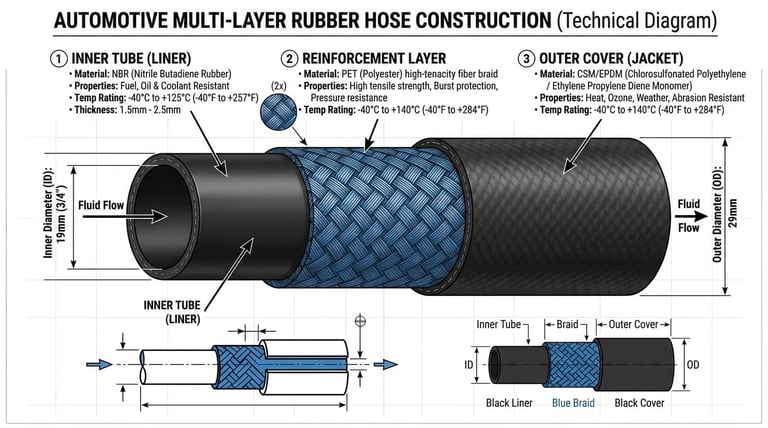
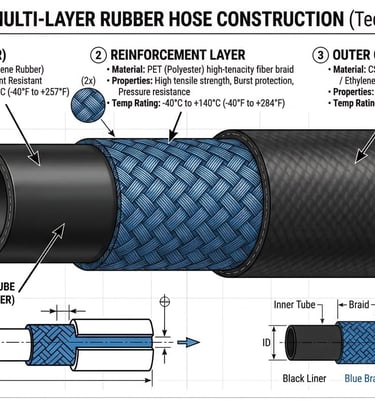
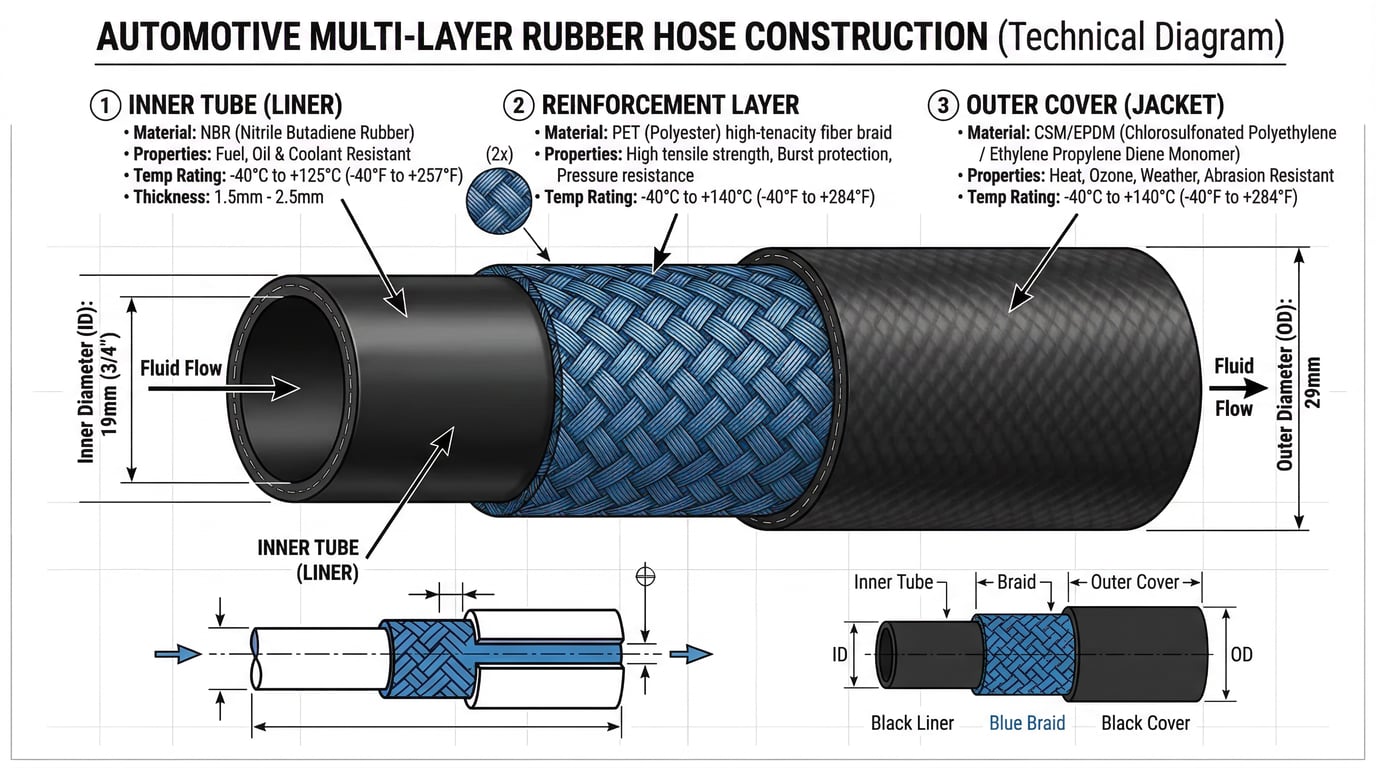
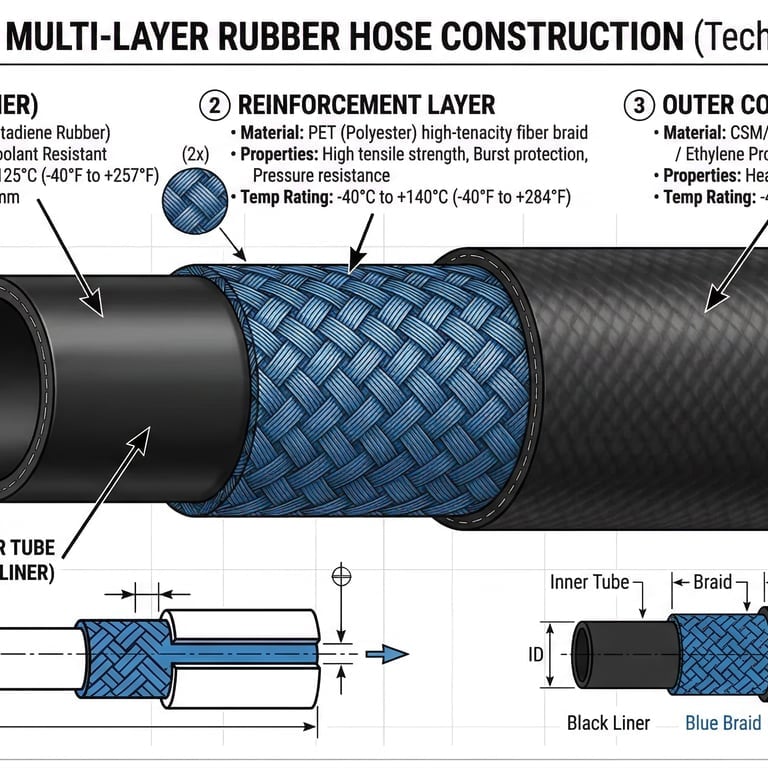
Automotive Hose Construction Layers
Modern automotive hoses feature multi-layer construction optimized for specific applications:
Inner Tube (Fluid Contact Layer):
Material selection based on fluid compatibility
Smooth bore for unrestricted flow
Chemical resistance to transported fluid
Temperature resistance appropriate for application
Reinforcement Layer:Textile braid: 1-3 layers of polyester or nylon (low-pressure applications)
Wire braid: Stainless steel wire (high-pressure applications)
Spiral wire: Multiple wire layers (very high pressure, hydraulic applications)
Function: Provides pressure resistance and dimensional stability
Outer Cover:Protects reinforcement from environmental damage
Abrasion resistance for routing through tight spaces
Heat resistance from nearby engine components
Ozone and UV resistance for underhood exposure
Coolant Hoses (Radiator and Heater Hoses)
Coolant hoses transport engine coolant between engine, radiator, heater core, and other cooling system components.
Material Specifications:
Inner tube: EPDM (Ethylene Propylene Diene Monomer)
Reinforcement: Polyester or aramid fiber braid
Outer cover: EPDM with heat and ozone resistance
Temperature rating: -40°C to +135°C continuous, +150°C peak
Pressure rating: 0.3-0.5 MPa (45-75 psi) typical
Types of Coolant Hoses:
Upper and Lower Radiator Hoses:Largest diameter hoses in cooling system (typically 30-50mm)
Often molded with specific bends for vehicle application
Wholesale options: Molded (vehicle-specific) or universal flex hose
Heater Hoses:Smaller diameter (typically 15-20mm)
Transport coolant to/from heater core
Often supplied as straight lengths cut to fit
Bypass Hoses:Small diameter (10-15mm)
Allow coolant circulation during thermostat closed condition
Often molded with complex shapes
Wholesale Considerations:Molded hoses: Higher price ($8-$25 per hose) but exact fit, vehicle-specific inventory
Universal flex hoses: Lower price ($3-$8 per foot) but requires cutting and fitting
Strategy: Stock molded hoses for high-volume applications, universal for low-volume
Quality Indicators:Wall thickness: Minimum 3.5mm for standard applications
Reinforcement visibility: Should not see reinforcement through inner tube
Flexibility: Should remain flexible when cold
Markings: SAE J20 rating clearly marked
Fuel Hoses
Fuel hoses transport gasoline or diesel fuel from tank to engine, requiring specific material compatibility and safety standards.
Material Specifications:
Inner tube: Fluoroelastomer (FKM) or fuel-resistant NBR (Nitrile Butadiene Rubber)
Reinforcement: Textile braid (low-pressure) or wire braid (high-pressure injection systems)
Outer cover: CR (Chloroprene) or CSM (Chlorosulfonated Polyethylene)
Temperature rating: -40°C to +100°C (low-pressure), -40°C to +125°C (high-pressure)
Pressure rating: 0.5 MPa (low-pressure), 1.0-2.0 MPa (high-pressure fuel injection)
Fuel Hose Types:
Low-Pressure Fuel Hose (Carbureted and Low-Pressure Injection):Applications: Fuel tank to fuel pump, older vehicles
Pressure: Up to 0.5 MPa (75 psi)
Standard: SAE J30 R6, R7, or R9
Wholesale cost: $2-$5 per foot
High-Pressure Fuel Injection Hose:Applications: Modern fuel injection systems (port and direct injection)
Pressure: 1.0-2.0 MPa (150-300 psi) for port injection, up to 20 MPa for direct injection
Standard: SAE J30 R10 or R12
Construction: Multi-layer with wire reinforcement
Wholesale cost: $8-$15 per foot
Submersible Fuel Hose:Applications: Inside fuel tank
Requirements: Resistant to fuel immersion, low permeation
Standard: SAE J30 R10 (submersible rating)
Critical Safety Considerations:Never substitute: Fuel hose must meet SAE J30 specifications; coolant hose is NOT acceptable
Permeation ratings: Modern hoses must meet low-permeation standards (EPA regulations)
Age limitations: Recommend replacement every 5-7 years regardless of appearance
Clamp requirements: Use fuel-injection rated clamps for high-pressure applications
Brake Hoses
Brake hoses are safety-critical components requiring the highest quality standards and certifications.
Material Specifications:
Inner tube: EPDM or synthetic rubber compatible with DOT 3/4/5 brake fluid
Reinforcement: Multiple textile braid layers with wire spiral
Outer cover: EPDM with abrasion resistance
Temperature rating: -40°C to +120°C
Pressure rating: Minimum 14 MPa (2,000 psi), burst pressure >70 MPa (10,000 psi)
Construction Requirements:Triple-layer construction: Inner tube, reinforcement, outer cover
Swaged end fittings: Crimped or swaged metal fittings (not reusable)
Length marking: DOT-required markings including manufacturer and date code
Protective spring: Optional coil spring over hose for abrasion protection
Regulatory Standards:FMVSS 106 (USA): Federal Motor Vehicle Safety Standard for brake hoses
ECE R90 (Europe): European brake component certification
SAE J1401: Technical specifications for hydraulic brake hoses
Wholesale Considerations:Unit cost: $8-$20 per hose (assembled with fittings)
Certification critical: Must have DOT/FMVSS 106 approval for legal sale
Liability exposure: Highest liability risk of any hose product
Quality imperative: Never compromise on brake hose quality
Application Types:Flexible brake hoses: Connect chassis-mounted brake lines to wheel cylinders/calipers
Stainless steel braided: Performance upgrade, reduced expansion under pressure
Extended length: For lifted vehicles or modified suspensions
Power Steering Hoses
Power steering hoses transport hydraulic fluid under high pressure from pump to steering gear.
Material Specifications:
Inner tube: NBR (Nitrile) or HNBR for fluid compatibility
Reinforcement: Multiple wire braid layers for high-pressure resistance
Outer cover: CR (Chloroprene) with abrasion and heat resistance
Temperature rating: -40°C to +135°C
Pressure rating: 10-17 MPa (1,500-2,500 psi) working pressure
Types:
High-Pressure Hose:From pump to steering gear
Wire-reinforced construction
Crimped end fittings
Wholesale cost: $15-$35 per hose (assembled)
Low-Pressure Return Hose:From steering gear back to reservoir
Lower pressure rating adequate
May use spring clamps instead of crimped fittings
Wholesale cost: $8-$18 per hose
Market Trends:Declining segment: Electric power steering (EPS) replacing hydraulic systems
Replacement market: Strong demand for 2000-2015 vehicles with hydraulic systems
Inventory strategy: Focus on high-volume vehicle applications
Air Conditioning Hoses
A/C hoses transport refrigerant between compressor, condenser, evaporator, and expansion valve.
Material Specifications:
Inner tube: Nylon or HNBR with barrier layer (prevents refrigerant permeation)
Reinforcement: Wire braid for high-pressure sections
Outer cover: EPDM or CR with heat resistance
Temperature rating: -40°C to +135°C
Pressure rating: High-pressure side: 3.0-4.5 MPa (450-650 psi), Low-pressure side: 0.3-0.5 MPa
Refrigerant Compatibility:R-134a: Standard refrigerant 1995-2015 vehicles
R-1234yf: New refrigerant for 2015+ vehicles (environmental regulations)
Barrier layer critical: Prevents refrigerant leakage through hose walls
Wholesale Considerations:Assembled hoses: Sold with crimped fittings (not field-serviceable)
Refrigerant-specific: R-134a and R-1234yf hoses not interchangeable
Unit cost: $25-$60 per hose (assembled with fittings)
Certification: SAE J2064 (R-134a) or SAE J2888 (R-1234yf) compliance required
Vacuum Hoses
Vacuum hoses distribute engine vacuum to various systems (brake booster, emission controls, HVAC controls).
Material Specifications:
Material: Silicone rubber or EPDM
Temperature rating: -50°C to +200°C (silicone), -40°C to +135°C (EPDM)
Pressure rating: Vacuum only (minimal positive pressure)
Sizes: 3mm to 12mm inner diameter (common: 4mm, 6mm, 8mm)
Wholesale Considerations:Bulk supply: Sold by the foot or in coils
Color coding: Black (standard), colored (emission control systems)
Silicone upgrade: Premium option for high-temperature applications
Unit cost: $0.50-$2.00 per foot (EPDM), $2-$5 per foot (silicone)
Quality Standards and Certifications
Understanding quality standards and certifications is essential for wholesale buyers to ensure product compliance, minimize liability, and communicate value to customers.
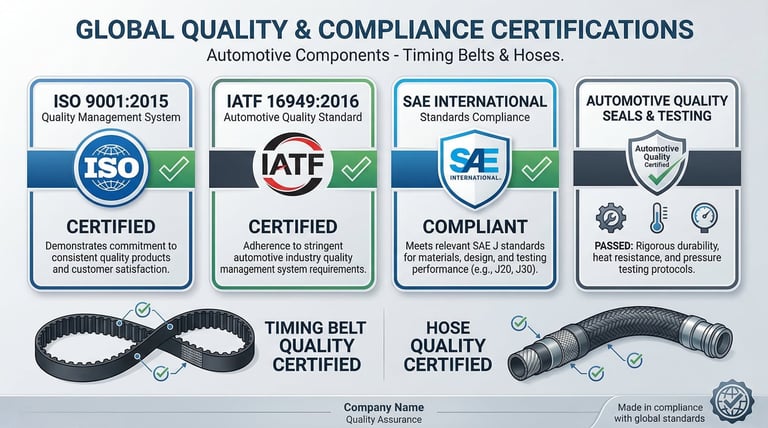
ISO and Automotive Quality Standards
ISO 9001:2015 - Quality Management Systems:
Baseline quality management certification
Demonstrates systematic quality processes
Required for serious wholesale suppliers
Verification: Request current certificate and audit reports
IATF 16949:2016 - Automotive Quality Management:Automotive-specific quality standard
Builds on ISO 9001 with automotive requirements
Includes PPAP, APQP, FMEA, SPC, MSA
Preferred certification for automotive suppliers
Indicates OEM-level quality systems
Product-Specific Standards
Timing Belts:
ISO 5296: Synchronous belt drives - Belts
DIN 7721: Synchronous belt drives (European standard)
RMA (Rubber Manufacturers Association): Industry specifications
Serpentine Belts:SAE J1459: V-ribbed belts and pulleys
ISO 9982: Belt drives - Pulleys and V-ribbed belts for industrial applications
DIN 7867: V-ribbed belt drives
Coolant Hoses:SAE J20: Coolant system hoses
Class D1: Standard duty (-40°C to +110°C)
Class D2: Heavy duty (-40°C to +125°C)
Class D3: Severe duty (-40°C to +135°C)
Fuel Hoses:SAE J30: Fuel and oil hoses
R6/R7: Low-pressure applications
R9: High-temperature applications
R10: High-pressure fuel injection
R12: Very high-pressure direct injection
Brake Hoses:FMVSS 106: Federal Motor Vehicle Safety Standard (USA)
ECE R90: European brake component approval
SAE J1401: Hydraulic brake hose assemblies
DOT approval: Required for legal sale in USA
Material Testing and Verification
Wholesale buyers should verify supplier material quality through testing protocols:
Physical Testing:
Tensile strength: Measures material strength
Elongation at break: Indicates material flexibility
Hardness: Shore A durometer testing
Compression set: Resistance to permanent deformation
Environmental Testing:Heat aging: Exposure to elevated temperature (e.g., 168 hours at 125°C)
Ozone resistance: Exposure to ozone atmosphere
Cold flexibility: Low-temperature bend testing
Fluid resistance: Immersion in relevant fluids (coolant, fuel, oil)
Performance Testing:
Timing Belts:Tensile strength testing of cords
Tooth shear strength
Fatigue testing (cyclic loading)
Temperature cycling
Serpentine Belts:Rib wear testing
Tensile cord strength
Flex fatigue testing
High-temperature aging
Hoses:Burst pressure testing (typically 4x working pressure)
Impulse testing (cyclic pressure)
Permeation testing (fuel hoses)
Vacuum collapse resistance
Third-Party Testing and Certification
Testing Laboratories:
TÜV (Germany) : Respected European testing authority
SGS (Switzerland): Global inspection and certification
Intertek: Product testing and certification
UL (Underwriters Laboratories): Safety certification
Verification Process:
Request test reports from supplier
Verify testing laboratory credentials
Confirm test methods match relevant standards
Check test sample traceability to production batches
Consider independent testing for high-volume orders
Competitive Brand Analysis and Aftermarket Positioning
The automotive belt and hose market is dominated by several premium OEM suppliers. Understanding their positioning helps wholesale buyers identify opportunities for aftermarket alternatives.
Premium Brand Market Positioning
Gates Corporation (USA)
Market Position:
Global market leader in automotive belts (approximately 30% market share)
Dominant in timing belts and serpentine belts
OEM supplier to virtually all major automakers
Strong brand recognition and customer loyalty
Product Range:Timing belts: Gates PowerGrip, PowerGrip GT
Serpentine belts: Gates Micro-V, Green Stripe
Hoses: Comprehensive coolant, fuel, and specialty hose lines
Retail pricing: Premium tier (highest prices in aftermarket)
Wholesale Alternative Strategy:Position aftermarket timing belts as "Gates-equivalent specifications"
Emphasize HNBR material and HTD profile matching Gates products
Target price point: 30-40% below Gates retail pricing
Highlight ISO/IATF certifications as quality equivalence
Continental (Germany)
Market Position:
Second-largest belt manufacturer globally (approximately 20% market share)
Strong presence in European market
OEM supplier to European and Asian automakers
ContiTech brand for aftermarket
Product Range:Timing belts: Conti SynchroBelt
Serpentine belts: Conti Multi-V
Hoses: Full range of automotive hoses
Retail pricing: Premium tier
Wholesale Alternative Strategy:Emphasize equivalent German-standard quality (DIN specifications)
Target European vehicle applications
Competitive pricing: 25-35% below Continental aftermarket
Dayco (USA/Italy)
Market Position:
Third-largest globally (approximately 15% market share)
Strong in both OEM and aftermarket channels
Particularly strong in serpentine belt market
Good brand recognition among professional technicians
Product Range:Timing belts: Dayco HPX (High Performance Extreme)
Serpentine belts: Dayco Poly Rib
Tensioners and pulleys: Comprehensive accessory drive components
Retail pricing: Mid-premium tier
Wholesale Alternative Strategy:Position as "professional-grade alternative"
Bundle belts with tensioners for complete solutions
Competitive pricing: 20-30% below Dayco
Aftermarket Brand Positioning Strategy
Tier 1 Positioning (Premium Aftermarket):
Pricing: 20-30% below Gates/Continental
Quality: Match or exceed OEM specifications
Materials: HNBR timing belts, EPDM serpentine belts, SAE-compliant hoses
Warranty: Lifetime or 100,000 km warranty
Target: Quality-conscious repair shops, dealerships, fleet operators
Margin: 35-45% wholesale-to-retail markup
Tier 2 Positioning (Value Aftermarket):Pricing: 40-50% below premium brands
Quality: Meet minimum specifications, adequate performance
Materials: May use chloroprene timing belts, standard EPDM serpentine
Warranty: 12-24 months or 30,000-50,000 km
Target: Price-sensitive customers, high-mileage vehicles, budget repair shops
Margin: 40-50% wholesale-to-retail markup
Private Label Positioning:Pricing: Flexible based on retailer strategy
Quality: Customizable (Tier 1 or Tier 2 specifications)
Warranty: Customizable based on quality tier
Target: Retailers building house brand equity
Advantage: Exclusive product, customer loyalty, higher margins
Sourcing Strategies for Belts and Hoses
Successful wholesale sourcing of automotive belts and hoses requires understanding manufacturing capabilities, quality verification processes, and regional sourcing advantages.
Geographic Sourcing Landscape
China
China dominates global automotive belt and hose manufacturing, accounting for approximately 55% of worldwide aftermarket production.
Key Manufacturing Regions:
Zhejiang Province (Ningbo, Wenzhou, Taizhou):
Specialization: Rubber hoses, serpentine belts, V-belts
Characteristics: Large number of small-to-medium manufacturers
Quality range: Wide variation from economy to premium
Pricing: Most competitive in global market
Notable manufacturers: Concentrated in Ningbo Yinzhou district
Jiangsu Province (Wuxi, Changzhou, Suzhou):Specialization: Timing belts, synchronous belts, precision components
Characteristics: Larger manufacturers with automotive certifications
Quality range: Mid-range to premium quality available
Pricing: Moderate, better quality-to-price ratio
Notable: Several IATF 16949 certified facilities
Guangdong Province (Guangzhou, Foshan, Dongguan):Specialization: Complete belt and hose systems, OEM production
Characteristics: Mix of large factories and specialized producers
Quality range: Premium focus, many OEM suppliers
Pricing: Higher but justified by quality and certification
Sourcing Advantages:Widest product selection across all quality tiers
Most competitive pricing structure
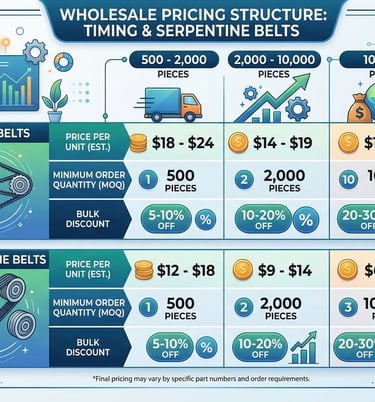
Flexible MOQs (minimum order quantities): 500-2,000 pieces typical
Established export infrastructure and English-speaking sales teams
Rapid product development and customization capabilities
Comprehensive testing facilities at major manufacturers
Sourcing Challenges:Quality verification requires due diligence and testing
Intellectual property concerns (counterfeit premium brands)
Longer shipping times (4-6 weeks sea freight)
Communication and time zone coordination
Need for clear specifications and quality agreements
Quality Verification in China:
Factory audit: Visit or hire third-party inspection (SGS, Intertek)
Certification verification: Confirm ISO 9001/IATF 16949 validity
Sample testing: Independent laboratory testing of samples
Production inspection: During-production and pre-shipment inspection
Ongoing monitoring: Regular quality audits and testing
India
India's automotive component manufacturing sector is growing rapidly, offering competitive alternatives to Chinese sourcing.
Key Manufacturing Regions:
Gujarat: Automotive hub with many component manufacturers
Tamil Nadu: Strong automotive presence (Chennai region)
Maharashtra: Pune automotive cluster
Sourcing Considerations:Pricing: Competitive with China (5-15% variation)
Quality: Improving rapidly, many ISO/IATF certified facilities
MOQs: Similar to China (500-2,000 pieces)
Communication: English widely spoken, easier communication
Shipping: Similar lead times to China for most markets
Strategic Advantage:Diversification from China-only sourcing
Growing manufacturing capabilities
Government support for automotive sector
Turkey
Turkey serves as a bridge between European quality standards and Asian pricing.
Sourcing Advantages:
Quality: European-standard manufacturing practices
Pricing: 20-30% above China, 30-40% below European manufacturers
Certifications: Strong compliance with European standards
Logistics: Excellent access to European and Middle Eastern markets
MOQs: Moderate (1,000-3,000 pieces typical)
Best Applications:European market supply
Middle Eastern distribution
Applications requiring European certifications
Thailand
Thailand has emerged as a significant automotive manufacturing hub, particularly for Japanese-brand components.
Sourcing Advantages:
Quality: High standards, many Japanese-affiliated manufacturers
Specialization: Strong in rubber products and precision components
Pricing: Moderate (15-25% above China)
Logistics: Good shipping access to global markets
Strategic Fit:Japanese vehicle applications
Quality-focused sourcing
ASEAN market distribution
Supplier Evaluation and Due Diligence
Thorough supplier evaluation is critical to avoiding quality issues, counterfeit products, and supply chain disruptions.
Factory Audit Checklist
Certifications and Documentation:
ISO 9001:2015 certification (minimum requirement)
IATF 16949:2016 certification (preferred for automotive quality)
Product liability insurance documentation
Export licenses and customs documentation
Intellectual property declarations (no counterfeit production)
Customer references and audit reports
Production Capabilities:Monthly production capacity by product type
Production line automation level
Raw material sourcing and traceability systems
Inventory management and lead time capabilities
Flexibility for custom specifications
Quality Control Systems:Incoming material inspection procedures
In-process quality checkpoints (SPC implementation)
Final product testing protocols
Defect tracking and corrective action systems
Calibration program for testing equipment
Testing Equipment:Tensile testing machines (for belt cord strength)
Hardness testers (durometer)
Environmental chambers (heat aging, ozone resistance)
Pressure testing equipment (hose burst and impulse)
Dimensional measurement equipment
Technical Capabilities:Engineering staff qualifications and experience
Product development and customization capabilities
Testing laboratory accreditation (ISO 17025)
Technical documentation quality (specifications, test reports)
Application engineering support
Sample Testing Protocol
Before committing to large orders, implement a rigorous sample testing protocol:
Phase 1: Visual and Dimensional Inspection
Verify packaging quality and labeling accuracy
Measure critical dimensions (belt width, length, hose diameter, wall thickness)
Inspect material quality and construction
Check for obvious defects or inconsistencies
Phase 2: Material Testing
Timing Belts:Tooth profile measurement and comparison to specifications
Tensile cord count and material verification
Rubber hardness testing (Shore A durometer)
Material composition analysis (if budget permits)
Serpentine Belts:Rib count and profile verification
Width and thickness measurement
Flexibility and stiffness testing
Rubber compound hardness
Hoses:Wall thickness measurement at multiple points
Reinforcement layer inspection (cut sample)
Inner tube smoothness inspection
Fitting quality and crimp inspection (assembled hoses)
Phase 3: Performance Testing
Belts:Tensile strength testing (if equipment available)
Flex fatigue testing
Temperature exposure testing (heat aging)
Comparative testing against known-good samples
Hoses:Pressure testing (minimum 2x working pressure)
Vacuum collapse testing (vacuum hoses)
Flexibility testing at temperature extremes
Fluid compatibility testing (immersion in relevant fluid)
Phase 4: Field TestingInstall samples on actual vehicles
Monitor performance over time
Gather feedback from technicians
Compare to OEM or premium brand performance
Red Flags and Warning Signs
Supplier Red Flags:
Unwillingness to provide factory visit or video tour
Cannot provide valid certifications or documentation
Prices significantly below market average (>50% below competitors)
Pressure to order without samples or testing
Poor communication or evasive answers to technical questions
No established export history or references
Reluctance to provide customer references
Product Red Flags:Packaging includes premium brand names without authorization
Inconsistent quality between samples and production batches
Missing or incorrect technical markings (SAE ratings, temperature ranges)
Poor packaging quality or missing safety warnings
Material properties don't match specifications
Unusual odors (indicating wrong rubber compound)
Dimensional variations beyond tolerance
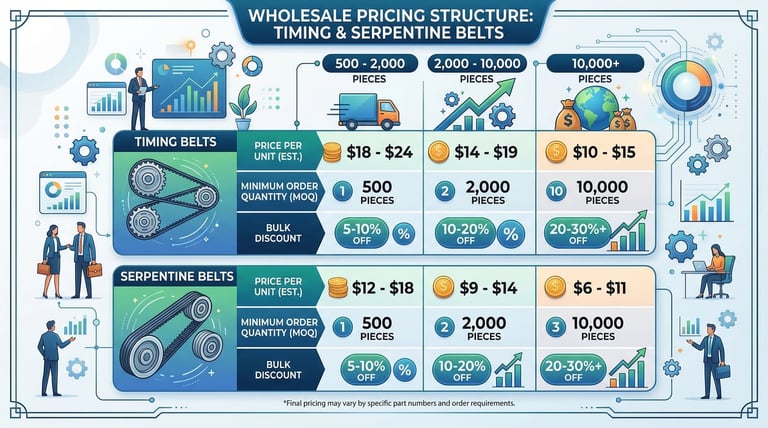
Minimum Order Quantities and Pricing Structure
Understanding typical MOQs and pricing tiers helps in negotiation and planning.
Typical MOQ Structures:
Timing Belts:
Small manufacturers: 500-1,000 pieces per SKU
Medium manufacturers: 1,000-2,000 pieces per SKU
Large manufacturers: 2,000-5,000 pieces per SKU
Mixed SKU orders: Often accepted with total quantity meeting minimum
Serpentine Belts:Small manufacturers: 500-1,000 pieces per SKU
Medium manufacturers: 1,000-2,000 pieces per SKU
Large manufacturers: 2,000-5,000 pieces per SKU
Hoses (Bulk/Universal):Sold by length: 100-500 meters per size/type
Assembled hoses: 100-500 pieces per application
Pricing Tier Structure:
Timing Belts (HNBR, HTD Profile):500-2,000 pieces: $10.00-$14.00 per piece
2,000-10,000 pieces: $8.00-$10.00 per piece
10,000+ pieces: $7.00-$8.00 per piece
Serpentine Belts (EPDM, 6PK):500-2,000 pieces: $6.00-$8.00 per piece
2,000-10,000 pieces: $4.50-$6.00 per piece
10,000+ pieces: $4.00-$4.50 per piece
Coolant Hoses (Molded, Vehicle-Specific):100-500 pieces: $10.00-$15.00 per piece
500-2,000 pieces: $8.00-$10.00 per piece
2,000+ pieces: $6.00-$8.00 per piece
Fuel Hoses (SAE J30 R10, per meter):100-500 meters: $8.00-$12.00 per meter
500-2,000 meters: $6.00-$8.00 per meter
2,000+ meters: $5.00-$6.00 per meter
Note: Prices vary significantly based on specifications, quality tier, and market conditions. These ranges represent typical Chinese manufacturing pricing as of 2026.
Product Range Strategy and SKU Management
Building an effective belt and hose product range requires balancing breadth of coverage with inventory management efficiency.
Coverage Strategy
Application-Based Coverage
Passenger Vehicles:
Focus on high-volume vehicle models (Toyota, Honda, Ford, Chevrolet, Nissan, Volkswagen)
Prioritize 2000-2020 vehicles (prime replacement age)
Cover both economy and premium segments
Timing Belt Priority Applications:Honda: Civic, Accord, CR-V (1996-2015 models with timing belts)
Toyota: Camry, Corolla, RAV4 (1997-2019 models with timing belts)
Volkswagen: Jetta, Golf, Passat (timing belt applications)
Subaru: Impreza, Forester, Outback (all models)
Serpentine Belt Priority Applications:Universal coverage: Most vehicles use standard 4PK, 5PK, 6PK, 7PK configurations
Length variation: Stock common lengths (1000mm-2500mm range)
Strategy: Fewer SKUs than timing belts due to standardization
Light Trucks and SUVs:Growing market segment with higher per-vehicle revenue
Longer belts and larger hoses = higher unit prices
Premium products more accepted in this segment
Commercial Vehicles:Specialized market with premium pricing
Higher-spec products (aramid timing belts, heavy-duty hoses)
Lower volume but higher margins
Product Line Breadth Strategy
Timing Belts:
SKU count: 200-400 for comprehensive coverage
Strategy: Focus on interference engines (higher urgency)
Inventory depth: Deeper stock on high-volume applications
Slow movers: Consider drop-ship or special order
Serpentine Belts:SKU count: 100-200 for comprehensive coverage
Strategy: Length-based inventory (common lengths in multiple rib counts)
Universal fit: Many belts fit multiple vehicle applications
Inventory efficiency: Higher turns than timing belts
Coolant Hoses:Molded hoses: 300-500 SKUs for comprehensive coverage
Universal hoses: 10-20 sizes/configurations
Strategy: Molded for high-volume, universal for low-volume
Inventory challenge: Molded hoses are vehicle-specific
Fuel Hoses:Bulk hose: 5-10 types (different pressure ratings and sizes)
Assembled hoses: 100-200 vehicle-specific applications
Strategy: Bulk hose for custom lengths, assembled for common applications
Brake Hoses:SKU count: 200-400 for comprehensive coverage
Critical factor: Must have DOT/FMVSS 106 certification
Inventory: Stock high-volume applications only
Liability: Highest risk category, quality critical
SKU Rationalization
Effective SKU management prevents inventory bloat while maintaining adequate coverage.
Pareto Analysis:
Typically 20% of SKUs generate 80% of sales volume
Identify and prioritize these high-velocity items
Maintain deeper inventory on fast-moving SKUs
Consider drop-ship or special order for slow-moving items
Inventory Investment Optimization:Calculate inventory turns by SKU category
Target 6-12 turns per year for fast-moving items
Accept 2-4 turns for comprehensive coverage items
Eliminate SKUs with <1 turn per year unless strategic
Cross-Reference Strategy:Maintain comprehensive cross-reference database
Link OEM part numbers to your SKUs
Include competitor cross-references
Provide online cross-reference tools for customers
Packaging Strategy
Packaging Options:
Individual Retail Packaging:
Blister pack or box with product information
Barcode and SKU identification
Installation instructions and specifications
Professional appearance for retail shelf
Cost: $0.50-$2.00 per unit packaging cost
Bulk Packaging:Multi-piece boxes (10-pack, 20-pack)
Plain packaging for professional installer market
Cost savings for price-sensitive customers
Cost: $0.10-$0.30 per unit packaging cost
Custom Private Label:Your brand name and logo
Custom color schemes and design
Builds brand equity and customer loyalty
Typically requires higher MOQs (2,000-5,000 pieces)
Cost: $0.80-$2.50 per unit (including custom packaging)
Packaging Quality Considerations:Moisture protection (especially for rubber products)
Physical protection during shipping
Clear product identification and specifications
Professional appearance reflects on product quality
Compliance with labeling regulations (safety warnings, specifications)
Logistics and Import Considerations
Efficient logistics management significantly impacts total landed cost and inventory availability.
Shipping Methods and Timing
Sea Freight (Most Common):
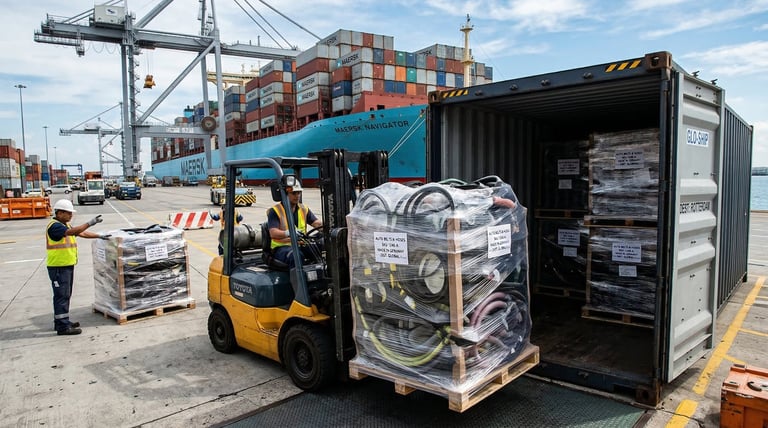
Transit time: 25-45 days (Asia to North America/Europe)
Cost: Most economical for full container loads
Minimum practical quantity: 1/2 container or full container
Best for: Regular replenishment orders, new product launches
Container Loading Capacity:20-foot container:
Timing belts: Approximately 30,000-50,000 pieces (depending on size)
Serpentine belts: Approximately 40,000-60,000 pieces
Hoses (bulk): Approximately 15,000-25,000 meters
Mixed loads: Common for diversified inventory
40-foot container:
Approximately double 20-foot capacity
More cost-effective per unit for full loads
Air Freight:
Transit time: 5-10 days
Cost: 5-10x more expensive than sea freight
Minimum practical quantity: 100-500kg
Best for: Rush orders, sample shipments, high-value items, initial inventory
Express Courier (DHL, FedEx, UPS):Transit time: 3-7 days
Cost: Most expensive per kg
Practical for: Samples, small urgent orders, documents
Import Duties and Regulations
HS Codes (Harmonized System):
Timing belts: 4010.31 (Endless transmission belts, V-ribbed, V < 60cm)
Serpentine belts: 4010.31 or 4010.32 (depending on circumference)
Rubber hoses: 4009.31, 4009.32, 4009.41, 4009.42 (varies by reinforcement type)
Verify current duty rates for your specific country and product classification
Typical Import Duties:United States: 2.5-5.0% (verify current rates, subject to trade agreements)
European Union: 2.5-6.5% (varies by country and product)
Canada: 6.0-8.5%
Australia: 5.0%
United Kingdom: 2.5-4.5% (post-Brexit rates)
Note: Rates change periodically; verify current rates with customs broker.
Regulatory Compliance:Product safety standards: Varies by country (DOT, ECE, SAE)
Packaging and labeling requirements: Language, safety warnings, specifications
Environmental regulations: RoHS, REACH (EU), Prop 65 (California)
Intellectual property clearance: Ensure no trademark infringement
Country of origin marking: Required in most markets
Total Landed Cost Calculation
Understanding true total cost is essential for accurate pricing and margin calculation.
Cost Components:
Product cost (FOB): Factory price
International shipping: Sea/air freight charges
Insurance: Typically 0.3-0.5% of cargo value
Import duties: Based on HS code and country
Customs clearance: Broker fees and documentation
Domestic transportation: Port to warehouse
Warehousing: Receiving and storage costs
Payment terms cost: LC fees or early payment discounts
Example Calculation (Timing Belts to USA):
Product cost (FOB China): $8.00 per piece
Quantity: 10,000 pieces = $80,000
Sea freight (20' container): $3,500
Insurance (0.4%): $320
Import duty (2.5%): $2,000
Customs clearance: $600
Domestic transport: $500
Total landed cost: $86,920
Per-piece landed cost: $8.69
Add warehousing and financing: ~$0.50
Total cost per piece: $9.19
Margin Calculation:Wholesale selling price: $14.00
Total cost: $9.19
Gross margin: $4.81 (34.4%)
Operating expenses allocation: $2.00
Net margin: $2.81 (20.1%)
Payment Terms and Risk Management
Common Payment Terms:
30% Deposit + 70% Before Shipment:
Most common for new supplier relationships
Moderate risk for buyer
Supplier has production cost coverage
Balance due upon production completion
Letter of Credit (LC):Lowest risk for both parties
Bank guarantees payment upon document compliance
Additional cost (1-2% of order value)
Best for large orders or new suppliers
Provides legal recourse
Net 30-60 Days:Requires established relationship and trust
Improves cash flow for buyer
Typically requires larger order volumes
May include early payment discount (2-3%)
Risk Mitigation Strategies:Start with smaller orders to establish relationship
Use inspection services before final payment (SGS, Intertek)
Maintain multiple supplier relationships (avoid single-source dependency)
Consider trade credit insurance for large orders
Verify supplier business licenses and registrations
Use escrow services for first-time large orders
MakexCar: Your Trusted Partner for Automotive Belts and Hoses
At MakexCar, we understand that wholesale success in the automotive aftermarket requires more than just competitive pricing—it demands consistent quality, reliable supply, and partnership-focused service. Our expertise in automotive belts and hoses, combined with our commitment to OEM-equivalent quality, makes us your ideal sourcing partner.
Our Manufacturing Capabilities
Production Facilities:
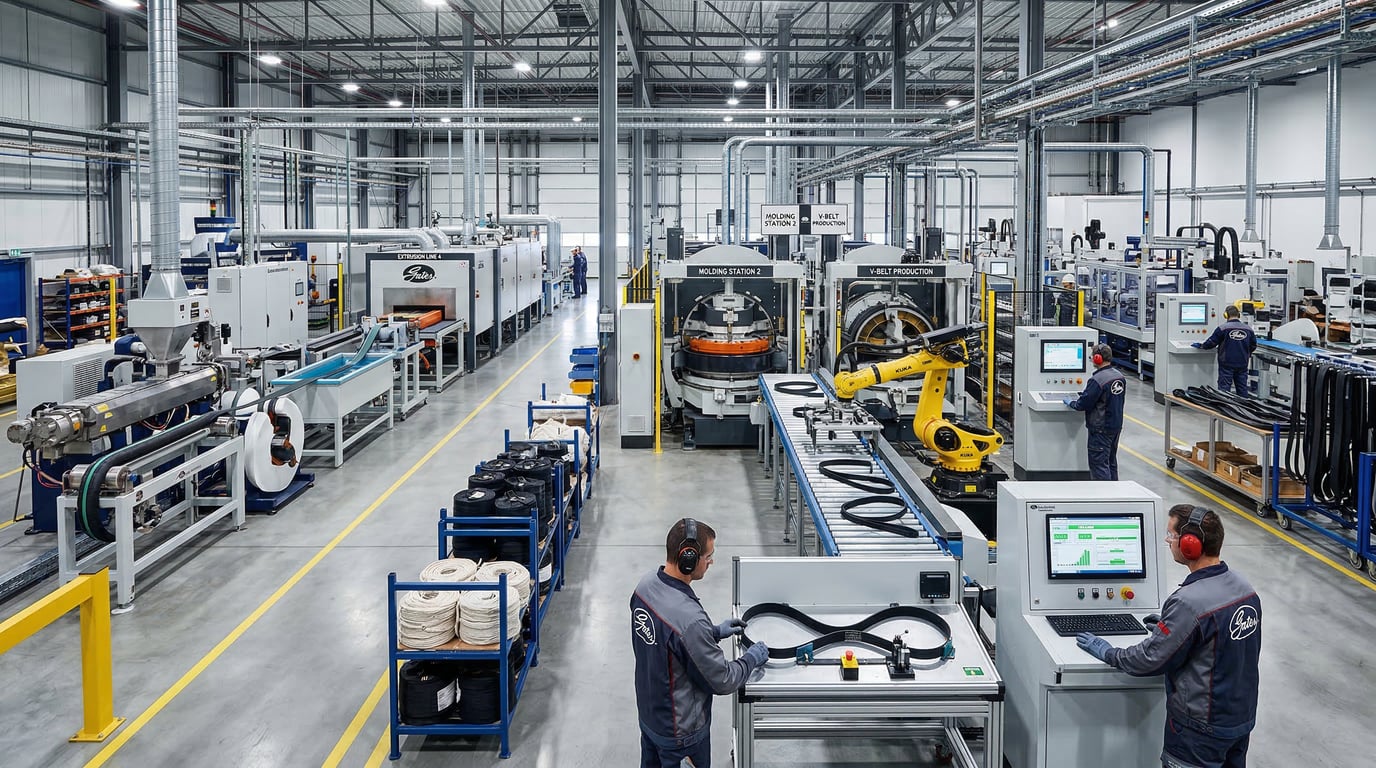
Our state-of-the-art manufacturing facilities employ advanced rubber compounding technology and precision molding systems to ensure every belt and hose meets or exceeds international standards. With monthly production capacity exceeding 100,000 timing belts, 150,000 serpentine belts, and 50,000 meters of automotive hoses, we have the scale to support your growth while maintaining the flexibility to accommodate custom specifications.
Quality Certifications:
ISO 9001:2015 Quality Management System
IATF 16949:2016 Automotive Quality Management
SAE J20, J30, J1401 product compliance
Product liability insurance coverage
Full traceability from raw materials to finished products
Technical Capabilities:
Our engineering team brings decades of automotive belt and hose expertise, enabling us to provide:Custom product development for specific applications
Material formulation optimization for regional requirements
Technical support for product selection and application
Comprehensive testing and validation services
Application engineering for complex installations
Our Product Range
Timing Belts:
HNBR and chloroprene constructions
HTD, STD, and trapezoidal tooth profiles
Fiberglass and aramid fiber reinforcement options
Coverage: 300+ applications for Asian, European, and American vehicles
Timing belt kits with tensioners and idler pulleys available
Serpentine Belts:EPDM construction for extended service life
4PK through 8PK rib configurations
Standard and heavy-duty specifications
Coverage: Comprehensive length range (1000mm-2500mm)
Compatible with all major vehicle applications
Automotive Hoses:Coolant hoses: EPDM construction, molded and universal configurations
Fuel hoses: SAE J30 R10/R12 compliance, low-permeation formulations
Brake hoses: FMVSS 106 certified, DOT-approved assemblies
Power steering hoses: High-pressure and return hose assemblies
A/C hoses: R-134a and R-1234yf compatible
Vacuum hoses: Silicone and EPDM options
Why Choose MakexCar
Quality Assurance:
Every product undergoes rigorous testing including material verification, dimensional inspection, and performance validation. Our quality control system ensures consistency across production batches, and we maintain comprehensive test records for traceability.
Competitive Pricing:
Direct factory pricing eliminates intermediary markups, allowing you to maximize margins while remaining competitive in your market. Volume discounts and flexible payment terms support your business growth.
Reliable Supply:
With substantial inventory of high-velocity items and efficient production scheduling, we minimize lead times and ensure product availability when you need it. Our logistics team coordinates efficient shipping and provides full tracking visibility.
Partnership Approach:
We view our customers as long-term partners, not just transactions. Our dedicated account management team provides:
Personalized service and responsive communication
Market insights and product recommendations
Custom packaging and private label options
Marketing support and product training
Flexible terms for qualified partners
Technical Support:
Our technical team is available to assist with:Product selection and application matching
Cross-reference verification
Installation guidance and best practices
Troubleshooting and warranty support
Custom product development
Getting Started with MakexCar
Step 1: Initial Consultation
Contact our sales team to discuss your market, customer base, and product requirements. We'll help you identify the optimal product range for your business and provide detailed specifications and pricing.
Step 2: Sample Evaluation
We'll provide samples of our belts and hoses for your evaluation and testing. Compare our quality against OEM and competitor products to verify our claims. We encourage independent testing to confirm our specifications.
Step 3: Custom Solution Development
Based on your feedback, we'll develop a customized product offering, pricing structure, and service package tailored to your business needs. We can accommodate private labeling, custom packaging, and specific quality requirements.
Step 4: First Order and Beyond
Start with an initial order to establish our relationship and verify our service quality. As our partnership grows, we'll continuously optimize our support to help you succeed in your market.
Contact MakexCar
Ready to explore how MakexCar can support your automotive parts business? Our team is ready to discuss your specific needs and develop a customized solution.
Contact Information:
Email: sales1@makexcar.com
Phone: +86 199 4123 4680
WhatsApp: +86 199 4123 4680
Website: www.makexcar.com
We look forward to becoming your trusted partner in automotive belts and hoses.
Conclusion: Building Success in the Belt and Hose Market
The automotive belt and hose aftermarket represents a substantial opportunity for wholesale distributors who combine product knowledge, quality sourcing, and customer-focused service. Success requires:
Technical Understanding:
Deep knowledge of belt and hose technology enables effective product selection, customer consultation, and competitive positioning. Understanding material differences, specifications, and applications builds credibility and trust with professional customers.
Quality Focus:
Prioritizing quality over lowest-cost sourcing protects your reputation and minimizes warranty costs. Rigorous supplier evaluation, sample testing, and ongoing quality monitoring ensure consistent product performance.
Strategic Sourcing:
Balancing cost, quality, and reliability through careful supplier selection and relationship management. Diversifying sourcing across multiple regions and suppliers mitigates risk while optimizing value.
Customer Partnership:
Building long-term relationships through reliable supply, technical support, and value-added services. Understanding customer needs and providing solutions rather than just products.
Market Intelligence:
Staying informed about industry trends, technology developments, and competitive dynamics. Adapting product offerings and strategies to capitalize on emerging opportunities.
The belt and hose market rewards distributors who invest in knowledge, quality, and relationships. By applying the insights and strategies outlined in this guide, you can build a sustainable competitive advantage and achieve long-term success in this essential automotive aftermarket segment.
Related Articles
For comprehensive information about other automotive parts and sourcing strategies, explore our related guides:
Whatsapp: +86 19941234680
Phone:+86 19941234680
© 2025. All rights reserved.
Email:sales1@makexcar.com
Wechat:Sgxwtxa