Cabin Air Filter Wholesale Guide: HEPA & Activated Carbon Filter Specifications, Quality Standards &
Professional cabin air filter wholesale sourcing guide covering HEPA, activated carbon, and standard filter specifications. Learn ISO 16890 testing standards, quality certifications, pricing structures, and best practices for working with Chinese manufacturers. Essential reading for automotive parts
博客
2/19/2026
Introduction: The Growing Importance of Cabin Air Quality
The global cabin air filter market is experiencing unprecedented growth, projected to reach $8.7 billion by 2028, driven by increasing consumer awareness of air quality and health concerns. As an automotive parts distributor or wholesale buyer, understanding the technical specifications and quality standards of cabin air filters has become essential for capturing this expanding market opportunity.
Unlike engine components that protect mechanical systems, cabin air filters directly impact driver and passenger health by filtering harmful particulates, allergens, and pollutants. With over 50 million Americans suffering from allergies annually and growing concerns about PM2.5 pollution worldwide, premium cabin air filters have evolved from optional accessories to essential safety components. This comprehensive guide provides wholesale buyers with the technical knowledge, quality standards, and sourcing strategies needed to build a profitable cabin air filter business.
Understanding Cabin Air Filter Types and Technologies
Standard Particulate Filters vs. Activated Carbon Filters
The cabin air filter market segments into distinct product categories, each serving specific customer needs and price points:
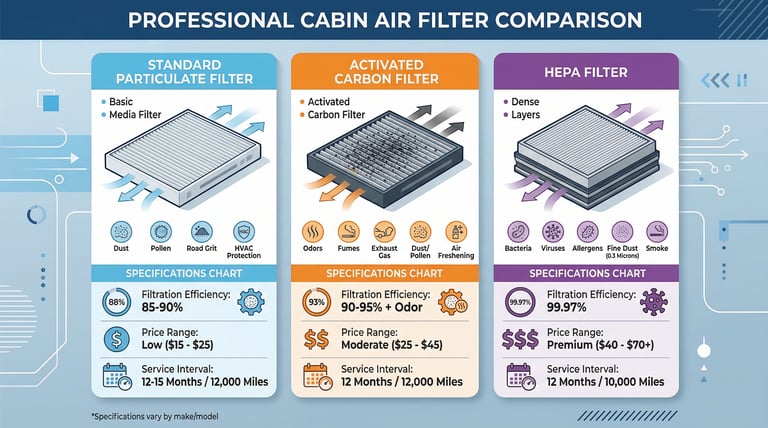
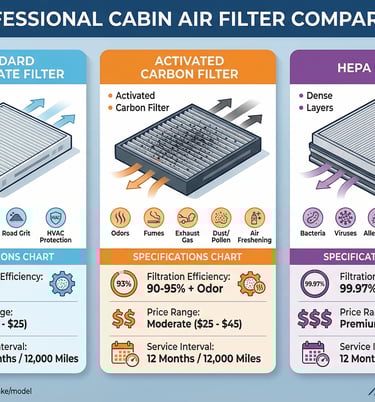
Standard Particulate Filters represent the economy segment, utilizing cellulose or synthetic media to capture larger particles. These filters provide basic protection against dust, pollen, and debris, making them suitable for cost-conscious consumers and standard replacement intervals. Technical specifications include:
Filtration efficiency: 85-92% for particles above 10 microns (PM10)
Filter media: cellulose paper or synthetic polyester
Media thickness: 0.4-0.8mm
Pleat count: 40-80 pleats per linear foot
Service interval: 12,000-15,000 miles or 12 months
Pressure drop: 0.3-0.5 inches H₂O at 250 CFM
Typical wholesale cost: $2.50-$4.50 per unit (FOB China)
Activated Carbon Filters dominate the mid-premium segment, combining particulate filtration with odor and gas absorption capabilities. The activated carbon layer absorbs volatile organic compounds (VOCs), exhaust fumes, and unpleasant odors, providing superior cabin air quality. Manufacturing specifications include:
Multi-layer construction: pre-filter + activated carbon + fine particulate layer
Carbon layer thickness: 2-4mm
Carbon content: 80-150 grams per filter
Filtration efficiency: 90-95% at PM2.5 (particles 2.5 microns and smaller)
Odor absorption: formaldehyde, benzene, ammonia, sulfur dioxide
Service interval: 10,000-12,000 miles or 12 months
Pressure drop: 0.4-0.7 inches H₂O at 250 CFM
Typical wholesale cost: $4.50-$8.00 per unit (FOB China)
The activated carbon used in premium filters undergoes specialized processing to maximize surface area. Honeycomb-structured activated carbon provides 30-40% more surface area compared to traditional granular carbon, significantly improving single-pass filtration efficiency for gaseous pollutants.
HEPA Cabin Air Filters: The Premium Segment
HEPA (High-Efficiency Particulate Air) Filters represent the fastest-growing premium segment, driven by health-conscious consumers and increasing air pollution concerns. True HEPA filters capture 99.97% of particles as small as 0.3 microns, providing medical-grade air purification for vehicle cabins. Critical specifications include:
Filtration efficiency: 99.97% at 0.3 microns (H13 grade) or 99.995% (H14 grade)
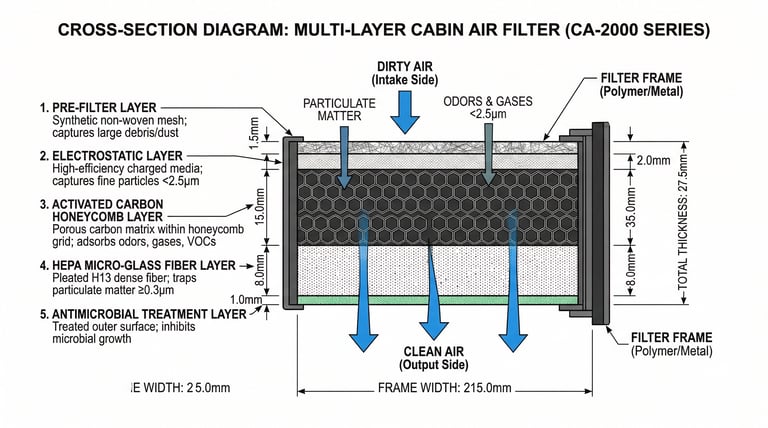
Multi-stage filtration: typically 4-5 layers including:
Pre-filter layer for large particles
HEPA-grade micro-glass fiber layer
Activated carbon layer for odors and gases
Antimicrobial treatment layer
Electrostatic layer (optional for enhanced efficiency)
Media material: micro-glass fiber or advanced synthetic materials
Pleat density: 120-200 pleats per linear foot
Frame construction: reinforced plastic or aluminum for structural integrity
Service interval: 15,000-20,000 miles or 18 months
Pressure drop: 0.6-1.0 inches H₂O at 250 CFM
Typical wholesale cost: $8.00-$15.00 per unit (FOB China)
HEPA cabin filters effectively capture:
Pollen and plant spores (10-100 microns)
Mold spores (3-40 microns)
Dust mites and debris (5-20 microns)
Fine dust and PM2.5 (≤2.5 microns)
Bacteria (0.5-5 microns)
Ultrafine particles and PM1 (≤1 micron)
Diesel exhaust particles (0.1-1 micron)
The premium pricing of HEPA filters is justified by their superior health benefits, particularly for customers with allergies, asthma, or respiratory sensitivities, and those living in high-pollution urban environments.
Electrostatic and Antimicrobial Technologies
Advanced cabin air filters incorporate additional technologies to enhance performance:
Electrostatic Filtration uses electrostatically charged fibers to attract and capture particles through electrostatic forces rather than purely mechanical filtration. This technology enables:
Higher filtration efficiency with lower pressure drop
Extended service life due to reduced media loading
Capture of sub-micron particles below 0.3 microns
15-25% improvement in filtration efficiency compared to non-electrostatic media
However, electrostatic charge gradually dissipates over time and with humidity exposure, requiring proper testing protocols to ensure consistent performance.
Antimicrobial Treatments prevent bacterial and mold growth on the filter media, particularly important in humid climates. Common antimicrobial technologies include:
Silver ion treatment: embedded silver particles inhibit microbial growth
Microban coating: proprietary antimicrobial surface treatment
Zinc pyrithione treatment: effective against bacteria and fungi
Natural antimicrobial agents: tea tree oil, bamboo charcoal extracts
When evaluating antimicrobial filters, verify that treatments maintain effectiveness throughout the filter's service life and don't significantly increase pressure drop or reduce airflow.
International Quality Standards and Testing Protocols
ISO 16890: The Global Standard for Air Filter Testing
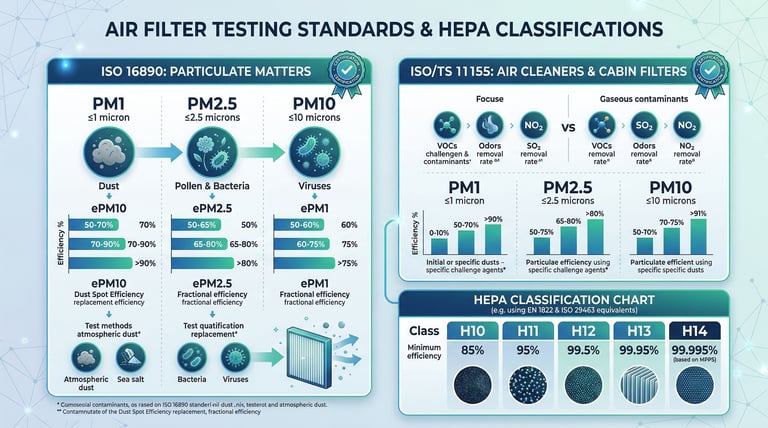
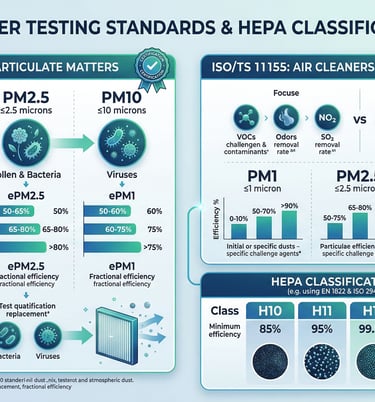
ISO 16890 has emerged as the international standard for testing and classifying air filters based on particulate matter (PM) efficiency. This standard replaced the previous European EN 779 standard and provides more relevant performance data aligned with environmental air quality measurements used by the World Health Organization (WHO).
ISO 16890 classifies filters based on their efficiency at capturing three critical particulate size ranges:
ePM1 (Particulate Matter ≤1 micron):
Most health-critical particle size
Includes ultrafine combustion particles, diesel exhaust, bacteria
Premium HEPA filters: ePM1 80-95% efficiency
High-quality activated carbon filters: ePM1 50-70% efficiency
ePM2.5 (Particulate Matter ≤2.5 microns):
Includes fine dust, pollen fragments, mold spores
HEPA filters: ePM2.5 90-99% efficiency
Standard activated carbon filters: ePM2.5 70-85% efficiency
Basic particulate filters: ePM2.5 40-60% efficiency
ePM10 (Particulate Matter ≤10 microns):
Includes coarse dust, pollen, larger allergens
Most cabin filters achieve ePM10 85-95% efficiency
Minimum 50% efficiency required for classification
The ISO 16890 testing protocol includes critical conditioning steps to account for electrostatic charge effects. Filters are tested both with and without electrostatic charge, and results are averaged to provide realistic long-term performance expectations. This prevents manufacturers from overstating performance based on initial electrostatic enhancement that degrades over time.
ISO/TS 11155: Cabin Air Filter Specific Testing
ISO/TS 11155 specifically addresses particulate filtration testing for automotive cabin air filters, providing standardized test procedures for consistent laboratory evaluation. This standard specifies:
Test Equipment Requirements:
Particle size range: 0.3-10 microns
Test aerosol: standardized synthetic dust (ISO 12103-1 A2 Fine)
Airflow rate: 85-250 CFM depending on filter size
Test duration: minimum 60 minutes at rated airflow
Environmental conditions: 23±2°C, 50±5% relative humidity
Performance Metrics:
Initial filtration efficiency at multiple particle sizes
Average filtration efficiency over test duration
Pressure drop characteristics at rated airflow
Dust holding capacity until terminal pressure differential
Structural integrity under vibration and temperature cycling
Quality Indicators:
Filters must maintain structural integrity throughout testing
No media tearing, frame deformation, or seal failure
Pressure drop increase should be gradual and predictable
No particle shedding or media degradation
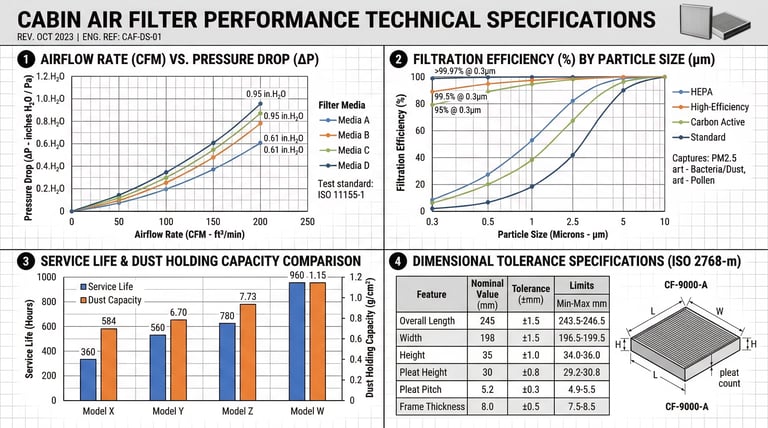
When sourcing cabin air filters, request ISO/TS 11155 test reports from manufacturers to verify performance claims. Reputable suppliers provide detailed test data including particle size distribution curves and efficiency measurements at 0.3, 0.5, 1.0, 2.5, 5.0, and 10.0 micron particle sizes.
EN 1822 and HEPA Classification Standards
For premium HEPA cabin air filters, EN 1822 (or equivalent ISO 29463) provides the classification system for high-efficiency filters:
HEPA Filter Classifications:
H10: 85% efficiency at MPPS (Most Penetrating Particle Size)
H11: 95% efficiency at MPPS
H12: 99.5% efficiency at MPPS
H13: 99.95% efficiency at MPPS (True HEPA)
H14: 99.995% efficiency at MPPS
Most automotive HEPA cabin filters are classified as H12 or H13 grade, providing excellent filtration while maintaining acceptable pressure drop for HVAC system compatibility. H14 filters, while offering maximum filtration, may restrict airflow excessively in some vehicle applications.
The MPPS (Most Penetrating Particle Size) is typically 0.1-0.3 microns—the particle size range most difficult to capture. Particles larger than MPPS are captured by interception and impaction, while smaller particles are captured by diffusion, making MPPS the most challenging size range and the basis for HEPA classification.
Critical Technical Specifications for Wholesale Buyers
Dimensional Standards and Fitment Requirements
Cabin air filters come in diverse sizes and configurations to fit various vehicle makes and models. Understanding dimensional specifications prevents costly returns and ensures customer satisfaction:
Common Filter Dimensions:
Compact cars: 180-220mm × 150-200mm × 20-35mm
Mid-size sedans: 220-280mm × 180-230mm × 25-40mm
SUVs and trucks: 250-350mm × 200-280mm × 30-50mm
Luxury vehicles: custom sizes, often larger for enhanced filtration
Critical Dimensional Tolerances:
Length and width: ±2mm maximum deviation
Thickness: ±1mm maximum deviation
Frame flatness: <1mm warpage across diagonal
Seal gasket compression: 20-30% at installation
Frame Construction Materials:
Economy filters: cardboard or thin plastic (0.8-1.2mm)
Standard filters: reinforced plastic or ABS (1.5-2.0mm)
Premium filters: high-impact plastic or aluminum (2.0-3.0mm)
Frame must maintain rigidity under 1.5× maximum operating pressure differential
Seal Design:
Polyurethane foam gasket: most common, 3-6mm thickness
EPDM rubber seal: premium option for better sealing and durability
Seal compression set: <30% after 1000 hours at 70°C
Seal must prevent bypass airflow around filter perimeter
Airflow and Pressure Drop Specifications
Proper airflow characteristics ensure compatibility with vehicle HVAC systems and maintain cabin comfort:
Airflow Requirements:
Compact cars: 85-150 CFM (cubic feet per minute)
Mid-size vehicles: 150-220 CFM
Large SUVs and trucks: 220-300 CFM
Luxury vehicles: 250-350 CFM (dual-zone climate control)
Pressure Drop Limits:
Clean filter (new): 0.3-0.7 inches H₂O at rated airflow
Service limit (replacement needed): 1.5-2.0 inches H₂O
Excessive pressure drop causes: reduced airflow, increased fan noise, HVAC system strain
Pressure Drop by Filter Type (at 200 CFM):
Standard particulate filter: 0.3-0.5 inches H₂O
Activated carbon filter: 0.4-0.7 inches H₂O
HEPA filter: 0.6-1.0 inches H₂O
Multi-stage HEPA with carbon: 0.8-1.2 inches H₂O
Filters with excessive pressure drop reduce HVAC efficiency, increase fan motor wear, and diminish customer satisfaction. When evaluating suppliers, request airflow-pressure drop curves showing performance across the full operating range.
Filter Media Specifications and Quality Indicators
The filter media determines filtration performance, durability, and service life:
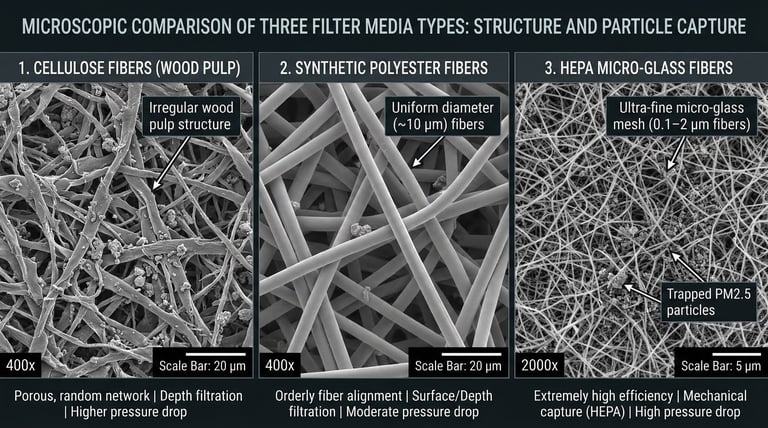
Cellulose Media (Economy Filters):
Material: wood pulp fibers with synthetic binder
Basis weight: 60-90 g/m²
Thickness: 0.4-0.6mm
Pleat spacing: 4-6mm
Wet strength retention: minimum 30% of dry strength
Suitable for: basic dust and pollen filtration
Synthetic Media (Standard to Premium):
Material: polyester, polypropylene, or blended fibers
Basis weight: 80-120 g/m²
Fiber diameter: 10-30 microns
Pleat spacing: 3-5mm
Superior moisture resistance and durability
Suitable for: PM2.5 and fine particle filtration
HEPA-Grade Media (Premium):
Material: micro-glass fiber or advanced synthetic
Basis weight: 100-180 g/m²
Fiber diameter: 0.5-5 microns
Pleat spacing: 2-4mm (high pleat density)
Requires rigid frame support due to high pressure drop
Suitable for: medical-grade air purification
Activated Carbon Specifications:
Carbon type: coconut shell or coal-based activated carbon
Particle size: 0.5-2mm granular or honeycomb structure
Iodine number: 800-1200 mg/g (indicates adsorption capacity)
Carbon layer weight: 80-150 grams per filter
Honeycomb structure: 30-40% better efficiency than granular
Manufacturing Quality Control and Supplier Evaluation
Production Facility Assessment
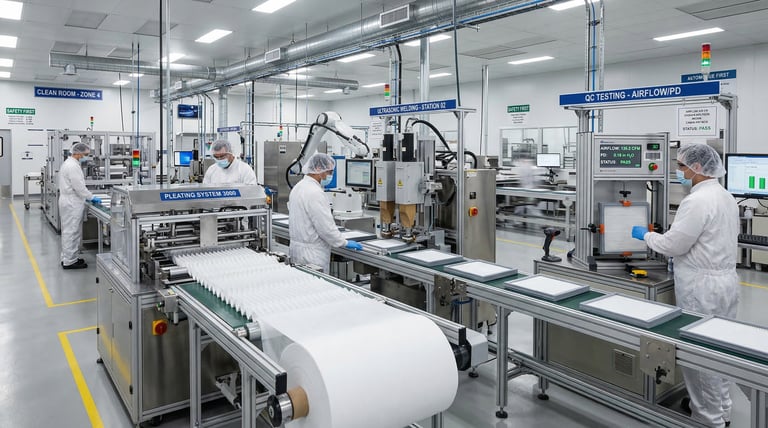
When evaluating cabin air filter manufacturers, assess these critical production capabilities:
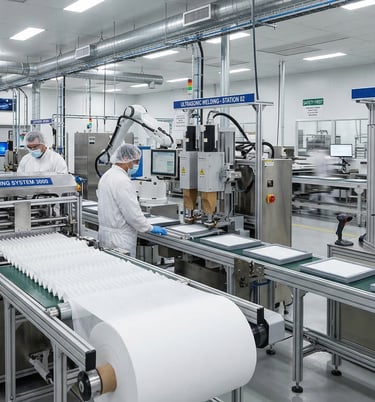
Manufacturing Equipment:
Automated pleating machines: ensure consistent pleat spacing (±0.5mm tolerance)
Ultrasonic welding systems: provide strong, leak-free frame bonding
Hot-melt adhesive application: precise bead placement for media-to-frame sealing
Automated cutting systems: accurate dimensional control
Clean assembly environment: Class 100,000 cleanroom or better
Quality Control Infrastructure:
Incoming material inspection: verify media specifications, frame dimensions, carbon quality
In-process monitoring: pleat count verification, adhesive bead inspection, dimensional checks
Airflow testing: 100% testing of pressure drop at rated flow
Leak testing: seal integrity verification (smoke test or pressure decay)
Final inspection: visual defect detection, packaging quality
Production Capacity Indicators:
Monthly capacity: 200,000-1,000,000 units indicates established operations
Lead time: 25-40 days for standard products, 45-60 days for custom specifications
Minimum order quantity: 300-1,000 pieces per SKU for standard filters
Setup time: 2-5 days for production line changeover
Certification and Documentation Requirements
Professional cabin air filter manufacturers provide comprehensive certifications:
Quality Management Certifications:
ISO 9001:2015: Fundamental quality management system
IATF 16949:2016: Automotive-specific quality standard (premium suppliers)
ISO 14001: Environmental management system
ISO 45001: Occupational health and safety management
Product Testing Documentation:
ISO/TS 11155 test reports with efficiency curves
ISO 16890 classification certificates (ePM1, ePM2.5, ePM10 ratings)
EN 1822 classification for HEPA filters
Material safety data sheets (MSDS) for all components
RoHS compliance certificates (lead-free, environmentally safe)
REACH registration for European markets
Traceability Systems:
Batch coding on each filter (production date, line number, inspector ID)
Certificate of Conformance (CoC) for each shipment
Raw material traceability to supplier lot numbers
Quality inspection records retained for minimum 3 years
Recall capability within 24 hours if quality issues detected
Performance Verification and Testing
Before committing to large orders, conduct thorough product validation:
Sample Testing Protocol:
Request 5-10 samples of each SKU with test reports
Verify dimensional fit on actual vehicle applications (minimum 3 vehicle models)
Measure pressure drop using calibrated airflow test equipment
Conduct visual inspection for workmanship quality
Evaluate packaging integrity and labeling accuracy
Compare performance against OEM or premium aftermarket benchmarks
Third-Party Testing Services:
Independent laboratory testing: verify manufacturer's performance claims
Recommended labs : SGS, Intertek, TÜV, Bureau Veritas
Testing cost: $500-$1,500 per filter type depending on test scope
Testing timeline: 2-4 weeks for complete evaluation
Field Testing:
Install filters in test vehicles for real-world performance evaluation
Monitor pressure drop increase over 5,000-10,000 miles
Assess customer feedback on airflow, noise, and odor control
Inspect used filters for media integrity and dust holding capacity
Packaging and Logistics for Bulk Orders
Packaging Standards for International Distribution
Proper packaging protects filter integrity during shipping and enhances retail presentation:
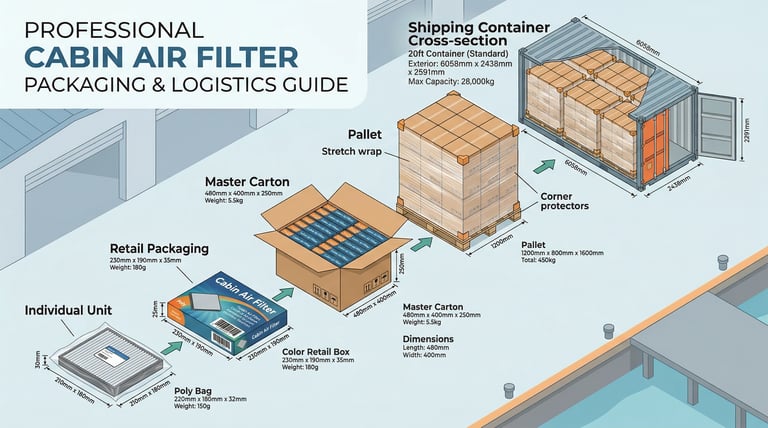
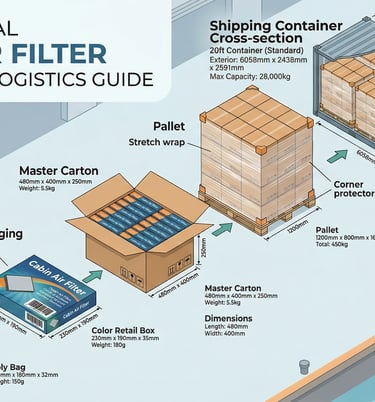
Individual Filter Packaging:
Poly bag with desiccant: prevents moisture absorption and contamination
Color box packaging: 300-350g CCNB paperboard with 4-color printing
Blister pack: clear plastic clamshell for retail hanging display
Shrink wrap: economy option for bulk distribution
Packaging Information Requirements:
Part number and vehicle application (year/make/model)
Filter type: Standard, Activated Carbon, or HEPA
Replacement interval recommendation
Installation instructions with diagrams
Barcode: EAN-13 or UPC-A for retail scanning
Multilingual text: English + target market language
Master Carton Specifications:
Material: 5-layer corrugated cardboard, BC flute
Bursting strength: minimum 200 PSI
Carton dimensions: optimized for pallet loading (typically 500-600mm × 350-450mm × 300-400mm)
Carton quantity: 20-40 pieces depending on filter size
Gross weight: <12kg per carton for manual handling
Carton marking: part number, quantity, gross/net weight, destination
Pallet Configuration:
Standard pallet: 1200×1000mm (European) or 1200×800mm
Pallet height: maximum 1.6m for stable stacking
Pallet loading: 30-50 cartons per pallet
Stretch wrap: 6-8 layers with corner protection
Moisture barrier: PE film for sea freight shipments
Container Loading Capacity:
20' container: 800-1,200 cartons (16,000-48,000 pieces)
40' container: 1,600-2,400 cartons (32,000-96,000 pieces)
40' HC container: 1,900-2,800 cartons (38,000-112,000 pieces)
Shipping Terms and Lead Time Planning
Understanding international logistics ensures smooth supply chain operations:
Common Incoterms:
FOB (Free on Board): Buyer arranges ocean freight and assumes risk after port loading
CIF (Cost, Insurance, Freight): Seller arranges shipping and insurance to destination port
DDP (Delivered Duty Paid): Seller handles all logistics, customs, and delivery to buyer's warehouse
Typical Lead Time Breakdown:
Order confirmation and deposit: 1-3 days
Production: 25-40 days for standard products
Quality inspection: 2-3 days (if third-party inspection required)
Inland transportation to port: 3-5 days
Sea freight: 15-35 days depending on destination
Customs clearance: 3-7 days
Inland delivery: 2-5 days
Total lead time: 50-90 days for first order, 35-60 days for repeat orders
Inventory Planning Recommendations:
Maintain 60-90 days safety stock for fast-moving SKUs
Reorder point: when inventory reaches 45-60 days supply
Consider air freight for emergency replenishment (7-10 days total lead time, 4-6× higher cost)
Private Label and OEM Opportunities
Custom Branding Options for Distributors
Building brand equity through private label cabin air filters:
Packaging Customization Levels:
Level 1 - Basic Branding (MOQ: 500-1,000 pieces per SKU):
Custom label with your brand logo and information
Standard packaging with label application
Typical cost: $0.20-$0.40 per unit additional
Level 2 - Custom Packaging (MOQ: 2,000-3,000 pieces per SKU):
Fully custom color box design
Your brand identity, colors, and graphics
Custom installation instructions
Typical cost: $0.50-$0.80 per unit additional
Level 3 - Complete Customization (MOQ: 5,000-10,000 pieces per SKU):
Custom filter specifications (media type, carbon content, pleat count)
Custom packaging design and materials
Branded filter frame with logo molding
Custom part numbering system
Typical cost: $0.80-$1.50 per unit additional
Product Differentiation Strategies:
Color-coded gaskets: distinguish product lines (blue=standard, red=carbon, gold=HEPA)
Branded installation tabs: molded plastic tabs with logo
QR codes: link to installation videos and product information
Warranty cards: build customer confidence and collect contact information
Quality Assurance for Private Label Programs
Protecting your brand reputation requires rigorous quality control:
Pre-Production Approval Process:
Sample approval: evaluate 3-5 pre-production samples
Packaging mock-up approval: verify all text, dimensions, colors, barcodes
First article inspection (FAI): detailed measurement and testing of first production batch
Production approval: authorize mass production after FAI passes all criteria
In-Process Quality Control:
Factory visit during production: observe manufacturing process and quality checks
In-process inspection: verify quality at 25%, 50%, and 75% production completion
Random sampling: pull samples for independent testing
Pre-Shipment Inspection (PSI):
Verify quantity: carton count and piece count sampling
Quality inspection: AQL 2.5 for critical defects, AQL 4.0 for major defects
Packaging inspection: verify labeling, barcodes, and carton marking
Measurement verification: dimensional checks on random samples
Performance spot-check: pressure drop testing on sample units
Recommended Inspection Standards:
Critical defects (AQL 0): seal leakage, frame cracks, wrong dimensions
Major defects (AQL 2.5): media damage, poor pleating, weak frame
Minor defects (AQL 4.0): cosmetic issues, packaging defects, label misalignment
Pricing Structure and Cost Analysis
Understanding Manufacturing Cost Components
Transparent cost breakdown helps evaluate supplier pricing:
Cost Components by Filter Type:
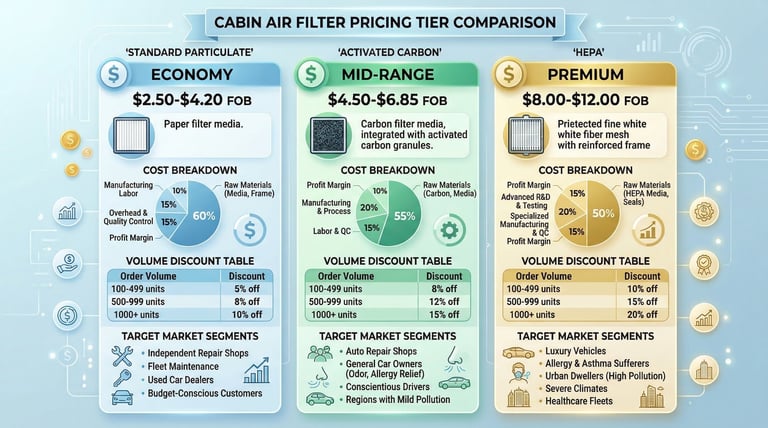
Standard Particulate Filter:
Filter media: $0.80-$1.20 (35-40% of cost)
Frame and seal: $0.60-$0.90 (25-30%)
Labor and manufacturing: $0.50-$0.70 (20-25%)
Quality control and testing: $0.15-$0.25 (5-8%)
Packaging: $0.25-$0.40 (8-12%)
Factory overhead and profit: $0.50-$0.75 (15-20%)
Total FOB cost: $2.80-$4.20 per unit
Activated Carbon Filter:
Filter media: $1.20-$1.80 (30-35%)
Activated carbon layer: $0.80-$1.20 (20-25%)
Frame and seal: $0.70-$1.00 (15-20%)
Labor and manufacturing: $0.60-$0.90 (12-18%)
Quality control and testing: $0.20-$0.35 (5-8%)
Packaging: $0.30-$0.50 (6-10%)
Factory overhead and profit: $0.70-$1.10 (15-20%)
Total FOB cost: $4.50-$6.85 per unit
HEPA Filter:
HEPA-grade media: $2.50-$4.00 (35-40%)
Activated carbon layer: $0.80-$1.20 (10-15%)
Reinforced frame: $1.00-$1.50 (12-18%)
Labor and manufacturing: $0.80-$1.20 (10-15%)
Quality control and testing: $0.40-$0.60 (5-8%)
Packaging: $0.40-$0.60 (5-7%)
Factory overhead and profit: $1.20-$1.90 (15-20%)
Total FOB cost: $8.10-$12.00 per unit
Wholesale Pricing and Volume Discounts
Typical Wholesale Price Ranges (FOB China):
Standard Particulate Filters:
500-1,000 pieces: $3.20-$4.50 per unit
1,000-3,000 pieces: $2.90-$4.00 per unit (8-12% discount)
3,000-5,000 pieces: $2.70-$3.70 per unit (12-18% discount)
5,000+ pieces: $2.50-$3.40 per unit (18-25% discount)
Activated Carbon Filters:
500-1,000 pieces: $5.50-$7.50 per unit
1,000-3,000 pieces: $5.00-$6.80 per unit (8-12% discount)
3,000-5,000 pieces: $4.70-$6.30 per unit (12-18% discount)
5,000+ pieces: $4.50-$6.00 per unit (18-20% discount)
HEPA Filters:
500-1,000 pieces: $10.00-$14.00 per unit
1,000-3,000 pieces: $9.00-$12.50 per unit (8-12% discount)
3,000-5,000 pieces: $8.50-$11.50 per unit (12-18% discount)
5,000+ pieces: $8.00-$10.80 per unit (18-23% discount)
Payment Terms and Financial Considerations
Standard Payment Terms:
New customers: 30% T/T deposit, 70% before shipment
Established customers (after 3-6 months): 30-60 day payment terms
Large orders (>$50,000): Letter of Credit (L/C at sight or usance)
Platform orders: Trade Assurance through Alibaba or Global Sources
Additional Costs to Budget:
Custom tooling and molds: $800-$2,500 per SKU (one-time cost)
Sample costs: $30-$80 per sample + international shipping ($50-$150)
Third-party inspection: $250-$450 per inspection
Ocean freight: $1,800-$4,000 per 20' container (varies by destination and season)
Import duties: 0-8% depending on country and trade agreements
Customs broker fees: $150-$400 per shipment
Warehousing and distribution: 8-12% of landed cost annually
Landed Cost Calculation Example (1,000 units activated carbon filters to USA):
FOB cost: $5.50 × 1,000 = $5,500
Ocean freight (share of container): $800
Insurance (0.5%): $32
Import duty (2.5%): $138
Customs broker: $200
Inland delivery: $250
Total landed cost: $6,920 ($6.92 per unit)
Warehousing and handling (10%): $692
Total cost per unit: $7.61
Market Trends and Growth Opportunities
Rising Demand for Premium Filtration
Several market trends favor premium cabin air filter adoption:
Health and Wellness Awareness:
Post-pandemic increased focus on air quality and respiratory health
Growing consumer knowledge about PM2.5 and air pollution health effects
Allergy sufferers seeking relief through better cabin air filtration
Premium HEPA filters growing at 12-15% CAGR vs. 5-7% for standard filters
Electric Vehicle (EV) Market Growth:
EVs require high-quality cabin filtration due to sealed cabin design
No engine noise makes HVAC noise more noticeable—premium filters reduce noise
EV owners typically more willing to invest in premium accessories
Tesla and premium EV brands specify HEPA filtration as standard or optional equipment
Regulatory and Environmental Trends:
Stricter air quality regulations in China, India, and developing markets
Vehicle manufacturers increasingly specifying activated carbon or HEPA filters as OEM equipment
Extended warranty programs requiring quality replacement parts
Environmental consciousness driving demand for longer-lasting, more efficient filters
Emerging Technologies and Product Innovations
Nanofiber Filter Media:
Electrospun nanofibers (diameter 100-500 nanometers)
20-30% lower pressure drop with equivalent filtration efficiency
Extended service life due to higher dust holding capacity
Currently 30-50% cost premium, expected to decrease with scale
Smart Cabin Air Filters:
Embedded RFID chips for replacement interval tracking
Integration with vehicle telematics systems
Automated replacement reminders via mobile apps
Premium market segment with 40-60% higher pricing
Biodegradable and Sustainable Filters:
Bio-based filter media from renewable resources
Biodegradable frames from PLA or other plant-based plastics
Reduced packaging materials
Appeals to environmentally conscious consumers
Currently niche market but growing 15-20% annually
Photocatalytic and Ionization Technologies:
TiO₂ photocatalytic coatings for VOC breakdown
Negative ion generation for particle agglomeration
Antimicrobial properties without chemical treatments
Premium pricing with 50-80% markup over standard filters
Best Practices for Working with Chinese Manufacturers
Supplier Verification and Due Diligence
Protecting your investment through thorough supplier vetting:
Factory Audit Checklist:
Business license verification: confirm legal registration and export license
Production facility visit: assess equipment, cleanliness, organization, capacity
Quality system audit: verify ISO certifications are current and legitimate
Customer reference checks: contact 2-3 existing customers for feedback
Financial stability: review company history (minimum 5 years operation preferred)
Export experience: verify customs records and international customer base
Red Flags to Avoid:
Prices 30-40% below market average (likely quality compromises)
Unwillingness to accept factory visits or third-party inspections
No verifiable certifications or test reports
Poor communication and unclear technical specifications
Requests for full payment before production or unusual payment methods
No physical factory address or only trading company operations
Verification Resources:
China Customs database: verify actual export history
National Enterprise Credit Information System: confirm business registration
Certification body websites: verify ISO certificates are genuine
Third-party audit services : SGS, Bureau Veritas, TÜV, Intertek
Communication and Technical Specification Management
Clear communication prevents costly misunderstandings:
Technical Specification Documents Should Include:
Dimensional drawings with tolerances (±mm specifications)
Filter media specifications: type, weight, thickness, pleat count
Activated carbon specifications: type, weight, iodine number
Frame material and thickness requirements
Seal material and compression specifications
Pressure drop requirements at specified airflow
Testing standards and acceptance criteria (ISO/TS 11155, ISO 16890)
Packaging and labeling requirements with examples
Sample Approval Process:
Request 5-10 samples with complete test reports
Conduct fitment testing on actual vehicles (minimum 3 models)
Measure pressure drop using calibrated equipment
Evaluate packaging quality and labeling accuracy
Compare performance against OEM or premium benchmark
Provide written approval or detailed feedback for corrections
Approve pre-production samples before authorizing mass production
Ongoing Communication Best Practices:
Designate single point of contact (project manager or sales engineer)
Schedule regular progress updates during production (weekly for first orders)
Request in-process photos at key manufacturing stages
Document all changes or modifications in writing with mutual confirmation
Maintain detailed records of all communications and approvals
Quality Control and Inspection Strategies
Three-Stage Inspection Approach:
Stage 1 - Pre-Production Inspection:
Verify raw materials meet specifications before production starts
Confirm production schedule and capacity allocation
Review quality control procedures and checkpoints
Stage 2 - During Production Inspection (DUPRO):
Conduct inspection when 30-50% of production is complete
Identify and correct issues before full production
Verify manufacturing process follows approved procedures
Stage 3 - Pre-Shipment Inspection (PSI):
Final inspection when 100% production complete and 80% packed
Verify quantity, quality, and packaging meet specifications
Authorize shipment only after passing all inspection criteria
Inspection Sampling Plans (per ANSI/ASQ Z1.4):
Lot size 500-1,200: sample 80 units
Lot size 1,201-3,200: sample 125 units
Lot size 3,201-10,000: sample 200 units
AQL 2.5 for critical defects, AQL 4.0 for major defects
Conclusion: Building a Profitable Cabin Air Filter Business
The cabin air filter market offers substantial opportunities for distributors and wholesale buyers who understand product specifications, quality standards, and sourcing best practices. Success in this market requires:
Product Knowledge: Understand the technical differences between standard, activated carbon, and HEPA filters to match products to customer needs and price points
Quality Focus: Prioritize suppliers with legitimate certifications (ISO 9001, IATF 16949) and comprehensive testing documentation (ISO/TS 11155, ISO 16890)
Supplier Relationships: Build long-term partnerships with reliable manufacturers through clear communication, fair pricing, and consistent orders
Quality Assurance: Implement rigorous inspection protocols including sample testing, third-party inspections, and field performance validation
Market Positioning: Develop a product portfolio spanning economy to premium segments to capture diverse customer needs
Private Label Strategy: Build brand equity through custom packaging and product differentiation to command premium pricing and customer loyalty
Inventory Management: Plan for 60-90 day lead times with adequate safety stock for fast-moving SKUs
Continuous Improvement: Stay informed about emerging technologies, market trends, and customer preferences to adapt your product offerings
The growing consumer awareness of air quality and health, combined with increasing vehicle complexity and premium content, creates favorable conditions for cabin air filter distributors. By focusing on quality, building strong supplier relationships, and understanding customer needs, wholesale buyers can build profitable and sustainable businesses in this expanding market.
About MakexCar: Your Trusted Cabin Air Filter Manufacturing Partner
MakexCar specializes in manufacturing premium automotive filters for global wholesale distribution, with particular expertise in advanced cabin air filtration technologies. Our comprehensive cabin air filter product line includes:
Product Range:
Standard Particulate Filters: Cost-effective solutions for basic dust and pollen filtration
Activated Carbon Filters: Multi-layer construction with honeycomb activated carbon for superior odor and gas absorption
HEPA Filters: Medical-grade H12 and H13 filtration capturing 99.5-99.95% of particles ≥0.3 microns
Premium Multi-Stage Filters: Combined HEPA + activated carbon with antimicrobial treatment
Quality Certifications:
ISO 9001:2015 certified manufacturing facility
IATF 16949:2016 automotive quality management system
ISO/TS 11155 compliant testing laboratory
ISO 16890 classification testing capability
Complete RoHS and REACH compliance documentation
Manufacturing Capabilities:
Monthly production capacity: 300,000+ cabin air filters
150+ SKUs covering 90% of popular vehicle applications (2010-2026 models)
Custom OEM and private label programs with flexible MOQ
In-house testing laboratory with airflow and efficiency measurement equipment
Clean assembly environment (Class 100,000 cleanroom standards)
Technical Support:
Application engineering assistance for custom specifications
Fitment verification and vehicle compatibility confirmation
Performance testing and certification support
Installation guide development and technical documentation
Why Choose MakexCar for Cabin Air Filters:
Direct manufacturer pricing without trading company markup (15-25% cost savings)
Experienced export team with 15+ years serving North American, European, and Middle Eastern markets
Flexible minimum order quantities starting from 500 pieces per SKU
Comprehensive quality control with third-party inspection welcome
Fast response time with English-speaking technical and sales support
Complete documentation package: test reports, certifications, installation guides
Specialized Capabilities:
Custom activated carbon formulations for specific odor absorption requirements
HEPA filter development for premium and EV applications
Antimicrobial treatment options for humid climate markets
Custom packaging design and private label programs
Cross-reference development for aftermarket catalog integration
Logistics and Support:
Competitive FOB, CIF, and DDP pricing options
Flexible payment terms for established customers
Consolidated shipping for mixed product orders (oil, fuel, air, cabin filters)
Technical training and product knowledge support for your sales team
Warranty support and quality issue resolution within 48 hours
Contact us today to discuss your cabin air filter sourcing requirements, request product samples, and receive detailed quotations. We're committed to building long-term partnerships based on quality, reliability, technical expertise, and mutual success.
Contact Information:
Website: www.makexcar.com
Email: sales1@makexcar.com
Product Catalog: Available upon request with complete application listings
Sample Request: Contact our sales team with your target vehicle applications
Download Resources:
[Cabin Air Filter Product Catalog with Application Guide]
[ISO/TS 11155 and ISO 16890 Test Reports]
[Quality Certifications Package]
[Installation Guide Templates]
[Cross-Reference Catalog for Popular Vehicles]
[Private Label Program Information]
This guide is regularly updated to reflect current industry standards, market conditions, and technological advances. Last updated: March 2026
Whatsapp: +86 19941234680
Phone:+86 19941234680
© 2025. All rights reserved.
Email:sales1@makexcar.com
Wechat:Sgxwtxa