FOB vs CIF vs DDP: Complete Incoterms Guide for Importing Oil Filters from China (2026 Cost Breakdown)
Complete guide to FOB, CIF, and DDP Incoterms for importing oil filters from China. Real cost breakdowns, risk analysis, and decision framework to save 20-40% on shipping costs
博客
2/27/2026
Introduction: The $8,000 Shipping Decision That Makes or Breaks Your Profit
When a California distributor placed his first 10,000-unit oil filter order from China, he faced a critical decision: FOB at $2.20 per unit, CIF at $2.65, or DDP at $3.35. The FOB price looked attractive—$11,500 cheaper than DDP for the same order. He chose FOB to "save money."
Three months later, after paying unexpected destination charges ($1,850), customs broker fees (680), and inland transport (3.28 per unit—only $700 less than the DDP quote, but with weeks of delays, countless emails, and massive stress managing international logistics.
Meanwhile, his competitor chose DDP at $3.35, received the shipment directly at their warehouse in 35 days with zero hassle, and was already selling while he was still fighting with the customs broker.
The lesson? Understanding Incoterms (International Commercial Terms) isn't just about comparing FOB prices—it's about understanding your total landed cost, risk exposure, and operational capacity. The wrong choice can cost you 20-40% in hidden expenses, cause shipment delays, and destroy your profit margins.
What This Guide Covers:
Complete explanation of FOB, CIF, and DDP for oil filter imports
Real cost breakdowns: what you actually pay beyond the quoted price
Risk analysis: who bears responsibility at each shipping stage
Decision framework: which term is right for your business
3 real case studies: new distributor, mid-size buyer, volume importer
Hidden costs and common traps that erode profitability
Negotiation strategies to get better terms from suppliers
Makexcar's flexible shipping solutions
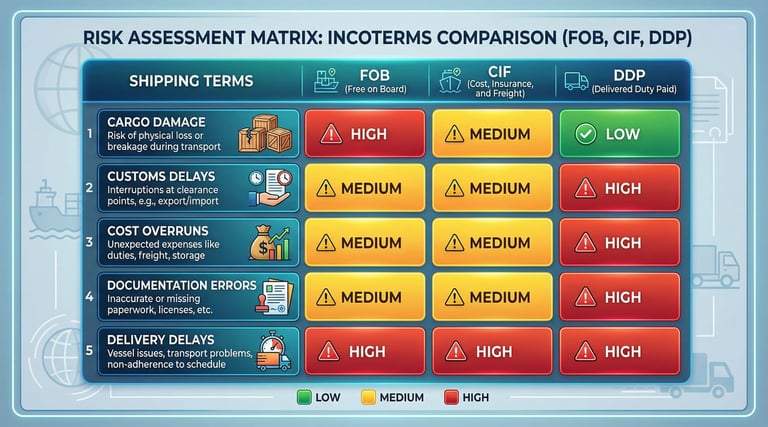
2026 Quick Comparison:
Understanding Incoterms: The Foundation of International Trade
What Are Incoterms?
Incoterms (International Commercial Terms) are standardized trade terms published by the International Chamber of Commerce (ICC) that define:
Who pays for transportation, insurance, and customs
Who bears risk if goods are damaged or lost
Where responsibility transfers from seller to buyer
What documents each party must provide
Current Version: Incoterms® 2020 (effective since January 1, 2020)
Previous Version: Incoterms® 2010 (still used by some suppliers)
Total Terms: 11 terms, but only 3 are commonly used for oil filter imports
Why Incoterms Matter for Oil Filter Imports
Cost Impact:
Wrong term selection can add 15-30% to your landed cost
Hidden fees can total $2,000-5,000 per shipment
Unexpected charges destroy profit margin calculations
Risk Impact:
Cargo damage during transit: who pays for replacement?
Customs delays: who bears the cost of storage fees?
Documentation errors: who fixes the problem and pays penalties?
Operational Impact:
Do you have customs broker relationships?
Can you arrange inland transport efficiently?
Do you have time to manage international logistics?
Real Example:
A Texas distributor ordered 5,000 oil filters FOB Ningbo at $2.30 per unit ($11,500 total product cost). He assumed shipping would be "a few hundred dollars." Final landed cost: $3.45 per unit ($17,250 total)—50% higher than the FOB price. His profit margin evaporated because he didn't understand the complete cost structure.
FOB (Free On Board): Detailed Breakdown
Definition and Responsibility
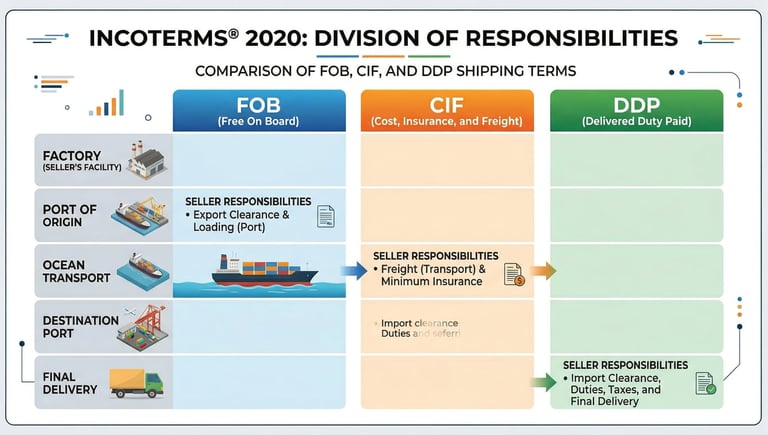
FOB (Free On Board) - Named Port of Shipment
Example: "FOB Ningbo" or "FOB Shanghai"
Supplier's Responsibilities:
Manufacture and package the oil filters
Deliver goods to the port of origin (Ningbo, Shanghai, etc.)
Load goods onto the vessel
Provide export documentation (commercial invoice, packing list, export license)
Clear goods for export from China
Pay all costs until goods are loaded on the ship
Your Responsibilities (Buyer):
Arrange and pay for ocean freight
Arrange and pay for marine insurance
Handle all costs and risks once goods are on the ship
Arrange customs clearance at destination
Pay import duties and taxes
Arrange inland transportation to your warehouse
Bear all risks of loss or damage during transit
Risk Transfer Point:
The critical moment when risk transfers from supplier to you is when goods pass the ship's rail at the port of origin. Once the container is loaded on the vessel, you own all the risk.
Complete FOB Cost Structure
Scenario: 10,000 oil filters, FOB Ningbo to Los Angeles
Supplier's Quote: $2.20 per unit FOB Ningbo
Product Cost: $22,000
Your Additional Costs:
1. Ocean Freight (China to USA):
20ft container (fits ~12,000 filters): $2,200-3,500
40ft container (fits ~25,000 filters): $3,500-5,500
For 10,000 units: Partial 20ft container or LCL
Cost: $2,800 (LCL) or $2,200 (shared container)
Per unit: $0.22-0.28
2. Marine Insurance:
Coverage: 110% of cargo value (CIF value)
Rate: 0.3-0.5% of insured value
Calculation: $22,000 × 110% × 0.4% = $97
Per unit: $0.01
3. Destination Port Charges (Los Angeles):
Terminal handling charge (THC): $300-450
Documentation fee: $75-150
Bill of lading fee: $50-100
Container freight station (CFS) fee (if LCL): $200-350
Chassis split fee: $50-100
Subtotal: $675-1,150
Per unit: $0.07-0.12
4. Customs Clearance:
Customs broker fee: $150-300
ISF (Importer Security Filing): $50-100
Entry fee: $100-150
Customs bond (annual): $300-500 (amortized: $25-40 per shipment)
Subtotal: $325-590
Per unit: $0.03-0.06
5. Import Duties and Taxes:
US import duty (oil filters HTS 8421.23.00): 2.5%
Calculation: $22,000 × 2.5% = $550
Per unit: $0.055
6. Inland Transportation (Port to Warehouse):
Drayage (port to warehouse): $400-800
Depends on distance and location
Per unit: $0.04-0.08
7. Miscellaneous Fees:
Demurrage (if container not picked up on time): $0-500
Exam fees (if customs inspection): $0-400
Fumigation (if required): $0-300
Contingency: $0.02-0.05 per unit
Total Additional Costs: $4,447-6,787
Per-Unit Additional Cost: $0.44-0.68
TOTAL LANDED COST:
FOB price: $2.20
Additional costs: $0.44-0.68
Total: $2.64-2.88 per unit
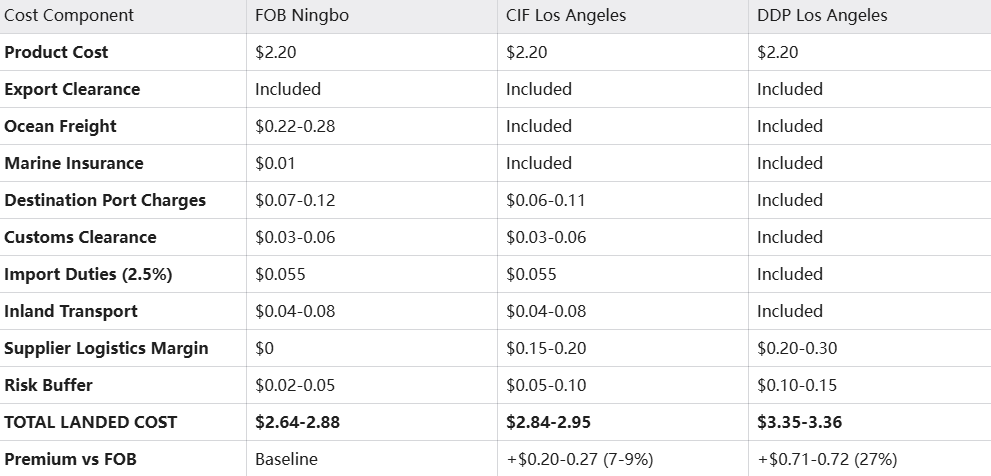
Key Insight: FOB $2.20 becomes $2.64-2.88 landed—a 20-31% increase from the quoted price.
FOB Advantages
1. Lowest Product Price:
Supplier's quote is the lowest (no freight/insurance markup)
Transparent pricing—you see exactly what you're paying for
Easier to compare multiple suppliers on equal footing
2. Full Control Over Logistics:
Choose your own freight forwarder (potentially better rates)
Select your preferred shipping route and carrier
Control insurance coverage level
Manage delivery timeline
3. Build Your Own Logistics Network:
Develop relationships with freight forwarders
Negotiate better rates with repeat business
Gain expertise in international shipping
More flexibility for future shipments
4. Cost Savings at Scale:
Experienced importers can save 15-25% vs CIF/DDP
Consolidate multiple suppliers into one container
Optimize shipping routes and carriers
Negotiate annual contracts with freight forwarders
FOB Disadvantages
1. Complexity and Time:
Requires managing multiple service providers
Coordinate freight forwarder, customs broker, trucker
Handle documentation and compliance
Troubleshoot issues across multiple parties
Time investment: 10-20 hours per shipment for new importers
2. Hidden Costs:
Destination charges can be 2-3x higher than expected
Demurrage fees if container not picked up on time
Exam fees if customs inspects your shipment
Storage fees if warehouse not ready
3. Risk Exposure:
You bear all risk once goods are loaded on ship
If cargo is damaged in transit, you file insurance claim
If shipment is delayed, you manage the consequences
If documentation is wrong, you fix it and pay penalties
4. Requires Expertise:
Must understand customs regulations
Need to classify products correctly (HTS codes)
Must prepare import documentation
Requires established relationships with service providers
5. Cash Flow Impact:
Pay freight forwarder before shipment
Pay customs duties before release
Pay trucker before delivery
Multiple payments to multiple parties
CIF (Cost, Insurance, Freight): Detailed Breakdown
Definition and Responsibility
CIF (Cost, Insurance, Freight) - Named Port of Destination
Example: "CIF Los Angeles" or "CIF New York"
Supplier's Responsibilities:
Everything in FOB, plus:
Arrange and pay for ocean freight to destination port
Arrange and pay for marine insurance (minimum coverage)
Provide freight and insurance documents
Deliver goods to the destination port
Your Responsibilities (Buyer):
Unload goods at destination port (usually included in freight)
Pay destination port charges (THC, documentation fees)
Arrange customs clearance
Pay import duties and taxes
Arrange inland transportation to your warehouse
Bear risk once goods arrive at destination port
Risk Transfer Point:
Risk transfers when goods are loaded on the ship at origin port (same as FOB), but supplier has already paid for freight and insurance. This creates an interesting dynamic: supplier pays for shipping, but you bear the risk during transit.
Complete CIF Cost Structure
Scenario: 10,000 oil filters, CIF Los Angeles
Supplier's Quote: $2.65 per unit CIF Los Angeles
Product Cost (including freight & insurance): $26,500
What's Included in CIF Price:
Product manufacturing: ~$2.20
Ocean freight: ~$0.22-0.28
Marine insurance: ~$0.01
Export clearance: ~$0.02
Supplier's margin on freight: ~$0.15-0.20
Your Additional Costs:
1. Destination Port Charges:
Terminal handling charge (THC): $300-450
Documentation fee: $75-150
Bill of lading fee: $50-100
Container freight station fee: $200-350 (if LCL)
Subtotal: $625-1,050
Per unit: $0.06-0.11
2. Customs Clearance:
Customs broker fee: $150-300
ISF filing: $50-100
Entry fee: $100-150
Customs bond: $25-40 (amortized)
Subtotal: $325-590
Per unit: $0.03-0.06
3. Import Duties and Taxes:
US import duty: 2.5% of FOB value
FOB value in CIF: ~$22,000 (product only)
Calculation: $22,000 × 2.5% = $550
Per unit: $0.055
4. Inland Transportation:
Drayage (port to warehouse): $400-800
Per unit: $0.04-0.08
5. Miscellaneous:
Contingency for unexpected fees: $0.02-0.05 per unit
Total Additional Costs: $1,900-2,990
Per-Unit Additional Cost: $0.19-0.30
TOTAL LANDED COST:
CIF price: $2.65
Additional costs: $0.19-0.30
Total: $2.84-2.95 per unit
Key Insight: CIF $2.65 becomes $2.84-2.95 landed—a 7-11% increase from the quoted price. Much more predictable than FOB.
CIF Advantages
1. Simplified Logistics:
Supplier handles ocean freight booking
Supplier arranges marine insurance
One less service provider to manage
Fewer coordination headaches
2. Predictable Ocean Freight Costs:
Freight cost locked in with supplier quote
No surprise rate increases
No need to negotiate with freight forwarders
Easier budgeting and cost forecasting
3. Supplier Leverage on Freight Rates:
High-volume shippers get better rates
Supplier may have freight contracts
Potential savings vs booking freight yourself
Especially beneficial for small orders
4. Reduced Upfront Coordination:
Don't need freight forwarder relationship immediately
Can focus on customs and inland logistics
Good middle ground for moderate experience level
5. Insurance Included:
Basic marine insurance covered
No need to arrange separately
Meets minimum requirement for protection
CIF Disadvantages
1. Limited Insurance Coverage:
Minimum coverage only: 110% of CIF value
Covers cargo value, not lost profit or consequential damages
May not cover all risks (strikes, riots, war)
Consider buying additional insurance
2. No Control Over Freight:
Can't choose carrier or route
Can't optimize shipping schedule
Supplier may use cheaper (slower) options
No relationship building with freight forwarders
3. Supplier Markup on Freight:
Supplier adds 10-20% margin on freight costs
May not get best available rates
Less transparent pricing
Difficult to verify if freight cost is reasonable
4. Risk Transfer Confusion:
Risk transfers at origin port (when loaded on ship)
But you haven't paid for freight yet
If cargo is damaged in transit, you claim insurance arranged by supplier
Can be complicated if supplier's insurance is inadequate
5. Still Need Customs Expertise:
Must handle destination port charges
Must arrange customs clearance
Must pay duties and taxes
Must coordinate inland transport
6. Currency Risk:
If freight rates change between quote and shipment, who pays?
Need clear agreement on rate validity period
Exchange rate fluctuations affect total cost
DDP (Delivered Duty Paid): Detailed Breakdown
Definition and Responsibility
DDP (Delivered Duty Paid) - Named Place of Destination
Example: "DDP Los Angeles warehouse" or "DDP buyer's facility"
Supplier's Responsibilities:
Everything in CIF, plus:
Pay all destination port charges
Arrange and pay for customs clearance
Pay all import duties and taxes
Arrange and pay for inland transportation
Deliver goods to your specified location
Bear all risks until goods are delivered to you
Your Responsibilities (Buyer):
Receive the goods at your warehouse
Unload from delivery truck (unless specified otherwise)
That's it—everything else is supplier's responsibility
Risk Transfer Point:
Risk transfers only when goods are delivered to your specified location and unloaded. You bear minimal risk throughout the entire shipping process.
Complete DDP Cost Structure
Scenario: 10,000 oil filters, DDP to Los Angeles warehouse
Supplier's Quote: $3.35 per unit DDP Los Angeles
Total Cost: $33,500
What's Included in DDP Price:
Product manufacturing: ~$2.20
Export clearance: ~$0.02
Ocean freight: ~$0.22-0.28
Marine insurance: ~$0.01
Destination port charges: ~$0.06-0.11
Customs clearance: ~$0.03-0.06
Import duties: ~$0.055
Inland transportation: ~$0.04-0.08
Supplier's margin on logistics: ~$0.20-0.30
Currency/risk buffer: ~$0.10-0.15
Your Additional Costs:
None (unless unloading at warehouse costs extra)
Some suppliers charge extra for liftgate service or inside delivery
Typical unloading: $0-100 total ($0-0.01 per unit)
TOTAL LANDED COST:
DDP price: $3.35
Additional costs: $0-0.01
Total: $3.35-3.36 per unit
Key Insight: DDP $3.35 is your true landed cost—no surprises, no hidden fees, no additional coordination.
DDP Advantages
1. Complete Simplicity:
One price, one supplier, one payment
No logistics coordination required
No customs broker needed
No freight forwarder needed
No trucker needed
2. Zero Hidden Costs:
All costs included in quoted price
No surprise fees or charges
Easy budgeting and forecasting
Predictable cash flow
3. Minimal Risk:
Supplier bears all risk until delivery
If cargo is damaged, supplier handles replacement
If customs delays occur, supplier manages
If documentation is wrong, supplier fixes it
4. Time Savings:
No time spent coordinating logistics
No emails with freight forwarders
No calls with customs brokers
No tracking shipments across multiple parties
Time saved: 15-25 hours per shipment
5. Ideal for New Importers:
No import experience required
No need to understand customs regulations
No need for service provider relationships
Focus on sales, not logistics
6. Faster Problem Resolution:
One point of contact (supplier)
Supplier has incentive to resolve issues quickly
No finger-pointing between multiple parties
Clear accountability
DDP Disadvantages
1. Highest Per-Unit Cost:
15-30% premium vs FOB
10-20% premium vs CIF
Supplier's markup on all logistics services
Less competitive on price-sensitive markets
2. No Logistics Control:
Can't choose freight forwarder or carrier
Can't optimize shipping route
Can't control delivery timeline
Dependent on supplier's logistics capabilities
3. Supplier Capability Risk:
Not all Chinese suppliers have DDP expertise
Supplier may underestimate costs and lose money
Supplier may use unreliable logistics partners
Quality of service varies widely
4. Customs Compliance Risk:
Supplier may undervalue goods to reduce duties (illegal)
Supplier may misclassify products (wrong HTS code)
You (importer of record) are ultimately liable for compliance
Customs penalties can be severe ($10,000-50,000+)
5. Limited Transparency:
Don't see breakdown of logistics costs
Can't verify if freight rates are reasonable
Supplier may inflate costs
Difficult to negotiate better terms
6. Inflexibility:
Difficult to change delivery location
Hard to split shipments to multiple locations
Less flexibility for urgent orders
May not accommodate special requirements
7. Currency and Tax Complexity:
Supplier must understand destination country tax laws
Exchange rate fluctuations affect supplier's margin
Supplier may build in large buffer for uncertainty
You pay for supplier's risk management
Side-by-Side Comparison: FOB vs CIF vs DDP
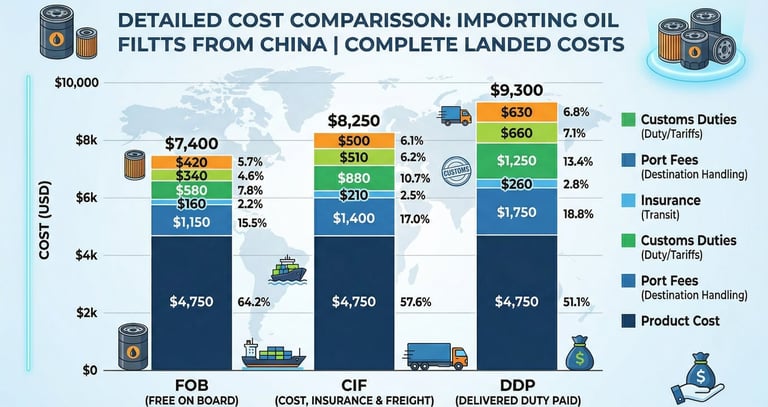
Complete Cost Comparison Table
Scenario: 10,000 oil filters, Ningbo to Los Angeles
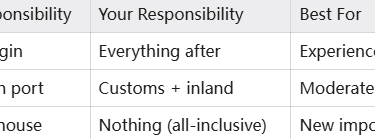
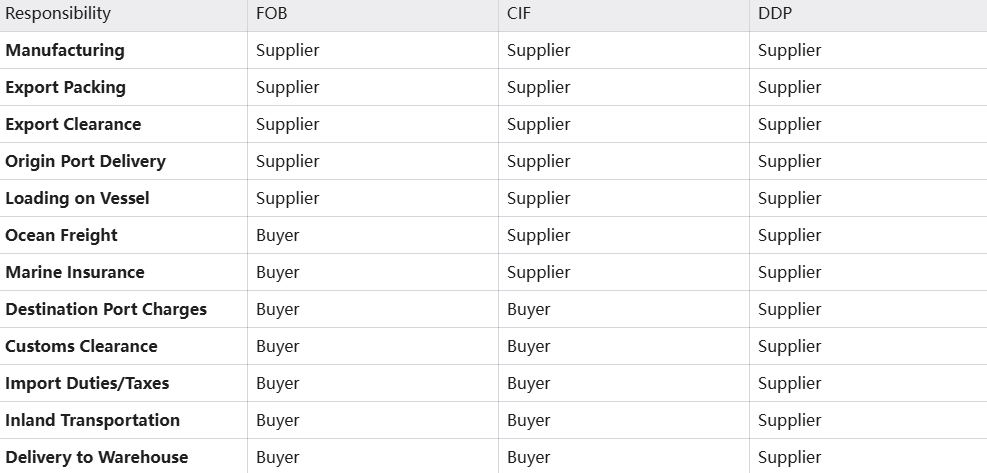
Responsibility Matrix
Supplier
Supplier
Supplier
Loading on Vessel
Supplier
Supplier
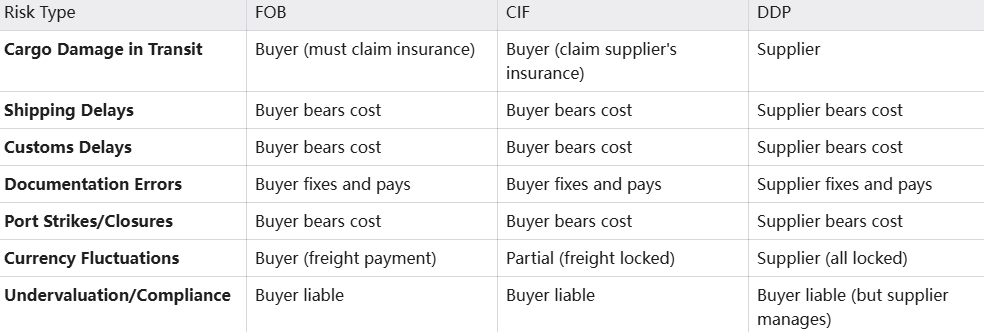
Risk Matrix
Supplier
Shipping Delays
Buyer bears cost
Buyer bears cost
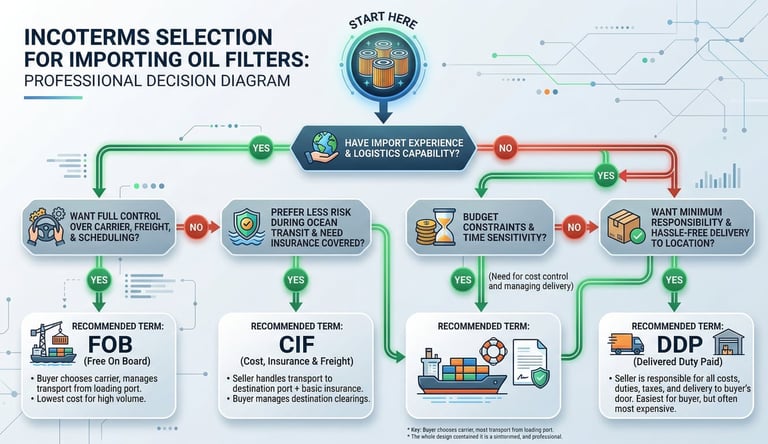
Decision Framework: Which Term Is Right for You?
Decision Tree
Start Here: Answer These Questions
Question 1: Have you imported goods from China before?
No → Consider DDP (minimize risk and complexity)
Yes, 1-2 times → Consider CIF (balance of cost and simplicity)
Yes, 5+ times → Consider FOB (maximize cost savings)
Question 2: What is your order value?
<$10,000 → DDP recommended (logistics cost per unit too high for FOB)
$10,000-$30,000 → CIF recommended (sweet spot for cost/convenience)
>$30,000 → FOB recommended (savings justify complexity)
Question 3: Do you have established logistics relationships?
No freight forwarder → DDP or CIF
No customs broker → DDP or CIF
Both established → FOB (leverage your relationships)
Question 4: How much time can you dedicate to logistics?
<5 hours per shipment → DDP (hands-off)
5-10 hours per shipment → CIF (moderate involvement)
10+ hours per shipment → FOB (full control)
Question 5: What is your risk tolerance?
Low (prefer certainty) → DDP (fixed cost, minimal risk)
Medium (can handle some uncertainty) → CIF (predictable freight, manage destination)
High (willing to manage complexity for savings) → FOB (maximum control and savings)
Recommended Term by Business Profile
Profile 1: New Distributor (First Import)
Import experience: None
Order size: $15,000-25,000
Risk tolerance: Low
Time availability: Limited
Recommended: DDP
Rationale: Minimize complexity and risk. Focus on sales and market validation, not logistics. Pay premium for peace of mind.
Profile 2: Growing Distributor (3-10 imports)
Import experience: Some
Order size: $25,000-50,000
Risk tolerance: Medium
Time availability: Moderate
Recommended: CIF
Rationale: Balance cost savings with manageable complexity. Start building customs broker relationship while supplier handles ocean freight.
Profile 3: Established Distributor (Regular importer)
Import experience: Extensive
Order size: $50,000+
Risk tolerance: High
Time availability: Can dedicate resources
Recommended: FOB
Rationale: Maximize cost savings (15-25%). Leverage established logistics network. Full control over shipping and delivery.
Profile 4: Volume Importer (Container loads)
Import experience: Expert
Order size: $100,000+
Risk tolerance: High
Time availability: Dedicated logistics staff
Recommended: FOB
Rationale: Significant cost savings at scale. Consolidate multiple suppliers. Optimize container utilization. Negotiate annual freight contracts.
Special Considerations
E-commerce Sellers (Amazon FBA, etc.):
Recommended: DDP to Amazon warehouse
Why: Amazon has strict delivery requirements. DDP ensures compliance and on-time delivery. Supplier handles all complexity.
Private Label Brands:
Recommended: CIF or FOB (depending on volume)
Why: Need control over quality and delivery timing. Build logistics expertise as part of business capability.
Test Orders (First-time supplier):
Recommended: DDP or CIF
Why: Minimize risk with unproven supplier. Focus on product quality validation, not logistics complexity.
Urgent Orders:
Recommended: DDP with air freight option
Why: Supplier can expedite and manage air freight logistics. You avoid coordination delays.
Real-World Case Studies
Case Study 1: New Distributor - DDP Saves the Day
Business Profile:
Company: Florida-based auto parts startup
Experience: First import from China
Order: 8,000 oil filters (8 SKUs × 1,000 units)
Budget: $25,000
The Decision:
Evaluated three options:
FOB: $2.25 per unit ($18,000 product cost)
CIF: $2.70 per unit ($21,600 product cost)
DDP: $3.20 per unit ($25,600 product cost)
Initial Reaction:
"FOB is $7,600 cheaper! We should save money and do FOB."
Reality Check:
No freight forwarder relationship
No customs broker relationship
No experience with import documentation
No time to learn (needed inventory in 6 weeks)
Final Decision: DDP at $3.20
Outcome:
Week 1: Placed order, paid 30% deposit
Week 3: Supplier sent shipment updates
Week 5: Received delivery confirmation
Week 6: Goods delivered to warehouse, ready to sell
Total time invested: 2 hours (order placement and receiving)
Total landed cost: $3.22 per unit ($25,760 total)
Actual cost vs budget: 2% over budget
What Would Have Happened with FOB:
Week 1-2: Research and contact freight forwarders (10 hours)
Week 2-3: Get quotes, compare, select forwarder (5 hours)
Week 3-4: Coordinate shipping, provide documentation (8 hours)
Week 5-6: Arrange customs clearance, find customs broker (12 hours)
Week 6-7: Resolve documentation issues, pay unexpected fees (10 hours)
Week 7-8: Finally receive goods
Total time invested: 45+ hours
Estimated landed cost: $2.85-3.10 per unit (with hidden fees)
Actual savings vs DDP: $0.10-0.35 per unit ($800-2,800 total)
Distributor's Conclusion:
"DDP cost $800 more than FOB would have, but saved us 40+ hours and 2 weeks of delays. We were selling while our competitors were still fighting with customs. The $800 premium was the best money we spent."
12-Month Update:
After gaining experience, the distributor switched to CIF for subsequent orders, saving $0.30-0.40 per unit while managing destination logistics themselves.
Case Study 2: Mid-Size Distributor - CIF Sweet Spot
Business Profile:
Company: Texas-based automotive distributor
Experience: 5 previous imports (mix of auto parts)
Order: 15,000 oil filters (15 SKUs × 1,000 units)
Budget: $40,000
The Decision:
FOB: $2.30 per unit ($34,500 product cost)
CIF: $2.65 per unit ($39,750 product cost)
DDP: $3.40 per unit ($51,000 product cost)
Analysis:
FOB: Potential savings of $5,250-7,500 vs CIF
CIF: Middle ground—supplier handles ocean freight
DDP: Over budget by $11,000
Experience Level:
Had customs broker relationship (from previous imports)
No established freight forwarder (used different ones each time)
Comfortable with customs clearance process
Wanted to save money but avoid freight coordination hassle
Final Decision: CIF at $2.65
Outcome:
Supplier's CIF quote included:
Ocean freight: Ningbo to Houston
Marine insurance: 110% coverage
Export clearance and documentation
Distributor handled:
Destination port charges: $850
Customs clearance: $400
Import duties: $863 (2.5% of $34,500)
Inland transport: $650
Total additional costs: $2,763
Final Landed Cost:
CIF price: $2.65 × 15,000 = $39,750
Additional costs: $2,763
Total: $42,513 ($2.83 per unit)
Comparison to FOB:
If they had chosen FOB at $2.30:
Product cost: $34,500
Ocean freight: $3,200 (estimated)
Insurance: $150
Destination charges: $850
Customs clearance: $400
Duties: $863
Inland transport: $650
Estimated total: $40,613 ($2.71 per unit)
Savings vs CIF: $1,900 ($0.12 per unit)
Time Investment:
CIF: 6 hours (customs and inland transport coordination)
FOB: Estimated 15-20 hours (freight forwarder selection, coordination, documentation)
Distributor's Conclusion:
"CIF saved us 10-15 hours of work for only $1,900 more. At our billing rate, that's break-even or better. Plus, we avoided the risk of freight rate increases between quote and shipment. CIF is our sweet spot."
Ongoing Strategy:
Continues to use CIF for most orders. Plans to switch to FOB when order volume reaches 30,000+ units per shipment (where savings justify dedicated logistics staff).
Case Study 3: Volume Importer - FOB Mastery
Business Profile:
Company: Multi-state automotive parts distributor
Experience: 50+ imports from China
Order: 60,000 oil filters (30 SKUs × 2,000 units)
Budget: $150,000
The Decision:
FOB: $2.15 per unit ($129,000 product cost)
CIF: $2.55 per unit ($153,000 product cost)
DDP: $3.25 per unit ($195,000 product cost)
Established Capabilities:
Dedicated logistics coordinator on staff
Annual contract with freight forwarder (negotiated rates)
Established customs broker relationship
Bonded warehouse for duty deferral
Expertise in HTS classification and customs compliance
Final Decision: FOB at $2.15
Complete Cost Breakdown:
Product Cost: $129,000 ($2.15 per unit)
Logistics Costs:
Ocean freight: 2× 40ft containers, negotiated rate: $4,200 per container = $8,400 total ($0.14 per unit)
Marine insurance: $129,000 × 110% × 0.35% = $496 ($0.008 per unit)
Destination port charges: $1,200 ($0.02 per unit)
Customs clearance: $350 ($0.006 per unit)
Import duties: $129,000 × 2.5% = $3,225 ($0.054 per unit)
Inland transport: $1,100 ($0.018 per unit)
Total Additional Costs: $14,771 ($0.246 per unit)
Final Landed Cost: $143,771 ($2.396 per unit)
Comparison to CIF:
If they had chosen CIF at $2.55:
CIF cost: $153,000
Destination charges: $1,200
Customs clearance: $350
Duties: $3,225
Inland transport: $1,100
Total: $158,875 ($2.648 per unit)
Savings vs CIF: $15,104 ($0.252 per unit)
Comparison to DDP:
If they had chosen DDP at $3.25:
DDP cost: $195,000
Savings vs DDP: $51,229 ($0.854 per unit)
Time Investment:
Logistics coordinator: 12 hours per shipment
Fully loaded cost (salary + benefits): $45/hour
Labor cost: $540 per shipment ($0.009 per unit)
Net Savings After Labor:
vs CIF: $14,564 ($0.243 per unit) = 9.2% savings
vs DDP: $50,689 ($0.845 per unit) = 26% savings
Annual Impact:
Imports 4 shipments per year (240,000 units total)
Annual savings vs CIF: $58,256
Annual savings vs DDP: $202,756
Distributor's Conclusion:
"FOB saves us $200,000+ annually compared to DDP. Even compared to CIF, we save $58,000 per year. Our logistics coordinator's salary ($60,000) pays for itself just from the CIF savings, and we gain full control over shipping schedules and carrier selection. FOB is non-negotiable for us."
Advanced Strategies:
Consolidates multiple suppliers into shared containers
Negotiates annual freight contracts (saves additional 10-15%)
Uses bonded warehouse to defer duty payment (cash flow benefit)
Optimizes container utilization (reduces per-unit freight cost)
Hidden Costs and Common Traps
FOB Hidden Costs
1. Destination Port Charges (The Big Surprise)
What they are: Fees charged by the destination port and terminal operators
Typical range: $600-1,500 per container
Common charges:
Terminal handling charge (THC): $300-500
Documentation fee: $75-150
Chassis usage fee: $50-100
Container freight station (CFS) fee: $200-400 (for LCL)
Bill of lading release fee: $50-100
Pier pass fee (US West Coast): $100-200
The trap: Many new importers budget $200-300 for "port fees" and get hit with $1,000+ in charges.
How to avoid:
Request detailed breakdown from freight forwarder before shipping
Ask for "all-in" destination charges quote
Budget 2x your initial estimate for safety
2. Demurrage and Detention Fees
What they are: Charges for keeping containers at port or using them beyond free time
Typical free time: 3-5 days at port, 5-7 days for container return
Cost: $75-150 per day after free time expires
The trap: If you're not ready to receive the shipment or your warehouse is full, fees accumulate quickly. $100/day × 10 days = $1,000 extra.
How to avoid:
Confirm warehouse space before shipment arrives
Arrange trucking pickup within free time
Communicate with freight forwarder about arrival date
3. Customs Exam Fees
What they are: If US Customs selects your shipment for physical inspection, you pay for it
Frequency: 2-5% of shipments (higher for new importers)
Cost: $300-800 per exam
The trap: Completely unpredictable. Budget for it even if it doesn't happen often.
How to avoid:
Ensure accurate and complete documentation
Use experienced customs broker
Classify products correctly (HTS codes)
Build good compliance history
4. Freight Rate Volatility
What it is: Ocean freight rates fluctuate based on demand, fuel costs, and capacity
Volatility: Can change 20-50% in 30-60 days
Peak season: August-October (rates increase 30-60%)
The trap: Supplier quotes FOB price, you get freight quote, but by the time you're ready to ship, freight rates have increased 40%.
How to avoid:
Get freight quotes with validity period (30-60 days)
Book freight immediately after supplier confirms production
Consider CIF to lock in freight cost with supplier
CIF Hidden Costs
1. Inadequate Insurance Coverage
What it is: CIF includes minimum insurance (110% of CIF value)
Coverage: Cargo value only, not consequential damages
Exclusions: Strikes, riots, war, delay, loss of profit
The trap: If cargo is damaged and you lose $50,000 in sales due to delay, insurance only covers the $25,000 cargo value.
How to avoid:
Review insurance policy details
Consider buying additional coverage
Ask supplier for "all risks" coverage (costs extra)
2. Supplier's Freight Markup
What it is: Supplier adds 10-25% margin on freight costs
Typical markup: $0.15-0.30 per unit
The trap: You're paying more for freight than if you booked directly, but you don't see the breakdown.
How to verify:
Get independent freight quote for comparison
Ask supplier to show freight invoice (they usually won't)
Accept the markup as cost of convenience
3. Currency Exchange Rate Risk
What it is: If freight is quoted in USD but supplier pays in CNY, exchange rate changes affect cost
Volatility: USD/CNY can fluctuate 3-5% in 60 days
The trap: Supplier quotes CIF based on current exchange rate. By shipment time, rate has changed 5%, and supplier asks for price adjustment.
How to avoid:
Confirm exchange rate is locked at time of quote
Specify that CIF price is fixed regardless of rate changes
Get written agreement on currency terms
DDP Hidden Costs
1. Undervaluation Risk
What it is: Supplier declares lower value to reduce import duties
Why it happens: Supplier wants to stay competitive on DDP pricing
Legal risk: You (importer of record) are liable for customs fraud
The trap: Supplier declares $15,000 value on a $30,000 shipment to save $375 in duties (2.5% × $15,000 difference). If caught, you face penalties of $10,000-50,000+ and potential criminal charges.
How to avoid:
Verify declared value matches actual value
Review commercial invoice before shipment
Insist on accurate customs declaration
Consider being importer of record yourself (even with DDP)
2. Misclassification of Products
What it is: Supplier uses wrong HTS code to reduce duty rate
Example: Classifies premium synthetic filters as standard filters (lower duty)
The trap: Customs discovers misclassification during audit (can happen years later). You owe back duties plus penalties.
How to avoid:
Verify HTS classification is correct
Consult with customs broker
Keep documentation proving correct classification
3. Delivery Location Restrictions
What it is: DDP quote assumes standard delivery location
Extra charges: Residential delivery, liftgate service, inside delivery
The trap: DDP quote is for delivery to commercial address with loading dock. Your warehouse is residential area or has no dock. Supplier charges extra $300-500.
How to avoid:
Specify exact delivery address and requirements in quote request
Confirm delivery terms in writing
Ask about extra charges for special delivery needs
4. Supplier's Logistics Capability
What it is: Not all Chinese suppliers have reliable DDP logistics partners
Risk: Delays, poor communication, unexpected problems
The trap: Supplier quotes DDP but uses inexperienced logistics partner. Shipment gets stuck at customs for 3 weeks due to documentation errors.
How to avoid:
Ask supplier about their DDP experience
Request references from other customers who used DDP
Verify supplier has established US customs broker relationship
Negotiation Strategies
How to Request Multiple Quote Options
Email Template to Supplier:
Subject: RFQ - Oil Filter Order with Multiple Shipping Terms Dear [Supplier Name], We are interested in ordering the following oil filters: - Product: [Specifications] - Quantity: [Units] - Packaging: [White box / Color box / Private label] - Delivery timeline: [Date] To evaluate the best shipping option for our business, please provide quotes for all three terms: 1. FOB [Port Name, e.g., Ningbo] 2. CIF [Destination Port, e.g., Los Angeles] 3. DDP [Our Warehouse Address] For each quote, please specify: - Unit price - Total order value - Payment terms - Lead time - Validity period of quote For CIF and DDP quotes, please provide breakdown of: - Product cost - Freight cost - Insurance cost (CIF) - Estimated duties and taxes (DDP) This will help us make an informed decision based on our logistics capabilities. Thank you, [Your Name]
What This Achieves:
Shows you're knowledgeable about Incoterms
Gives you complete cost comparison
Allows you to verify supplier's freight markup
Demonstrates you're serious and professional
How to Negotiate Better FOB Terms
Strategy 1: Volume Commitment
Approach: Commit to annual volume in exchange for better FOB pricing
Example:
"We project 100,000 units annually across multiple SKUs. If you can offer FOB $2.10 (instead of $2.20), we'll commit to quarterly orders of 25,000 units with a 12-month contract."
Expected outcome: 5-10% price reduction
Strategy 2: Flexible Shipping Schedule
Approach: Give supplier flexibility on shipping date to optimize their container utilization
Example:
"We can be flexible on shipping date within a 2-week window. If this helps you consolidate shipments and reduce costs, can you pass some savings to us?"
Expected outcome: 3-5% price reduction or free freight to port
Strategy 3: Longer Payment Terms Trade-Off
Approach: Offer faster payment in exchange for better FOB price
Example:
"Your standard terms are 30% deposit + 70% before shipment. If we pay 50% deposit + 50% before shipment (faster cash flow for you), can you reduce FOB price by 3-5%?"
Expected outcome: 3-5% price reduction
How to Negotiate Better CIF Terms
Strategy 1: Freight Cost Transparency
Approach: Ask supplier to show freight invoice to verify reasonable markup
Example:
"We'd like to use CIF terms. Can you provide your freight forwarder's invoice so we can verify the freight cost is reasonable? We're happy with a 10-15% markup for your coordination effort."
Expected outcome: Supplier reduces markup or provides transparent breakdown
Strategy 2: Insurance Upgrade
Approach: Request "all risks" insurance coverage instead of minimum coverage
Example:
"Your CIF quote includes standard 110% coverage. Can you upgrade to 'all risks' coverage for an additional $0.02-0.03 per unit? This protects both of us against more scenarios."
Expected outcome: Better insurance protection for minimal cost increase
Strategy 3: Freight Forwarder Selection
Approach: Suggest using your preferred freight forwarder for CIF shipment
Example:
"We have a freight forwarder we work with who offers competitive rates. Would you be willing to use them for the ocean freight portion of CIF? This might reduce costs for both of us."
Expected outcome: Potential 5-10% reduction in CIF price
How to Negotiate Better DDP Terms
Strategy 1: Delivery Location Optimization
Approach: Choose delivery location that minimizes supplier's inland transport cost
Example:
"We can receive shipment at a warehouse near the port (instead of 200 miles inland). If this reduces your inland transport cost, can you pass the savings to us?"
Expected outcome: $0.05-0.15 per unit reduction
Strategy 2: Flexible Delivery Timeline
Approach: Give supplier flexibility on delivery date to optimize their logistics
Example:
"We don't need delivery on a specific date—anytime within a 2-week window works. If this helps you consolidate deliveries and reduce costs, can you offer a better DDP price?"
Expected outcome: 3-5% price reduction
Strategy 3: Importer of Record
Approach: Offer to be importer of record (you handle customs compliance) while supplier manages logistics
Example:
"We're comfortable being the importer of record for customs purposes. If you handle the logistics but we take on customs compliance responsibility, can you reduce the DDP price?"
Expected outcome: 5-10% reduction (supplier's risk buffer removed)
Common Negotiation Mistakes to Avoid
Mistake 1: Comparing FOB to DDP Without Calculating Landed Cost
❌ "Your FOB is $2.20 but competitor's DDP is $3.00. You're too expensive."
✓ "Your FOB $2.20 lands at $2.85 for us. Competitor's DDP $3.00 is competitive. Can you offer DDP at $2.95?"
Mistake 2: Demanding Unrealistic Terms
❌ "I want FOB pricing with DDP service."
✓ "I understand DDP includes logistics costs. Can you provide a detailed breakdown so I can evaluate the value?"
Mistake 3: Changing Terms After Agreement
❌ Agreeing to FOB, then asking supplier to arrange freight after production starts
✓ Decide on terms before order confirmation and stick to it
Mistake 4: Not Confirming Validity Period
❌ Assuming quote is valid indefinitely
✓ "Please confirm this CIF quote is valid for 60 days and freight rate is locked."
Makexcar's Flexible Shipping Solutions
At Makexcar, we understand that different customers have different logistics capabilities and preferences. That's why we offer all three Incoterms options with complete transparency.
Our FOB Service
FOB Ningbo or FOB Shanghai
What We Provide:
Competitive factory-direct pricing
Professional export packing (seaworthy packaging)
Complete export documentation (commercial invoice, packing list, certificate of origin)
Export clearance from China
Delivery to port and loading supervision
Container loading photos and documentation
Shipping mark customization
Our FOB Advantages:
Transparent pricing—no hidden margins
Flexible port options (Ningbo or Shanghai)
Fast port delivery (50km from our factory to Ningbo port)
Experienced export team (15+ years)
Container loading optimization (maximize units per container)
Recommended Freight Forwarders:
We can introduce you to our trusted freight forwarder partners who offer competitive rates:
Ocean freight: $2,000-3,500 per 40ft container (Ningbo to US West Coast)
Reliable service and competitive pricing
Experience with automotive parts shipments
FOB Pricing Example (2026):
10,000 units: $2.20 per unit FOB Ningbo
20,000 units: $2.05 per unit FOB Ningbo
50,000 units: $1.90 per unit FOB Ningbo
Our CIF Service
CIF to Major US Ports
What We Include:
Everything in FOB, plus:
Ocean freight to destination port (Los Angeles, Long Beach, New York, Houston, etc.)
Marine insurance (110% of CIF value, all risks coverage)
Freight forwarder coordination
Shipment tracking and updates
Arrival notification
Our CIF Advantages:
Transparent freight cost breakdown (we show you our freight invoice)
Competitive freight rates (we ship 200+ containers annually)
Upgraded insurance coverage (all risks, not just minimum)
Proactive communication (weekly shipment updates)
Reliable transit times (25-35 days to US West Coast)
CIF Pricing Example (2026):
10,000 units to Los Angeles: $2.65 per unit CIF
20,000 units to Los Angeles: $2.50 per unit CIF
50,000 units to Los Angeles: $2.35 per unit CIF
Freight Cost Transparency:
Ocean freight: $0.22-0.28 per unit (we show actual freight invoice)
Insurance: $0.01-0.02 per unit (all risks coverage)
Our coordination fee: $0.10-0.15 per unit (covers our logistics team's effort)
Our DDP Service
DDP to Your Warehouse (US Destinations)
What We Include:
Everything in CIF, plus:
Destination port charges (THC, documentation fees)
Customs clearance (we work with established US customs brokers)
Import duties and taxes (we pay upfront)
Inland transportation (port to your warehouse)
Delivery to your specified location
Unloading assistance (if needed)
Our DDP Advantages:
Accurate customs valuation (we declare true value—no undervaluation)
Correct HTS classification (we work with licensed customs brokers)
Transparent cost breakdown (we show you all logistics costs)
Reliable delivery timeline (35-45 days door-to-door)
Single point of contact (our export manager handles everything)
DDP Pricing Example (2026):
10,000 units to Los Angeles area: $3.35 per unit DDP
20,000 units to Los Angeles area: $3.20 per unit DDP
50,000 units to Los Angeles area: $3.05 per unit DDP
Cost Breakdown (Transparent):
Product cost: $2.20
Ocean freight: $0.25
Insurance: $0.02
Destination charges: $0.10
Customs clearance: $0.05
Import duties (2.5%): $0.055
Inland transport: $0.08
Our logistics margin: $0.25
Risk buffer: $0.15
Total: $3.35 per unit
How to Choose with Makexcar
Step 1: Request Multi-Term Quote
Contact us with your requirements, and we'll provide FOB, CIF, and DDP quotes simultaneously.
Step 2: Review Cost Breakdown
We provide transparent breakdown of all costs for each term, so you can make an informed decision.
Step 3: Discuss Your Capabilities
Our export team will discuss your import experience and recommend the best term for your situation.
Step 4: Flexible Transition
Start with DDP for your first order, transition to CIF or FOB as you gain experience. We support your growth.
Our Commitment
Transparency:
We show you actual freight invoices (CIF/DDP)
We explain all costs and margins
No hidden fees or surprise charges
Compliance:
Accurate customs valuation (no undervaluation)
Correct HTS classification
Complete and accurate documentation
Support:
Dedicated export manager for your account
Proactive communication and updates
Problem-solving and logistics support
Flexibility:
Switch between FOB/CIF/DDP as your needs change
Accommodate special delivery requirements
Adjust terms based on order size
Frequently Asked Questions
Q1: Which Incoterm is cheapest: FOB, CIF, or DDP?
A: FOB has the lowest quoted price, but your total landed cost depends on your logistics efficiency.
Detailed Answer:
Quoted Price (Lowest to Highest):
FOB: $2.20 (baseline)
CIF: $2.65 (+20%)
DDP: $3.35 (+52%)
Actual Landed Cost (Depends on Your Efficiency):
Experienced Importer:
FOB: $2.64-2.75 (best option)
CIF: $2.84-2.95
DDP: $3.35
Moderate Experience:
FOB: $2.75-2.95 (potential hidden costs)
CIF: $2.84-2.95 (best option)
DDP: $3.35
New Importer:
FOB: $2.85-3.15 (hidden costs + mistakes)
CIF: $2.95-3.10
DDP: $3.35 (best option—no surprises)
Key Insight: FOB is cheapest if you know what you're doing. DDP is cheapest if you factor in time, mistakes, and learning curve for new importers.
Break-Even Analysis:
If FOB landed cost > $3.20, choose DDP
If you can land FOB at < $2.80, FOB is worth the effort
CIF is the safe middle ground at $2.85-2.95
Q2: Can I switch from DDP to FOB after my first order?
A: Yes, absolutely. This is a common and recommended progression as you gain experience.
Typical Progression:
Order 1-2: Start with DDP
Focus on product quality validation
Learn the import process by observing
Build customer base and sales
Minimize risk and complexity
Order 3-5: Transition to CIF
Establish customs broker relationship
Handle destination logistics yourself
Save $0.30-0.50 per unit
Gain confidence in import process
Order 6+: Move to FOB
Establish freight forwarder relationship
Full control over logistics
Save $0.50-0.70 per unit
Optimize shipping and delivery
How to Transition:
Inform your supplier: "We'd like to try CIF for our next order to reduce costs."
Supplier adjusts pricing: They'll remove their logistics margin from DDP price
You handle destination: Arrange customs broker and inland transport
Evaluate results: Compare actual landed cost to previous DDP orders
Makexcar's Support:
We encourage this progression and support customers at every stage:
DDP phase: We handle everything
CIF phase: We introduce you to reliable customs brokers
FOB phase: We recommend trusted freight forwarders
Real Example:
A Florida distributor started with DDP at $3.35 per unit. After 3 orders, switched to CIF at $2.70 (saved $0.40 per unit). After 10 orders, switched to FOB at $2.25 (saved additional $0.30 per unit). Total savings: $0.70 per unit (21% reduction).
Q3: What happens if my shipment is damaged in transit?
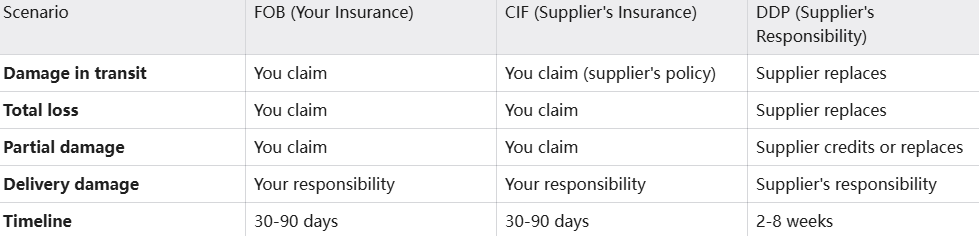
A: It depends on the Incoterm and when the damage occurred.
FOB: You Handle Insurance Claim
Scenario: Container damaged during ocean transit
Responsibility: You (buyer) bear the risk
Process:
Document damage immediately (photos, inspection report)
File claim with your marine insurance provider
Provide supporting documentation (bill of lading, commercial invoice, packing list)
Insurance company investigates and pays claim
Timeline: 30-90 days for claim settlement
Supplier's Role: None (risk transferred when goods loaded on ship)
CIF: You Handle Claim with Supplier's Insurance
Scenario: Container damaged during ocean transit
Responsibility: You (buyer) bear the risk, but supplier arranged insurance
Process:
Document damage immediately
Contact supplier to initiate insurance claim
Supplier coordinates with their insurance provider
You provide supporting documentation
Insurance pays claim to you (you're the beneficiary)
Timeline: 30-90 days
Complication: Supplier's insurance may have limited coverage (110% of CIF value, basic coverage). If damage exceeds coverage, you bear the loss.
DDP: Supplier Handles Everything
Scenario: Container damaged during transit or delivery
Responsibility: Supplier bears all risk until delivery to your warehouse
Process:
Document damage and notify supplier immediately
Supplier arranges replacement shipment or repair
Supplier handles insurance claim
You receive replacement goods
Timeline: Depends on supplier's responsiveness (2-8 weeks)
Your Role: Document damage and communicate with supplier
Best Practices:
For FOB/CIF:
Inspect goods immediately upon arrival
Document any damage with photos and detailed notes
File insurance claim within 24-48 hours
Keep all original documentation (bill of lading, packing list, commercial invoice)
Consider hiring surveyor for major damage ($300-500)
For DDP:
Inspect goods upon delivery
Refuse delivery if damage is obvious (document and notify supplier)
If damage discovered after delivery, notify supplier within 24 hours
Supplier arranges replacement or credit
Insurance Coverage Comparison:
S
Q4: How do I verify my supplier's CIF freight cost is reasonable?
A: Get independent freight quotes and compare to supplier's CIF pricing.
Verification Process:
Step 1: Request CIF Breakdown from Supplier
Email template:
"Thank you for the CIF quote of $2.65 per unit. To help us evaluate this offer, could you provide a breakdown of: - FOB product cost - Ocean freight cost - Insurance cost - Your coordination fee This transparency will help us make an informed decision."
What to expect:
Transparent suppliers will provide breakdown
Some suppliers may decline (consider this a red flag)
Typical breakdown: FOB $2.20 + Freight $0.25 + Insurance $0.02 + Margin $0.18 = CIF $2.65
Step 2: Get Independent Freight Quotes
Contact 2-3 freight forwarders:
Provide: Origin port (Ningbo), destination port (Los Angeles), cargo details (oil filters, 10,000 units, ~8 CBM)
Request: Ocean freight quote (all-in, including origin charges)
Typical quotes (2026):
Freight forwarder A: $2,400 per 20ft container
Freight forwarder B: $2,600 per 20ft container
Freight forwarder C: $2,200 per 20ft container
Calculate per-unit freight:
12,000 units fit in 20ft container
For 10,000 units: $2,400 ÷ 10,000 = $0.24 per unit
Step 3: Compare and Evaluate
Supplier's CIF breakdown:
FOB: $2.20
Freight: $0.28 per unit
Insurance: $0.02
Margin: $0.15
Total CIF: $2.65
Your independent research:
FOB: $2.20
Freight (independent quote): $0.24 per unit
Insurance (independent quote): $0.01
Expected CIF: $2.45
Supplier's markup: $0.20 per unit ($0.04 freight markup + $0.01 insurance markup + $0.15 coordination fee)
Evaluation:
Reasonable: $0.10-0.20 per unit markup (4-8% of FOB price)
High: $0.20-0.30 per unit markup (8-12% of FOB price)
Excessive: >$0.30 per unit markup (>12% of FOB price)
In this example: $0.20 markup is at the high end of reasonable. You could:
Accept it: Convenience of CIF may be worth $0.20 per unit
Negotiate: "Independent quotes show freight at $0.24. Can you adjust CIF to $2.55?"
Choose FOB: Save $0.20 per unit by arranging freight yourself
Step 4: Consider Total Value
CIF at $2.65 vs FOB at $2.20:
CIF additional cost: $0.45 per unit
Your time saved: 10-15 hours per shipment
Your hourly value: $50-100/hour
Time value: $500-1,500 per shipment
For 10,000 units: $4,500 CIF premium vs $500-1,500 time value
Conclusion: If supplier's markup is reasonable ($0.10-0.20), CIF may be worth it for the convenience. If markup is excessive (>$0.30), negotiate or choose FOB.
Q5: Can I use DDP but be the importer of record for customs?
A: Yes, this is called "DDP Excluding Duties" or "DDP with Buyer as Importer of Record." It's a hybrid approach.
Standard DDP:
Supplier is importer of record
Supplier pays all duties and taxes
Supplier handles customs compliance
You receive goods at your warehouse
Modified DDP (Buyer as Importer of Record):
You are importer of record (your company name on customs documents)
You pay duties and taxes directly to customs
Supplier handles all logistics (freight, customs broker coordination, delivery)
You receive goods at your warehouse
Why Use This Hybrid Approach?
Advantages:
Compliance Control: You ensure accurate customs valuation (no undervaluation risk)
Duty Savings: You pay duties directly (no supplier markup)
Customs Record: You build your own import history (useful for future shipments)
Logistics Convenience: Supplier still handles all logistics coordination
Disadvantages:
Payment Complexity: You pay supplier for product + logistics, plus pay customs separately for duties
Customs Broker Needed: You need your own customs broker relationship
Documentation: You must provide customs broker with commercial invoice and other docs
How to Arrange:
Step 1: Discuss with Supplier
"We'd like to use DDP terms for logistics convenience, but we prefer to be the importer of record for customs compliance. Can you accommodate this?"
Step 2: Agree on Pricing
Supplier quotes DDP price minus duties/taxes
Example: Standard DDP $3.35 - Duties $0.055 - Tax markup $0.10 = Modified DDP $3.195
You save $0.155 per unit by paying duties directly
Step 3: Coordinate Customs Clearance
Supplier's freight forwarder contacts your customs broker
Your customs broker handles customs entry using your company as importer of record
You pay duties directly to customs (via customs broker)
Supplier's logistics partner delivers to your warehouse
Example:
Standard DDP:
Pay supplier: $3.35 per unit × 10,000 = $33,500 (all-inclusive)
Modified DDP:
Pay supplier: $3.195 per unit × 10,000 = $31,950 (product + logistics, no duties)
Pay customs: $550 (2.5% duty on $22,000 FOB value)
Total: $32,500 (save $1,000)
Best For:
Buyers who want logistics convenience but need customs compliance control
Buyers with established customs broker relationship
Buyers concerned about supplier's customs practices
Buyers who want to build import history
Makexcar's Approach:
We support this hybrid model and recommend it for customers who:
Have customs broker relationship
Want to ensure accurate customs valuation
Prefer to be importer of record for compliance reasons
Still want us to handle all logistics coordination
Q6: What if freight rates increase between quote and shipment?
A: It depends on the Incoterm and what was agreed in the contract.
FOB: You Bear Freight Rate Risk
Scenario: Supplier quotes FOB $2.20. You get freight quote of $2,400 per container. Two months later, when ready to ship, freight rates have increased to $3,500 per container.
Responsibility: You pay the higher freight rate
Cost impact: +$1,100 per container (+$0.09 per unit for 12,000 units)
How to Protect Yourself:
Book freight immediately: Once supplier confirms production, book freight with forwarder
Get rate validity period: Request 60-90 day rate lock from freight forwarder
Consider CIF: Transfer freight rate risk to supplier
CIF: Depends on Contract Terms
Scenario: Supplier quotes CIF $2.65. Freight rates increase 40% between quote and shipment.
Key Question: Is the CIF price locked or subject to adjustment?
Option A: Fixed CIF Price (Recommended)
Contract states: "CIF price of $2.65 per unit is fixed regardless of freight rate changes"
Supplier bears freight rate risk
Your cost remains $2.65 per unit
This is the standard and recommended approach
Option B: Adjustable CIF Price (Risky)
Contract states: "CIF price subject to adjustment based on actual freight costs"
Supplier can request price increase if freight rates rise
Your cost could increase to $2.85+ per unit
Avoid this unless you have no choice
How to Protect Yourself:
Specify in contract: "CIF price is fixed and not subject to freight rate adjustments"
Get validity period: "CIF quote valid for 90 days from date of quote"
Confirm in writing: Before production starts, reconfirm CIF price is locked
DDP: Supplier Bears All Risk
Scenario: Supplier quotes DDP $3.35. Freight rates increase 40% between quote and shipment.
Responsibility: Supplier bears the cost increase
Your cost: Remains $3.35 per unit (assuming contract specifies fixed price)
Supplier's Options:
Absorb the cost: Supplier's margin decreases
Request price adjustment: Supplier asks you to pay more (you can refuse if contract says fixed price)
Delay shipment: Supplier waits for freight rates to decrease (rare)
How to Protect Yourself:
Fixed DDP price in contract: "DDP price of $3.35 per unit is fixed for this order"
Validity period: "Quote valid for 90 days"
No adjustment clause: "Price not subject to adjustment for freight, fuel, or currency changes"
Best Practices:
For All Incoterms:
Get quotes in writing with validity period (60-90 days)
Specify fixed pricing in purchase order or contract
Confirm before production that price is still valid
Book freight early (for FOB) to lock in rates
Consider peak season (August-October) when freight rates are highest
Peak Season Planning:
Freight rates increase 30-60% during peak season (August-October)
If possible, ship before August or after October
If must ship during peak season, lock in CIF or DDP pricing early
Real Example:
A distributor got FOB quote in May ($2.20) and freight quote ($2,400 per container). Delayed order until August. Freight rates increased to $4,200 per container (+75%). Total landed cost increased from $2.70 to $2.95 per unit—a $2,500 surprise on a 10,000-unit order.
Lesson: Lock in pricing early, especially if shipping during peak season.
Q7: How long does each shipping method take?
A: FOB, CIF, and DDP have similar ocean transit times, but differ in total door-to-door timeline.
Ocean Transit Time (Same for All):
China to US West Coast: 14-18 days
China to US East Coast: 25-30 days
China to Europe: 28-35 days
China to Middle East: 18-22 days
Total Door-to-Door Timeline:
FOB: 35-50 Days Total
Production: 20-30 days
Delivery to port: 1-2 days
Port processing: 2-3 days
Ocean transit: 14-18 days (US West Coast)
Destination port clearance: 3-5 days (you arrange)
Customs clearance: 2-4 days (you arrange)
Inland transport: 1-3 days (you arrange)
Total: 43-65 days (production to delivery)
Potential Delays:
Freight forwarder coordination: +2-5 days
Customs broker delays: +3-7 days
Documentation issues: +5-10 days
Container availability: +3-7 days
CIF: 35-45 Days Total
Production: 20-30 days
Delivery to port: 1-2 days
Port processing: 2-3 days
Ocean transit: 14-18 days (supplier arranged)
Destination port clearance: 2-3 days (supplier paid)
Customs clearance: 2-4 days (you arrange)
Inland transport: 1-3 days (you arrange)
Total: 42-63 days
Faster than FOB because:
Supplier handles freight booking (no coordination delay)
Destination port charges pre-paid (faster release)
DDP: 35-45 Days Total
Production: 20-30 days
Delivery to port: 1-2 days
Port processing: 2-3 days
Ocean transit: 14-18 days
Destination port clearance: 2-3 days (supplier arranged)
Customs clearance: 1-2 days (supplier arranged)
Inland transport: 1-3 days (supplier arranged)
Total: 41-61 days
Fastest option because:
Supplier coordinates all logistics (no handoff delays)
Supplier's customs broker is ready (no setup time)
Pre-arranged delivery (no scheduling delays)
Comparison Summary:
Key Insight: DDP is typically 3-5 days faster than FOB because supplier manages all coordination. For time-sensitive orders, DDP's speed advantage may justify the higher cost.
Expedited Options:
Air Freight (All Terms):
Transit time: 5-7 days (door-to-door: 10-15 days)
Cost: 5-8x higher than ocean freight
Best for: Urgent orders, high-value products, small quantities
Express Ocean (Premium Service):
Transit time: 10-12 days (China to US West Coast)
Cost: 30-50% higher than standard ocean
Best for: Time-sensitive orders, willing to pay premium
Q8: Can I mix FOB and DDP in the same order?
A: No, each shipment must use one Incoterm. However, you can split orders across multiple shipments with different terms.
Why You Can't Mix:
Incoterms define responsibility for the entire shipment
Customs clearance is done at shipment level, not SKU level
Freight is booked for the entire container, not individual products
Insurance covers the whole shipment, not specific items
What You CAN Do:
Option 1: Split Order into Multiple Shipments
Example:
Shipment 1: 5,000 units of SKU A + SKU B (FOB) - you arrange freight
Shipment 2: 5,000 units of SKU C + SKU D (DDP) - supplier arranges everything
Use Case:
Test DDP service with part of order
Urgent SKUs via DDP, non-urgent via FOB
Different delivery locations (FOB to your warehouse, DDP to Amazon FBA)
Option 2: Use Different Terms for Different Orders
Example:
Order 1 (March): 10,000 units FOB (you have freight forwarder ready)
Order 2 (June): 10,000 units DDP (you're busy, want supplier to handle logistics)
Use Case:
Seasonal flexibility (DDP during busy season, FOB during slow season)
Learning progression (start DDP, transition to FOB)
Option 3: Negotiate Hybrid Terms
Example: "FOB with Freight Assistance"
Supplier quotes FOB price
Supplier introduces you to their freight forwarder
You book and pay freight directly with forwarder
Supplier coordinates loading and documentation
Benefit: FOB pricing with some logistical support
Example: "DDP with Buyer as Importer of Record"
Supplier handles all logistics
You are importer of record for customs
You pay duties directly
Supplier delivers to your warehouse
Benefit: DDP convenience with customs compliance control
Makexcar's Flexibility:
We support all these approaches:
Split orders across multiple shipments with different terms
Mix terms across different orders
Customize hybrid arrangements
Transition between terms as your needs evolve
Real Example:
A distributor orders quarterly:
Q1: 15,000 units DDP (busy season, no time for logistics)
Q2: 15,000 units CIF (moderate season, handle destination logistics)
Q3: 20,000 units FOB (slow season, maximize cost savings)
Q4: 15,000 units DDP (holiday rush, need speed and simplicity)
This flexibility allows them to optimize cost and convenience based on seasonal demands.
Conclusion: Making the Right Incoterms Decision
Choosing between FOB, CIF, and DDP isn't just about comparing prices—it's about understanding your total landed cost, operational capabilities, risk tolerance, and business priorities.
Key Takeaways:
FOB offers lowest cost but highest complexity: Best for experienced importers with established logistics networks. Savings of 15-25% justify the 10-20 hours of coordination per shipment.
CIF provides middle ground: Supplier handles ocean freight, you handle destination. Good balance of cost savings (vs DDP) and reduced complexity (vs FOB). Ideal for growing importers.
DDP maximizes simplicity and speed: Highest cost but zero hassle. Perfect for new importers, time-sensitive orders, or when you want to focus on sales rather than logistics.
Hidden costs matter: FOB $2.20 can become $2.85+ with unexpected fees. Always calculate total landed cost, not just quoted price.
Progression is normal: Start with DDP, transition to CIF, eventually move to FOB as you gain experience and volume. This is the natural evolution for most successful importers.
Transparency is critical: Work with suppliers who provide detailed cost breakdowns and honest pricing. Avoid suppliers who hide logistics margins or undervalue goods for customs.
Flexibility is valuable: Choose suppliers who offer all three terms and support your transition between them as your business grows.
Your Action Plan:
If You're a New Importer:
Start with DDP for your first 1-2 orders
Focus on product quality and market validation
Observe the import process and learn
Transition to CIF once you have customs broker relationship
If You Have Some Experience:
Use CIF for most orders (balance of cost and convenience)
Build relationships with customs broker and freight forwarder
Evaluate FOB for large orders (>$50,000)
Keep DDP as option for urgent or complex shipments
If You're an Experienced Importer:
Use FOB for maximum cost savings
Leverage your logistics network for competitive advantage
Negotiate annual freight contracts
Consider DDP only for special circumstances (urgent orders, new markets)
Ready to Import Oil Filters from China?
Contact Makexcar for Transparent Multi-Term Quotes:
📧 Email: sale1@makexcar.com
📱 WhatsApp: +86 199 1234 680
📞 Phone: +86 199 1234 680
🌐 Website: www.makexcar.com
What We Offer:
✓ All Three Incoterms Available: FOB, CIF, and DDP with transparent pricing
✓ Detailed Cost Breakdowns: See exactly what you're paying for
✓ Flexible Transitions: Start with DDP, move to FOB as you grow
✓ Logistics Support: Introduce you to trusted freight forwarders and customs brokers
✓ Compliance Guarantee: Accurate customs valuation, correct HTS classification
✓ 15+ Years Export Experience: We've shipped to 50+ countries
✓ ISO 9001 & IATF 16949 Certified: Quality you can trust
Request Your Multi-Term Quote Today:
Provide us with:
Target SKUs (OE numbers or vehicle applications)
Order quantity per SKU
Preferred Incoterm (or request all three for comparison)
Destination (city and state/country)
Delivery timeline
Receive within 24 hours:
FOB, CIF, and DDP pricing (if requested)
Detailed cost breakdown for each term
Lead time estimate
Payment terms
Shipping timeline
Related Resources:
Low MOQ Oil Filter Sourcing Guide - Start with 500-unit orders
Factory Direct Wholesale Pricing Guide - Understand bulk discounts
ISO & IATF Certification Verification Guide - Ensure supplier quality
China Oil Filter Manufacturer Sourcing Guide - Complete B2B sourcing guide
About Makexcar:
Wenzhou Makexcar Auto Parts Co., Ltd. is a leading Chinese manufacturer of automotive filters with 15+ years of export experience. We specialize in oil filters, fuel filters, air filters, and cabin filters for passenger cars, light trucks, and heavy-duty vehicles.
Our Certifications:
ISO 9001:2015 (TÜV Rheinland)
IATF 16949:2016 (TÜV Rheinland)
All certificates verifiable online
Our Advantages:
500+ SKUs covering 95% of popular vehicle models
True 500-unit MOQ (no hidden requirements)
Flexible Incoterms (FOB, CIF, DDP)
Private label support
Fast lead times (25-35 days)
Transparent pricing (no hidden fees)
Factory Location:
Wenzhou, Zhejiang Province, China
50km from Ningbo Port (major export hub)
Start Your Import Journey with Confidence.
Understanding Incoterms is the foundation of successful international trade. Whether you choose FOB, CIF, or DDP, the key is working with a transparent, experienced supplier who supports your growth and provides honest guidance.
At Makexcar, we're not just selling oil filters—we're partnering with you to build a successful distribution business. From your first 500-unit test order to your 50,000-unit bulk shipments, we're here to support you every step of the way.
Contact us today to get started. 🚀




Whatsapp: +86 19941234680
Phone:+86 19941234680
© 2025. All rights reserved.
Email:sales1@makexcar.com
Wechat:Sgxwtxa