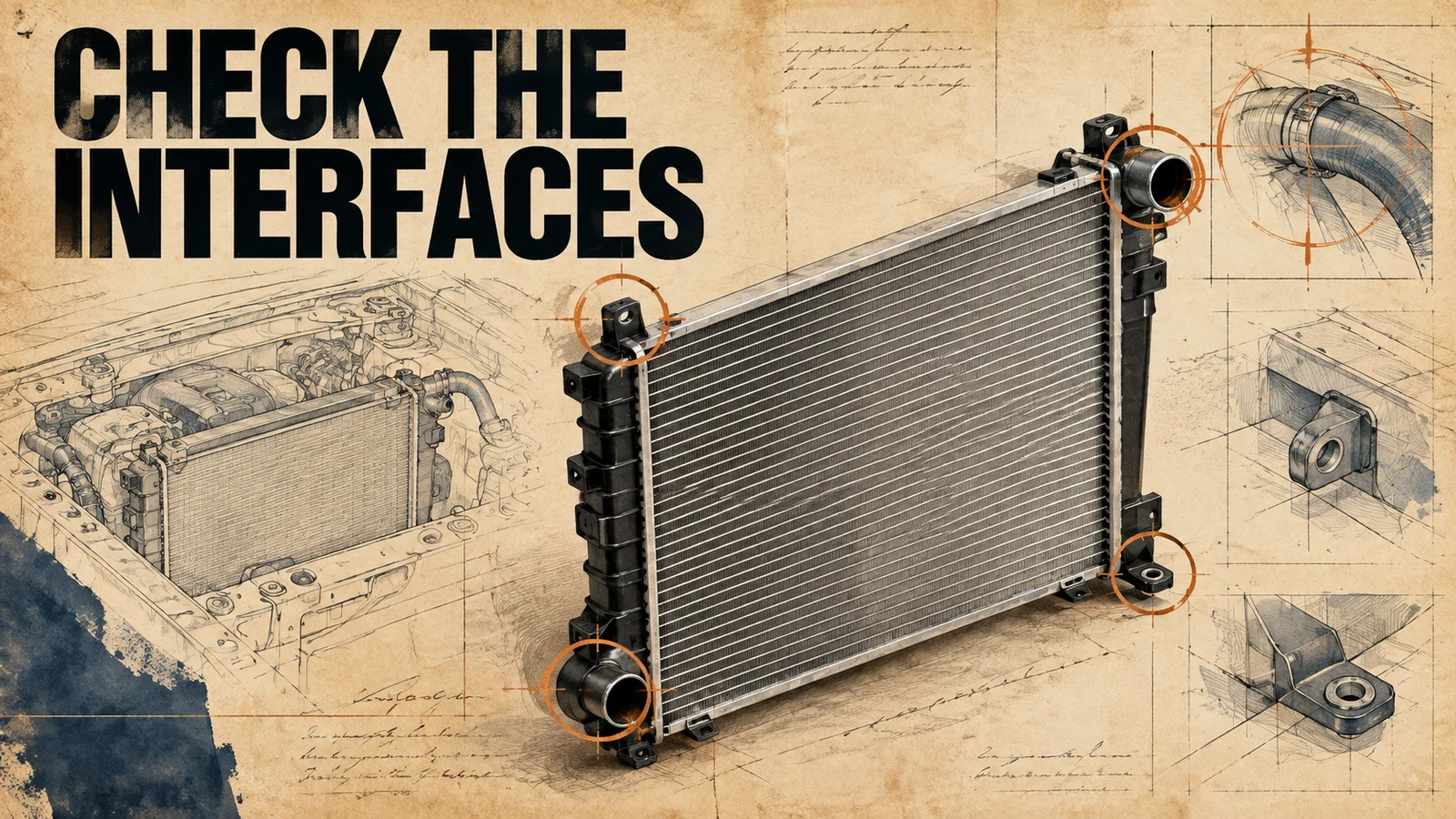
This guide focuses on radiator mounts, hose necks and ports. It is not a universal dimension table and does not assign any MAKEXCAR SKU to a vehicle without part-specific evidence. The purpose is to make a supplier conversation precise enough to prevent a plausible-looking but unworkable substitution.
Why a radiator fit check needs more than core dimensions
The radiator core is only one part of the cooling module. MAHLE's technical information describes the radiator as a core plus water tanks, connections and fastening elements. Those surrounding details determine how the unit sits in the vehicle and joins the coolant circuit. The same apparent core envelope can be packaged with different side tanks, outlets or attachment points for different engine and transmission versions.
Start the inquiry with vehicle make, model, market, production date, engine designation, transmission configuration and OE radiator reference. Include a VIN only through an approved private quoting channel if it is needed to resolve a catalog ambiguity. The application listing should refer to the exact engine and build period, not merely a vehicle family. If the OE reference has changed, ask the supplier for the documented supersession chain.
Gather photographs of the old unit from the front, rear, top and both tank ends, but treat them as supporting evidence. A photograph may not reveal a hidden fan-shroud clip or the direction of a lower hose neck. The manufacturer's drawing or catalog record for the offered part should remain the controlling description. Core dimensions can then be checked in the separate dimensional review without letting them stand in for interface fit.
Map the mounting points before comparing parts
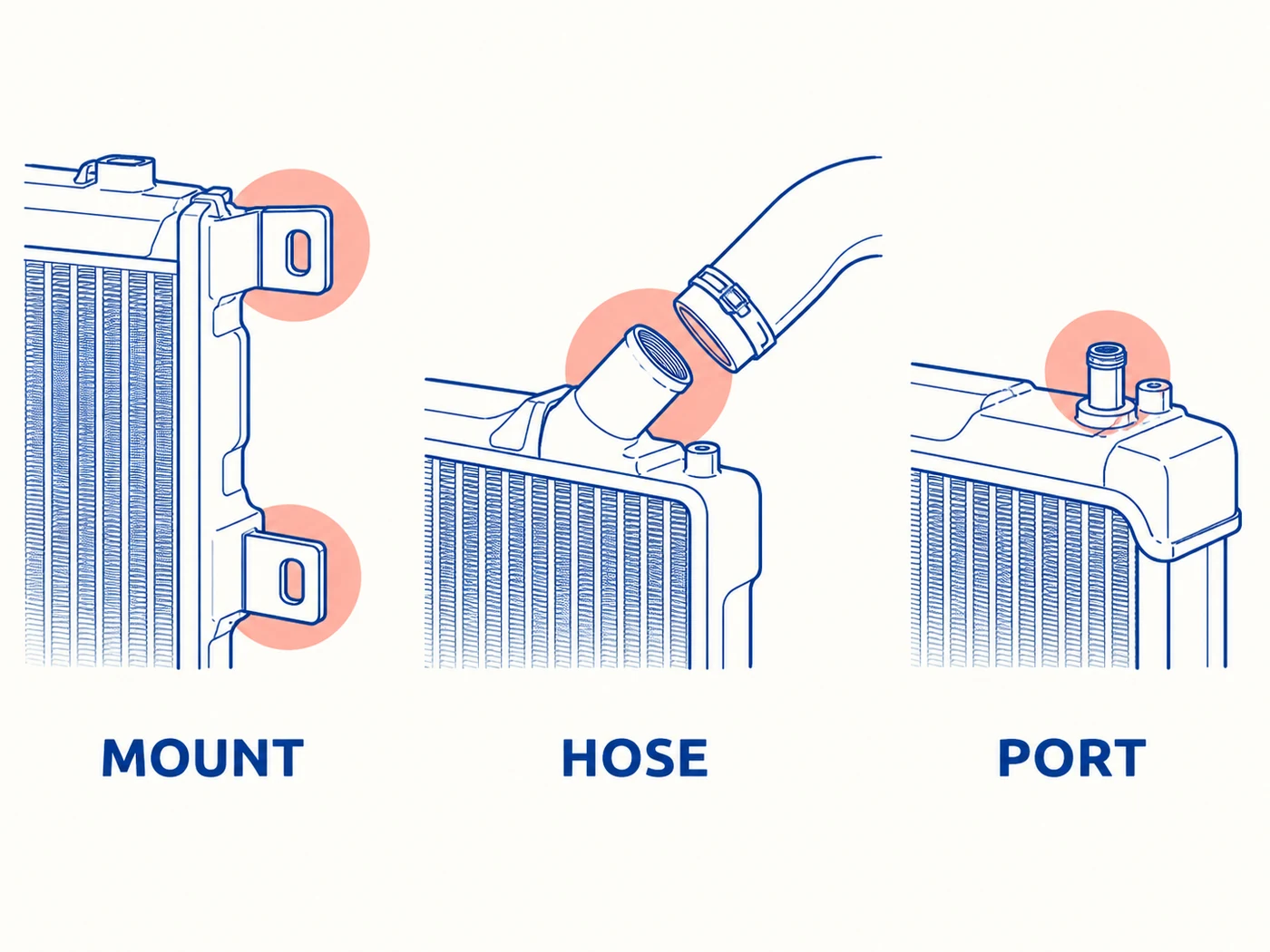
Locate the lower locating pins or feet, upper retainers, side brackets and any isolated rubber mounts. Note which items are moulded into the radiator, which are supplied separately, and which are transferred from the removed assembly. The position and orientation of these features matter: a bracket that appears similar in a frontal image may not meet the vehicle carrier at the same plane.
Check how the radiator attaches to neighboring hardware. Depending on the vehicle, the fan assembly, condenser, air guides or support frame may clip, bolt or slide onto radiator features. Nissens publishes separate mounting instructions for some radiator frame arrangements, illustrating why a pre-mounted frame or attachment scheme deserves its own check. Do not assume that a bare core and a framed module are delivered with the same included parts.
Ask for a rear view or dimensioned mounting drawing when the listing shows only a front image. Identify the center-to-center relationship of attachment features using the manufacturer's stated datum; do not invent a tolerance from a photograph. If a bracket is present on one part and absent on the other, resolve whether the bracket is transferable and whether the replacement is approved for that configuration. An improvised modification at installation is not a purchasing approval.
What to ask when a mount seems missing
Ask the supplier whether the missing feature is a separate accessory, a removable frame part or evidence of a wrong part number. Request the accessory's own reference and an assembly view. Record whether grommets, clips and fasteners are included, reused or ordered separately. A clear bill of supplied components is more useful than a promise that the mechanic can “make it fit.”
Check hose neck location, direction and connection style
Identify the coolant inlet and outlet on the original radiator, then compare the offered unit's tank side, vertical position, neck angle and connection form. A hose may be flexible yet still have a molded route and limited clearance around the fan, belt drive or body structure. Gates describes molded coolant hoses as parts formed for upper, lower and other specific coolant paths; their existence is a reminder that hose routing is an application feature, not an invitation to stretch a hose toward any nearby neck.
Record whether each connection accepts a clamped hose, quick connector or other application-specific fitting. Check the neck's sealing surface and any retaining groove or clip arrangement from the exact drawing. If a port is capped for shipping, determine whether it is a transport cap, a functional blank or a connection to be opened for the target vehicle. Do not remove a cap based solely on how a similar radiator is arranged in another model.
Request photographs from both tank ends and a top view, since a conventional front view can hide the neck's angle. Ask the supplier to identify the inlet and outlet according to the product documentation. A generic “upper” or “lower” label can be ambiguous when radiators use different flow layouts. MAHLE distinguishes downdraft and crossflow radiator designs, including crossflow arrangements with both connections on one side. The route must therefore be checked on the actual part.
Identify every sensor and auxiliary connection
List each threaded boss, sensor socket, vent line, expansion-tank connection, drain, integrated cooler fitting and unused blank. Some are easy to miss because they face the engine compartment rather than the camera. The relevant question is not simply whether a hole is visible: determine its purpose, whether the vehicle uses it, and how the manufacturer expects it to be sealed when unused.
MAHLE's technical note on unused radiator connections explains that some radiators serve manual and automatic transmission configurations. A unit with an integrated transmission-oil cooler may have extra connections that are not used in a manual-transmission installation. MAHLE also cautions that an open oil-cooler connection in that example does not necessarily mean coolant can escape. That fact is specific to the described design. It is not permission to leave any unknown port open on a different radiator.
Nissens gives an application-specific example of an additional connection on certain MAN radiators: one emissions configuration uses the hose while other listed configurations require the supplied plug. That bulletin demonstrates the importance of part-number and vehicle-specific instructions. Do not transfer its plugging requirement to a passenger-car radiator or an unidentified MAKEXCAR unit. For each candidate, obtain the supplier's exact drawing and installation note.
Do not label every electrical-looking boss a sensor port
A molded recess, threaded insert or auxiliary cooler fitting can resemble a sensor opening in a photograph. Ask for the component description and mating-part reference. If the offered radiator includes a sensor, switch or seal, list it in the supplied-parts record. If it does not, establish whether the old component may be transferred and whether a new seal is required. Avoid a fitment claim until the connection and sealing method are clear.
Make a side-by-side interface record
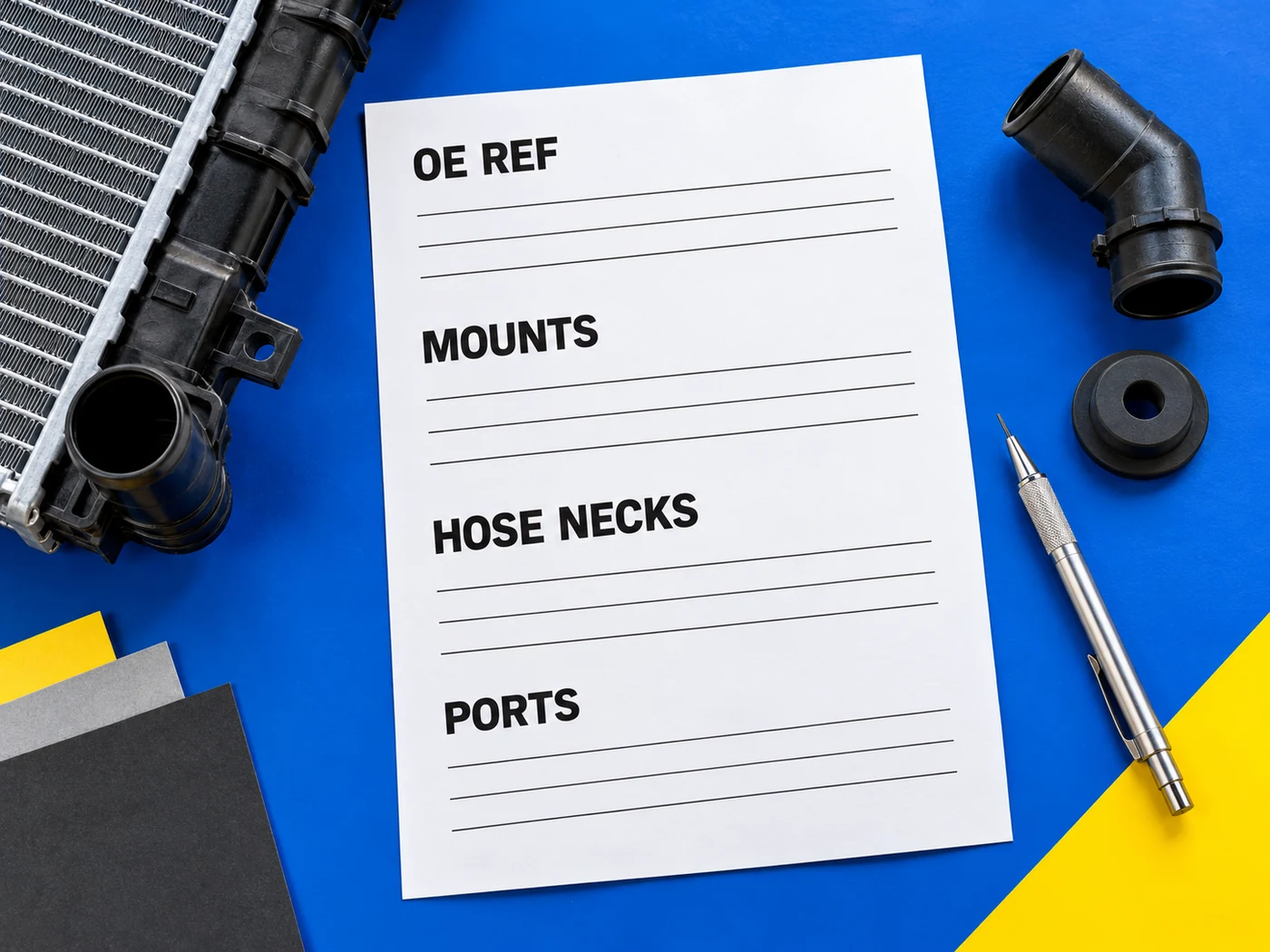
Use a comparison sheet with columns for the OE assembly, the offered unit and the evidence source. “Looks similar” should never be the evidence entry. Cite the exact catalog page, drawing number or written supplier response and its revision. The table below lists the questions that usually expose a false fit. Its cells are prompts, not specifications for an actual MAKEXCAR radiator.
| Interface | Record from the OE assembly | Confirm for the offered radiator |
|---|---|---|
| Application | Engine, transmission, build period and OE reference | Exact current catalog application or approved supersession |
| Lower and upper mounts | Pin, foot, bracket and isolator arrangement | Drawing, included hardware and transfer instructions |
| Fan and condenser attachment | Clips, tabs, bosses and frame details | Compatible attachment layout and supplied components |
| Coolant connections | Inlet/outlet position, neck direction and connection type | Tank-end views and product drawing |
| Additional ports | Sensor, vent, drain, cooler or unused blank | Function and manufacturer-specific sealing instruction |
| Document control | OE drawing or service reference | Offered part number, drawing revision and approval owner |
Check every “not applicable” entry. A transmission-cooler port that the vehicle does not use still needs an understood delivered state. A sensor position that appears unused on a generic catalog image may matter on the exact engine variant. Attach annotated photographs only after the formal source has defined the feature; the annotation then helps the installer identify it.
Separate ordering fit from installation checks
A correct-looking replacement can be damaged by an unsuitable installation procedure, but installation advice must come from the vehicle and part makers. Before work begins, confirm the manufacturer-specific instructions for any transferred mounts, new seals, hoses, clamps and coolant filling. MAHLE advises replacing seals on opened quick locks and flanges and thoroughly bleeding the cooling circuit after component replacement. Those are general cautions; the exact vehicle procedure controls the job.
Do not use a leak complaint to retroactively prove the unit was the wrong part. A leak can arise at a connection, a transferred fitting, a damaged tank or elsewhere in the circuit. Keep the fitment evidence separate from a pressure-test or leak-test report. That separation makes it possible to investigate a claim without assuming the cause from a photograph of coolant on the floor.
At receiving, compare the carton label, full part number and supplied assembly against the approved record. Inspect the tank and fins for transit damage and check that protective caps and loose hardware match the supplier's packing list. If a revised part arrives, ask for its supersession documentation before it replaces the approved reference in inventory. The receiving team should not have to infer interchange from a similar core shape.
Frequently asked buyer questions
Can two radiators with the same core size be interchanged?
Core size alone does not establish interchange. Mounts, tank layout, hose connections, fan and condenser attachments, auxiliary ports and the exact application listing must also agree. Request the full offered part number and its drawing rather than approving from a size line in a marketplace listing.
Does an extra connection always mean the radiator is wrong?
No. MAHLE and Nissens document specific radiators that cover multiple configurations and use extra connections differently. The correct treatment depends on the exact radiator and vehicle. Obtain the maker's instruction for that part number and do not plug, open or ignore the connection by analogy.
What if the old radiator number is unavailable?
Collect the VIN or detailed vehicle identification through an appropriate private channel, engine and transmission data, production period, clear photos of all interfaces and the removed unit's markings. Ask the supplier for the current catalog match and any supersession statement. An undocumented visual match should remain a candidate, not an approved purchase.
Send a radiator inquiry that can be answered precisely
For a MAKEXCAR quote, provide the vehicle market, build period, engine, transmission, OE reference if available, quantity and destination. Add front, rear and tank-end photos plus a list of mounts, hose connections and ports that must match. Request the full part number, current application entry, interface drawing, included hardware and instructions for unused connections. Browse the published Radiators category for the product family, then contact MAKEXCAR with the evidence sheet. A supplier can assess a documented interface set; a core measurement or one front photo is only a starting clue.