
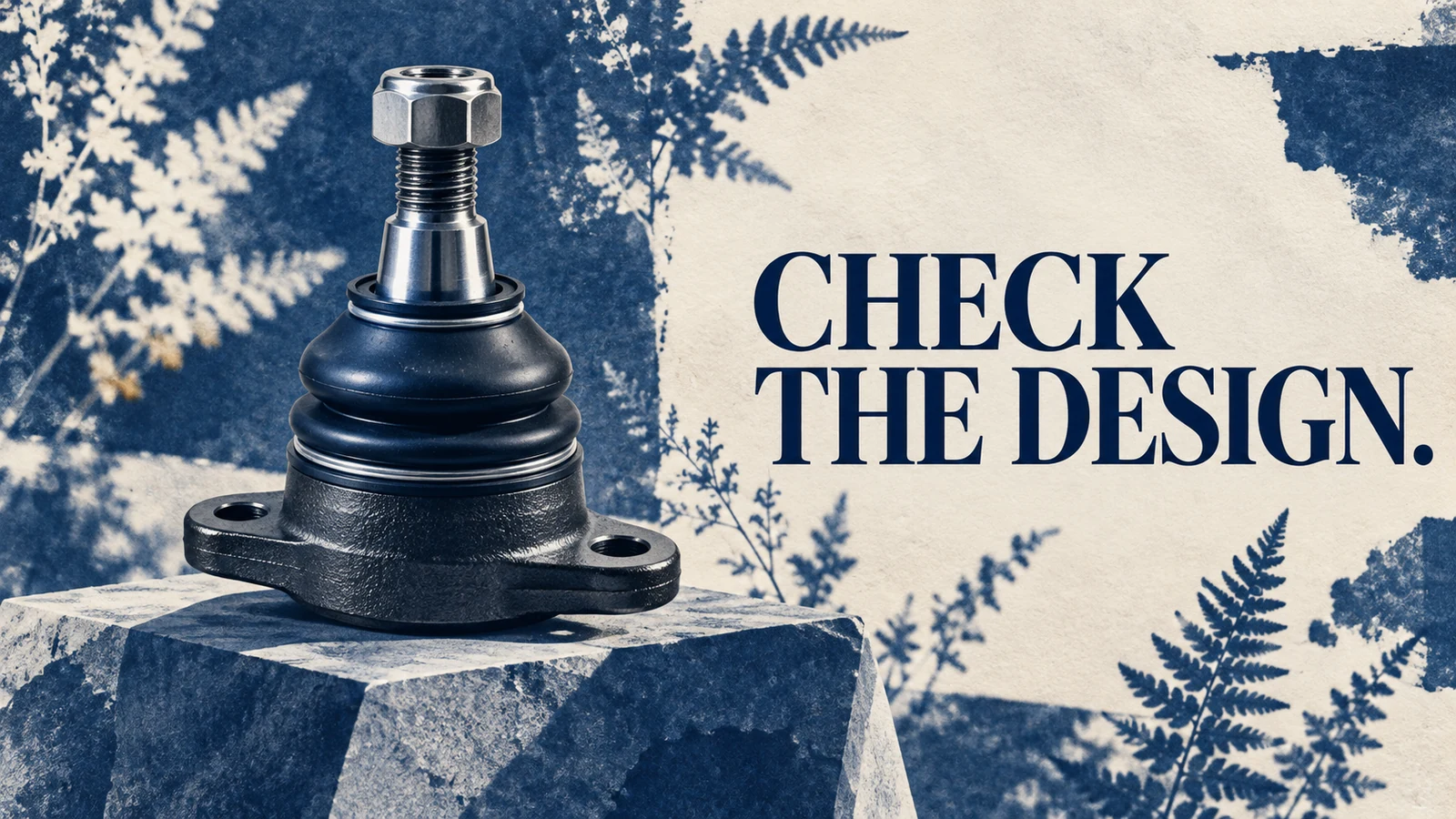
Separate boot sealing from lubrication serviceability
The word sealed can describe the dust boot or the joint's maintenance design. Those meanings should not be merged in a purchasing record. A boot intended to exclude contamination can exist on a product described as greasable; conversely, a generic product photograph cannot establish a lubrication provision.
MOOG's ball-joint overview describes greasable designs and sealed boot features within its own range. This is useful evidence that the two terms are not automatically opposites. It does not establish either feature for a MAKEXCAR reference.
Ask the supplier what sealed means in the selected description. Is it referring to a boot feature, a non-serviceable lubrication design, or only a marketing phrase? Preserve the original wording, then add the clarified field that your catalog needs.
If the answer remains broad, keep the field unresolved. A buyer should not translate “sealed boot” into “maintenance-free ball joint” without source support. That translation changes the customer-facing claim rather than simply improving the English.
Identify the selected lubrication provision
MOOG's lubrication guidance uses a grease fitting to identify its greasable components. It also provides instructions specific to its products. Use that manufacturer example to frame a supplier question, not to assign a design or maintenance schedule to another brand.
For the quoted reference, request the product description and a labelled view of the documented lubrication feature. Ask whether the fitting is attached, supplied separately, or absent by design. A photograph without a visible fitting may be incomplete or may depict a different reference.
Keep fitting presence separate from fitting inclusion. A design that accepts a supplied fitting is a different quotation statement from a unit that arrives with it already fitted. The supplier should identify both the construction provision and the actual supply condition.
Do not assign a grease type, amount, interval or procedure from an unrelated manufacturer page. Request the instruction sheet for the selected product and application. Your sourcing file can record whether such instructions are available without rewriting them as generic advice.
Match the design statement to an exact reference
Record the customer OE reference, supplier SKU, vehicle market, model, production interval and required position. Add engine or chassis information where the selected catalog needs it. Lubrication serviceability is an additional design field, not a substitute for the application record.
Keep upper or lower, left or right, and any selected equipment notes as distinct fields. A ball-joint family picture should not be assigned to every reference in the range. Request a reference-specific catalog entry or drawing when the photographed design and written description disagree.
Cross-references can help locate candidate products, but they do not alone prove that every feature or supplied accessory matches. Ask the supplier to identify the proposed reference and explain its relevant design differences against the customer request.
Retain source dates and revisions. If a later catalog changes a greasable flag or picture, review the affected reference before copying the new label into all stock descriptions. A data update may require clarification even when the commercial SKU remains familiar.
Where a source uses maintenance-free wording, ask the supplier to define its scope rather than expand it. The phrase may refer to lubrication service, while other application or inspection requirements remain governed by the selected documentation. Keep that distinction visible in customer-facing text and avoid promising an unrestricted maintenance exemption.
A source-labelled drawing is especially useful when the fitting location or supply condition differs between two candidate references. Request the version corresponding to the quoted SKU. A range illustration can introduce the question, but the final response should identify the item the buyer will actually order.
Use a buyer checklist for sealed and greasable offers
The following record keeps the design and commercial questions together. It is an inquiry tool; none of the fields establishes an actual specification or universal servicing requirement.
| Field | Evidence to obtain |
|---|---|
| Exact identity | Customer reference, supplier SKU and source revision |
| Application | Vehicle configuration and selected position notes |
| Meaning of sealed | Boot description or non-serviceable design statement |
| Lubrication provision | Reference-specific fitting arrangement and description |
| Supply condition | Attached fitting, separate accessory or documented absence |
| Instructions | Selected product instruction sheet and applicable revision |
| Marketing claims | Exact source for serviceability or maintenance wording |
| Open question | Unresolved difference and requested clarification |
Store the supplier reply next to the question it answers. A close-up may resolve where a fitting is located while leaving inclusion or instruction availability unanswered. Mark the specific issue resolved rather than approving the whole inquiry at once.
Keep unknown separate from no. If the supplier has not answered whether a fitting is included, the correct record is unresolved, not excluded. This distinction helps prevent a missing reply from becoming an inaccurate packing or sales statement.
Do not rank serviceability as a universal quality grade
A greasable label describes a design feature. It does not by itself prove greater durability, better fitment or a longer service life than a sealed non-serviceable alternative. Those claims need the selected product's relevant evidence and a defined comparison.
Likewise, non-serviceable should not be expanded into unlimited life or freedom from all inspection requirements. Keep the maintenance description within the source's scope. Avoid turning a convenient catalog phrase into a warranty promise.
If a customer asks which design is better, identify the actual application and requirement first. A distributor can compare documented features and available instructions without claiming a universal winner. Explain which information remains necessary to assess the selected alternatives.
Where a supplier offers test data, retain the product identity, conditions, endpoints and report version. Do not compare unexplained cycle counts or a generic durability brochure as if they measure the two quoted references under matching conditions.

Resolve a contradictory catalog description
Consider an illustrative offer with the phrases “sealed joint” and “greasable” in different fields. A buyer might assume one must be an error. Start instead by asking what each term describes for the exact SKU.
The supplier may explain that sealed refers to the boot and greasable refers to the lubrication provision. If that explanation is supported by the selected documentation, record the two meanings separately. If the fields refer to conflicting reference versions, request the current authoritative record.
Do not remove one field merely to make the description simpler. A concise catalog entry can state the documented maintenance design while keeping the boot feature in a separate specification field. That preserves the distinction for future orders.
This scenario is a documentation example, not a real supplier dispute or a confirmed MAKEXCAR construction. Its purpose is to show how an apparent contradiction can become a precise inquiry rather than an unsupported correction.
Keep service documents separate from sourcing advice
Ask for the relevant instruction document and preserve its title, reference coverage and revision. A distributor's product file should point to it accurately. The buyer checklist does not replace it or authorize any maintenance action.
If customer material asks about grease selection, filling, fitting installation or a missing service point, direct the question to the selected product documentation and responsible technical reviewer. Do not adapt a procedure from another brand simply because the components look similar.
Product photographs can support identity and supply review. They should not be used to authorize modification of a sealed design, drilling, adding a fitting or dismantling a joint. The quotation task can be completed through documentation without creating those instructions.
Preserve design and packing fields for repeat orders
Store the approved design wording, selected application response, accessory inclusion and instruction reference alongside the quote. Include the date and supplier contact responsible for clarification. This helps a later buyer detect a change without relying on memory.
If the supplier sends a revised sample or packing photograph, compare the affected field with the approved record. A fitting may be separately packed while the product identity remains unchanged, or a revised reference may require a new design confirmation. Do not assume either outcome.
Receiving records should identify what arrived separately from what was ordered. Where the supply differs, preserve the observation and request review. Updating the catalog to match an unexplained shipment can hide the underlying discrepancy.
Frequently asked questions
Does a sealed boot mean the ball joint cannot be greased?
No such conclusion follows from that phrase alone. Ask whether sealed describes the boot or the selected lubrication design, then retain the reference-specific explanation.
Does no visible fitting prove a non-serviceable design?
A photograph alone is insufficient. Confirm the exact reference, documented fitting arrangement and supplied accessories; the image may not show the relevant feature.
Can a greasable joint be described as longer lasting?
Only when a selected claim is supported by relevant evidence. Serviceability by itself is not a universal durability ranking or a guarantee of service life.
Which grease or interval should a buyer specify?
Request the selected product's applicable instructions. Do not copy grease values or maintenance intervals from another manufacturer's general guidance into a MAKEXCAR SKU record.
Send a design-specific ball-joint inquiry
Browse the current MAKEXCAR ball-joint category and select the reference for review. Send vehicle details, position, exact reference, quantity and the sealed or greasable wording that needs clarification.
Use the MAKEXCAR contact page to request a design statement, fitting supply description and applicable instruction reference. Keep each unresolved field explicit so that the reply can support a clear quotation and catalog entry.

