Spark Plugs & Ignition Coils Wholesale Guide: Copper, Platinum, Iridium Specifications for Distributors (2026)
Complete spark plugs & ignition coils wholesale guide. Compare copper, platinum, iridium specifications, NGK alternatives, and bulk sourcing from certified manufacturers.
博客
2/22/2026
The global automotive ignition system market reached $28.4 billion in 2025, with spark plugs and ignition coils representing critical maintenance components requiring regular replacement across the vehicle lifecycle. For wholesale distributors, auto parts retailers, and bulk purchasers, understanding the technical specifications, material differences, and sourcing strategies for ignition system components is essential to capturing market share in both the replacement parts segment and the performance upgrade market.
This comprehensive guide synthesizes technical expertise, material science fundamentals, and practical sourcing intelligence to help you make informed wholesale purchasing decisions. Whether you're evaluating copper versus iridium spark plugs, sourcing alternatives to premium brands like NGK and Bosch, or navigating quality certifications, this manual provides the actionable insights necessary for success in the competitive automotive ignition parts wholesale market.
Understanding Spark Plug Technology: Materials and Performance
Modern spark plugs have evolved from simple copper-core designs to sophisticated precious metal electrodes offering extended service intervals and improved performance. Understanding these material differences is fundamental to wholesale product selection and customer consultation.
Spark Plug Anatomy and Function
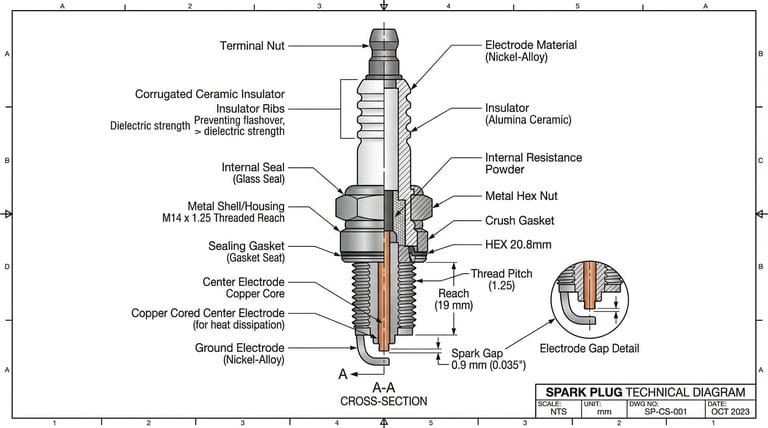
A spark plug serves as the critical interface between the ignition system and the combustion chamber, creating the electrical arc that ignites the air-fuel mixture. The basic components include:
Core Components:
Center electrode: Conducts high voltage from ignition coil to spark gap
Ceramic insulator: Provides electrical insulation and heat dissipation
Metal shell: Threaded housing that seals combustion chamber
Ground electrode: Creates spark gap with center electrode
Terminal: Connection point for ignition wire or coil-on-plug assembly
Critical Specifications:Thread diameter and reach: 10mm, 12mm, 14mm, 18mm (most common: 14mm)
Heat range: Indicates thermal characteristics (colder vs. hotter plugs)
Spark gap: Typically 0.028-0.060 inches (0.7-1.5mm)
Seat type: Gasket seat or tapered seat
Hex size: 16mm, 18mm, 21mm (for installation socket)
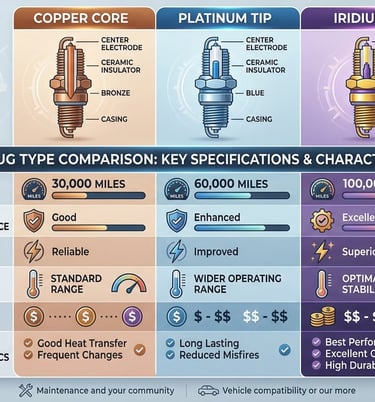
Copper Core Spark Plugs
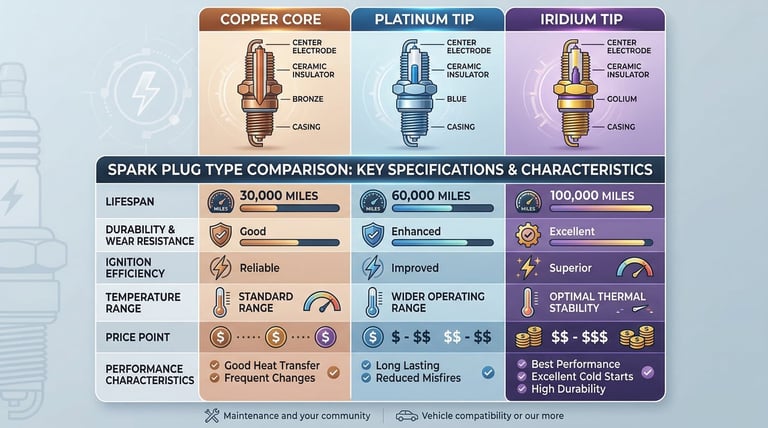
Copper spark plugs represent the traditional baseline technology, still accounting for approximately 35% of global spark plug sales in 2025 despite declining market share.
Technical Characteristics:
Electrode material: Nickel-alloy center and ground electrodes with copper core
Core conductor: Solid copper for optimal electrical and thermal conductivity
Average lifespan: 20,000-30,000 miles (32,000-48,000 km)
Heat dissipation: Excellent thermal conductivity through copper core
Operating temperature: Typically 500-850°C at electrode tip
Performance Profile:
Copper spark plugs offer the largest electrode diameter (typically 2.5mm center electrode) which provides excellent heat dissipation but requires more voltage to create spark across the wider gap. The nickel-alloy electrode coating wears relatively quickly due to the erosive nature of repeated spark discharge.
Wholesale Considerations:Unit cost: $1.50-$3.00 per plug (bulk pricing, 1,000+ units)
Market positioning: Economy replacement segment
Customer profile: Price-sensitive consumers, older vehicles, high-mileage applications
Replacement cycle: More frequent replacement generates recurring revenue
Competitive advantage: Lowest entry price point for market penetration
Application Recommendations:Vehicles with conventional (non-coil-on-plug) ignition systems
Older vehicles (pre-2000) originally equipped with copper plugs
High-performance engines requiring frequent spark plug changes
Budget-conscious repair shops and DIY customers
Platinum Spark Plugs
Platinum spark plugs emerged in the 1990s as an extended-life alternative to copper, offering significantly longer service intervals through precious metal electrode technology.
Technical Characteristics:
Electrode material: Platinum disc welded to center electrode tip (single platinum) or both center and ground electrodes (double platinum)
Platinum disc size: Typically 0.6-0.8mm diameter, 0.4-0.6mm thickness
Average lifespan: 60,000-80,000 miles (96,000-128,000 km)
Melting point: 1,768°C (platinum) vs. 1,455°C (nickel)
Electrode wear rate: Approximately 3x slower than copper/nickel
Single vs. Double Platinum:
Single Platinum:Platinum disc on center electrode only
Suitable for conventional distributor-based ignition systems
Lower cost than double platinum
Wholesale price: $3.50-$6.00 per plug
Double Platinum:Platinum discs on both center and ground electrodes
Required for waste-spark ignition systems (fires both directions)
Extended ground electrode life
Wholesale price: $5.00-$8.50 per plug
Wholesale Considerations:Market positioning: Mid-range replacement and upgrade segment
Value proposition: 2-3x lifespan of copper at 2x price = better total cost of ownership
Customer profile: Quality-conscious consumers, fleet operators, vehicles with 60k-100k service intervals
Margin opportunity: Higher unit price with comparable markup percentage = better absolute margin
Iridium Spark Plugs
Iridium spark plugs represent the premium segment, offering the longest service life and optimal performance characteristics through the hardest and most durable electrode material available.
Technical Characteristics:
Electrode material: Iridium tip welded to center electrode (0.4-0.6mm diameter)
Melting point: 2,446°C (highest of all metals)
Hardness: Approximately 6x harder than platinum
Average lifespan: 100,000-120,000 miles (160,000-192,000 km)
Electrode diameter: Ultra-fine 0.4-0.6mm enables lower voltage requirement
Wear resistance: Approximately 8x more resistant than copper/nickel
Performance Advantages:
The ultra-fine iridium electrode tip creates several performance benefits beyond extended life:
Improved Ignitability:Smaller electrode diameter concentrates electrical field
Requires 5-15% less voltage to create spark
More consistent ignition across varying conditions
Benefits cold starts and high-altitude operation
Enhanced Combustion:Minimal electrode intrusion into combustion chamber
Reduced flame kernel quenching
More complete combustion = slight fuel economy improvement (1-2%)
Reduced emissions through more efficient burn
Thermal Management:Fine electrode tip runs hotter, reducing carbon fouling
Improved self-cleaning characteristics
Better performance in direct-injection engines
Wholesale Considerations:Unit cost: $7.00-$14.00 per plug (bulk pricing varies significantly by brand positioning)
Market positioning: Premium replacement and performance upgrade segment
Customer profile: Luxury vehicle owners, performance enthusiasts, customers prioritizing quality
Margin opportunity: Highest absolute margin per unit
Competitive differentiation: Quality positioning against economy alternatives
Double Iridium Technology:
Premium iridium spark plugs feature iridium on both center and ground electrodes, further extending service life and maintaining optimal spark gap throughout the service interval. Wholesale pricing: $10.00-$16.00 per plug.
Specialty Spark Plug Technologies
Ruthenium-Enhanced Spark Plugs:
Recent innovation from premium manufacturers (NGK Ruthenium HX, introduced 2023) combines iridium center electrode with ruthenium-enhanced ground electrode. Ruthenium offers superior high-temperature strength and corrosion resistance.
Lifespan: 120,000+ miles
Wholesale cost: $12.00-$18.00 per plug
Market status: Emerging premium segment, limited aftermarket availability
Multi-Ground Electrode Designs:
Some performance spark plugs feature 2-4 ground electrodes to extend service life and improve ignitability through multiple spark paths.Applications: High-performance engines, racing applications
Wholesale cost: $8.00-$15.00 per plug depending on electrode material
Market consideration: Niche segment, not suitable for all engine designs
Ignition Coil Technology and Specifications
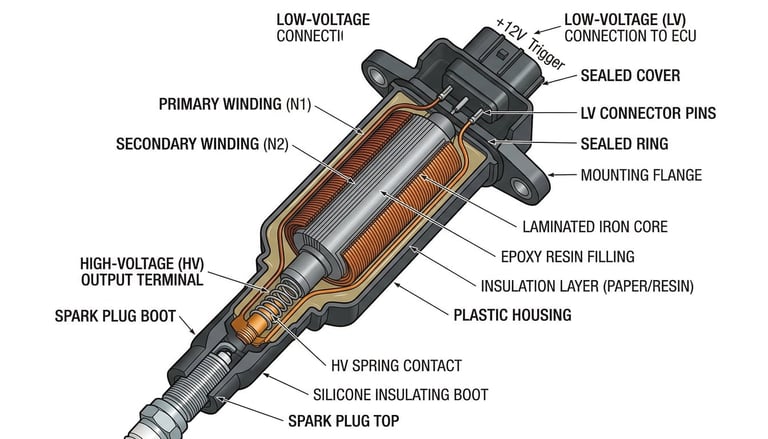
Ignition coils transform the vehicle's 12-volt battery power into the 15,000-50,000 volts required to create spark across the spark plug gap. Modern vehicles predominantly use coil-on-plug (COP) or coil-near-plug designs, replacing older distributor-based systems.
Ignition Coil Types and Applications
Conventional Coil (Single Coil with Distributor)
The traditional design used in vehicles through the 1990s, featuring a single coil serving all cylinders through a mechanical distributor.
Technical Specifications:
Primary winding: 100-200 turns of heavy wire (low resistance, typically 0.5-2.0 ohms)
Secondary winding: 15,000-30,000 turns of fine wire (high resistance, typically 6,000-12,000 ohms)
Output voltage: 15,000-30,000 volts
Inductance: 5-10 millihenries
Wholesale Considerations:Declining market segment (legacy vehicles only)
Unit cost: $15-$35 per coil
Lower volume but stable replacement demand from older vehicle population
Coil Pack (Waste-Spark System)
Intermediate technology used primarily in 1990s-2000s vehicles, featuring one coil serving two cylinders in a waste-spark configuration.
Technical Specifications:
Dual-tower design serving paired cylinders
Output voltage: 25,000-35,000 volts
Fires both cylinders simultaneously (one on compression stroke, one on exhaust stroke)
Integrated ignition module in some designs
Wholesale Considerations:Moderate market segment (vehicles 15-30 years old)
Unit cost: $25-$60 per coil pack
Typical vehicle requires 2-3 coil packs (4-6 cylinder engines)
Coil-on-Plug (COP) / Coil-Near-Plug
Modern standard design featuring individual coil for each cylinder, mounted directly on or near the spark plug.
Technical Specifications:
Output voltage: 30,000-50,000 volts (higher than previous designs)
Integrated ignition driver circuitry in most designs
Direct mounting eliminates spark plug wires
Improved electromagnetic interference (EMI) shielding
Design Variants:
Pencil Coil:Long, narrow design that extends into spark plug well
Most common COP design
Typical dimensions: 100-150mm length, 20-30mm diameter
Block Coil:Shorter, wider design mounted near spark plug
Short high-voltage lead to spark plug
More compact packaging for tight engine compartments
Wholesale Considerations:Dominant market segment (all vehicles 2005+)
Unit cost: $18-$55 per coil (significant variation by vehicle application)
Higher per-vehicle revenue (4-8 coils per vehicle)
Replacement pattern: Often replaced as complete set for reliability
Ignition Coil Failure Modes and Quality Indicators
Understanding common failure modes helps wholesale buyers evaluate product quality and anticipate warranty claims.
Common Failure Mechanisms:
Internal Short Circuit:
Insulation breakdown between primary and secondary windings
Caused by thermal cycling, moisture intrusion, or manufacturing defects
Symptoms: Misfire, reduced power output, check engine light
Quality indicator: High-temperature insulation materials, sealed construction
Open Circuit:Break in primary or secondary winding
Caused by vibration, thermal stress, or poor manufacturing
Symptoms: Complete loss of spark, no-start condition
Quality indicator: Robust wire bonding, stress-relief design
Insulation Breakdown:High-voltage leakage to ground through cracked insulation
Caused by thermal cycling, ozone exposure, contamination
Symptoms: Intermittent misfire, especially in wet conditions
Quality indicator: Epoxy-filled construction, environmental sealing
Driver Circuit Failure:Failure of integrated ignition driver transistor
Caused by voltage spikes, overheating, or electrical faults
Symptoms: No spark, may damage ECU if not properly protected
Quality indicator: Overvoltage protection, thermal management
Quality Standards and Testing
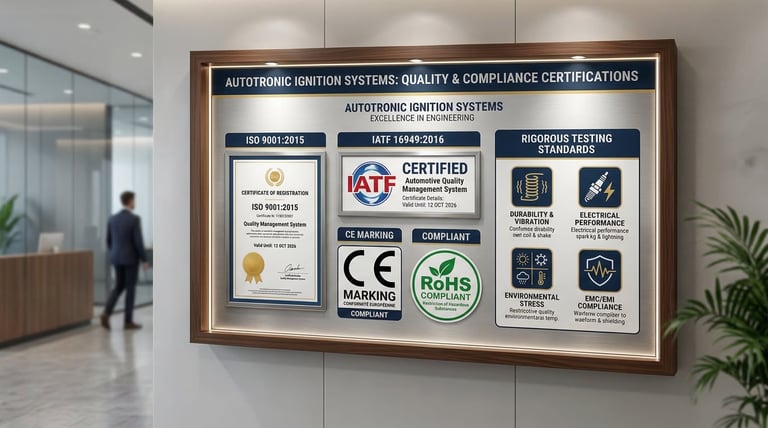
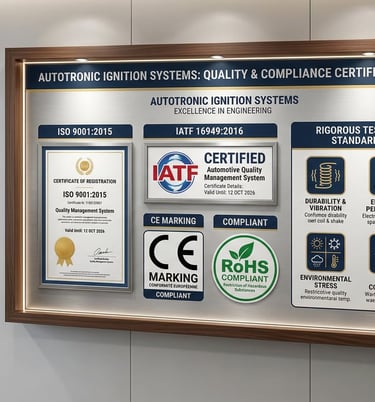
ISO 9001 and IATF 16949:
Ignition system manufacturers should maintain automotive-specific quality management certification. Verify supplier certification status and audit reports.
Performance Testing Requirements:
Electrical Testing:
Primary and secondary resistance measurement
Inductance verification
High-voltage output testing (oscilloscope verification)
Insulation resistance testing (megohm meter)
Environmental Testing:Temperature cycling: -40°C to +150°C
Humidity resistance: 95% RH at 40°C
Vibration testing: Automotive standard profiles
Salt spray corrosion testing: 96-hour minimum
Durability Testing:Thermal shock cycling: Rapid temperature transitions
High-voltage endurance: Extended operation at maximum output
Mechanical shock: Drop and impact testing
Competitive Brand Analysis: NGK, Bosch, Denso Alternatives
The spark plug and ignition coil market is dominated by several premium OEM suppliers. Understanding their positioning helps wholesale buyers identify opportunities for aftermarket alternatives.
Premium Brand Market Positioning
NGK (Japan)
Market Position:
Global market leader (approximately 40% market share)
OEM supplier to Toyota, Honda, Nissan, and many others
Strong brand recognition and customer loyalty
Product Range:Copper: NGK Standard series
Platinum: NGK Platinum, V-Power Platinum
Iridium: NGK Iridium IX, Laser Iridium, Ruthenium HX
Retail pricing: Premium tier (highest prices)
Wholesale Alternative Strategy:Position aftermarket iridium plugs against NGK copper/platinum
Emphasize equivalent specifications at 30-40% lower cost
Target price-conscious customers who don't require NGK branding
Bosch (Germany)
Market Position:
Second-largest global manufacturer (approximately 25% market share)
Strong presence in European and American markets
OEM supplier to BMW, Mercedes-Benz, Volkswagen, GM
Product Range:Copper: Bosch Copper Plus
Platinum: Bosch Platinum Plus, Platinum+4 (4 ground electrodes)
Iridium: Bosch Double Iridium, Iridium Fusion
Retail pricing: Premium tier
Wholesale Alternative Strategy:Highlight equivalent performance specifications
Offer double iridium products at Bosch single platinum prices
Emphasize ISO 9001/IATF 16949 certification equivalence
Denso (Japan)
Market Position:
Third-largest manufacturer (approximately 15% market share)
OEM supplier to Toyota (Denso is Toyota group company)
Strong technical reputation, particularly in iridium technology
Product Range:Copper: Denso Standard
Platinum: Denso Platinum TT (twin-tip)
Iridium: Denso Iridium Power, Iridium TT, Iridium Tough
Retail pricing: Premium tier
Wholesale Alternative Strategy:Position as "OEM-equivalent quality" at aftermarket prices
Target Toyota/Lexus aftermarket with compatible specifications
Emphasize extended warranty to build confidence
Aftermarket Brand Positioning Strategy
Tier 1 Positioning (Premium Aftermarket):
Pricing: 20-30% below NGK/Bosch/Denso
Quality: Match or exceed OEM specifications
Warranty: Lifetime or 100,000-mile warranty
Target: Quality-conscious customers seeking value
Tier 2 Positioning (Value Aftermarket):Pricing: 40-50% below premium brands
Quality: Meet minimum specifications, adequate performance
Warranty: 12-24 months or 30,000-50,000 miles
Target: Price-sensitive customers, high-mileage vehicles
Private Label Positioning:Pricing: Flexible based on retailer strategy
Quality: Customizable (Tier 1 or Tier 2 specifications)
Warranty: Customizable based on quality tier
Target: Retailers building house brand equity
Sourcing Strategies for Spark Plugs and Ignition Coils
Successful wholesale sourcing of ignition system components requires understanding manufacturing capabilities, quality verification processes, and regional sourcing advantages.
Geographic Sourcing Landscape
China
China dominates global spark plug and ignition coil manufacturing, accounting for approximately 60% of worldwide aftermarket production.
Key Manufacturing Regions:
Zhejiang Province (Ruian, Wenzhou, Yueqing):
Specialization: Ignition coils, spark plug wires
Characteristics: Large number of small-to-medium manufacturers
Quality range: Wide variation from economy to premium
Pricing: Most competitive in global market
Guangdong Province (Guangzhou, Foshan):Specialization: Spark plugs, complete ignition systems
Characteristics: Mix of large factories and specialized producers
Quality range: Mid-range to premium quality available
Pricing: Moderate, better quality-to-price ratio
Jiangsu Province (Changzhou, Wuxi):Specialization: OEM-quality spark plugs and coils
Characteristics: Larger manufacturers with automotive certifications
Quality range: Premium focus, many OEM suppliers
Pricing: Higher but justified by quality and certification
Sourcing Advantages:Widest product selection across all quality tiers
Most competitive pricing structure
Flexible MOQs (minimum order quantities)
Established export infrastructure and English-speaking sales teams
Rapid product development and customization capabilities
Sourcing Challenges:Quality verification requires due diligence and testing
Intellectual property concerns (counterfeit premium brands)
Longer shipping times (4-6 weeks sea freight)
Communication and time zone coordination
Japan
Japanese manufacturers focus on premium and OEM-quality products, with limited aftermarket wholesale availability.
Key Manufacturers:
NGK (market leader, limited wholesale access)
Denso (primarily OEM channel, some aftermarket)
Smaller specialized manufacturers (niche applications)
Sourcing Considerations:Premium pricing (typically 2-3x Chinese equivalents)
Excellent quality and consistency
Strong technical support and documentation
Higher MOQs and stricter terms
Longer lead times for custom specifications
Taiwan
Taiwan offers a middle ground between Chinese pricing and Japanese quality, with several established automotive component manufacturers.
Sourcing Advantages:
Better quality control than mainland China average
Moderate pricing (20-40% above Chinese, 30-50% below Japanese)
Strong engineering capabilities and customization
Better intellectual property protection
Sourcing Challenges:Smaller production capacity than mainland China
Higher MOQs than Chinese manufacturers
Limited product range compared to China
India
India's automotive aftermarket manufacturing sector is growing, particularly for domestic and regional markets.
Sourcing Considerations:
Competitive pricing similar to China
Growing quality standards and certifications
Increasing export capabilities
Longer lead times and less established export infrastructure
Best for South Asian and Middle Eastern market focus
Supplier Evaluation and Due Diligence
Thorough supplier evaluation is critical to avoiding quality issues, counterfeit products, and supply chain disruptions.
Factory Audit Checklist
Certifications and Documentation:
ISO 9001:2015 certification (minimum requirement)
IATF 16949:2016 certification (preferred for automotive quality)
Product liability insurance documentation
Export licenses and customs documentation
Intellectual property declarations
Production Capabilities:Monthly production capacity (pieces per month)
Production line automation level
Quality control procedures and testing equipment
Raw material sourcing and traceability
Inventory management and lead time capabilities
Quality Control Systems:Incoming material inspection procedures
In-process quality checkpoints
Final product testing protocols
Defect tracking and corrective action systems
Statistical process control (SPC) implementation
Technical Capabilities:Engineering staff qualifications and experience
Product development and customization capabilities
Testing laboratory equipment and capabilities
Technical documentation quality (specifications, test reports)
Reverse engineering and compatibility verification
Sample Testing Protocol
Before committing to large orders, implement a rigorous sample testing protocol:
Phase 1: Visual and Dimensional Inspection
Verify packaging quality and labeling accuracy
Measure critical dimensions (thread size, reach, hex size)
Inspect electrode materials and construction quality
Check for obvious defects or inconsistencies
Phase 2: Electrical Testing
For spark plugs:Spark gap measurement
High-voltage breakdown testing
Insulation resistance testing
For ignition coils:Primary and secondary resistance measurement
Inductance testing
Output voltage verification
Insulation resistance testing
Phase 3: Comparative TestingSide-by-side comparison with OEM or known-good samples
Weight comparison (indicates material quality)
Material analysis (if budget permits)
Fitment verification on actual vehicle applications
Phase 4: Durability TestingThermal cycling (if equipment available)
Vibration testing
Moisture resistance testing
Extended operation testing
Red Flags and Warning Signs
Supplier Red Flags:
Unwillingness to provide factory visit or video tour
Cannot provide valid certifications or documentation
Prices significantly below market average (>50% below competitors)
Pressure to order without samples or testing
Poor communication or evasive answers to technical questions
No established export history or references
Product Red Flags:Packaging includes premium brand names without authorization
Inconsistent quality between samples and production batches
Missing or incorrect technical markings
Poor packaging quality or missing safety warnings
Electrode materials don't match specifications
Unusual weight or dimensional variations
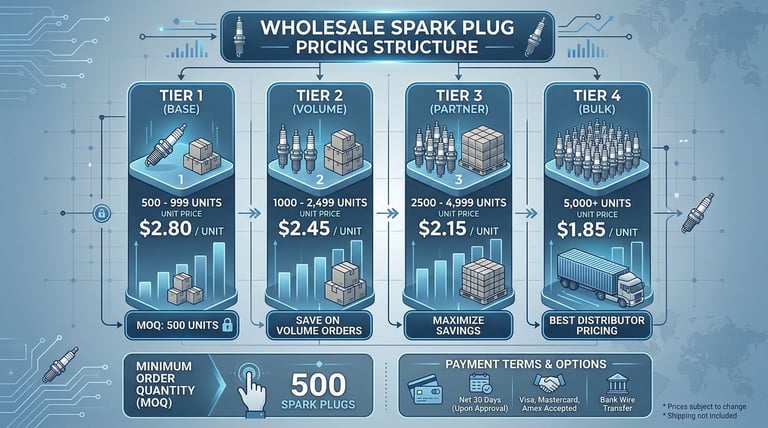
Minimum Order Quantities and Pricing Structure
Understanding typical MOQs and pricing tiers helps in negotiation and planning.
Typical MOQ Structures:
Spark Plugs:
Small manufacturers: 1,000-5,000 pieces per SKU
Medium manufacturers: 5,000-10,000 pieces per SKU
Large manufacturers: 10,000-50,000 pieces per SKU
Mixed SKU orders: Often accepted with total quantity meeting minimum
Ignition Coils:Small manufacturers: 500-1,000 pieces per SKU
Medium manufacturers: 1,000-3,000 pieces per SKU
Large manufacturers: 3,000-10,000 pieces per SKU
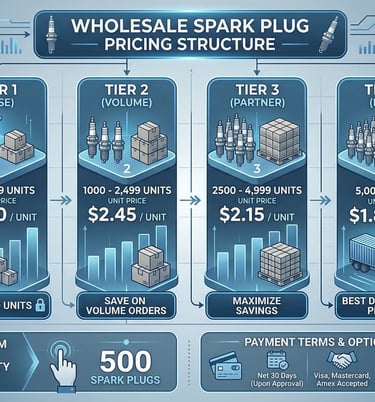
Pricing Tier Structure:
Copper Spark Plugs:1,000-5,000 pieces: $2.00-$2.50 per piece
5,000-20,000 pieces: $1.70-$2.00 per piece
20,000+ pieces: $1.50-$1.70 per piece
Platinum Spark Plugs:1,000-5,000 pieces: $5.00-$6.00 per piece
5,000-20,000 pieces: $4.20-$5.00 per piece
20,000+ pieces: $3.50-$4.20 per piece
Iridium Spark Plugs:1,000-5,000 pieces: $9.00-$11.00 per piece
5,000-20,000 pieces: $7.50-$9.00 per piece
20,000+ pieces: $7.00-$7.50 per piece
Ignition Coils (COP):500-2,000 pieces: $22.00-$28.00 per piece
2,000-10,000 pieces: $18.00-$22.00 per piece
10,000+ pieces: $15.00-$18.00 per piece
Note: Prices vary significantly based on specifications, quality tier, and market conditions. These ranges represent typical Chinese manufacturing pricing as of 2025.
Product Range Strategy and SKU Management
Building an effective spark plug and ignition coil product range requires balancing breadth of coverage with inventory management efficiency.
Coverage Strategy
Application-Based Coverage
Passenger Vehicles:
Focus on high-volume vehicle models (Toyota, Honda, Ford, Chevrolet, Nissan)
Prioritize 2005+ vehicles (largest replacement market)
Cover both economy and premium segments
Light Trucks and SUVs:Growing market segment with higher per-vehicle revenue
Typically require more spark plugs (6-8 cylinder engines)
Premium products more accepted in this segment
European Vehicles:Specialized market with higher margins
Requires precise OEM compatibility
Customers more quality-sensitive, less price-sensitive
Asian Vehicles:Largest volume segment in most markets
Strong OEM brand loyalty (NGK, Denso)
Opportunity for value positioning
Material-Based Product Ladder
Entry Level: Copper
SKU count: 50-100 most common applications
Purpose: Price-competitive entry point
Target: Economy segment, older vehicles
Mid-Range: PlatinumSKU count: 100-200 common applications
Purpose: Value proposition (extended life)
Target: Mainstream replacement market
Premium: IridiumSKU count: 150-300 comprehensive coverage
Purpose: Quality positioning and margin
Target: Quality-conscious customers, newer vehicles
Ultra-Premium: Double Iridium/SpecialtySKU count: 50-100 high-demand applications
Purpose: Competitive differentiation
Target: Enthusiasts, luxury vehicles
SKU Rationalization
Effective SKU management prevents inventory bloat while maintaining adequate coverage.
Pareto Analysis:
Typically 20% of SKUs generate 80% of sales volume
Identify and prioritize these high-velocity items
Maintain deeper inventory on fast-moving SKUs
Consider drop-ship or special order for slow-moving items
Cross-Reference Strategy:One spark plug design often fits multiple vehicle applications
Consolidate similar specifications to reduce SKU count
Maintain comprehensive cross-reference database
Clearly communicate multi-vehicle compatibility
Inventory Investment Optimization:Calculate inventory turns by SKU category
Target 6-12 turns per year for fast-moving items
Accept 2-4 turns for comprehensive coverage items
Eliminate SKUs with <1 turn per year unless strategic
Private Label and Packaging Strategy
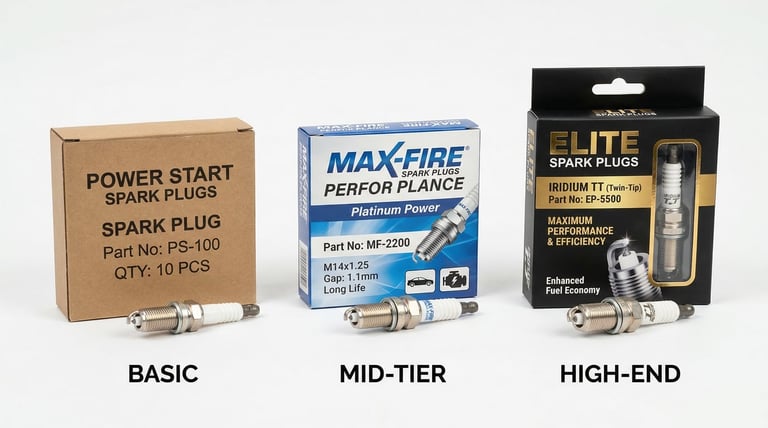
Packaging Options:
Individual Retail Packaging:
Blister pack or box with product information
Barcode and SKU identification
Installation instructions and specifications
Professional appearance for retail shelf
Bulk Packaging:Multi-piece boxes (4-pack, 8-pack for sets)
Plain packaging for professional installer market
Cost savings for price-sensitive customers
Custom Private Label:Your brand name and logo
Custom color schemes and design
Builds brand equity and customer loyalty
Typically requires higher MOQs (5,000-10,000 pieces)
Packaging Quality Considerations:Moisture protection (especially for spark plugs)
Physical protection during shipping
Clear product identification and specifications
Professional appearance reflects on product quality
Logistics and Import Considerations
Efficient logistics management significantly impacts total landed cost and inventory availability.
Shipping Methods and Timing
Sea Freight (Most Common):
Transit time: 25-45 days (Asia to North America/Europe)
Cost: Most economical for full container loads
Minimum practical quantity: 1/2 container or full container
Best for: Regular replenishment orders, new product launches
Air Freight:Transit time: 5-10 days
Cost: 5-10x more expensive than sea freight
Minimum practical quantity: 100-500kg
Best for: Rush orders, sample shipments, high-value items
Express Courier (DHL, FedEx, UPS):Transit time: 3-7 days
Cost: Most expensive per kg
Practical for: Samples, small urgent orders, documents
Container Loading:20-foot container: Approximately 50,000-80,000 spark plugs (depending on packaging)
40-foot container: Approximately 100,000-160,000 spark plugs
Ignition coils: Approximately 8,000-12,000 pieces per 20-foot container
Import Duties and Regulations
HS Codes (Harmonized System):
Spark plugs: 8511.10
Ignition coils: 8511.30
Verify current duty rates for your specific country
Typical Import Duties:United States: 2.5-3.5% (verify current rates)
European Union: 2.7-4.5% (varies by country)
Canada: 6.0-8.0%
Australia: 5.0%
Note: Rates change periodically; verify current rates with customs broker.
Regulatory Compliance:Product safety standards (varies by country)
Packaging and labeling requirements
Environmental regulations (RoHS, REACH in EU)
Intellectual property clearance
Country of origin marking requirements
Total Landed Cost Calculation
Understanding true total cost is essential for accurate pricing and margin calculation.
Cost Components:
Product cost (FOB): Factory price
International shipping: Sea/air freight charges
Insurance: Typically 0.3-0.5% of cargo value
Import duties: Based on HS code and country
Customs clearance: Broker fees and documentation
Domestic transportation: Port to warehouse
Warehousing: Receiving and storage costs
Payment terms cost: LC fees or early payment discounts
Example Calculation (Iridium Spark Plugs to USA):
Product cost (FOB China): $8.00 per piece
Quantity: 10,000 pieces = $80,000
Sea freight (20' container): $3,000
Insurance (0.4%): $320
Import duty (2.5%): $2,000
Customs clearance: $500
Domestic transport: $400
Total landed cost: $86,220
Per-piece landed cost: $8.62
Add warehousing and financing: ~$0.40
Total cost per piece: $9.02
Payment Terms and Risk Management
Common Payment Terms:
30% Deposit + 70% Before Shipment:
Most common for new supplier relationships
Moderate risk for buyer
Supplier has production cost coverage
Letter of Credit (LC):Lowest risk for both parties
Bank guarantees payment upon document compliance
Additional cost (1-2% of order value)
Best for large orders or new suppliers
Net 30-60 Days:Requires established relationship and trust
Improves cash flow for buyer
Typically requires larger order volumes
May include early payment discount (2-3%)
Risk Mitigation Strategies:Start with smaller orders to establish relationship
Use inspection services before final payment
Maintain multiple supplier relationships
Consider trade credit insurance for large orders
Verify supplier business licenses and registrations
Marketing and Sales Strategies
Successfully selling spark plugs and ignition coils requires understanding customer needs and effective value communication.
B2B Customer Segments
Auto Parts Retailers
Needs:
Comprehensive SKU coverage
Competitive pricing for retail markup
Attractive packaging for shelf appeal
Marketing support and product training
Value Proposition:Better margins than premium brands
Equivalent quality and performance
Flexible ordering and fast delivery
Co-branding and private label options
Repair Shops and Mechanics
Needs:
Reliable product quality
Fast availability
Technical support
Warranty support
Value Proposition:Professional-grade quality
Better margins than OEM parts
Technical hotline support
Hassle-free warranty process
Fleet Operators
Needs:
Consistent quality
Volume pricing
Predictable availability
Simplified procurement
Value Proposition:Volume discounts
Dedicated account management
Scheduled delivery programs
Extended payment terms
Online Retailers
Needs:
Dropship capabilities
Comprehensive product data
Competitive wholesale pricing
Fast order fulfillment
Value Proposition:Dropship program with low/no minimum
Complete product data feeds
Competitive pricing for online margins
Same-day/next-day shipping
Value Proposition Development
Quality Positioning:
"OEM-equivalent specifications"
"Manufactured to ISO/IATF standards"
"Tested to exceed industry standards"
Provide test reports and certifications
Performance Positioning:"Extended service life" (with specific mileage claims)
"Improved fuel efficiency" (for iridium products)
"Reliable cold-start performance"
"Reduced emissions"
Price Positioning:"Premium quality at aftermarket prices"
"30-40% savings vs. OEM"
"Better value per mile"
Total cost of ownership comparison
Service Positioning:"Expert technical support"
"Fast delivery and availability"
"Hassle-free warranty"
"Dedicated account management"
Warranty Strategy
Warranty terms signal quality confidence and reduce customer risk.
Copper Spark Plugs:
12-24 months or 20,000-30,000 miles
Matches expected service life
Industry standard coverage
Platinum Spark Plugs:24-36 months or 50,000-60,000 miles
Demonstrates extended life advantage
Competitive with premium brands
Iridium Spark Plugs:Lifetime or 100,000+ miles
Strong quality signal
Matches or exceeds premium brand warranties
Differentiates from economy alternatives
Ignition Coils:24-36 months or 50,000-75,000 miles
Reflects typical failure patterns
Competitive with aftermarket standards
Warranty Administration:Clear, simple claim process
Fast claim resolution (target: 5-7 days)
Replacement or credit options
Track warranty rates by SKU to identify quality issues
MakexCar: Your Trusted Partner for Automotive Ignition Components
At MakexCar, we understand that wholesale success in the automotive aftermarket requires more than just competitive pricing—it demands consistent quality, reliable supply, and partnership-focused service.
Our Manufacturing Capabilities
Production Facilities:
Our state-of-the-art manufacturing facilities employ advanced automation and rigorous quality control systems to ensure every spark plug and ignition coil meets or exceeds international standards. With monthly production capacity exceeding 500,000 spark plugs and 50,000 ignition coils, we have the scale to support your growth while maintaining the flexibility to accommodate custom specifications.
Quality Certifications:
ISO 9001:2015 Quality Management System
IATF 16949:2016 Automotive Quality Management
Product liability insurance coverage
Full traceability from raw materials to finished products
Technical Capabilities:
Our engineering team brings decades of automotive ignition system expertise, enabling us to provide:Custom product development for specific applications
Reverse engineering and OEM compatibility verification
Technical support for product selection and application
Comprehensive testing and validation services
Our Product Range
Spark Plugs:
Copper core: 200+ SKUs covering popular applications
Platinum (single and double): 300+ SKUs
Iridium (single and double): 400+ SKUs
Specialty products: Performance and racing applications
Ignition Coils:Conventional coils for legacy vehicles
Coil packs for waste-spark systems
Coil-on-plug (COP) for modern vehicles
Custom designs for specific applications
Coverage:Asian vehicles: Comprehensive coverage (Toyota, Honda, Nissan, Hyundai, Kia)
American vehicles: Major applications (Ford, GM, Chrysler)
European vehicles: Popular models (VW, BMW, Mercedes-Benz)
Continuously expanding based on market demand
Why Choose MakexCar
Quality Assurance:
Every product undergoes rigorous testing including electrical performance verification, dimensional inspection, and durability testing. Our quality control system ensures consistency across production batches, and we maintain comprehensive test records for traceability.
Competitive Pricing:
Direct factory pricing eliminates intermediary markups, allowing you to maximize margins while remaining competitive in your market. Volume discounts and flexible payment terms support your business growth.
Reliable Supply:
With substantial inventory of high-velocity items and efficient production scheduling, we minimize lead times and ensure product availability when you need it. Our logistics team coordinates efficient shipping and provides full tracking visibility.
Partnership Approach:
We view our customers as long-term partners, not just transactions. Our dedicated account management team provides:
Personalized service and responsive communication
Market insights and product recommendations
Custom packaging and private label options
Marketing support and product training
Flexible terms for qualified partners
Technical Support:
Our technical team is available to assist with:Product selection and application matching
Cross-reference verification
Installation guidance
Troubleshooting and warranty support
Getting Started with MakexCar
Step 1: Initial Consultation
Contact our sales team to discuss your market, customer base, and product requirements. We'll help you identify the optimal product range for your business.
Step 2: Sample Evaluation
We'll provide samples of our products for your evaluation and testing. Compare our quality against OEM and competitor products to verify our claims.
Step 3: Custom Solution Development
Based on your feedback, we'll develop a customized product offering, pricing structure, and service package tailored to your business needs.
Step 4: First Order and Beyond
Start with an initial order to establish our relationship and verify our service quality. As our partnership grows, we'll continuously optimize our support to help you succeed.
Contact MakexCar
Ready to explore how MakexCar can support your automotive parts business? Our team is ready to discuss your specific needs and develop a customized solution.
Contact Information:
Email: sales1@makexcar.com
Phone: +8619941234680
Website: www.makexcar.com
We look forward to becoming your trusted partner in automotive ignition components.
Conclusion: Building Success in the Ignition Parts Market
The automotive ignition system aftermarket represents a substantial opportunity for wholesale distributors who combine product knowledge, quality sourcing, and customer-focused service. Success requires:
Technical Understanding:
Deep knowledge of spark plug and ignition coil technology enables effective product selection, customer consultation, and competitive positioning. Understanding material differences, specifications, and applications builds credibility and trust with professional customers.
Quality Focus:
Prioritizing quality over lowest-cost sourcing protects your reputation and minimizes warranty costs. Rigorous supplier evaluation, sample testing, and ongoing quality monitoring ensure consistent product performance.
Strategic Sourcing:
Balancing cost, quality, and reliability through careful supplier selection and relationship management. Understanding geographic advantages, conducting thorough due diligence, and maintaining multiple supplier relationships mitigates risk.
Market Positioning:
Clear value proposition development that differentiates your offering from both premium OEM brands and low-quality alternatives. Effective positioning as "OEM-equivalent quality at aftermarket prices" captures the large middle market.
Customer Partnership:
Viewing customers as long-term partners rather than transactions. Providing technical support, reliable supply, flexible terms, and responsive service builds loyalty and recurring business.
The ignition system aftermarket continues to evolve with advancing vehicle technology, but the fundamental need for quality replacement components remains constant. By applying the insights and strategies outlined in this guide, wholesale distributors can build profitable, sustainable businesses serving this essential market.
Whether you're expanding an existing automotive parts business or entering the aftermarket for the first time, success comes from combining product expertise, quality sourcing, and customer focus. The information provided here gives you the foundation to make informed decisions, evaluate suppliers effectively, and position your offering competitively.
The opportunity is substantial—the global automotive ignition system market continues to grow, driven by the expanding vehicle population and ongoing replacement demand. With the right approach, you can capture your share of this market while building a reputation for quality and service that drives long-term success.




Whatsapp: +86 19941234680
Phone:+86 19941234680
© 2025. All rights reserved.
Email:sales1@makexcar.com
Wechat:Sgxwtxa