
Define the question the test must answer
For a purchasing team, the purpose of this review is to decide whether the supplied thermostat sample meets an agreed thermal-response requirement. It is not to choose a new vehicle temperature rating or diagnose an installed engine. Establish the correct application and component specification first. The test report then needs to show what happened to the identified sample under a defined procedure.
MAHLE describes the wax expansion element as moving the piston when heated, with a spring returning it as temperature falls. That general description explains why both temperature and movement matter. It does not provide a universal acceptance curve for every thermostat. Neither an opening-temperature stamp nor a photograph of an open valve supplies the missing displacement evidence.
Write the review objective in the RFQ or sample plan: the required rating definition, specified movement criterion, applicable procedure and component revision. If those items are missing, ask the responsible technical contact to define them before a supplier selects convenient limits. A result can be measured accurately and still answer the wrong approval question.
Connect the report to the sample
Check the supplier part number, sample identifier and drawing revision before examining the graph. The report should distinguish an insert from a housed assembly and identify the tested configuration. A document for a visually similar thermostat is not automatically evidence for the offered SKU. Ask how the laboratory links the record to the received sample.
Record the quantity of samples, their identifiers and any preparation that could affect interpretation. If a report summarizes several units, ask whether the displayed line is an individual trace, an average or a selected example. An average can conceal differences among samples, so retain the individual results when the agreed approval plan requires them.
The link should survive replenishment. A distributor may approve a sample today and receive a later production batch under the same sales description. Preserve the approved configuration and document revision with the purchase record. Request a review of changes that affect the thermal element or assembly, rather than assuming the old curve covers every future version.
Read the axes and measurement definitions
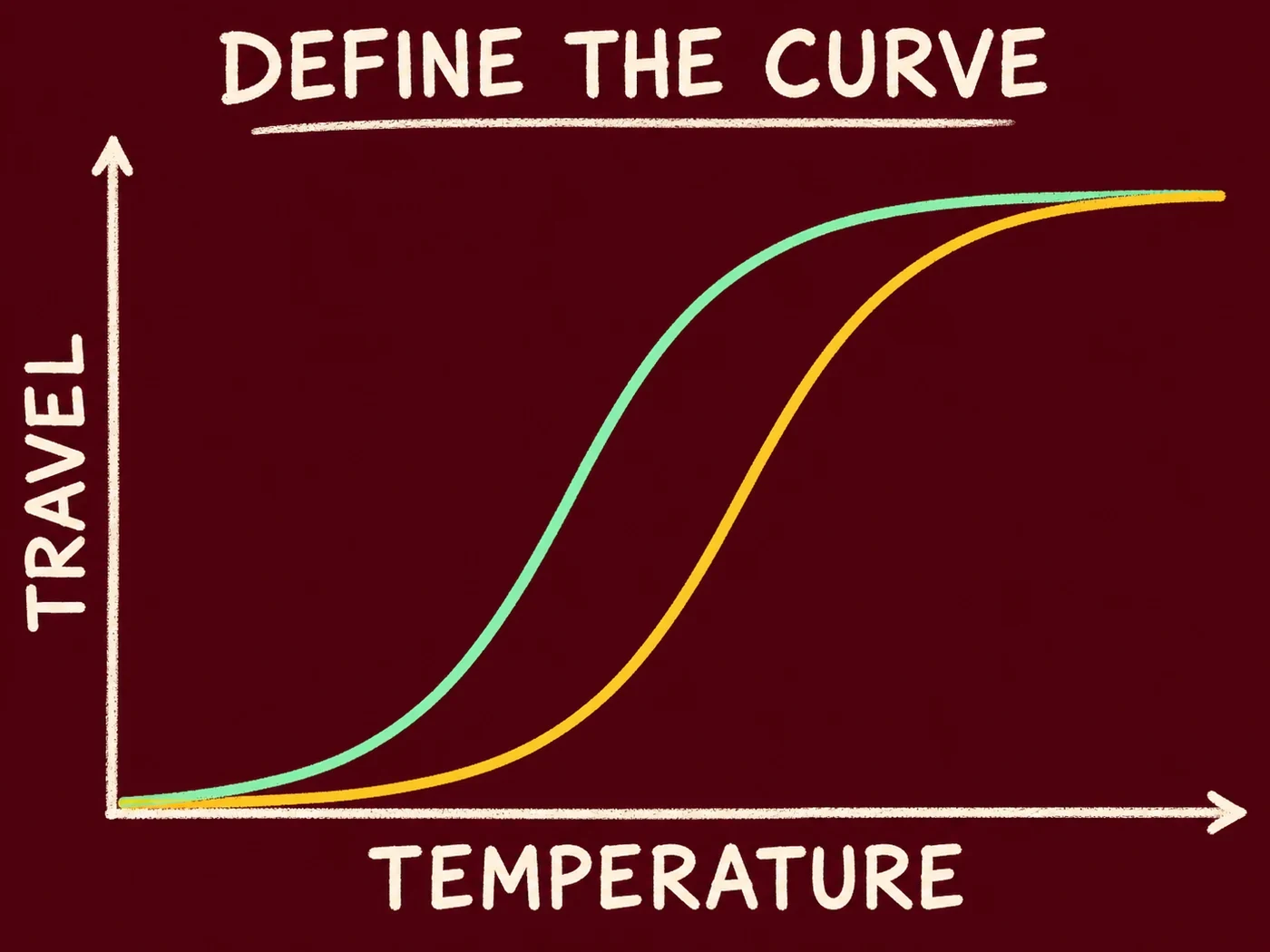
The graph should state what is measured on each axis, with units. For displacement, identify the reference position and the point on the component whose movement is recorded. A valve lift value and a fixture displacement value may describe different measurements. Ask the supplier to explain the relationship instead of treating every movement trace as the same quantity.
For temperature, ask whether the recorded value comes from the test medium, a sensor near the sample or another defined location. Preserve the measurement location and method in the report. A heater setting is not automatically the temperature experienced by the component. The lab should explain how its recorded temperature represents the agreed test condition.
Clarify the opening criterion. “Starts to open” needs a defined observation or measurement rule in the applicable procedure. A report should not rely on the buyer guessing where a line begins to rise. Also distinguish the specified opening point from any specified travel at a later temperature. Do not invent a universal minimum stroke or temperature tolerance.
Review the medium, heating sequence and fixture
MAHLE's cooling-system troubleshooting guide mentions checking a removed thermostat in a water bath where necessary. This is general service guidance. It does not establish that every supplied thermostat should be accepted using the same bath setup, especially where the specification requires a particular medium, control condition or assembled configuration.
Ask the laboratory to state the test medium, sample placement and support arrangement. Request the heating and cooling sequence, measurement intervals and any specified stabilization periods. These are report fields to review with the responsible laboratory, not a new test recipe. The required values and method belong to the approved procedure.
Ask whether the fixture applies a load, limits movement or measures a particular point. Where the procedure defines a pressure or other operating condition, ensure that it is recorded. A comparison between suppliers should not silently mix tests with different fixtures or thermal sequences. First determine whether the methods answer the same requirement.
Keep heating and cooling records distinct
If the agreed procedure includes both heating and cooling, identify each trace and its direction. Ask the supplier to explain any separation between the two records using the procedure's definitions. Do not assume that two different traces show a defect, and do not assume that a single heating line proves the return behavior was checked.
For repeated cycles, identify the cycle associated with each reported result. A first observation and a later stabilized cycle should not be interchanged without explanation. Record any required preconditioning and its relationship to the final acceptance test. This makes it possible to compare a new report with the approved sample record.
Request individual observations or raw readings when the plot leaves a decision unresolved. The purpose is to understand the evidence behind the graph. A purchasing reviewer should avoid smoothing, replotting or averaging the supplier's values in a way that changes the decision without documenting the change and agreeing the method.
| Report field | What to request | Why it matters |
|---|---|---|
| Part and sample | SKU, configuration, revision and sample identifier | Links evidence to the offered component |
| Acceptance reference | Approved specification and procedure version | Defines the decision criteria |
| Temperature measurement | Units, sensor location and measurement method | Clarifies the thermal condition |
| Travel measurement | Reference point, units and displacement method | Defines what the curve records |
| Test conditions | Medium, sequence, stabilization and fixture | Makes reports comparable |
| Cycles and direction | Heating/cooling identity and cycle number | Prevents selective interpretation |
| Result and disposition | Actual readings, applicable limits and reviewer decision | Separates data from acceptance |
Treat electronically controlled units separately
MAHLE distinguishes mechanically controlled thermostats from electronically controlled units that respond to engine operating conditions. For an electronically controlled component, ask whether the report evaluates its mechanical thermal response, an electrical-control condition or both. A bath trace without that explanation cannot establish the whole control function.
Request the exact procedure applicable to the offered assembly. Any electrical supply, actuation or control setup must come from the component documentation and qualified test plan. This article assigns no voltage, pinout, duty cycle or wiring connection to a MAKEXCAR thermostat. Connector appearance alone cannot establish those details.
Keep the conclusion within the test scope. A report may support one defined mechanical characteristic without proving vehicle-level control compatibility. If application approval also requires separate electrical or system evidence, retain those records alongside the curve. Do not turn one narrow test result into a complete performance claim.

Compare suppliers against one agreed requirement
Before placing reports side by side, compare their methods. Check sample configuration, measurement definitions, medium, sequence and acceptance reference. If these differ, ask for a comparable test or an explanation from the responsible technical reviewer. The prettiest graph is not necessarily the strongest record.
When a supplier reports only “passed,” ask for the measured result and the limit used for that conclusion. MAHLE's service checklist records thermostat opening temperature as a review item, but that checklist is not a factory sample acceptance specification. A checklist tick and an engineering test record have different scopes.
If the result is outside an agreed limit, document the discrepancy and request the supplier's response. If the method is unclear, document the missing information before declaring failure. Keep those two situations separate: a known out-of-limit result and an unresolved report definition require different corrective actions.
Resolve the report gap before choosing a disposition
A single trace represents several samples
A purchasing reviewer receives one rising curve and a report cover listing several sample identifiers. The first decision is whether the trace belongs to one unit or summarizes the group. If it is an average, obtain the individual records required by the agreed plan before deciding that every listed sample meets the requirement. If it is a selected example, establish which sample it represents and where the remaining results are recorded. A report can remain useful while its coverage is narrower than the cover suggests.
This distinction changes the action. A missing identity mapping calls for a corrected record; a mapped individual result outside an agreed limit calls for technical disposition. Neither situation is resolved by making the line smoother. Preserve the received document, identify the replacement revision and link the correction to the same sample list so that approval does not depend on two inconsistent files.
The result lies between recorded temperatures
Consider an explicitly hypothetical report: travel is recorded as 0.2 mm at 86°C and 0.8 mm at 88°C. Assume the agreed procedure defines its opening observation at 0.5 mm. Under an additional straight-line interpolation assumption, the fraction is (0.5 − 0.2) / (0.8 − 0.2) = 0.5, giving 86 + 0.5 × (88 − 86) = 87°C. These invented inputs illustrate how a calculation depends on a measurement definition and an interpolation rule; they are not thermostat ratings, real readings or recommended criteria.
The computed 87°C is not itself an observed data point. If the approved method does not permit interpolation, the buyer cannot silently substitute it for a required observation. If interpolation is permitted, the laboratory should identify the rule and its use in the report. Acceptance still requires the actual specification and its decision rule. This example provides no measurement uncertainty or tolerance and therefore cannot establish compliance.
Two graphs use different displacement references
Supplier A labels its vertical axis valve lift; Supplier B labels it fixture travel. Even if both axes use millimeters and the lines look similar, the same unit does not establish the same measured quantity. The reviewer needs the reference position, observed point and method relating fixture motion to component movement. If that relationship is not documented, compare the definitions first and leave the numerical ranking unresolved.
A suitable next step is to request a marked setup description or measurement definition from the laboratory. A photograph or video can clarify where movement is observed, but visual motion without the required readings does not replace a traceable result. Avoid demanding identical equipment merely to simplify purchasing: the technical question is whether the methods provide comparable evidence for the same requirement.
A passing label has no acceptance reference
Retain the readings as observations and return the approval question to the person responsible for the requirement. Record that the missing item is the specification or decision rule, rather than recording a defective sample. If a specification is subsequently provided, document its version and whether the existing test supplies the required evidence. Do not invent a limit that conveniently matches the received curve.
A worksheet for one identified sample review
Use the following editorial worksheet alongside the actual report. The blanks are intended for the buyer and technical reviewer; they are not a standard laboratory form. Keep supporting file references in the same record so another reviewer can reproduce the approval basis without treating the purchasing worksheet as the test itself.
| Review entry | Fillable record | Decision it supports |
|---|---|---|
| Identity and coverage | Offered SKU: ___; sample ID: ___; component revision: ___; trace ID: ___; individual/average/selected: ___ | Determine which supplied units the evidence describes. |
| Requirement | Specification and version: ___; procedure and version: ___; opening definition: ___; travel criterion: ___ | Establish the question and limits before disposition. |
| Measurement basis | Temperature location/unit: ___; displacement point/reference/unit: ___; medium/fixture record: ___ | Check whether the recorded quantities match the requirement. |
| Sequence and result | Heating/cooling: ___; cycle: ___; raw record: ___; permitted calculation rule: ___; reported result: ___ | Distinguish observations from computed or summarized results. |
| Disposition | Evidence gap or discrepancy: ___; reviewer: ___; decision and scope: ___; follow-up owner/date: ___ | Separate acceptance, an out-of-limit result and unresolved evidence. |
Close the record with a specific scope statement: which identified sample and characteristic were reviewed, against which document, and what remains outside the conclusion. If a supplier revises the report, preserve the reason for revision. If the assembly changes, route that change to technical review rather than automatically extending the earlier sample approval.
Request a traceable thermostat sample report
Use the MAKEXCAR thermostat category to identify the relevant product family, then send your sample-report enquiry with the application, OE reference, offered SKU and required procedure. Ask for the temperature and travel definitions, test conditions, cycle identification and actual results linked to the supplied sample.
The useful deliverable is a report that another reviewer can understand and apply to the same approval question. No MAKEXCAR sample is declared tested or compliant in this guide. Approval requires the actual component evidence and agreed acceptance criteria.