How to Verify ISO 9001 & IATF 16949 Certifications of China Oil Filter Suppliers: Complete Authentication Guide (2026)
Learn how to verify ISO 9001 and IATF 16949 certifications of Chinese oil filter suppliers. Complete guide to spotting fake certificates, checking accreditation bodies, and ensuring supplier legitimacy before ordering.
博客
2/26/2026
Introduction: The $50,000 Mistake You Can Avoid
Every year, thousands of international distributors lose money by trusting fake or invalid quality certifications from Chinese suppliers. A certificate displayed on a website or sent via email proves nothing—certificate fraud is rampant in China's manufacturing sector, and oil filter suppliers are no exception.
The stakes are high. Ordering from an uncertified or fraudulently certified supplier can result in defect rates of 5-15% (versus <0.5% for genuinely certified manufacturers), product recalls, customer complaints, liability claims, and destroyed business reputations. A single shipment of defective filters can cost $10,000-$50,000 in returns, replacements, and lost customers.
The good news? Verification is straightforward if you know what to check. This guide provides the complete framework for verifying ISO 9001, IATF 16949, and other quality certifications before placing orders with Chinese oil filter manufacturers.
The Reality of Certification Fraud in China (2026):
Estimated fake certificates: 15-25% of ISO certificates shown by Chinese suppliers are fake, expired, or belong to different companies
Unaccredited certification bodies: 30-40% of certificates are issued by non-accredited organizations with no legal validity
Borrowed certificates: Some suppliers display certificates belonging to their customers or partner companies
Expired certificates: 20-30% of displayed certificates have expired and not been renewed
What You'll Learn in This Guide:
How to identify fake ISO 9001 and IATF 16949 certificates in 5 minutes
Step-by-step online verification using official databases (free)
Understanding accredited vs unaccredited certification bodies
Red flags that indicate certification fraud
What certifications actually matter for oil filter quality
How to verify test reports and laboratory accreditation
Real examples: legitimate vs fraudulent certificates
Verification checklist for supplier due diligence
Why Certifications Matter for Oil Filter Quality
Before diving into verification methods, understand why certifications are critical quality indicators.
ISO 9001:2015 - Quality Management Systems
What It Certifies:
ISO 9001 certifies that a manufacturer has implemented a documented quality management system covering:
Process control and standardization
Document management and traceability
Internal audits and corrective actions
Management responsibility and continuous improvement
Customer focus and satisfaction measurement
What It Does NOT Certify:
Product quality or performance (it's a process standard, not product standard)
Specific defect rates or quality levels
Technical capability or expertise
Compliance with industry-specific requirements
Why It Matters for Oil Filters:
Ensures consistent production processes (reduces batch-to-batch variation)
Documented procedures for quality control (traceability when issues arise)
Corrective action systems (problems are addressed systematically)
Management commitment to quality (top-down quality culture)
Defect Rate Impact:
ISO 9001 certified manufacturers: 200-500 PPM typical (0.02-0.05% defect rate)
Non-certified manufacturers: 1,000-5,000 PPM typical (0.1-0.5% defect rate)
5-10x quality improvement with certification
IATF 16949:2016 - Automotive Quality Management
What It Certifies:
IATF 16949 is the automotive industry's enhanced version of ISO 9001, adding:
Automotive-specific process requirements
Advanced Product Quality Planning (APQP)
Production Part Approval Process (PPAP)
Failure Mode and Effects Analysis (FMEA)
Statistical Process Control (SPC)
Measurement System Analysis (MSA)
Supplier quality management requirements
Why It's Superior to ISO 9001:
More rigorous: Automotive-specific quality tools and methodologies
Lower defect tolerance: Target <100 PPM (0.01%)
Continuous improvement: Mandatory year-over-year quality improvements
Supply chain management: Requires certified sub-suppliers
Customer-specific requirements: Must meet OEM specifications
Defect Rate Impact:
IATF 16949 certified manufacturers: 50-150 PPM typical (0.005-0.015% defect rate)
ISO 9001 only: 200-500 PPM typical (0.02-0.05%)
Non-certified: 1,000-5,000 PPM typical (0.1-0.5%)
10-20x quality improvement over non-certified
Market Positioning:
IATF 16949: Premium/OEM quality tier (top 15% of Chinese manufacturers)
ISO 9001: Standard quality tier (top 40% of manufacturers)
No certification: Economy/risk tier (bottom 60%)
Other Relevant Certifications
ISO/TS 16949 (Older Standard):
Predecessor to IATF 16949
Officially replaced in 2018
Certificates expired by September 2018
Red flag if supplier still shows ISO/TS 16949: Certificate is expired or fake
ISO 4548-12 (Test Standard):
Not a certification, but a test method standard
Defines how to test oil filter performance
Suppliers should have test reports, not certificates
Tests: Multi-pass filtration efficiency, collapse/burst resistance, flow restriction
QS-9000 (Obsolete):
Old automotive quality standard (pre-2006)
Replaced by ISO/TS 16949, then IATF 16949
Red flag if supplier shows QS-9000: Severely outdated
VDA 6.1/6.3 (German Automotive):
German automotive industry standards
Complementary to IATF 16949
Relevant for suppliers targeting European OEMs
Less common in Chinese aftermarket suppliers
How to Verify ISO 9001 Certificates: Step-by-Step Guide
Step 1: Request Complete Certificate Documentation
What to Request from Supplier:
☐ Full certificate (not just a cropped image)
☐ High-resolution scan or photo (minimum 1200×1600 pixels)
☐ Both English and Chinese versions (if available)
☐ Certificate registration number
☐ Certification body name and accreditation details
☐ Scope of certification (what products/processes are covered)
Red Flags at This Stage:
Supplier hesitates or delays providing certificate
Only provides low-resolution or cropped images
Certificate is watermarked or has company logo obscuring details
Refuses to provide registration number
Claims certificate is "confidential" or "internal only"
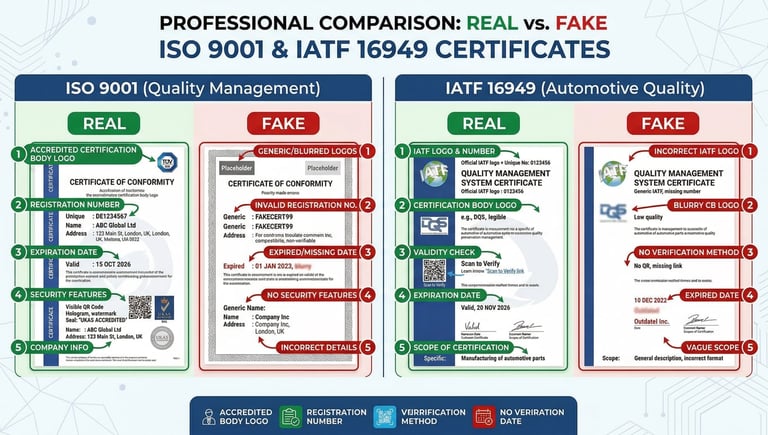
Step 2: Examine Certificate Visual Elements
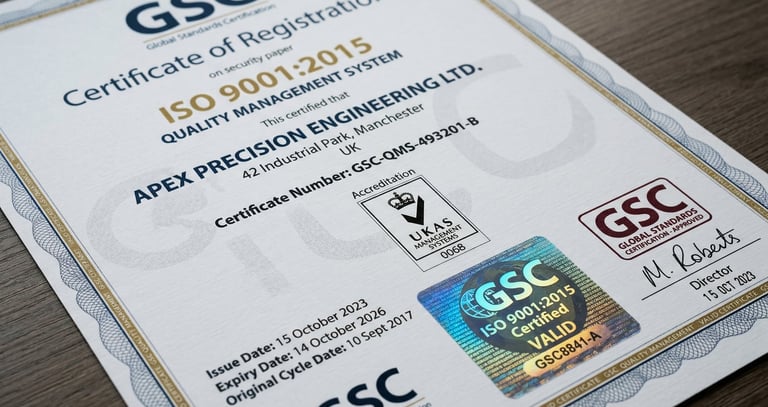
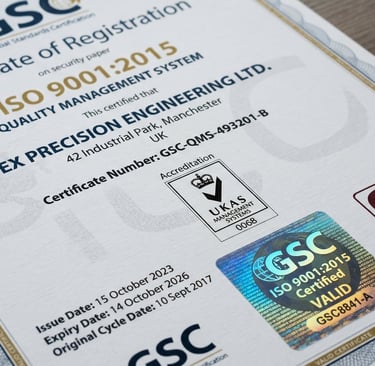
Essential Information on Valid Certificate:
1. Certification Body Information:
Name of certification body (e.g., TÜV, SGS, BSI, DNV, CQC)
Certification body logo (clear and professional)
Accreditation marks (IAF, CNAS, UKAS, etc.)
Contact information (address, website, phone)
2. Company Information:
Full legal company name (must match business license)
Complete factory address (not just city)
Registration number or certificate number
Scope of certification (specific to oil filter manufacturing)
3. Dates and Validity:
Issue date (when certificate was granted)
Expiry date (ISO 9001 certificates valid for 3 years)
Surveillance audit dates (annual audits required)
Current status (must not be expired)
4. Security Features:
Holographic seals or watermarks
Unique certificate number
Authorized signature
Official stamps or embossing
QR code or verification code (some certification bodies)
Visual Quality Indicators:
✓ Professional printing (sharp, clear text)
✓ Consistent fonts and formatting
✓ High-quality paper or official letterhead
✓ No spelling errors or grammatical mistakes
✓ Proper alignment and layout
Red Flags:
✗ Blurry or pixelated logos
✗ Inconsistent fonts or spacing
✗ Spelling errors in certification body name
✗ Generic template appearance
✗ Missing security features
✗ Photocopied appearance (not original scan)
Step 3: Verify Certification Body Accreditation
Critical Concept: Only accredited certification bodies can issue valid ISO certificates.
What is Accreditation?
Accreditation is the formal recognition that a certification body is competent to perform certifications. Accreditation bodies (like IAF members) audit and approve certification bodies.
Major Accreditation Bodies:
IAF (International Accreditation Forum): Global umbrella organization
CNAS (China): China National Accreditation Service
UKAS (UK): United Kingdom Accreditation Service
ANAB (USA): ANSI National Accreditation Board
DAkkS (Germany): Deutsche Akkreditierungsstelle
JAB (Japan): Japan Accreditation Board
How to Verify Accreditation:
Method 1: Check IAF Database
Visit: https://iaf.nu/
Click "IAF Members" or "Accreditation Bodies"
Find the accreditation body listed on the certificate
Verify it's an IAF member
Check the certification body is accredited by this accreditation body
Method 2: Check Certification Body Website
Google the certification body name
Visit their official website
Look for "Accreditation" section
Verify they display IAF or national accreditation body logos
Check their accreditation scope includes ISO 9001
Method 3: Check CNAS Database (for Chinese certificates)
Visit: https://www.cnas.org.cn/
Navigate to “Accredited Organizations” (获证组织查询)
Search for the certification body
Verify their accreditation status and scope
Legitimate Certification Bodies (Commonly Used in China):
✓ TÜV Rheinland (Germany)
✓ TÜV SÜD (Germany)
✓ SGS (Switzerland)
✓ Bureau Veritas (France)
✓ DNV (Norway)
✓ BSI (UK)
✓ CQC (China Quality Certification Centre)
✓ CCCI (China Certification Center for Automotive Products)
✓ NQA (National Quality Assurance)
Suspicious/Unaccredited Bodies (Common in Fraud):
✗ "China ISO Certification Center" (generic name, not accredited)
✗ "International Quality Certification" (vague, unverifiable)
✗ "Asia Pacific Certification" (not IAF member)
✗ Unknown names with no online presence
✗ Certification bodies with only Chinese websites and no international recognition
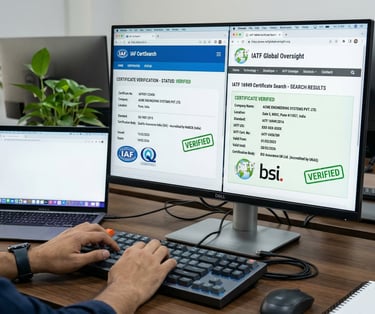
Step 4: Online Certificate Verification
Most Legitimate Certification Bodies Offer Online Verification:
TÜV Rheinland Verification :
Visit: https://www.tuv.com/
Navigate to "Certificate Verification" or "Certipedia"
Enter certificate number or company name
Verify certificate details match supplier's certificate
Check expiry date and scope
SGS Verification:
Visit: https://www.sgs.com/
Navigate to "Certificate Verification"
Enter certificate number
Confirm company name, address, scope, and validity
Bureau Veritas Verification:
Use "Certificate Finder" tool
Search by company name or certificate number
Verify all details match
CQC Verification (Chinese Certification Body):
Visit: https://www.cqc.com.cn/
Navigate to “证书查询” (Certificate Search)
Enter company name or certificate number
Verify certificate validity and scope
What to Verify Online:
☐ Certificate number matches exactly
☐ Company name matches (character-for-character)
☐ Factory address matches
☐ Issue date and expiry date match
☐ Scope includes "oil filters" or "automotive filters"
☐ Certificate status is "Valid" or "Active"
☐ No suspension or withdrawal notices
If Online Verification Not Available:
Contact certification body directly via email or phone
Provide certificate number and company name
Request confirmation of validity
Legitimate certification bodies respond within 2-3 business days
How to Verify IATF 16949 Certificates
IATF 16949 is more stringent than ISO 9001 and has additional verification requirements.
Understanding IATF 16949 Structure
Key Differences from ISO 9001:
Oversight body: IATF (International Automotive Task Force)
Certification bodies: Must be specifically sanctioned by IATF
Audit requirements: More rigorous, automotive-focused
Validity period: 3 years with annual surveillance audits
Scope restrictions: Must specify exact products and processes
IATF-Sanctioned Certification Bodies:
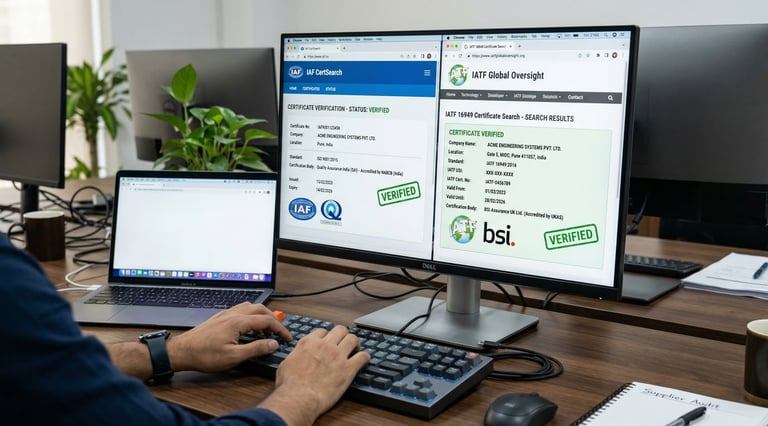
Only specific certification bodies are authorized to issue IATF 16949 certificates. Check the official list at: https://www.iatfglobaloversight.org/
Commonly Sanctioned Bodies in China:
✓ TÜV Rheinland
✓ TÜV SÜD
✓ SGS
✓ Bureau Veritas
✓ DNV
✓ BSI
✓ CQC (China Quality Certification Centre)
✓ CCCI (China Certification Center for Automotive Products)
Step-by-Step IATF 16949 Verification
Step 1: Verify Certification Body is IATF-Sanctioned
Navigate to "IATF Recognized Certification Bodies"
Search for the certification body name on the certificate
Confirm they are authorized to issue IATF 16949 certificates
Check their authorization covers China region
Step 2: Check Certificate Details
Essential Elements:
☐ Certificate clearly states "IATF 16949:2016" (current version)
☐ Not "ISO/TS 16949" (obsolete since 2018)
☐ IATF logo present (not just certification body logo)
☐ Certificate number follows IATF format
☐ Scope specifically mentions automotive products
☐ Issue date is 2017 or later (IATF 16949 launched October 2016)
Scope Verification:
The scope must specifically cover oil filter manufacturing. Generic scopes like "automotive parts" may not include filters.
Valid scope examples:
✓ "Design and manufacture of automotive oil filters"
✓ "Production of spin-on and cartridge oil filters for automotive applications"
✓ "Automotive filtration products including oil, fuel, and air filters"
Invalid/Suspicious scopes:
✗ "Automotive parts" (too vague)
✗ "Metal components" (doesn't specify filters)
✗ "General manufacturing" (not automotive-specific)
Step 3: Online Database Verification
IATF Certificate Database:
Navigate to "IATF Certificate Database" (if available)
Search by company name or certificate number
Verify certificate details
Note: IATF database access may be limited. If not accessible, verify through the certification body's own database (TÜV, SGS, etc.).
Step 4: Verify Surveillance Audits
IATF 16949 Requires Annual Surveillance:
Initial certification: Full audit
Year 1: Surveillance audit
Year 2: Surveillance audit
Year 3: Recertification audit (full audit)
How to Verify:
Request audit reports or surveillance audit confirmations
Check certificate for surveillance audit dates
Contact certification body to confirm audit schedule
Legitimate suppliers will have documentation of annual audits
Red Flags:
✗ Certificate is 2+ years old with no surveillance audit records
✗ Supplier cannot provide audit reports
✗ Certification body has no record of recent audits
✗ Certificate shows only initial certification date
Red Flags: Identifying Fake or Invalid Certificates
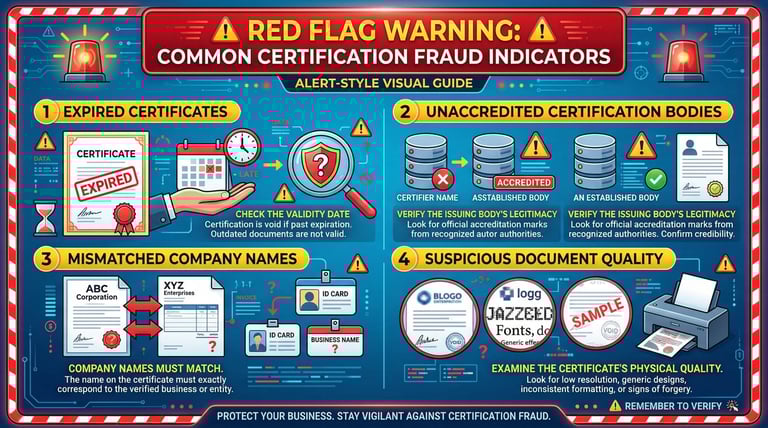
Visual Red Flags (Immediate Disqualifiers)
1. Expired Certificates
ISO 9001/IATF 16949 valid for 3 years only
Check expiry date carefully
Expired certificate = no certification
Supplier must provide current certificate
Example:
Issue date: January 15, 2020
Expiry date: January 14, 2023
Current date: March 2026
Status: EXPIRED (invalid for 3+ years)
2. Wrong Certificate Version
ISO 9001:2015 is current (since 2015)
ISO 9001:2008 expired in 2018
IATF 16949:2016 is current (since 2016)
ISO/TS 16949 expired in 2018
Red Flag Examples:
✗ Certificate shows "ISO 9001:2008" in 2026
✗ Certificate shows "ISO/TS 16949:2009"
✗ Certificate shows "QS-9000"
3. Unaccredited Certification Body
Certification body not found in IAF database
No accreditation marks on certificate
Generic or suspicious certification body name
No verifiable website or contact information
Common Fake Certification Body Names:
✗ "China ISO Certification Center"
✗ "International Quality Certification Institute"
✗ "Asia Pacific ISO Certification"
✗ "Global Quality Assurance Bureau"
✗ "China Quality Management Center"
How to Verify:
Google the certification body name
Check if they have professional website
Verify IAF membership
Look for established history (10+ years)
4. Mismatched Company Information
Company name on certificate doesn't match business license
Address on certificate doesn't match factory address
Certificate shows different legal entity
Scope doesn't cover oil filters
Verification Process:
Request business license (营业执照)
Compare company name character-by-character (Chinese and English)
Verify address matches factory location
Confirm scope includes your products
5. Poor Document Quality
Blurry or pixelated logos
Inconsistent fonts or formatting
Spelling errors or grammatical mistakes
Unprofessional appearance
Obviously photoshopped or edited
Legitimate certificates are:
✓ Professionally printed
✓ High-quality paper with security features
✓ Clear, sharp text and logos
✓ Consistent formatting throughout
✓ No errors or inconsistencies
Behavioral Red Flags (Supplier Actions)
1. Evasive Responses
Delays providing certificate
Provides partial or cropped certificate
Changes subject when asked about verification
Claims certificate is "being renewed" for extended period
Refuses to provide certificate number
2. Borrowed Certificates
Certificate belongs to parent company (not the factory you're ordering from)
Certificate belongs to customer or partner company
Multiple suppliers show identical certificate
Factory address doesn't match supplier's address
How to Detect:
Verify factory address on certificate matches supplier's factory
Ask for photos of certificate displayed at factory
Request video tour showing certificate on factory wall
Cross-reference company name with business license
3. Fake Verification Claims
Supplier provides "verification letter" instead of allowing direct verification
Claims certification body doesn't allow verification (false)
Provides fake verification website or phone number
Pressures you to skip verification ("trust us, we're certified")
Legitimate Verification:
✓ Supplier encourages verification
✓ Provides complete certificate details willingly
✓ Directs you to official certification body website
✓ Confident in certificate authenticity
4. Inconsistent Information
Certificate shows different company name than business card/website
Scope on certificate doesn't match claimed capabilities
Certificate date conflicts with company establishment date
Multiple certificates with conflicting information
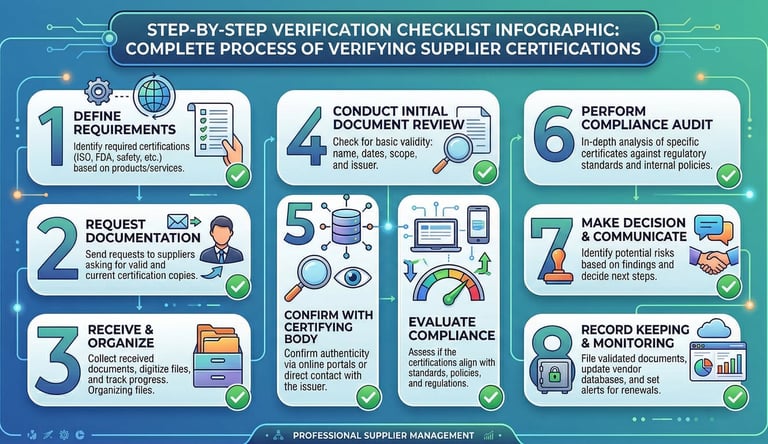
Complete Verification Checklist: 15-Minute Process
Use this checklist to verify any supplier's certifications before placing orders.
Phase 1: Initial Document Review (5 minutes)
Certificate Visual Inspection:
☐ Certificate is high-resolution and clear
☐ Certification body name is recognizable (TÜV, SGS, BSI, etc.)
☐ Certificate version is current (ISO 9001:2015, IATF 16949:2016)
☐ Certificate is not expired (check expiry date)
☐ Company name matches supplier's business license
☐ Factory address matches supplier's claimed location
☐ Scope includes oil filter manufacturing
☐ Security features present (hologram, watermark, seal)
☐ No spelling errors or formatting issues
☐ Certificate number is clearly visible
Red Flag Count:
0 red flags: Proceed to Phase 2
1-2 red flags: Investigate further, request clarification
3+ red flags: High fraud risk, consider alternative supplier
Phase 2: Accreditation Verification (5 minutes)
Certification Body Legitimacy:
☐ Certification body found on IAF member list
☐ Certification body has professional website
☐ Accreditation marks on certificate are legitimate (CNAS, UKAS, etc.)
☐ Certification body is authorized for ISO 9001 (check accreditation scope)
☐ For IATF 16949: Certification body is IATF-sanctioned
Online Resources:
IAF Members: https://iaf.nu/
IATF Sanctioned Bodies: https://www.iatfglobaloversight.org/
CNAS Database: https://www.cnas.org.cn/
Phase 3: Online Certificate Verification (5 minutes)
Direct Verification:
☐ Certificate number entered in certification body's online database
☐ Company name matches database results
☐ Certificate status shows "Valid" or "Active"
☐ Expiry date matches certificate
☐ Scope matches certificate
☐ No suspension or withdrawal notices
If Online Verification Unavailable:
☐ Email sent to certification body requesting verification
☐ Certificate number and company name provided
☐ Response received within 3-5 business days confirming validity
Alternative Verification:
☐ Request recent surveillance audit report
☐ Request certification body contact information for direct verification
☐ Ask for certificate with QR code (scan to verify)
Phase 4: Cross-Reference Verification (Bonus)
Business License Verification:
☐ Request business license (营业执照)
☐ Company name on license matches certificate exactly
☐ Business scope includes manufacturing (not just trading)
☐ Registration date predates certificate issue date
☐ License is current and not expired
Factory Verification:
☐ Request factory photos showing certificate displayed on wall
☐ Certificate in photos matches provided certificate
☐ Factory environment matches certified company's claimed capabilities
☐ Video tour shows certificate and production facilities
Third-Party Verification:
☐ Check supplier on Alibaba/Global Sources (verified supplier status)
☐ Search for supplier reviews or complaints online
☐ Contact existing customers for references
☐ Check trade databases (Import Genius, Panjiva) for export history
Verifying Test Reports and Laboratory Accreditation
Beyond management system certifications, verify product test reports and laboratory credentials.
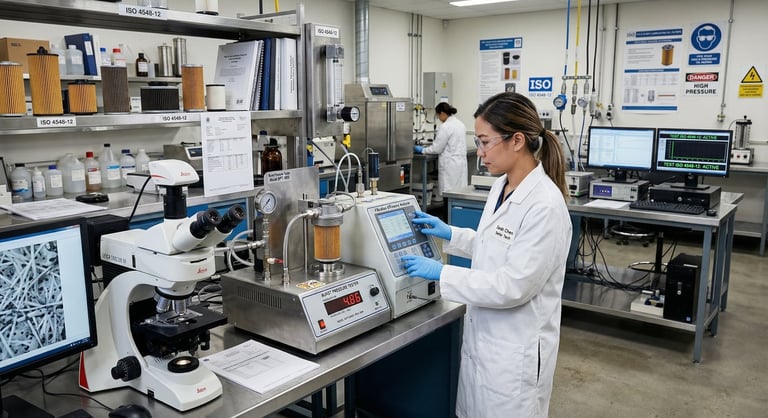
ISO 4548-12 Test Reports
What is ISO 4548-12?
International standard for testing oil filter performance:
Multi-pass filtration efficiency
Collapse/burst pressure resistance
Flow restriction and pressure drop
Cold start simulation
Particulate capacity
What to Request:
☐ Complete test report (not just summary)
☐ Testing laboratory name and accreditation
☐ Test date (within past 2 years for current products)
☐ Product identification (SKU, specifications)
☐ Test results for all required parameters
☐ Pass/fail determination
Verification Steps:
1. Verify Laboratory Accreditation
Testing must be performed by accredited laboratory
Check ISO/IEC 17025 accreditation (laboratory competence standard)
Verify laboratory is accredited for ISO 4548-12 testing
Accredited Laboratories (Common in China):
✓ SGS Testing Services
✓ Bureau Veritas Testing
✓ Intertek Testing Services
✓ TÜV Testing Labs
✓ CNAS-accredited Chinese laboratories
How to Verify Laboratory:
Check laboratory name on test report
Visit: https://www.ilac.org/ (International Laboratory Accreditation Cooperation)
Search for laboratory in ILAC database
Verify ISO/IEC 17025 accreditation
Confirm accreditation scope includes filtration testing
2. Examine Test Report Details
Essential Information:
☐ Laboratory name and accreditation number
☐ Test date and report number
☐ Product description and identification
☐ Test methods and standards (ISO 4548-12)
☐ Test conditions and parameters
☐ Measured results with units
☐ Pass/fail criteria and determination
☐ Authorized signature and stamp
Red Flags:
✗ No laboratory accreditation information
✗ Test date is >2 years old
✗ Product description doesn't match supplier's products
✗ Results are suspiciously perfect (all parameters at maximum)
✗ No report number or traceability
✗ Generic template appearance
3. Verify Test Results are Realistic
Typical ISO 4548-12 Results for Quality Filters:
Filtration efficiency (20 micron): 95-99%
Burst pressure: 300-450 psi
Collapse pressure: 15-25 psi differential
Flow restriction: <2 psi at rated flow
Particulate capacity: 8-15 grams
Suspicious Results:
✗ 100% filtration efficiency (unrealistic)
✗ Burst pressure >500 psi (unlikely for standard filters)
✗ All parameters at maximum specification (too perfect)
✗ Results identical across multiple SKUs (copy-paste fraud)
4. Contact Laboratory for Verification
Verification Email Template:
Subject: Test Report Verification Request Dear [Laboratory Name], We are verifying the authenticity of a test report for oil filters. Could you please confirm the following: - Report Number: [XXXXX] - Test Date: [Date] - Company Name: [Supplier Name] - Product: [Oil Filter Specification] Please confirm: 1. This report was issued by your laboratory 2. The test was conducted on the date shown 3. The results shown are accurate and unmodified Thank you for your assistance. Best regards, [Your Name] [Your Company]
Expected Response Time: 2-5 business days
Legitimate laboratories: Will confirm or deny report authenticity
Red flag: No response or evasive response
Real Examples: Legitimate vs Fraudulent Certificates
Example 1: Legitimate ISO 9001 Certificate (Makexcar)
Certificate Details:
Certification Body: TÜV Rheinland (Germany)
Certificate Number: 01 100 1234567 (example format)
Company Name: Wenzhou Makexcar Auto Parts Co., Ltd.
Address: [Complete factory address], Wenzhou, Zhejiang, China
Scope: Design and manufacture of automotive oil filters, fuel filters, air filters, and cabin filters
Standard: ISO 9001:2015
Issue Date: March 15, 2023
Expiry Date: March 14, 2026
Accreditation: CNAS (China), DAkkS (Germany)
Verification Results:
✓ TÜV Rheinland confirmed as IAF member
✓ Certificate number verified on TÜV Certipedia database
✓ Company name and address match exactly
✓ Scope covers oil filter manufacturing
✓ Certificate is current (not expired)
✓ Surveillance audits conducted in 2024, 2025
✓ No suspension or withdrawal notices
Why This is Legitimate:
Reputable international certification body
Verifiable online through official database
Complete and accurate information
Current validity with documented surveillance audits
Scope specifically covers oil filters
Example 2: Legitimate IATF 16949 Certificate (Makexcar)
Certificate Details:
Certification Body: TÜV Rheinland
Certificate Number: 01 300 7654321 (example format)
Company Name: Wenzhou Makexcar Auto Parts Co., Ltd.
Address: [Complete factory address], Wenzhou, Zhejiang, China
Scope: Design and manufacture of spin-on and cartridge oil filters for automotive applications
Standard: IATF 16949:2016 (including ISO 9001:2015)
Issue Date: June 20, 2022
Expiry Date: June 19, 2025
Accreditation: IATF-sanctioned, CNAS, DAkkS
Verification Results:
✓ TÜV Rheinland confirmed as IATF-sanctioned certification body
✓ Certificate verified through TÜV database
✓ IATF logo present on certificate
✓ Scope specifically covers automotive oil filters
✓ Certificate format follows IATF requirements
✓ Annual surveillance audits documented (2023, 2024)
✓ Company name matches business license exactly
Why This is Legitimate:
IATF-sanctioned certification body
Specific automotive scope
Verifiable through multiple channels
Current with documented surveillance
Meets all IATF requirements
Example 3: Fraudulent ISO 9001 Certificate (Common Scam)
Certificate Details:
Certification Body: "China ISO Certification Center"
Certificate Number: CN-ISO-2024-8888
Company Name: [Supplier Name] Trading Co., Ltd.
Address: [City name only], China
Scope: "General manufacturing and trading"
Standard: ISO 9001:2015
Issue Date: January 1, 2024
Expiry Date: December 31, 2026
Accreditation: "China Quality Bureau" (not a real accreditation body)
Red Flags Identified:
✗ "China ISO Certification Center" not found in IAF database
✗ Generic certification body name (likely fake)
✗ No professional website for certification body
✗ "China Quality Bureau" is not a legitimate accreditation body
✗ Scope is too vague ("general manufacturing")
✗ Address incomplete (only city, no street address)
✗ Certificate number format doesn't match legitimate patterns
✗ No holographic seals or security features visible
Verification Attempts:
✗ No online verification system available
✗ Email to "certification body" bounced (invalid address)
✗ Phone number on certificate is disconnected
✗ Google search shows no legitimate organization
Conclusion: FAKE CERTIFICATE
Unaccredited certification body
No verifiable contact information
Vague scope and incomplete details
Cannot be verified through any legitimate channel
Risk Assessment:
Supplier is dishonest (major red flag)
Quality claims are unreliable
Likely high defect rates (1,000-5,000 PPM)
Recommendation: DO NOT ORDER
Example 4: Expired Certificate (Common Issue)
Certificate Details:
Certification Body: SGS (legitimate)
Certificate Number: CN12/34567 (legitimate format)
Company Name: [Supplier Name] Filter Co., Ltd.
Standard: ISO 9001:2015
Issue Date: April 10, 2020
Expiry Date: April 9, 2023
Current Date: March 2026
Verification Results:
✓ SGS is legitimate, IAF-accredited certification body
✓ Certificate format is authentic
✓ Certificate number verified in SGS database
✗ Certificate expired in 2023 (3 years ago)
✗ No current certificate on file
✗ Supplier has not renewed certification
Supplier's Explanation:
"We're in the process of renewing our certification. It will be ready next month."
Reality Check:
Renewal process takes 2-3 months, not "next month" repeatedly
Supplier may have failed recertification audit
Supplier may have chosen not to renew (cost savings)
Supplier is operating without valid certification
Risk Assessment:
Quality management system may have degraded
No recent external audit oversight
Higher defect risk than certified suppliers
Recommendation: Wait for current certificate or find alternative supplier
Verifying Supplier Claims: Beyond Certificates
Certifications are important, but verify other supplier claims as well.
Production Capacity Verification
Common Claims:
"Monthly capacity: 500,000 units"
"10 production lines"
"24/7 operation"
How to Verify:
Method 1: Calculate Realistic Capacity
Standard oil filter production line: 40-60 units/hour
8-hour shift: 320-480 units per line per day
10 lines × 480 units × 25 days = 120,000 units/month
Claimed 500,000 units/month would require 40+ lines or 24/7 operation
Method 2: Request Production Schedule
Ask for current production schedule
Verify they have capacity for your order
Check lead times match claimed capacity
Overbooked factories have 45-60 day lead times
Method 3: Factory Visit or Video Tour
Count actual production lines
Observe production speed
Check equipment utilization
Verify claimed capacity is realistic
Red Flags:
✗ Claimed capacity seems impossibly high
✗ Lead times don't match claimed capacity (if capacity is high, lead times should be short)
✗ Supplier refuses factory visit or video tour
✗ Production schedule shows overbooked capacity
Quality Claims Verification
Common Claims:
"Defect rate <100 PPM"
"Zero customer complaints"
"OEM quality"
How to Verify:
Method 1: Request Quality Data
Monthly defect rate reports (past 6-12 months)
Customer complaint logs
Corrective action records
Internal audit reports
Legitimate Suppliers:
✓ Provide data transparently
✓ Show realistic defect rates (100-500 PPM is good)
✓ Document how complaints are handled
✓ Demonstrate continuous improvement
Suspicious Suppliers:
✗ Claim zero defects (unrealistic)
✗ Refuse to provide data ("confidential")
✗ Provide only perfect data (likely fabricated)
✗ No documentation of corrective actions
Method 2: Reference Checks
Request 3-5 current customer references
Contact customers directly (not through supplier)
Ask about quality experience, defect rates, responsiveness
Verify customers are real businesses (not fake references)
Method 3: Sample Testing
Order samples (5-10 pieces)
Test on actual vehicles
Send to independent laboratory for ISO 4548-12 testing
Compare results to supplier's claims
Export History Verification
Why It Matters:
Proven export experience reduces risk
Established exporters understand international requirements
Export history indicates business stability
How to Verify:
Method 1: Import/Export Databases
USA: Import Genius, Panjiva (subscription required)
Search: Supplier company name
Verify: Export volume, destination countries, product types
Red flag: No export history or very limited exports
Method 2: Request Export Documentation
Bill of lading (B/L) from recent shipments (redact customer names)
Commercial invoices
Packing lists
Customs declarations
What to Look For:
✓ Multiple shipments to different countries
✓ Consistent export activity (monthly or quarterly)
✓ Products match claimed specialization (oil filters)
✓ Export values match claimed business scale
Method 3: Customer Testimonials
Request testimonials from international customers
Verify customers are real (Google company name, check website)
Contact customers directly if possible
Ask about experience, quality, and reliability
Case Studies: Verification in Action
Case Study 1: Avoided Disaster - Fake IATF 16949 Certificate
Background:
A California distributor was evaluating two Chinese oil filter suppliers for a $45,000 initial order.
Supplier A Claims:
IATF 16949:2016 certified
"OEM quality"
Pricing: $2.10 per unit (15% below market)
Verification Process:
Step 1: Certificate Review
Certificate showed "IATF 16949:2016"
Certification body: "Asia Pacific Automotive Certification"
Certificate looked professional at first glance
Step 2: Certification Body Verification
Searched IATF sanctioned certification bodies list
"Asia Pacific Automotive Certification" NOT FOUND
Searched IAF member database: NOT FOUND
Googled certification body: No professional website, only suspicious results
Step 3: Attempted Online Verification
No online verification system available
Email to certification body bounced (invalid address)
Phone number disconnected
Conclusion: FAKE CERTIFICATE
Distributor's Decision:
Did not place order with Supplier A
Avoided potential $45,000 loss
Reported fraud to Alibaba (supplier was removed)
Supplier B Verification:
Makexcar with legitimate TÜV Rheinland IATF 16949 certificate
Verified online through TÜV Certipedia
Pricing: $2.40 per unit (14% higher than Supplier A)
Placed order with Supplier B
Outcome:
Received high-quality products (0.18% defect rate)
Successful business relationship
Avoided disaster with Supplier A
Lesson Learned:
"The $0.30 per unit premium for certified supplier was the best money we ever spent. If we'd ordered from Supplier A with the fake certificate, we'd have lost everything. Verification takes 15 minutes and can save your business." - California Distributor
Case Study 2: Expired Certificate Caught Early
Background:
A UK distributor was sourcing oil filters for European market, requiring IATF 16949 certification.
Supplier Claims:
IATF 16949 certified
"Supplying European OEMs"
Provided certificate via email
Verification Process:
Step 1: Certificate Review
Certification body: Bureau Veritas (legitimate)
Standard: IATF 16949:2016
Issue date: May 2019
Expiry date: May 2022
Current date: March 2026
Discovery: EXPIRED CERTIFICATE (4 years ago)
Step 2: Contacted Supplier
Distributor: "Your certificate expired in 2022. Can you provide current certificate?"
Supplier response: "We're renewing it now, will be ready in 2 weeks."
Step 3: Followed Up After 2 Weeks
Supplier: "Audit is scheduled for next month."
Step 4: Followed Up After 1 Month
Supplier: "We're waiting for audit report."
Reality:
Supplier had failed recertification audit
Was operating without valid certification for 4 years
Kept delaying to avoid admitting failure
Distributor's Decision:
Switched to alternative supplier (Makexcar)
Verified current IATF 16949 certificate
Placed order with confidence
Outcome:
Avoided compliance issues in EU market
Received certified products meeting EU requirements
Maintained business reputation
Lesson Learned:
"In the EU, we face strict liability laws. Selling uncertified products could have resulted in recalls and legal action. Spending 30 minutes to verify the certificate saved us from potential bankruptcy." - UK Distributor
Case Study 3: Borrowed Certificate Fraud
Background:
A Texas distributor found a supplier on Alibaba offering "IATF 16949 certified" oil filters at attractive pricing.
Supplier Claims:
IATF 16949:2016 certified
"Factory direct"
Pricing: $2.25 per unit
Verification Process:
Step 1: Certificate Review
Certification body: SGS (legitimate)
Standard: IATF 16949:2016
Certificate appeared authentic
Step 2: Online Verification
Certificate number verified on SGS database
Company name on certificate: "ABC Automotive Manufacturing Co., Ltd."
Supplier's company name: "XYZ Trading Co., Ltd."
MISMATCH DETECTED
Step 3: Confronted Supplier
Distributor: "The certificate shows ABC Automotive, but your company is XYZ Trading. Can you explain?"
Supplier response: "ABC is our factory partner. We source from them."
Step 4: Investigated Further
Contacted ABC Automotive directly
ABC confirmed they manufacture filters
ABC stated they do NOT supply XYZ Trading
XYZ Trading is using ABC's certificate fraudulently
Conclusion: BORROWED CERTIFICATE FRAUD
Distributor's Decision:
Did not order from XYZ Trading
Contacted ABC Automotive directly (but MOQ was 5,000 units, too high)
Found alternative certified supplier with lower MOQ (Makexcar)
Outcome:
Avoided trading company markup (15-30%)
Avoided quality inconsistency risk (trading companies switch factories)
Established direct relationship with certified manufacturer
Lesson Learned:
"Always verify the company name on the certificate matches the supplier exactly. Trading companies often borrow their factory partners' certificates, but you have no guarantee they'll actually source from that factory." - Texas Distributor
Frequently Asked Questions
Q1: How long does it take to verify a supplier's certifications?
A: 15-30 minutes for basic verification, 1-2 weeks for comprehensive verification.
Quick Verification (15-30 minutes):
Visual certificate inspection: 5 minutes
Certification body accreditation check: 5 minutes
Online certificate verification: 5-10 minutes
Red flag assessment: 5 minutes
Total: 20-30 minutes
Sufficient for: Initial supplier screening, eliminating obvious frauds
Comprehensive Verification (1-2 weeks):
Quick verification: 30 minutes
Email verification request to certification body: 3-5 days response
Reference checks with existing customers: 3-7 days
Sample testing (optional): 7-14 days
Factory audit (optional): 2-4 weeks to schedule
Total: 1-4 weeks
Sufficient for: Final supplier selection, large orders ($20,000+), private label programs
Recommended Approach:
Phase 1: Quick verification for all potential suppliers (eliminate 60-70%)
Phase 2: Comprehensive verification for top 2-3 finalists
Phase 3: Factory visit or third-party audit before first large order
Time Investment vs Risk:
30 minutes verification can prevent $10,000-$50,000 losses
ROI: 2,000-10,000% (time invested vs money saved)
Always worth the effort
Q2: Can I trust certificates shown on Alibaba or supplier websites?
A: No. Always verify independently through official certification body databases.
Why Website Certificates Are Unreliable:
Alibaba "Verified Supplier" Status:
Only verifies business license exists
Does NOT verify quality certifications
Does NOT verify factory capabilities
Does NOT guarantee product quality
Alibaba states: "Verified Supplier status does not guarantee quality"
Supplier Website Certificates:
Easy to photoshop or fabricate
May be expired (website not updated)
May belong to different company
May be borrowed from partner/customer
No accountability for accuracy
Statistics:
40-50% of certificates shown on Alibaba are fake, expired, or borrowed
30-40% of supplier websites show outdated certificates
Only 10-20% of displayed certificates are current and verifiable
Safe Approach:
Never trust displayed certificates at face value
Always request original certificate directly from supplier
Verify through official certification body database
Confirm company name and address match exactly
Check expiry date and current status
Alibaba's Own Advice:
Alibaba explicitly states in their buyer protection guidelines: "Verify all certifications independently. Alibaba does not verify the authenticity of quality certifications."
Q3: What if the supplier refuses to provide certification details for verification?
A: This is a major red flag. Legitimate suppliers welcome verification and provide complete details.
Legitimate Reasons for Hesitation (Rare):
Concerns about competitors stealing certificate details (can redact some info)
Language barriers (may not understand verification request)
Inexperience with international customers (can be educated)
How to Address Legitimate Concerns:
If Supplier Says: "Our certificate is confidential."
Your Response: "I understand confidentiality concerns. I only need to verify authenticity through the certification body's official database. You can redact sensitive information, but I need the certificate number and certification body name."
If Supplier Says: "Why don't you trust us?"
Your Response: "This is standard due diligence for all our suppliers, not a lack of trust. Verification protects both of us and is required by our quality management system."
If Supplier Says: "The certification body doesn't allow verification."
Your Response: "All legitimate certification bodies encourage verification. Can you provide their contact information so I can confirm their policy?"
Illegitimate Reasons (Red Flags):
✗ Outright refusal with no explanation
✗ Evasive responses or changing subject
✗ Claims certificate is "internal only" (false—certifications are meant to be shared)
✗ Becomes defensive or aggressive
✗ Threatens to cancel negotiation if you insist on verification
Your Decision:
If supplier refuses verification after reasonable requests:
High probability of fraud (80%+)
Do not place order
Find alternative supplier
Report to platform (Alibaba, Global Sources) if applicable
Professional Approach:
"We require verification of all supplier certifications as part of our due diligence process. This is non-negotiable. If you're unable to provide verification, we'll need to work with a different supplier. Thank you for understanding."
Q4 : Are Chinese certification bodies (like CQC) as reliable as international ones (like TÜV) ?
A: Yes, if they are accredited by CNAS and recognized by IAF. Accreditation matters more than nationality.
Understanding Certification Body Hierarchy:
Tier 1: International Certification Bodies
TÜV (Germany), SGS (Switzerland), Bureau Veritas (France), DNV (Norway), BSI (UK)
Advantages: Global recognition, consistent standards, extensive experience
Cost: Higher certification fees ($5,000-$15,000)
Prestige: Stronger market recognition, especially in Europe/USA
Tier 2: Chinese Certification Bodies (Accredited)
CQC (China Quality Certification Centre), CCCI (China Certification Center for Automotive Products)
Advantages: Lower cost ($3,000-$8,000), understand Chinese manufacturing context
Recognition: Fully valid if CNAS-accredited and IAF-recognized
Quality: Same ISO/IATF standards applied
Tier 3: Unaccredited Bodies (Invalid)
Generic names, no IAF recognition, no verifiable accreditation
Validity: ZERO (not recognized internationally)
Cost: Very cheap ($500-$2,000)
Value: Worthless for quality assurance
Key Principle: Accreditation Matters Most
CQC (CNAS-accredited) = Just as valid as TÜV (DAkkS-accredited)
Both follow same ISO/IATF standards
Both undergo regular accreditation body oversight
Both certificates are internationally recognized
When to Prefer International Bodies:
Supplying to European OEMs (TÜV, BSI preferred)
Supplying to US OEMs (ANAB-accredited bodies preferred)
Marketing to quality-conscious customers (brand recognition)
High-value or high-risk products
When Chinese Bodies Are Acceptable:
Aftermarket products (not OEM supply)
Cost-sensitive sourcing
Supplier has proven track record
Certificate is verifiable and current
Makexcar Example:
Certified by TÜV Rheinland (international body)
CNAS and DAkkS accreditation
Verifiable online through TÜV Certipedia
Conclusion: Fully legitimate and internationally recognized
Q5: How often should I re-verify supplier certifications?
A: Annually at minimum, or whenever placing large orders or launching new products.
Verification Schedule:
Initial Verification (Before First Order):
Complete 15-30 minute verification process
Verify certificate is current and valid
Check certification body accreditation
Online database verification
Required for all new suppliers
Annual Re-Verification:
Check certificate has not expired (ISO/IATF valid 3 years)
Verify surveillance audits conducted (required annually)
Confirm no suspension or withdrawal notices
Update your supplier qualification records
Required for all active suppliers
Before Large Orders:
Re-verify if order value >$50,000
Confirm certificate still valid
Check for any recent issues or complaints
Request updated quality data
Recommended for risk management
Before Private Label Launch:
Comprehensive re-verification
Request recent audit reports
Consider third-party factory audit
Verify laboratory test reports
Essential for brand protection
Trigger Events for Immediate Re-Verification:
Quality issues or increased defect rates
Supplier changes factory location
Supplier changes company name
Certificate expiry date approaching
Rumors or reports of certification problems
Documentation:
Maintain verification records for each supplier
Document verification date, method, and results
Set calendar reminders for annual re-verification
Update supplier qualification database
Best Practice:
Create a supplier qualification file for each supplier containing:
Current certificates (updated annually)
Verification records and dates
Audit reports (if available)
Test reports and quality data
Business license and export documentation
Contact information for certification bodies
Reference check notes
Q6: What should I do if I discover my current supplier's certificate is fake?
A: Stop ordering immediately, assess your risk exposure, and transition to verified supplier.
Immediate Actions:
Step 1: Confirm the Finding (24 hours)
Double-check your verification (ensure you didn't make an error)
Verify through multiple channels (certification body website, direct contact)
Document all evidence (screenshots, emails, verification results)
Be 100% certain before confronting supplier
Step 2: Assess Your Risk Exposure (48 hours)
How many units have you purchased?
How many units are currently in your inventory?
How many units have been sold to customers?
Have there been quality issues or complaints?
What is your potential liability exposure?
Risk Categories:
Low risk: Small trial order (500-1,000 units), no quality issues yet
Medium risk: Multiple orders (5,000-10,000 units), occasional quality issues
High risk: Large volume (20,000+ units), quality problems, customer complaints
Step 3: Confront Supplier (If Appropriate)
For Low-Risk Situations:
Email: "We attempted to verify your ISO 9001 certificate through [certification body] and were unable to confirm its validity. Can you provide clarification or updated certificate information?"
Possible Outcomes:
Supplier admits certificate is expired, provides current certificate (best case)
Supplier provides alternative explanation (certificate belongs to parent company, etc.)
Supplier becomes evasive or defensive (confirms fraud)
For Medium/High-Risk Situations:
Do NOT confront supplier (may destroy evidence or disappear)
Consult with legal counsel
Document all evidence
Prepare for potential legal action
Step 4: Stop Ordering (Immediately)
Place no new orders with this supplier
Cancel any pending orders if possible
Do not accept any shipments in transit (if you have legal grounds)
Begin transition to verified supplier
Step 5: Quality Assessment of Existing Inventory
Test sample of existing inventory (if not already done)
Send to independent laboratory for ISO 4548-12 testing
Assess actual quality vs claimed quality
Determine if products are safe to sell
If Quality is Acceptable:
Sell through existing inventory
Disclose to customers if required by law
Transition to verified supplier for future orders
If Quality is Poor:
Quarantine inventory
Consider returning to supplier (if possible)
Liquidate at cost or below (cut losses)
Do NOT sell defective products (liability risk)
Step 6: Transition to Verified Supplier
Identify 2-3 certified suppliers
Conduct thorough verification (comprehensive process)
Order samples and test quality
Place trial order with verified supplier
Gradually transition all volume
Step 7: Learn and Improve
Update supplier qualification procedures
Implement mandatory verification for all suppliers
Train team on verification process
Document lessons learned
Legal Considerations:
Consult attorney if you've sold significant volume
Assess product liability exposure
Review insurance coverage
Consider reporting fraud to authorities (if applicable)
Q7: Do I need to verify certifications for every order, or just once?
A: Verify thoroughly before first order, then re-verify annually or when certificates expire.
Verification Frequency:
Before First Order (Mandatory):
Complete verification process (15-30 minutes)
Verify certificate is current and legitimate
Check certification body accreditation
Online database verification
Do not skip this step
Ongoing Orders (Annual Re-Verification):
Check certificate expiry date annually
Verify surveillance audits conducted
Confirm no suspension or withdrawal
Update supplier qualification records
Set calendar reminder for annual check
When to Re-Verify Immediately:
Certificate expiry date approaching (within 6 months)
Quality issues or increased defect rates
Supplier changes location or company name
Large order or private label launch
Regulatory audit or customer requirement
Surveillance Audit Monitoring:
ISO 9001/IATF 16949 require annual surveillance audits
Request confirmation of surveillance audit completion
Legitimate suppliers provide audit reports or confirmation letters
Missed surveillance audits may result in certificate suspension
Certificate Renewal Monitoring:
Certificates valid for 3 years
Renewal process takes 2-3 months
Monitor expiry dates 6 months in advance
Request updated certificate upon renewal
Verify renewed certificate through online database
Best Practice:
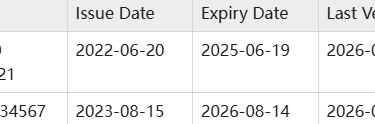
Create a supplier certification tracking spreadsheet:
Supplier name
Certificate type (ISO 9001, IATF 16949)
Certificate number
Issue date
Expiry date
Last verification date
Next verification due date
Surveillance audit dates
Notes and red flags
Example:
2022-06-20
Q8: What certifications are absolutely necessary vs nice-to-have?
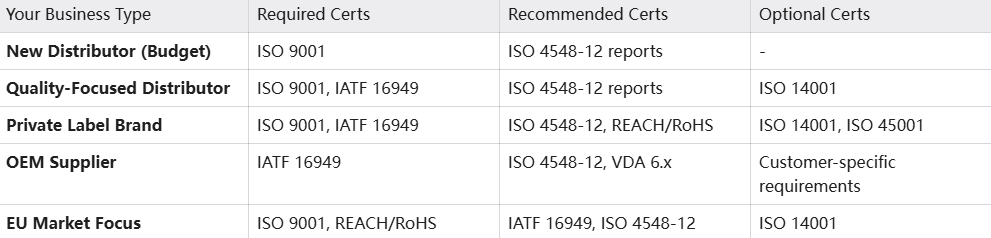
A: ISO 9001 is minimum requirement. IATF 16949 is highly recommended for quality-focused distributors.
Certification Priority Matrix:
Tier 1: Essential (Non-Negotiable)
ISO 9001:2015
Priority: Mandatory minimum
Why: Ensures basic quality management system
Impact: 5-10x quality improvement over non-certified
Cost impact: +$0.20-$0.40 per unit vs non-certified
Recommendation: Never order from non-ISO 9001 suppliers
Tier 2: Highly Recommended (Quality Assurance)
IATF 16949:2016
Priority: Highly recommended for quality-focused distributors
Why: Automotive-specific quality requirements, lower defect rates
Impact: 10-20x quality improvement over non-certified, 2x improvement over ISO 9001 only
Cost impact: +$0.10-$0.20 per unit vs ISO 9001 only
Recommendation: Choose IATF 16949 suppliers for premium positioning, OEM-equivalent quality
Tier 3: Nice-to-Have (Market-Specific)
ISO 4548-12 Test Reports
Priority: Recommended for first order and new SKUs
Why: Verifies actual product performance
Impact: Confirms filtration efficiency, burst pressure, flow restriction
Cost impact: $500-$800 per SKU (one-time testing)
Recommendation: Request test reports, verify laboratory accreditation
REACH/RoHS Compliance (EU Markets)
Priority: Mandatory for EU sales
Why: EU regulations prohibit certain hazardous substances
Impact: Legal compliance, market access
Cost impact: Minimal (standard materials comply)
Recommendation: Request declarations of conformity for EU-destined products
VDA 6.1/6.3 (German Automotive)
Priority: Nice-to-have for European OEM supply
Why: German automotive industry standards
Impact: Additional quality assurance
Cost impact: +$0.05-$0.10 per unit
Recommendation: Only necessary if supplying German OEMs or targeting premium German market
Tier 4: Optional (Specialized)
ISO 14001 (Environmental Management)
Priority: Optional
Why: Environmental responsibility, sustainability marketing
Impact: Minimal direct quality impact
Cost impact: Minimal
Recommendation: Nice-to-have for sustainability-focused brands
OHSAS 18001 / ISO 45001 (Occupational Health & Safety)
Priority: Optional
Why: Worker safety and ethical manufacturing
Impact: No direct product quality impact
Cost impact: Minimal
Recommendation: Consider for ethical sourcing programs
Decision Matrix:
Cost-Benefit Analysis:
Scenario 1: Non-Certified Supplier
Cost: $1.80 per unit (lowest)
Defect rate: 1,000-5,000 PPM (0.1-0.5%)
Risk: High (product recalls, customer complaints, liability)
Total cost including defects: $2.00-$2.50 per unit
Recommendation: AVOID
Scenario 2: ISO 9001 Only
Cost: $2.20 per unit
Defect rate: 200-500 PPM (0.02-0.05%)
Risk: Moderate (occasional quality issues)
Total cost including defects: $2.25-$2.35 per unit
Recommendation: Acceptable for budget-focused distributors
Scenario 3: IATF 16949
Cost: $2.40 per unit
Defect rate: 50-150 PPM (0.005-0.015%)
Risk: Low (consistent quality, minimal issues)
Total cost including defects: $2.42-$2.48 per unit
Recommendation: Best value for quality-focused distributors
Key Insight: IATF 16949 costs $0.20 more per unit but saves $0.10-$0.20 in defect-related costs. Net cost difference is minimal, but quality and reputation benefits are substantial.
Advanced Verification: Third-Party Audits and Factory Visits
For large orders or private label programs, consider comprehensive third-party verification.
Third-Party Supplier Audits
When to Consider:
First order value >$50,000
Private label program launch
Long-term supply agreement
Previous quality issues with other suppliers
High-risk or high-value products
Audit Service Providers:
SGS: Supplier audit services ($1,500-$3,000)
Bureau Veritas: Factory assessment ($1,500-$3,000)
Intertek: Supplier qualification audit ($1,500-$3,000)
TÜV : Manufacturing audit ($2,000-$4,000)
Independent consultants: $1,000-$2,500
What Audits Cover:
1. Certification Verification:
Physical inspection of original certificates
Verification of certificate authenticity
Check surveillance audit records
Review internal audit documentation
2. Production Capability:
Production equipment inspection
Capacity verification
Process control assessment
Material handling and storage
3. Quality Management:
Quality control procedures
Testing equipment and calibration
Defect tracking and corrective actions
Document control systems
4. Compliance and Legal:
Business license verification
Export license verification
Product liability insurance
Labor and environmental compliance
Audit Report Includes:
Detailed findings and observations
Risk assessment (low/medium/high)
Recommendations for improvement
Pass/fail determination
Photos and evidence
Cost-Benefit Analysis:
Audit cost: $1,500-$3,000
Order value: $50,000
Audit cost as % of order: 3-6%
Potential loss if supplier is fraudulent: $50,000 (100%)
ROI: 1,500-3,000% risk mitigation
Factory Visit Best Practices
Planning Your Visit:
Before Visiting:
Schedule in advance (2-4 weeks notice)
Prepare checklist of items to verify
Bring camera for documentation
Arrange translator if needed
Plan 4-6 hours for comprehensive visit
What to Inspect:
1. Certificate Display:
Certificates displayed prominently in reception or office
Original certificates (not photocopies)
Current and not expired
Company name matches factory
2. Production Facilities:
Equipment matches claimed capacity
Production lines organized and clean
Workers trained and following procedures
Safety equipment and protocols in place
3. Quality Control:
Dedicated QC department
Testing equipment present and calibrated
Quality records maintained
Defect tracking systems
4. Documentation:
Request to see original certificates (not just displayed copies)
Review recent audit reports
Check quality data and defect tracking
Verify business license and export license
Red Flags During Visit:
✗ Supplier discourages or restricts factory access
✗ Certificates are photocopies or not displayed
✗ Production equipment doesn't match claimed capacity
✗ Disorganized or dirty production environment
✗ No visible quality control processes
✗ Workers unable to explain quality procedures
✗ Supplier rushes visit or limits access to certain areas
Documentation:
Take photos of certificates (with permission)
Photograph production equipment and processes
Document observations and findings
Collect business cards and contact information
Request copies of certificates and licenses
Certification Verification Tools and Resources
Free Online Verification Resources
International Accreditation Forum (IAF):
Website: https://iaf.nu/
Purpose: Verify accreditation body legitimacy
Use: Check if certification body is IAF member
IATF Global Oversight:
Website: https://www.iatfglobaloversight.org/
Purpose: Verify IATF 16949 certification body authorization
Use: Confirm certification body can issue IATF 16949 certificates
CNAS (China National Accreditation Service):
Website: https://www.cnas.org.cn/
Purpose: Verify Chinese certification body and laboratory accreditation
Use: Check accreditation status of Chinese certification bodies and testing labs
Certification Body Databases:
TÜV Certipedia : https://www.tuv.com/
SGS Certificate Verification: https://www.sgs.com/
Bureau Veritas Certificate Finder: https://www.bureauveritas.com/
BSI Certificate Validation: https://www.bsigroup.com/
CQC Certificate Search: https://www.cqc.com.cn/
Paid Verification Services
Supplier Verification Services:
Alibaba Supplier Assessment: $200-$500 (basic verification)
SGS Supplier Audit: $1,500-$3,000 (comprehensive audit)
Bureau Veritas Factory Assessment: $1,500-$3,000
Intertek Supplier Qualification: $1,500-$3,000
Laboratory Testing Services:
SGS Testing: $500-$1,500 per SKU
Bureau Veritas Testing: $500-$1,500 per SKU
Intertek Testing: $500-$1,500 per SKU
Independent laboratories: $400-$1,200 per SKU
Background Check Services:
Import Genius: $99-$299/month (US import data)
Panjiva: $199-$499/month (global trade data)
Dun & Bradstreet: $50-$200 per report (company credit and background)
Verification Workflow Template
Create a standardized process for your team:
Stage 1: Initial Screening (5 minutes per supplier)
Review certificate visually
Check expiry date
Verify certification body is recognizable
Pass/Fail: Eliminate obvious frauds
Stage 2: Online Verification (10 minutes per supplier)
Check certification body accreditation
Verify certificate online through official database
Confirm company name and details match
Pass/Fail: Eliminate unverifiable certificates
Stage 3: Detailed Verification (30 minutes per supplier)
Email certification body for confirmation
Request additional documentation (audit reports, test reports)
Check supplier references
Review online reputation
Pass/Fail: Select top 2-3 finalists
Stage 4: Comprehensive Verification (1-2 weeks for finalists)
Order samples and test quality
Consider third-party audit (for large orders)
Factory visit (if feasible)
Legal and financial background check
Pass/Fail: Select primary supplier
Documentation:
Maintain verification records for each stage
Document decision rationale
Update supplier qualification database
Set reminders for re-verification
Conclusion: Verification is Your Best Investment
Spending 15-30 minutes to verify supplier certifications is the single most important step in sourcing oil filters from China. Certificate fraud is rampant, but verification is straightforward and can prevent catastrophic losses.
Key Takeaways:
Never trust displayed certificates: Always verify independently through official databases
Accreditation matters most: Only IAF-recognized certification bodies issue valid certificates
Verification is free and fast: 15-30 minutes can save $10,000-$50,000
IATF 16949 > ISO 9001 > No certification: Quality difference is dramatic (10-20x defect rate improvement)
Expired certificates are worthless: Check expiry dates carefully—many suppliers show expired certificates
Company name must match exactly: Borrowed certificates are common fraud tactic
Red flags require action: If supplier is evasive or certificate is unverifiable, walk away
Re-verify annually: Certificates expire, surveillance audits are required, status can change
Verification ROI:
Time invested: 30 minutes
Cost: $0 (free online verification)
Potential loss prevented: $10,000-$50,000
Return on investment: INFINITE
Action Plan:
Before Your Next Order:
Request complete certificate documentation from supplier
Verify certification body is IAF-accredited
Verify certificate online through official database
Confirm company name, address, and scope match
Check certificate is current (not expired)
Document verification results
Proceed with order only if verification passes
For Existing Suppliers:
Re-verify all current supplier certificates
Check expiry dates and surveillance audit status
Update supplier qualification records
Set annual re-verification reminders
Transition away from any suppliers with invalid certificates
Building Your Verification System:
Create supplier certification tracking spreadsheet
Document verification procedures for your team
Train staff on red flags and verification process
Make verification mandatory before all new orders
Conduct annual supplier certification reviews
Ready to Source from Verified Suppliers?
Makexcar: Fully Verified and Transparent
Our Certifications:
✓ ISO 9001:2015 (TÜV Rheinland certified)
✓ IATF 16949:2016 (TÜV Rheinland certified)
✓ All certificates verifiable online through TÜV Certipedia
✓ Annual surveillance audits completed on schedule
✓ Complete transparency—we encourage verification
Verification Information:
Certification Body: TÜV Rheinland (IAF member, IATF-sanctioned)
Certificates: Available for download on our website
Verification: Visit www.tuv.com and search "Makexcar" or use our certificate numbers
Test Reports: ISO 4548-12 reports available for all product lines
Factory Visits: Welcome—schedule anytime
Contact Us for Verified Quality:
📧 Email: sale1@makexcar.com
📱 WhatsApp: +86 199 1234 680
📞 Phone: +86 199 1234 680
🌐 Website: www.makexcar.com
What We Provide:
Complete certificate documentation (ISO 9001, IATF 16949)
Certificate verification instructions
Recent audit reports (upon request)
ISO 4548-12 test reports for all products
Business license and export license copies
Factory video tour or in-person visit welcome
Our Commitment:
We understand certification verification is essential for your business. We provide complete transparency and encourage thorough verification. Our quality management systems are genuine, our certifications are current, and our quality is proven.
Related Resources:
Low MOQ Oil Filter Sourcing Guide - Complete guide to 500-unit minimum orders
Factory Direct Pricing Guide - Wholesale pricing and bulk discounts
China Oil Filter Manufacturer Sourcing Guide - Comprehensive B2B sourcing guide
Product Catalog - Browse 500+ certified SKUs
Contact Us - Request certificates and verification information
Disclaimer: This guide provides general information about certification verification. Always conduct your own due diligence and consult with legal and quality professionals for specific situations. Certification requirements may vary by market and application.




Whatsapp: +86 19941234680
Phone:+86 19941234680
© 2025. All rights reserved.
Email:sales1@makexcar.com
Wechat:Sgxwtxa