What does integrated electronics actually tell the buyer?
The description signals that the drive includes some electronic functionality. It does not, by itself, describe every function or establish where the complete window control system resides. For purchasing, the useful question is what the specified unit must do in the particular vehicle and how that requirement is documented.
Brose's official door-system overview provides an example of this distinction. Its window regulator drive section describes scalable electronic functions, including sensing, automatic lowering, anti-trap functionality and PWM control. A separate door control unit section identifies CAN or LIN interfaces. These are descriptions of Brose's portfolio, not specifications for a MAKEXCAR product or proof that every motor uses those interfaces.
Ask the supplier to identify the offered assembly and the source that describes its functions. The response should distinguish the motor or drive from a separate door controller, switches and vehicle wiring. The objective is an application-specific match, rather than a general statement that the replacement is an electronic motor.
Start with the application and component identity
Record the destination market, vehicle model, model year or production interval, body variant and door position. Keep the original component reference separate from the supplier's SKU. If the catalog lists qualifiers concerning window options or electronic equipment, retain the exact wording and the catalog revision used for the inquiry.
A vehicle registration year is useful background but may leave production or equipment distinctions unresolved. Ask the customer for the identification needed by the applicable catalog. A photograph of the original label can help establish a reference; it cannot replace the vehicle application check or prove that two revisions share the same function set.
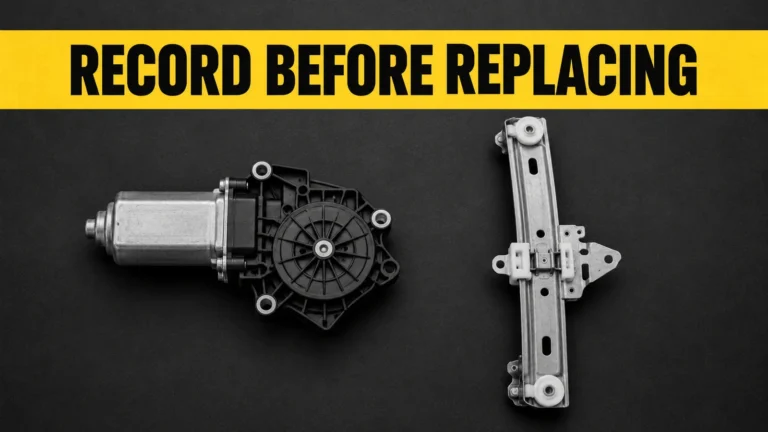
Clarify the supply boundary as well. Is the quotation for a motor alone, a drive with its electronic housing, or a regulator assembly including the drive? Identify any separate controller or retained component involved in the proposed replacement. This establishes what the supplier is evaluating and prevents a quotation from silently assuming that an existing electronic component will be reused.
Build a function record for the offered SKU
Use a short record that links each requirement to evidence. A catalog entry may establish the application while a technical sheet explains the electronic interface. If a requirement remains unresolved, mark it explicitly and request the missing source before approving the replacement.
| Field to establish | Why it matters | Next request if missing |
|---|---|---|
| Application and component reference | A familiar housing can cover a different build or equipment arrangement. | Request current catalog qualifiers, original reference and offered SKU. |
| Electrical interface and its location | A door-system protocol statement may describe a separate controller. | Request the actual unit's interface document and component boundary. |
| Required functions and dependencies | Ordinary movement does not establish automatic or protection behavior. | Ask which source supports each required function for the offered assembly. |
| Configuration and retained components | A lower quote may assume setup work or reuse that remains undocumented. | Request application-specific setup information and the defined supply scope. |
| Revision and acceptance record | An earlier confirmation may not support a revised unit or application. | Identify the current document version and responsible application reviewer. |
This is an editorial purchasing worksheet. It is not a universal electrical standard or a test procedure. A line reading “not applicable” should have a documented reason, while “not yet confirmed” should identify who will supply the answer. Those responses have different implications for an order decision.
Separate connector appearance from electrical compatibility
A connector image helps compare visible housing features and locate the relevant documentation. It does not establish terminal assignments, signal characteristics or the electrical function of each connection. Do not convert a visible pin count into a claim about automatic operation, communication or protection functions.
CARDONE's PT42-0007 guidance, published in 2020, cautions that wire colors and connections must not be assumed and directs readers to the applicable vehicle information and the information supplied with the unit. Here, that guidance supports a request for the correct interface documentation. It is not being used as a universal wiring map or an instruction for energizing an unidentified motor.
When an offer describes PWM, CAN or LIN, ask where the named interface is located and which source supports the statement for that SKU. A vehicle may have a separate control component in the arrangement under review. An interface named in a general door-system description cannot establish the interface at the offered motor's connector.
If the supplier proposes an adapter or a different connector version, request the application-specific basis and the defined supply scope. A photograph of a mating connector is not approval of a conversion. Any unresolved electrical difference should remain visible in the inquiry record rather than being dismissed because the mounting shape looks similar.
Keep each required function visible in the comparison
Use the actual requirement names and their supporting sources. Automatic lowering and automatic raising are separate entries when both are relevant. Protection behavior belongs to the applicable system documentation. Confirmation of ordinary movement cannot silently close an automatic or protection-function field.
For a hypothetical offer, the supplier supports ordinary movement and automatic lowering but provides no evidence for a required protection function. Name that open requirement and request the relevant function description for the proposed reference. Do not infer the missing capability from another portfolio or from several other answered fields.
A reply marked not applicable needs an application explanation; a reply awaiting confirmation names an evidence gap. These statements should not be combined into one negative or positive compatibility field. Their distinction tells the buyer whether the request or the supplier evidence needs further review.
Keep the underlying function entries beside the quotation and identify who will resolve each question. A percentage of confirmed rows cannot establish the missing function or serve as acceptance evidence. Update the affected requirement when new documentation arrives instead of using a favorable total to conceal the gap.
Identify configuration requirements before placing the order
Ask whether the specified application requires coding, initialization, adaptation or another documented setup step after replacement. Do not infer the answer from the word integrated, from the number of terminals or from a generic claim of plug-and-play operation. Obtain the source and its applicability to the offered component and vehicle arrangement.
This article defines what the buyer should request; it does not supply a procedure for a particular vehicle. The supplier should state whether the necessary information accompanies the unit or must come from the vehicle service source. The customer's technician then needs the appropriate instructions and equipment for that application.
Also clarify any restrictions attached to a proposed retained or transferred component. If the offer depends on reusing an existing electronic housing or controller, identify that dependency explicitly. Ask who confirms the permitted replacement scope and the condition of the retained component. A lower quotation does not resolve an undocumented transfer assumption.

Define what sample acceptance will demonstrate
A sample request should state the application, supplied assembly and unresolved questions. Identify the documentation to accompany the sample and who will evaluate it. The supplier's confirmation and the customer's application review should refer to the same SKU and revision.
Define the intended observations before the review. Ordinary movement, automatic functions and protection behavior should not collapse into one vague statement that the window works. The applicable service and test information must determine how those functions are assessed; this worksheet does not authorize an improvised obstacle test or a direct-power experiment.
If a problem is reported, preserve the component label, vehicle identification, observed behavior and relevant diagnostic records. Record what changed between the original condition and the replacement assessment. Those observations help frame the investigation but do not independently establish that the motor, controller, wiring or setup caused the issue.
For a production order, retain the approved application record and any agreed reference sample or documentation revision. Ask the supplier to identify substitutions or revision changes before shipment. A later unit with a familiar housing should still correspond to the approved description, rather than being accepted solely on appearance.
Resolve three incomplete electronic-motor offers
A LIN statement names the door system but not the motor
In this hypothetical case, the supplier provides a general system description while the inquiry asks about the offered motor's interface. Request which component uses LIN and the applicable document for the proposed assembly. Keep a separate-controller statement at its actual scope; it cannot establish the protocol at the motor connector.
A familiar connector accompanies an unexplained revision
A hypothetical candidate resembles the original unit, but its reference carries a different revision. Ask for the application basis, relevant interface record and function scope for that revision. Preserve the visible resemblance as an identification clue rather than assuming equivalent terminal functions or configuration requirements.
A motor-only price assumes electronics will be transferred
A hypothetical quotation excludes an electronic housing and assumes retention or transfer from the original assembly. Request the written supply boundary and application-specific basis for that proposal. Identify who will confirm the retained component's suitability. A lower unit price does not resolve an undocumented replacement-scope dependency.
Send a fillable electronic-motor inquiry
Use the relevant MAKEXCAR Window Regulators category as a starting point. It does not confirm availability or compatibility of a particular integrated motor or separate controller.
Send these fields through Contact MAKEXCAR, replacing brackets with available information and marking unresolved items unknown.
Application and identity: [vehicle market, model/build/body qualifiers, exact door position, original reference and label photograph].
Assembly boundary: [motor-only, drive with electronics or regulator including drive; included and retained components, quantity].
Interfaces: [actual connector photograph, applicable documentation and the component using each named interface].
Functions and configuration: [separate required behaviors, system dependencies, applicable setup information and source versions].
Reply requested: [proposed SKU/revision, application basis and specific evidence to close each open requirement].
Keep the response beside the current quotation and sample-review record. Request renewed applicability when the unit or application changes. This makes the offer reviewable without treating electronic naming, physical resemblance or partial function confirmation as a complete replacement match.