
Fuel Filter Wholesale Guide: Gasoline & Diesel Filter Specifications, Quality Standards & Sourcing for Distributors
Complete fuel filter wholesale guide for distributors. Learn gasoline & diesel filter specifications, quality standards, and sourcing from certified manufacturers.
2/17/2026
Introduction: The Critical Role of Fuel Filtration in Modern Engines
For automotive parts distributors and wholesale buyers, fuel filters represent one of the most critical components in protecting engine longevity and performance. With modern fuel injection systems operating at pressures exceeding 30,000 PSI in gasoline direct injection (GDI) engines and common rail diesel systems, even microscopic contaminants can cause catastrophic failures costing thousands in warranty claims and customer dissatisfaction.
The global automotive fuel filter market is projected to reach $4.8 billion by 2028, driven by increasingly stringent emission regulations, the proliferation of high-pressure fuel injection systems, and growing awareness of fuel quality issues worldwide. For wholesale buyers, understanding the technical distinctions between gasoline and diesel fuel filters, recognizing quality indicators, and establishing relationships with certified manufacturers is essential for building a profitable and sustainable filter distribution business. If you're also sourcing oil filters, check out our comprehensive Oil Filter Wholesale Guide for detailed specifications and quality standards.
This comprehensive guide provides wholesale buyers with the technical knowledge, quality standards, and sourcing strategies necessary to confidently select fuel filter suppliers and build product lines that meet the demanding requirements of modern automotive applications.
Understanding Fuel Filter Types and Applications
Technical cross-section diagram showing the internal structure of a diesel fuel filter with water separator, including filter media, water collection bowl, drain valve, and sensor components.
Gasoline Fuel Filters vs. Diesel Fuel Filters: Critical Differences
While both gasoline and diesel fuel filters serve the fundamental purpose of removing contaminants, their design requirements differ significantly due to the distinct characteristics of each fuel type and injection system:
Gasoline Fuel Filters must accommodate the unique properties of gasoline and the requirements of modern fuel injection systems:
Modern gasoline direct injection (GDI) systems operate at injection pressures of 2,000-3,000 PSI, with some systems exceeding 3,600 PSI. These extreme pressures demand exceptional filtration precision, as injector tolerances have tightened to 2-5 microns. Key specifications include:
Filtration efficiency: 10-40 micron nominal rating depending on application
High-pressure capability: Burst pressure minimum 150-200 PSI for in-line filters
Flow rate capacity: 30-60 gallons per hour (GPH) for typical passenger vehicles
Ethanol compatibility: Materials must resist degradation from E10-E85 fuel blends
Vapor lock prevention: Design considerations for fuel return systems
Filter media: Typically cellulose or synthetic paper optimized for gasoline chemistry
Diesel Fuel Filters face more demanding requirements due to diesel fuel's higher contamination levels and the critical importance of water separation:
Diesel fuel naturally contains higher levels of particulate contamination and is particularly susceptible to water contamination, which can cause catastrophic damage to high-pressure common rail (HPCR) injection systems operating at 25,000-35,000 PSI. Modern diesel engines require fuel cleanliness levels of ISO 12/9/6 or better—a standard 64 times cleaner than typical fuel station dispensing standards. Essential specifications include:
Multi-stage filtration: Primary filters (10-30 micron) and secondary filters (2-10 micron)
Water separation efficiency: Minimum 95% efficiency per ISO 16332 standard
Water detection and drainage: Integrated water sensors and drain valves
Cold weather performance: Fuel heater compatibility and wax crystal management
Higher dirt holding capacity: 15-30 grams typical for heavy-duty applications
Biodiesel compatibility: Materials resistant to B5-B20 biodiesel blends
The fundamental difference in contamination profiles between gasoline and diesel fuel drives these distinct design requirements. Diesel fuel typically contains 10-100 times more particulate contamination than gasoline and is far more prone to water contamination due to condensation in storage tanks and hygroscopic properties of biodiesel blends.
Fuel Filter Configuration Types
Side-by-side comparison showing three main fuel filter types: in-line filters, spin-on filters, and cartridge filters, with their key features and applications labeled.
In-Line Fuel Filters
In-line filters represent the most common aftermarket fuel filter configuration, installed in the fuel line between the tank and engine. These filters offer several advantages for wholesale distribution:
Universal fitment: Available with various inlet/outlet sizes (5/16", 3/8", 1/2" common)
Easy installation: Simple replacement without specialized tools
Visible service indicator: Transparent housings allow visual inspection
Cost-effective: Lower manufacturing costs enable competitive pricing
Multiple mounting options: Bracket mount or hose clamp installation
Technical specifications for quality in-line filters:
Housing material: Steel or aluminum with corrosion-resistant coating
Pressure rating: 60-100 PSI operating, 150-200 PSI burst pressure
Filter element: Pleated paper or synthetic media
Flow capacity: Sized for application (30-100+ GPH)
Connection types: Barbed, quick-connect, or threaded fittings
Spin-On Fuel Filters
Spin-on fuel filters provide convenient servicing similar to oil filters, popular in diesel applications and some gasoline systems:
Complete assembly replacement: Housing and element replaced together
Consistent quality: Factory-sealed unit ensures proper assembly
Integrated features: Can include water separators, heaters, and sensors
Thread standardization: Common sizes include M16×1.5, M18×1.5, 3/4-16 UNF
Manufacturing specifications:
Canister material: Cold-rolled steel, 0.6-0.8mm thickness
Thread accuracy: ISO 965-1 tolerance class 6g
Gasket material: Nitrile or HNBR for fuel resistance
Anti-drain valve: Prevents fuel system air entry during service
Relief valve: Opens at 8-15 PSI to protect filter from over-pressure
Cartridge Fuel Filters
Cartridge filters represent the eco-friendly evolution in fuel filtration, increasingly specified by OEMs:
Reduced waste: Only filter element replaced, housing remains on vehicle
Environmental benefits: 90% less waste compared to spin-on designs
OEM preference: Specified by most European and Asian manufacturers
Integrated housing: Permanent housing mounted on engine or chassis
Quality indicators for cartridge filters:
End cap material: Reinforced polymer or steel
Media pleating: Uniform pleat spacing and height
Seal integrity: O-rings or gaskets with proper compression characteristics
Center tube perforation: Adequate open area for flow
Fuel Filter/Water Separator Assemblies
Essential for diesel applications, these integrated units combine filtration with water removal:
Coalescing technology: Hydrophobic media causes water droplets to combine and separate
Water collection bowl: Transparent or opaque reservoir with drain valve
Water-in-fuel (WIF) sensor: Electrical warning when water reaches critical level
Heating elements: Optional fuel heaters prevent wax crystal formation in cold climates
Performance specifications per ISO 16332:
Water separation efficiency: ≥95% for droplets 5-100 microns
Pressure drop: <5 PSI at rated flow when clean
Bowl capacity: 100-500ml depending on application
Sensor activation: Typically at 80-90% bowl capacity
ISO 16332: Fuel/Water Separation Efficiency Test (Learn more about ISO standards)
Critical Quality Standards and Certifications
Flowchart showing the comprehensive quality control and testing process including ISO 16332, SAE J905, and certification standards for professional fuel filter manufacturing.
International Testing Standards for Fuel Filters
SAE J905: Fuel Filter Test Methods
This comprehensive SAE standard defines qualification tests for fuel filters including performance, structural integrity, and environmental testing. Reputable manufacturers should provide test reports demonstrating compliance with:
Dirt holding capacity test: Measures filter capacity using ISO 12103-1 A2 Fine test dust
Pressure drop vs. flow test: Characterizes flow resistance across operating range
Burst pressure test: Validates structural integrity at 3× maximum operating pressure
Vibration resistance: 10-2000 Hz frequency sweep per SAE J1455
Temperature cycling: -40°C to +80°C for gasoline, -40°C to +100°C for diesel
Fuel compatibility: Immersion testing in reference fuels and ethanol/biodiesel blends
ISO 4548: Diesel Engine Fuel Filters - Test Methods
The international standard for diesel fuel filter testing, ISO 4548 series includes multiple parts covering:
ISO 4548-12: Multi-pass filtration performance test measuring efficiency and capacity
Filtration efficiency: Beta ratio (β) testing at specified micron ratings
Dirt holding capacity: Grams of contaminant captured until terminal pressure
Flow-pressure characteristics: Pressure drop at various flow rates and temperatures
Quality diesel filters should achieve:
β10 ≥ 75 (captures 98.7% of particles 10 microns and larger)
β5 ≥ 200 (captures 99.5% of particles 5 microns and larger) for secondary filters
Dirt holding capacity: 15-25 grams for heavy-duty applications
ISO 16332: Fuel/Water Separation Efficiency Test
This standard specifically evaluates water separation performance for diesel fuel filters:
Test methodology: Emulsified water injected into diesel fuel at controlled concentrations
Separation efficiency: Percentage of water removed from fuel stream
Pressure side testing: Fine droplets (5-20 microns) for filters after fuel pump
Suction side testing: Coarse droplets (50-200 microns) for filters before fuel pump
Premium fuel/water separators should demonstrate:
≥95% separation efficiency for specified droplet size range
Consistent performance across temperature range (-10°C to +60°C)
Minimal pressure drop increase (<2 PSI) with water loading
SAE J1488: Emulsified Water/Fuel Separation Test
Complementary to ISO 16332, this SAE standard evaluates separation of finely dispersed water:
Emulsified water concentration: Must reduce to <200 ppm to pass specification
Biodiesel compatibility: Test method applicable for B5-B20 biodiesel blends
Flow rate testing: Performance evaluated at rated flow conditions
Material Quality Specifications
Filter Media Technology
Microscopic comparison of cellulose, synthetic, and blended fuel filter media showing fiber structure and filtration characteristics.
The filter media represents the heart of fuel filter performance. Understanding media types helps buyers evaluate quality:
Cellulose (Paper) Media - Traditional and cost-effective:
Basis weight: 60-100 g/m² typical for fuel applications
Resin impregnation: 18-25% phenolic or epoxy resin for fuel resistance
Micron rating: 10-40 micron nominal efficiency
Advantages: Low cost, adequate for standard applications
Limitations: Lower dirt holding capacity, sensitive to water damage
Synthetic Media - Advanced performance:
Material composition: Polyester, glass fiber, or micro-glass fibers
Fiber diameter: 1-5 microns for high efficiency
Micron rating: 2-10 micron absolute efficiency possible
Advantages: Higher dirt holding capacity (40-60% improvement), water resistant, extended service life
Applications: High-performance engines, extended drain intervals, severe duty
Blended Media - Optimized balance:
Cellulose/synthetic ratio: 50/50 to 70/30 typical
Micron rating: 5-20 micron nominal efficiency
Cost position: 20-40% premium over pure cellulose
Performance: 25-35% better dirt holding than cellulose alone
Hydrophobic Coatings
For diesel applications, hydrophobic (water-repelling) treatment of filter media is critical:
Coating materials: Silicone or fluoropolymer treatments
Water separation mechanism: Causes water droplets to coalesce and separate by gravity
Efficiency impact: Enables 90-98% water separation efficiency
Durability: Must maintain effectiveness throughout filter service life
Housing and Component Materials
Metal Housings (spin-on and in-line filters):
Material: Cold-rolled steel, SPCC or equivalent
Thickness: 0.6-0.8mm for structural integrity
Coating: Electrophoretic paint, powder coating, or zinc plating
Corrosion resistance: 500+ hour salt spray test per ASTM B117
Thread accuracy: CNC machining for precise thread tolerances
Plastic Housings (cartridge and some in-line filters):
Material: Nylon 6/6, polypropylene, or reinforced composites
Glass fiber reinforcement: 30-40% for strength and temperature resistance
Temperature rating: -40°C to +120°C continuous
Fuel compatibility: Resistance to gasoline, diesel, ethanol, and biodiesel
UV resistance: For filters with external mounting exposure
Seal and Gasket Materials:
Nitrile rubber (NBR): Standard for gasoline and diesel, -40°C to +100°C
Hydrogenated nitrile (HNBR): Enhanced temperature and fuel resistance, -40°C to +150°C
Fluoroelastomer (FKM/Viton): Premium applications requiring maximum chemical resistance
Silicone: Excellent temperature range but lower fuel resistance
End Cap Materials:
Steel: Stamped or deep-drawn, spot welded to center tube
Reinforced polymer: Glass-filled nylon or polyamide
Adhesive bonding: Structural adhesives for media-to-end-cap attachment
Dimensional stability: Must maintain seal integrity throughout service life
Technical Specifications for Wholesale Sourcing
Comprehensive performance data chart showing filtration efficiency curves, pressure drop characteristics, flow rates, and dirt holding capacity for different fuel filter grades.
Dimensional and Performance Specifications
Thread Specifications (spin-on filters):
Metric threads: M16×1.5, M18×1.5, M20×1.5 (common Asian/European)
Imperial threads: 3/4-16 UNF, 1-12 UNF (common North American)
Thread tolerance: ISO 965-1 class 6g for external threads
Thread engagement: Minimum 6-8mm for structural integrity
Gasket sealing surface: Flatness tolerance ±0.1mm
Connection Sizes (in-line filters):
Barbed connections: 5/16" (8mm), 3/8" (10mm), 1/2" (12mm) common sizes
Quick-connect fittings: SAE J2044 standardized sizes (3/8", 1/2", 5/8")
Threaded connections: M10×1.0, M12×1.5, M14×1.5, 1/4" NPT, 3/8" NPT
Connection orientation: Inline, 90-degree, or multi-port configurations
Dimensional Tolerances:
Overall height: ±2mm
Outer diameter: ±1mm
Thread concentricity: <0.3mm TIR (Total Indicator Reading)
Gasket diameter and thickness: ±0.5mm
Pressure Performance Specifications:
Operating pressure:
Gasoline systems: 40-80 PSI (2.8-5.5 bar) typical, up to 120 PSI for high-pressure systems
Diesel systems: 5-15 PSI (0.3-1.0 bar) suction side, 30-60 PSI (2.1-4.1 bar) pressure side
Burst pressure: Minimum 3× maximum operating pressure
Proof pressure: 2× maximum operating pressure without permanent deformation
Pressure drop: <5 PSI at rated flow when clean, <15 PSI at end of service life
Flow Rate Specifications:
Passenger vehicle gasoline: 30-60 GPH (115-230 LPH)
High-performance gasoline: 100-200+ GPH (380-760+ LPH)
Light-duty diesel: 15-30 GPH (60-115 LPH)
Heavy-duty diesel: 50-150 GPH (190-570 LPH)
Application-Specific Requirements
Gasoline Passenger Vehicle Filters:
Service interval: 30,000-60,000 miles typical
Filtration efficiency: 10-40 micron nominal
Ethanol compatibility: E10 minimum, E85 for flex-fuel applications
Flow capacity: 40-60 GPH at 60 PSI
Pressure drop: <3 PSI clean, <10 PSI at end of life
Gasoline High-Performance Applications:
Flow capacity: 100-200+ GPH to support high horsepower
Filtration efficiency: 10 micron nominal (finer than standard)
Pressure drop: <2 PSI at rated flow (minimal restriction)
Construction: Stainless steel mesh or high-flow synthetic media
Mounting: AN fittings (-6, -8, -10, -12 common)
Diesel Light-Duty Applications (pickup trucks, SUVs):
Primary filter: 10-30 micron, integrated water separator
Secondary filter: 5-10 micron (if dual-stage system)
Water separation: ≥95% efficiency
Service interval: 15,000-30,000 miles
Cold weather: Fuel heater option for climates below -10°C
Diesel Heavy-Duty Applications (commercial trucks, equipment):
Primary filter: 30 micron, large capacity water separator (200-500ml)
Secondary filter: 2-5 micron for ultimate protection
Dirt holding capacity: 20-30 grams minimum
Service interval: 25,000-50,000 miles
Flow capacity: 80-150 GPH for large displacement engines
Water-in-fuel sensor: Standard equipment
Fuel heater: Often integrated for cold climate operation
Marine and Off-Road Applications:
Enhanced water separation: ≥98% efficiency due to higher water contamination risk
Corrosion resistance: Stainless steel or marine-grade coatings
Larger capacity: Extended service intervals for remote operations
Multi-stage filtration: Primary (30 micron) + secondary (10 micron) + final (2 micron) common
Manufacturing Quality Indicators
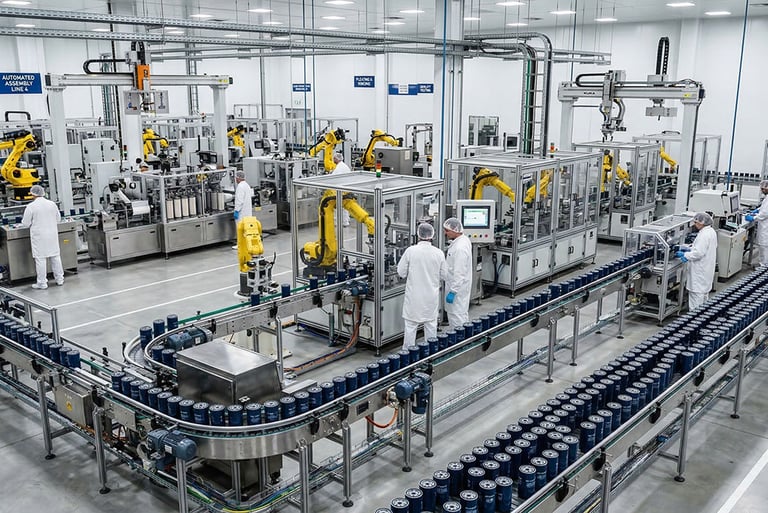
Modern automated fuel filter production line at MakexCar's manufacturing facility, featuring robotic assembly, testing equipment, and quality control stations.
Production Capabilities and Quality Control
Manufacturing Equipment and Processes:
Automated Pleating Machines:
Consistent pleat height: ±0.5mm tolerance
Uniform pleat spacing: Optimizes media surface area and flow
Controlled media tension: Prevents pleat collapse under flow
Production rate: 50-100 elements per hour for established manufacturers
Welding and Assembly:
Robotic seam welding: Ensures leak-free canister construction
Resistance welding: End cap attachment to center tube
Ultrasonic welding: Plastic component assembly
100% pressure testing: Every filter tested for leaks
Quality Control Infrastructure:
Incoming Material Inspection:
Filter media: Basis weight, thickness, permeability, burst strength
Steel coil: Thickness measurement, coating verification
Rubber components: Hardness testing, dimensional verification
Thread gauges: Go/no-go verification of threaded components
In-Process Inspection:
Dimensional checks: Every 2 hours or per production lot
Welding quality: Visual inspection and leak testing
Assembly verification: Correct components and orientation
Statistical process control (SPC): Monitor critical dimensions
Final Inspection and Testing:
100% visual inspection: Defects, proper assembly, labeling
100% pressure testing: Air or water pressure test to verify integrity
Sample performance testing: Batch sampling for flow and efficiency testing
Packaging inspection: Correct labeling, barcode verification
Laboratory Testing Capabilities:
Professional manufacturers should maintain or have access to:
Multi-pass filter test stands: ISO 4548-12 and SAE J905 testing
Particle counters: ISO 11171 calibrated for efficiency measurement
Water separation test equipment: ISO 16332 and SAE J1488 testing
Burst pressure testing: Hydraulic test stands to 500+ PSI
Environmental chambers: Temperature cycling and humidity testing
Fuel compatibility testing: Immersion testing in various fuel types
Traceability and Documentation
Product Identification and Traceability:
Batch/lot codes: Laser marked or printed on filter housing
Date codes: Manufacturing date for shelf life tracking
QR codes: Link to production records and test data
Serialization: For critical applications requiring full traceability
Quality Documentation:
Certificate of Conformance (CoC): Certifies product meets specifications
Material certificates: Mill certificates for steel, media specifications
Test reports: Performance data from ISO/SAE testing
Inspection records: Dimensional measurements and visual inspection results
Non-conformance reports: Documentation of defects and corrective actions
Compliance Certifications:
ISO 9001:2015: Quality management system certification
IATF 16949:2016: Automotive quality management (premium suppliers)
ISO 14001: Environmental management system
RoHS compliance: Lead-free and hazardous substance restrictions
REACH registration: European chemical regulations compliance
Packaging and Logistics for Fuel Filter Distribution
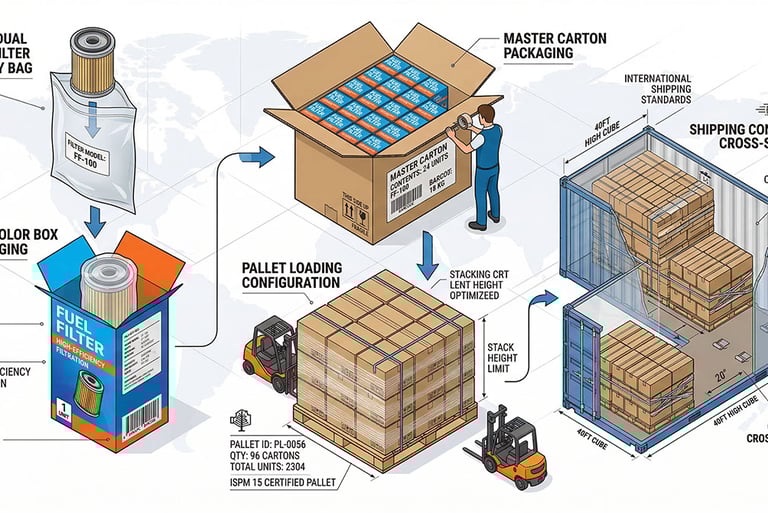
8: Fuel filter price comparison showing economy, standard, and premium grades with wholesale pricingComplete packaging and logistics workflow showing individual product packaging, master cartons, pallet configuration, and container loading standards for international shipping.
Packaging Standards
Individual Product Packaging:
Poly bag or shrink wrap: Moisture barrier and contamination protection
Color box packaging: 300-350g coated paperboard
Blister packaging: Retail hanging display option
Labeling requirements:
Part number and application information
Barcode (EAN-13 or UPC-A)
Installation direction arrows
Warnings and safety information
Multilingual text for target markets
Master Carton Specifications:
Carton material: 5-layer corrugated, BC or AB flute
Bursting strength: 200 PSI minimum (14 kg/cm²)
Carton quantity: 12-48 pieces depending on filter size
Gross weight: <15kg for manual handling compliance
Labeling: Part number, quantity, barcode, handling symbols
Pallet Configuration:
Standard pallets: 1200×1000mm (Euro) or 1200×800mm
Pallet loading: 500-1,500 pieces typical depending on size
Stretch wrap: 6-8 layers with corner protection
Moisture barrier: PE film or desiccant for sea freight
Pallet weight: <800kg for forklift handling
Container Loading Capacity:
20' container: 15,000-30,000 pieces (varies by filter size)
40' container: 30,000-60,000 pieces
40' HC container: 35,000-70,000 pieces
International Shipping Considerations
Incoterms for Fuel Filter Sourcing:
EXW (Ex Works): Buyer arranges all transportation - lowest cost but maximum responsibility
FOB (Free on Board): Most common for experienced importers - seller delivers to port
CIF (Cost, Insurance, Freight): Seller arranges ocean freight and insurance - convenient for smaller buyers
DDP (Delivered Duty Paid): Seller handles all logistics and customs - premium service
Lead Time Planning:
Production: 30-45 days for standard products
Custom specifications: 60-90 days including tooling and samples
Quality inspection: 3-5 days (if third-party inspection required)
Inland transportation: 5-7 days to departure port
Sea freight: 15-35 days depending on destination
Customs clearance: 3-7 days
Total lead time: 60-90 days for first order, 45-60 days for repeat orders
Import Considerations:
Customs classification: HS Code 8421.23 (fuel filters)
Import duties: 2-8% typical (varies by country and trade agreements)
Customs documentation: Commercial invoice, packing list, bill of lading, certificate of origin
Product compliance: Ensure filters meet destination country regulations
Private Label and OEM Programs
Custom Branding Opportunities
Packaging Customization Options:
Custom color box design: MOQ 3,000-5,000 pieces per SKU
Brand logo printing on filter housing: Pad printing, laser engraving, or labels
Custom part numbering: Align with your catalog system
Packaging inserts: Installation instructions, warranty cards, promotional materials
Display packaging: Blister packs or hanging cards for retail distribution
Product Customization:
Gasket color coding: Differentiate product lines or quality tiers
Housing color: Custom paint or powder coating colors
Label design: Custom graphics and technical information
Special features: Integrated sensors, heaters, or unique fittings
Minimum Order Quantities:
Standard product with custom label: 500-1,000 pieces
Full custom packaging: 3,000-5,000 pieces
Custom filter specifications: 5,000-10,000 pieces
Tooling costs: $500-$2,500 per SKU for custom specifications
Quality Assurance for Private Label
Pre-Production Approval Process:
Sample evaluation: Test 3-5 samples for fit, function, and quality
Packaging mock-up approval: Verify all text, graphics, and dimensions
First article inspection (FAI): Detailed measurement and testing of first production batch
Pre-production meeting: Clarify all specifications and quality requirements
Third-Party Inspection Services:
Pre-shipment inspection (PSI): Verify quantity, quality, and packaging before shipment
Container loading supervision: Ensure proper loading and prevent damage
Laboratory testing: Independent verification of performance claims
Factory audit: Assess manufacturing capabilities and quality systems
Recommended Inspection Standards:
AQL 1.5 for critical defects (leakage, thread damage, structural failure)
AQL 2.5 for major defects (dimensional errors, component defects)
AQL 4.0 for minor defects (cosmetic issues, labeling errors)
Sample size per ANSI/ASQ Z1.4 (ISO 2859-1)
Pricing Structure and Cost Analysis
Comprehensive price-quality comparison showing economy, standard, and premium fuel filter grades with detailed feature breakdowns and typical wholesale pricing ranges.
Understanding Manufacturing Costs
Cost Components (typical percentages):
Raw materials: 45-55% (filter media, housing, rubber components)
Labor and manufacturing: 18-25%
Quality control and testing: 5-8%
Packaging materials: 8-12%
Factory overhead and profit: 12-18%
Price Ranges by Type and Quality (FOB China, per piece):
Gasoline Filters:
Economy in-line filter: $0.60-$1.20
Standard in-line filter: $1.20-$2.00
Premium in-line filter (synthetic media): $2.00-$3.50
Spin-on gasoline filter: $1.80-$3.50
Diesel Filters:
Primary filter (spin-on, no water separator): $2.50-$4.50
Fuel/water separator assembly: $4.50-$8.00
Secondary filter (cartridge): $2.00-$4.00
Heavy-duty commercial filter: $6.00-$12.00
Volume Discount Structure:
500-1,000 pieces: List price
1,000-3,000 pieces: 5-8% discount
3,000-5,000 pieces: 8-12% discount
5,000-10,000 pieces: 12-15% discount
10,000+ pieces: 15-20% discount (negotiable)
Payment Terms and Financial Planning
Standard Payment Terms:
New customers: 30% deposit, 70% balance before shipment (T/T)
Established customers (after 3-6 months): 30-60 day payment terms
Letter of Credit (L/C): Accepted for orders >$30,000
Trade assurance: Available through B2B platforms (Alibaba, Made-in-China)
Additional Costs to Budget:
Sample costs: $30-$80 per sample + express shipping ($50-$100)
Tooling for custom specifications: $500-$2,500 per SKU
Third-party inspection: $200-$350 per inspection
Freight forwarding: $1,500-$3,000 per 20' container
Import duties and taxes: 2-8% of product value (country dependent)
Warehousing and distribution: 10-15% of landed cost
Working with Chinese Fuel Filter Manufacturers
Supplier Verification Best Practices
Factory Audit Checklist:
Business license verification: Confirm legal registration and business scope
Production facility visit: Assess equipment, cleanliness, and organization
Quality certifications: Verify ISO 9001, IATF 16949 certificates are current and legitimate
Customer references: Contact existing customers for feedback
Export history: Verify actual export activity through customs records
Financial stability: Review company history and credit standing
Red Flags to Avoid:
Prices 25-35% below market average (indicates quality compromises)
Unwillingness to accept factory visits or third-party inspections
No verifiable test reports or certifications
Poor communication and vague technical specifications
Requests for unusual payment methods or full payment upfront
No established export history or customer references
Verification Resources:
China Customs Import/Export database: Verify export activity
National Enterprise Credit Information System: Confirm business registration
Certification body databases : Verify ISO certificates (BSI, TÜV, SGS, etc.)
Third-party audit services : SGS, Bureau Veritas, Intertek, TÜV
Communication and Technical Specification Management
Technical Specification Documents Should Include:
Detailed dimensional drawings with tolerances
Thread specifications with explicit standards (ISO, SAE, JIS)
Filter media specifications: Micron rating, material type, efficiency requirements
Pressure and flow requirements
Material specifications for housing, seals, and components
Testing requirements and acceptance criteria
Packaging and labeling specifications
Quality documentation requirements
Sample Approval Process:
Request 5-10 samples with complete test reports
Conduct fit testing on actual vehicle applications
Perform pressure testing and flow testing if possible
Evaluate packaging quality and labeling accuracy
Provide written approval or detailed feedback for corrections
Approve pre-production samples before mass production
Ongoing Communication Best Practices:
Establish single point of contact (project manager or sales engineer)
Schedule regular progress updates during production (weekly for first order)
Request in-process photos at key manufacturing stages
Document all changes or modifications in writing
Maintain detailed records of all communications and approvals
Use clear, simple English and confirm understanding
Market Trends and Emerging Opportunities
Growing Market Segments
Biodiesel and Alternative Fuel Compatibility:
As biodiesel blends (B5-B20) become more common globally, fuel filters must accommodate:
Enhanced water separation (biodiesel is hygroscopic)
Material compatibility with biodiesel chemistry
Potential for microbial growth in fuel systems
Filter media resistant to biodiesel degradation
Electric Vehicle (EV) Considerations:
While pure EVs eliminate fuel filters, hybrid vehicles present opportunities:
Plug-in hybrids (PHEVs) require full fuel filtration systems
Extended fuel storage periods require enhanced filtration
Smaller fuel systems may use compact filter designs
Extended Service Interval Filters:
Fleet operators and consumers increasingly demand:
50,000-100,000 mile service intervals
Synthetic media with higher dirt holding capacity
Condition monitoring and service indicators
Premium pricing with higher profit margins
Aftermarket Opportunities:
Aging vehicle fleet requires ongoing filter replacement
DIY market growth for in-line filters
Online retail distribution channels expanding
Cross-reference catalogs essential for market penetration
Regulatory Trends
Emission Standards Driving Filtration Requirements:
Euro 7 and China 7 emission standards require cleaner fuel
Tighter injector tolerances demand finer filtration
Warranty requirements specify filter quality standards
OEM-equivalent quality increasingly expected in aftermarket
Environmental Regulations:
Recyclable filter designs (cartridge vs. spin-on)
Reduced packaging materials
RoHS compliance (lead-free materials)
Extended producer responsibility (EPR) programs
Counterfeit Prevention:
Authentication features (holograms, QR codes)
Traceability systems
Brand protection programs
Quality verification through testing
Conclusion: Building a Successful Fuel Filter Sourcing Strategy
Successful fuel filter sourcing requires understanding the critical differences between gasoline and diesel applications, recognizing quality indicators, and establishing relationships with certified manufacturers. Key strategies for wholesale buyers:
Understand Application Requirements: Match filter specifications to target markets and customer needs
Prioritize Quality Certifications: Verify ISO 9001, IATF 16949, and performance test documentation
Conduct Thorough Due Diligence: Factory audits and third-party inspections protect your investment
Start with Comprehensive Samples: Test filters in actual applications before committing to production
Build Long-Term Supplier Relationships: Consistent quality, better pricing, and priority service
Plan for Adequate Lead Times: 60-90 day lead times require careful inventory management
Invest in Quality Control: Third-party inspections and testing protect your brand reputation
Consider Private Label Programs: Build brand equity and customer loyalty
Stay Informed on Market Trends: Biodiesel compatibility, extended intervals, and emission regulations
Provide Technical Support: Help customers select correct filters for their applications
About MakexCar: Your Professional Fuel Filter Manufacturing Partner
MakexCar specializes in manufacturing premium automotive fuel filters for global wholesale distribution. Learn more about our company history, certifications, and manufacturing capabilities on our About Us page.
Our Fuel Filter Product Range:
Gasoline Fuel Filters: In-line, spin-on, and cartridge designs for all applications
Diesel Fuel Filters: Primary and secondary filters with integrated water separators
Fuel/Water Separator Assemblies: Complete systems with sensors and drain valves
Heavy-Duty Filters: Commercial vehicle and equipment applications
High-Performance Filters: Racing and modified engine applications
Quality Certifications and Standards:
ISO 9001:2015 certified manufacturing facility
IATF 16949:2016 automotive quality management system
ISO 16332 water separation efficiency testing
SAE J905 and ISO 4548 performance testing
100% pressure testing and leak verification
Comprehensive product liability insurance
Manufacturing Capabilities:
Monthly production capacity: 300,000+ units across all filter types
150+ SKUs covering gasoline and diesel applications
Custom OEM and private label programs
Flexible MOQ starting from 500 pieces per SKU
Complete technical documentation and certification support
Application engineering assistance
Technical Support Services:
Cross-reference catalog development
Application fitment verification
Installation instruction creation
Technical training for your sales team
Warranty support and claims assistance
Why Choose MakexCar for Fuel Filters:
Direct manufacturer pricing without trading company markup
Experienced export team with 12+ years international trade expertise
English-speaking technical support and sales team
Comprehensive quality control with third-party inspection welcome
Flexible payment terms for established customers
Fast response time (within 24 hours)
Complete supply chain transparency
Our Commitment to Your Success:
We understand that your reputation depends on the quality of products you supply. That's why we're committed to manufacturing fuel filters that meet or exceed OEM specifications, providing complete documentation, and supporting your business growth with responsive service and technical expertise.
Contact MakexCar Today:
Website: www.makexcar.com
Email: sales1@makexcar.com
WhatsApp: +86 19941234680
Product Catalog: Request our comprehensive fuel filter catalog
Sample Request: Contact our sales team with your application requirements
Download Resources:
Fuel Filter Product Specification Sheets
Cross-Reference Catalog (50,000+ applications)
ISO 9001 and IATF 16949 Certificates
Quality Control Procedures Manual
Packaging and Shipping Guide
Installation Instructions Library
Technical Training Materials
This guide is regularly updated to reflect current industry standards, market conditions, and technological developments. Last updated: March 2026





Contact us
Whatsapp: +86 19941234680
Phone:+86 19941234680
© 2025. All rights reserved.
Email:sales1@makexcar.com
Wechat:Sgxwtxa
Quick links