Air Filter Wholesale Guide: Engine & Cabin Filter Specifications, Quality Standards & Bulk Sourcing for Distributors
Comprehensive air filter wholesale guide covering engine and cabin filter specifications, ISO 5011 quality standards, filtration media technologies, and bulk sourcing strategies for automotive distributors.
博客
2/18/2026
Air Filter Wholesale Guide: Engine & Cabin Filter Specifications, Quality Standards & Bulk Sourcing for Distributors
Introduction
Air filtration represents one of the most critical yet often underestimated components in automotive maintenance. Whether protecting engines from abrasive contaminants or ensuring passenger comfort through cabin air quality, air filters serve as the first line of defense against environmental pollutants. For wholesale distributors and importers serving the global automotive aftermarket, understanding the technical distinctions between engine air filters and cabin air filters, recognizing quality indicators, and establishing relationships with certified manufacturers is essential for building a profitable and sustainable filter distribution business.
The global automotive air filter market continues to demonstrate robust growth, driven by increasing vehicle populations, stricter emission regulations, and growing consumer awareness of air quality. Engine air filters directly impact engine performance, fuel efficiency, and longevity, while cabin air filters have become standard equipment in modern vehicles, addressing health concerns related to air pollution. For wholesale buyers, this creates a dual opportunity: supplying performance-critical engine filters to repair shops and offering health-focused cabin filters to environmentally conscious consumers.
This comprehensive guide examines the technical specifications, quality standards, and wholesale sourcing strategies for both engine and cabin air filters. We'll explore filtration media technologies, performance testing standards, OEM quality indicators, and practical considerations for building a competitive filter distribution business. If you're also sourcing fuel filters, check out our comprehensive Fuel Filter Wholesale Guide for detailed specifications and quality standards.
Understanding Air Filter Types and Applications
Engine Air Filters: Protecting Engine Performance
Engine air filters prevent dust, dirt, pollen, and other airborne contaminants from entering the engine's combustion chamber. A typical automotive engine consumes approximately 10,000 to 12,000 liters of air for every liter of fuel burned, making filtration efficiency critical to engine protection and performance.
Primary Functions:
Contaminant Removal: Trapping particles as small as 5-10 microns to prevent cylinder wear, piston ring damage, and valve deterioration
Airflow Optimization: Maintaining adequate air supply for complete combustion while providing filtration
Engine Protection: Extending engine life by preventing abrasive particle ingestion
Performance Maintenance: Ensuring optimal air-fuel mixture for power output and fuel efficiency
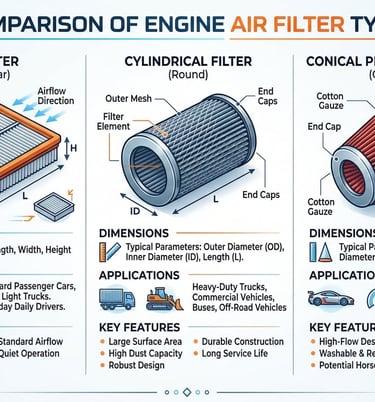
Common Engine Air Filter Designs:
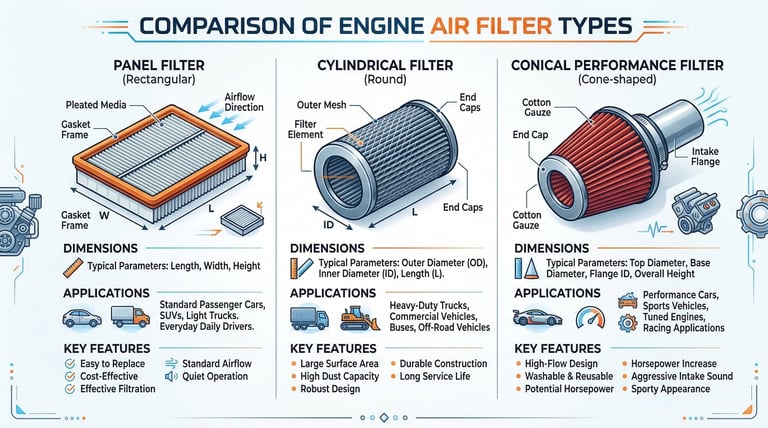
Panel Filters (Most Common):
Flat rectangular or square design fitting into airbox housings
Available in flexible frame (polyurethane seal) or rigid frame (plastic with separate gasket) construction
Standard replacement interval: 12,000-15,000 miles (20,000-24,000 km) for normal driving conditions
Typical dimensions: 8-12 inches in length, varying thickness from 1.5 to 3 inches
Cylindrical/Conical Filters:
Round or cone-shaped design used in performance applications and some truck models
Larger surface area for increased airflow capacity
Common in aftermarket cold air intake systems
Requires precise installation to prevent air bypass
Radial Seal Filters:
Heavy-duty design for commercial vehicles and off-road equipment
Metal end caps with radial seal gasket
Higher dust capacity for extended service intervals
Often paired with pre-cleaners in severe-duty applications
Cabin Air Filters: Ensuring Passenger Comfort and Health
Cabin air filters, also known as HVAC filters or pollen filters, clean the air entering the vehicle's passenger compartment through the heating, ventilation, and air conditioning (HVAC) system. Introduced widely in the 1990s, cabin filters have become standard equipment in most modern vehicles.
Primary Functions:
Particulate Filtration: Removing dust, pollen, mold spores, and fine particulate matter (PM2.5, PM10)
Odor Reduction: Activated carbon variants absorb exhaust fumes, industrial odors, and volatile organic compounds (VOCs)
Allergen Control: Providing relief for passengers with respiratory sensitivities
HVAC System Protection: Preventing debris accumulation on evaporator coils and blower motors
Cabin Air Filter Types:
Particulate Filters (Standard):
Synthetic or cellulose media capturing particles down to 3-5 microns
Efficiency typically 85-95% for particles >10 microns
Replacement interval: 12,000-15,000 miles (20,000-24,000 km) or annually
Lower cost option suitable for most applications
Activated Carbon Filters (Premium):
Particulate media layer combined with activated carbon layer
Odor and gas adsorption capability
Efficiency >95% for particulate matter, plus VOC reduction
Recommended for urban environments with high pollution
20-30% price premium over standard particulate filters
HEPA-Grade Cabin Filters (High-End):
High-Efficiency Particulate Air (HEPA) media capturing 99.97% of particles ≥0.3 microns
Multi-layer construction with electrostatic charging
Significant improvement in PM2.5 filtration
Growing market segment driven by air quality concerns
50-100% price premium over standard filters
Air Filter Media Technologies and Performance Characteristics
Engine Air Filter Media Types
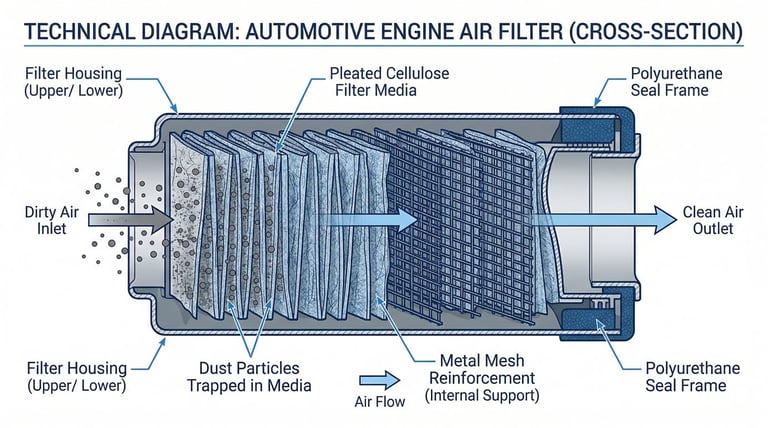
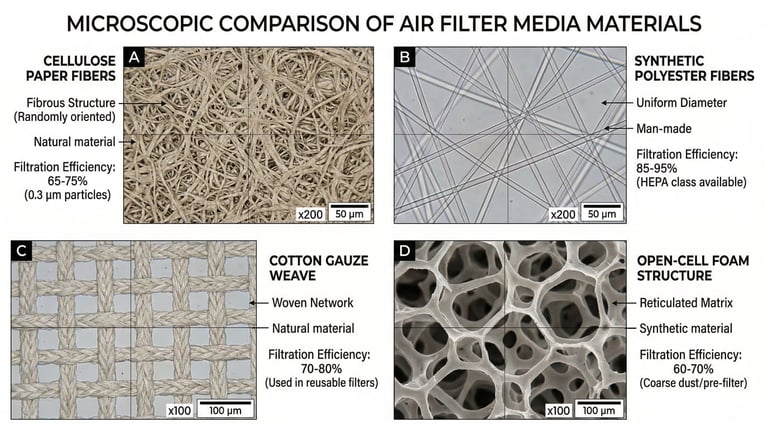
Cellulose (Paper) Media:
Construction: Natural wood pulp fibers bonded with resin
Filtration Efficiency: 95-98% for particles >5 microns (ISO 5011 testing)
Advantages: Low cost, good initial efficiency, biodegradable
Limitations: Lower dust capacity, performance degrades when wet, single-use disposable
Applications: OEM and value-grade aftermarket filters
Typical Service Life: 12,000-15,000 miles under normal conditions
Synthetic Media:
Construction: Polyester or polypropylene fibers in non-woven structure
Filtration Efficiency: 98-99.5% for particles >5 microns
Advantages: Higher dust capacity, water-resistant, consistent performance across temperature range
Limitations: Higher material cost
Applications: Premium OEM and aftermarket filters
Typical Service Life: 15,000-20,000 miles
Cotton Gauze Media (Performance Applications):
Construction: Layered cotton fabric treated with oil
Filtration Efficiency: 95-97% (lower than cellulose but higher airflow)
Advantages: Reusable/washable, very low restriction, long service life
Limitations: Requires periodic cleaning and re-oiling, higher initial cost, potential for over-oiling
Applications: Aftermarket performance filters (K&N, S&B Filters brands)
Service Life: 50,000+ miles with proper maintenance
Foam Media:
Construction: Polyurethane foam with controlled pore structure
Filtration Efficiency: Variable (85-95%) depending on pore size
Advantages: Excellent dust capacity, washable and reusable, good for dusty environments
Limitations: Higher restriction than cellulose, requires oil treatment
Applications: Off-road vehicles, motorcycles, small engines
Service Life: Multiple cleanings over 25,000-50,000 miles
Cabin Air Filter Media Technologies
Electrostatic Media:
Electrostatically charged synthetic fibers attract and capture particles
Enhanced efficiency without increasing airflow restriction
Charge may degrade over time, reducing performance
Common in mid-grade cabin filters
Multi-Layer Composite Media:
Combines coarse pre-filter layer, fine filtration layer, and support layer
Graduated density structure optimizes dust capacity and efficiency
Standard construction for quality cabin filters
Activated Carbon Layer:
Granular or powdered activated carbon bonded between media layers
Adsorbs odor molecules and gaseous pollutants
Carbon loading typically 50-150 grams per filter
Requires adequate contact time for effective adsorption
HEPA-Grade Media:
Ultra-fine glass fiber or synthetic media
Captures 99.97% of particles ≥0.3 microns (true HEPA standard)
Higher pressure drop requires consideration of HVAC blower capacity
Premium pricing justified by superior health protection
Quality Standards and Certifications for Air Filters
International Testing Standards
ISO 5011 - Engine Air Filter Testing:
ISO 5011 is the globally recognized standard for testing engine air filter performance. This comprehensive protocol evaluates:
Initial Efficiency: Percentage of test dust captured when filter is new
Dust Capacity: Total amount of contaminant the filter can hold before reaching terminal restriction
Pressure Drop: Airflow resistance across the filter (measured in inches of water or kPa)
Structural Integrity: Filter's ability to maintain seal and media integrity under operating conditions
Test Procedure:
Filter mounted in standardized test rig with controlled airflow
ISO 12103-1 A2 Fine Test Dust introduced at specified rate
Efficiency measured gravimetrically at intervals
Test continues until terminal restriction reached (typically 10-25 inches H₂O)
Quality Indicators:
Premium filters achieve >99% efficiency with dust capacity >200 grams
Pressure drop when clean should be <3 inches H₂O at rated airflow
Efficiency should remain >98% throughout service life
ISO 16890 - General Ventilation Filters (Applicable to Cabin Filters):
This standard classifies filters based on their ability to remove particulate matter (PM):
ePM1: Efficiency for particles 0.3-1.0 microns (most health-relevant)
ePM2.5: Efficiency for particles 0.3-2.5 microns
ePM10: Efficiency for particles 0.3-10 microns
Cabin filters meeting ISO 16890 ePM1 >50% classification provide excellent protection against fine particulate matter, making this a valuable specification for premium products.
SAE Standards:
SAE J726: Air Cleaner Test Code (North American standard similar to ISO 5011)
SAE J1669: Engine Air Cleaner Test Dust specifications
Manufacturing Quality Certifications
ISO 9001:2015 - Quality Management System:
Demonstrates manufacturer's commitment to consistent quality control
Covers entire production process from raw material inspection to final testing
Requires documented procedures, regular audits, and continuous improvement
Essential certification for suppliers to major distributors
IATF 16949 - Automotive Quality Management:
Automotive-specific extension of ISO 9001
Required for OEM suppliers and tier-1 manufacturers
Emphasizes defect prevention, variation reduction, and supply chain management
Indicates manufacturer meets stringent automotive industry standards
TS 16949 (Predecessor to IATF 16949):
Still referenced by some manufacturers
Demonstrates historical commitment to automotive quality standards
Regional Certifications and Compliance
European Standards:
ECE R51: European regulation for noise emissions (relevant for air filter restriction)
CE Marking: Indicates conformity with EU health, safety, and environmental standards
North American Standards:
CARB Compliance: California Air Resources Board approval for aftermarket filters
Ensures filter does not negatively impact vehicle emissions
Important for distribution in California and states adopting CARB standards
Chinese Standards:
GB/T Standards: Chinese national standards for automotive components
Increasingly important as Chinese manufacturers expand global presence
Technical Specifications and Performance Parameters
Engine Air Filter Specifications
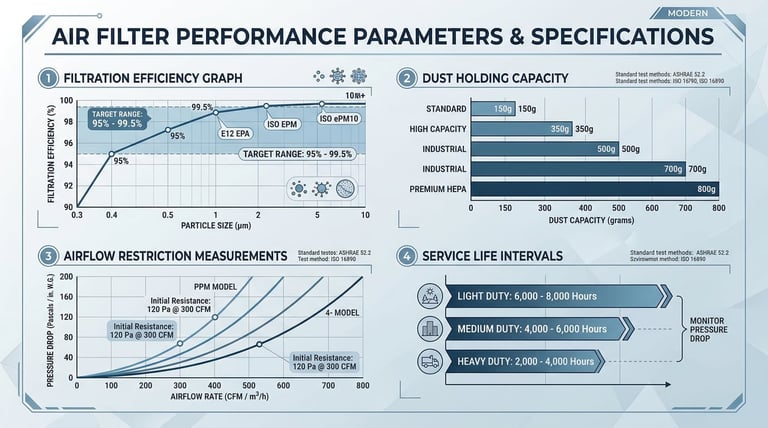
Filtration Efficiency:
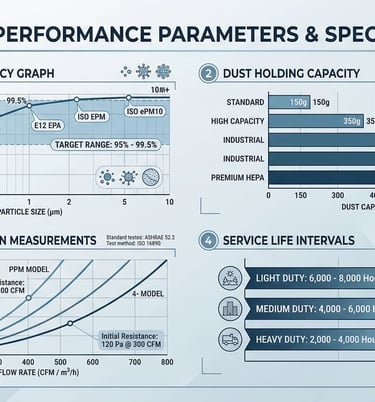
Standard Grade: 95-97% efficiency for particles >5 microns
Premium Grade: 98-99.5% efficiency for particles >5 microns
Performance Grade: 95-97% efficiency with optimized airflow (lower restriction)
Dust Capacity:
Passenger Car Filters: 150-250 grams (ISO 12103-1 A2 test dust)
Light Truck Filters: 250-400 grams
Heavy-Duty Filters: 400-800 grams
Airflow Restriction (Clean Filter):
Acceptable Range: 1.5-3.0 inches H₂O at rated CFM
Premium Filters: <2.0 inches H₂O
Performance Filters: <1.5 inches H₂O (optimized for airflow)
Terminal Restriction (Replacement Point):
Passenger Vehicles: 10-15 inches H₂O
Commercial Vehicles: 15-25 inches H₂O
Exceeding terminal restriction causes measurable performance loss
Physical Specifications:
Media Area: 1,500-4,000 cm² for typical passenger car filters
Pleat Count: 40-80 pleats for panel filters
Pleat Height: 15-30 mm
Frame Material: Polyurethane (flex frame) or rigid plastic with gasket
Cabin Air Filter Specifications
Filtration Efficiency by Particle Size:
Standard Particulate Filters: 85-95% for particles >10 microns, 60-80% for particles >3 microns
Premium Particulate Filters: >95% for particles >10 microns, 80-90% for particles >3 microns
HEPA-Grade Filters: 99.97% for particles ≥0.3 microns
Activated Carbon Performance (for carbon filters):
Carbon Loading: 50-150 grams per filter
Odor Reduction: 70-90% reduction in common automotive odors
VOC Adsorption: Effective against formaldehyde, benzene, toluene
Airflow Characteristics:
Pressure Drop (Clean): 0.3-0.8 inches H₂O at 200 CFM
HVAC Compatibility: Must not exceed blower motor capacity
Service Life: Typically 12,000-15,000 miles or 12 months
Physical Specifications:
Common Dimensions: Vary widely by vehicle model (typically 8-12 inches length)
Media Area: 800-2,000 cm²
Construction: Pleated media with cardboard or plastic frame
Seal Type: Foam or rubber gasket for airtight installation
Manufacturing Quality Indicators for Wholesale Buyers
Engine Air Filter Quality Assessment
Media Quality:
Uniform Pleating: Consistent pleat spacing and height across entire filter
Pleat Stability: Pleats maintain shape without collapsing or spreading
Media Thickness: Adequate thickness (typically 0.5-0.8 mm for cellulose, 0.6-1.0 mm for synthetic)
Resin Content: Proper resin bonding prevents fiber shedding
Frame and Seal Construction:
Frame Rigidity: Plastic frames should not flex or warp
Seal Integrity: Polyurethane seals should be uniform thickness, free of voids or tears
Gasket Fit: Rigid frame gaskets must seat properly in housing
End Cap Security: Metal end caps (if present) should be firmly crimped without gaps
Manufacturing Defects to Avoid:
Media Tears or Holes: Even small defects allow unfiltered air bypass
Incomplete Seal: Gaps between media and frame create bypass paths
Adhesive Failures: Delamination of media from frame
Pleat Collapse: Indicates insufficient media stiffness or support
Foreign Material: Contamination during manufacturing
Testing and Inspection:
Visual Inspection: 100% inspection for obvious defects
Sample Testing: Batch testing for efficiency and restriction per ISO 5011
Dimensional Verification: Ensuring filters fit OEM housings properly
Seal Testing: Verifying airtight seal in housing
Cabin Air Filter Quality Assessment
Media Construction:
Layer Bonding: Multi-layer filters should have secure bonding between layers
Carbon Distribution: Activated carbon should be evenly distributed (for carbon filters)
Pleat Uniformity: Consistent pleat geometry
Edge Sealing: Proper sealing at media edges to prevent bypass
Frame and Installation Features:
Frame Strength: Adequate rigidity to maintain shape during installation
Gasket Quality: Foam or rubber gaskets should compress evenly for airtight seal
Installation Guides: Arrows or markings indicating airflow direction
Fit Accuracy: Precise dimensions for proper fit in HVAC housing
Performance Verification:
Efficiency Testing: Sample testing per ISO 16890 or equivalent
Pressure Drop Testing: Ensuring compatibility with vehicle HVAC system
Carbon Activity Testing: For activated carbon filters, verifying adsorption capacity
Durability Testing: Resistance to moisture and temperature cycling
About MakexCar: Your Trusted Air Filter Manufacturing Partner
MakexCar specializes in manufacturing premium automotive air filters for global wholesale distribution. With advanced production facilities and rigorous quality control systems, we serve distributors, importers, and private-label brands across more than 40 countries. Learn more about our company history, certifications, and manufacturing capabilities on our About Us page.
Product Range:
Engine Air Filters: Panel, cylindrical, and radial seal designs for passenger vehicles, light trucks, and commercial applications
Cabin Air Filters: Standard particulate, activated carbon, and HEPA-grade filters
Fuel Filters: Gasoline and diesel applications with advanced filtration media (Read our comprehensive Fuel Filter Wholesale Guide)
Oil Filters: Spin-on and cartridge designs for passenger and commercial vehicles (Learn more in our Oil Filter Wholesale Guide)
Manufacturing Capabilities:
Production Capacity: 500,000+ air filters per month across all product lines
Media Technologies: Cellulose, synthetic, cotton gauze, and activated carbon media
Custom Development: Private-label programs with custom packaging and branding
Quality Systems: ISO 9001:2015 and IATF 16949 certified manufacturing
Quality Assurance:
ISO 5011 Testing: In-house testing laboratory for engine air filter performance verification
100% Visual Inspection: Every filter inspected for manufacturing defects
Batch Testing: Statistical sampling for efficiency, restriction, and dimensional accuracy
Traceability: Complete production records for quality tracking and continuous improvement
Global Distribution Support:
Flexible MOQ: Accommodating orders from 500 to 50,000+ units
Cross-Reference Database: Comprehensive OEM and competitor cross-reference for easy catalog integration
Technical Support: Engineering assistance for product selection and application questions
Logistics Expertise: Efficient container loading and international shipping coordination
Wholesale Sourcing Strategy for Air Filters
Supplier Evaluation Criteria
Technical Capabilities:
Testing Equipment: In-house ISO 5011 or equivalent testing capability
Media Sourcing: Relationships with reputable media suppliers (Ahlstrom, Hollingsworth & Vose, etc.)
Engineering Support: Ability to provide technical specifications and application data
Product Development: Capacity for custom products and private-label programs
Quality Management:
Certifications: ISO 9001 minimum, IATF 16949 preferred for OEM-quality products
Inspection Procedures: Documented quality control processes
Defect Rates: Historical data on defect rates and customer returns
Corrective Actions: Responsive approach to quality issues
Business Considerations:
Production Capacity: Ability to meet your volume requirements consistently
Lead Times: Reasonable production and delivery schedules
MOQ Flexibility: Minimum order quantities aligned with your business model
Payment Terms: Competitive terms (typically 30% deposit, 70% before shipment for new customers)
References: Verifiable customer references from established distributors
Product Line Strategy
Breadth vs. Depth:
Broad Coverage Strategy: Offering filters for wide range of vehicle makes and models
Advantages: One-stop shopping for customers, higher sales volume potential
Challenges: Higher inventory investment, slower-moving SKUs
Focused Strategy: Concentrating on high-volume applications or specific vehicle segments
Advantages: Lower inventory costs, expertise in specific applications
Challenges: Limited customer base, vulnerability to market shifts
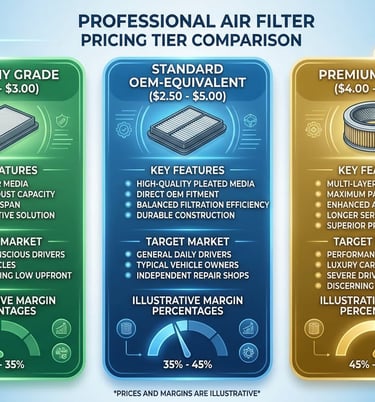
Quality Tiers:
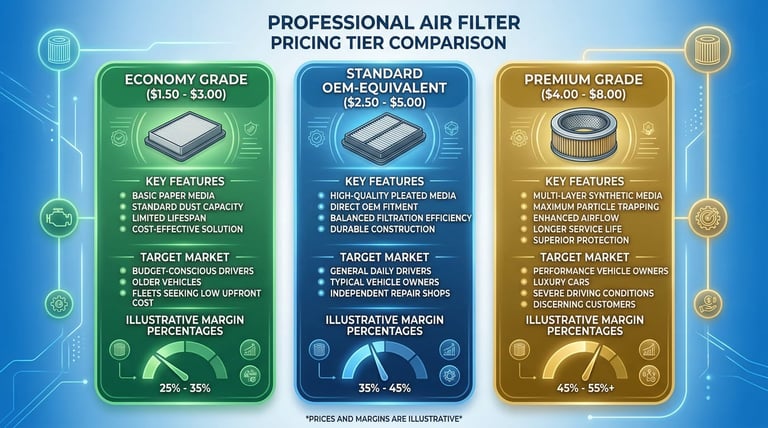
Economy Line: Value-priced filters meeting basic performance standards
Target: Price-sensitive customers, older vehicles, budget repair shops
Margin: 20-30% gross margin
Standard Line: OEM-equivalent quality at competitive pricing
Target: General repair shops, fleet maintenance, retail customers
Margin: 30-40% gross margin
Premium Line: Superior performance or features (extended life, enhanced filtration)
Target: Performance enthusiasts, premium vehicle owners, quality-focused shops
Margin: 40-60% gross margin
Engine vs. Cabin Filter Balance:
Engine filters: Higher volume, more frequent replacement, essential maintenance item
Cabin filters: Growing market, higher margins, less price competition
Recommended approach: Strong engine filter coverage with expanding cabin filter offerings
Pricing and Margin Considerations
Typical Wholesale Pricing (FOB China):
Engine Air Filters:
Economy Grade: $1.50-$3.00 per unit (cellulose media, basic construction)
Standard Grade: $2.50-$5.00 per unit (quality cellulose or synthetic media)
Premium Grade: $4.00-$8.00 per unit (synthetic media, enhanced features)
Performance Grade: $6.00-$15.00 per unit (cotton gauze, high-flow designs)
Cabin Air Filters:
Standard Particulate: $2.00-$4.00 per unit
Activated Carbon: $3.00-$6.00 per unit
HEPA-Grade: $5.00-$10.00 per unit
Retail Pricing Benchmarks (North American Market):
Engine filters: $15-$40 retail (3-8x wholesale cost)
Cabin filters: $15-$50 retail (4-10x wholesale cost)
Premium/performance filters: $40-$80 retail
Volume Discounts:
500-1,000 units: List price
1,000-5,000 units: 5-8% discount
5,000-10,000 units: 8-12% discount
10,000+ units: 12-15% discount (negotiable)
Packaging and Branding Options
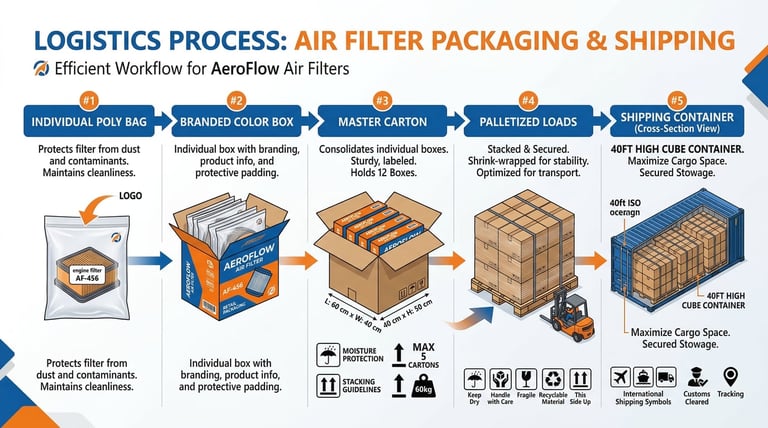
Standard Packaging:
Individual polyethylene bag or shrink wrap
Generic color box with basic product information
Master carton (typically 20-50 units depending on filter size)
Suitable for: General distribution, price-focused markets
Custom Packaging:
Branded color boxes with your logo and design
Enhanced product information and marketing messages
Retail-ready packaging with hang tabs or display features
MOQ typically 1,000-5,000 units per SKU
Additional cost: $0.20-$0.80 per unit depending on complexity
Private Label Programs:
Complete branding customization
Custom part numbering system
Exclusive product designs or specifications
Marketing support materials
Typical requirements: Annual volume commitment, higher MOQ per SKU
Logistics and Quality Control for Air Filter Imports
Container Loading and Shipping
Container Capacity (20ft container):
Engine Air Filters: 15,000-25,000 units (depending on size)
Cabin Air Filters: 20,000-30,000 units
Mixed Container: Optimize by combining different filter types
Packaging Considerations:
Filters should be individually wrapped to prevent damage and contamination
Master cartons should be sturdy enough for stacking (typically 5-6 high)
Dunnage or void fill to prevent shifting during transit
Moisture protection for ocean freight (desiccants, moisture barrier bags)
Shipping Documentation:
Commercial invoice with detailed product descriptions and HS codes
Packing list with carton dimensions and weights
Certificate of Origin (if required for tariff preferences)
Quality certificates (ISO certifications, test reports)
HS Codes for Customs:
Engine air filters: 8421.31 (Intake air filters for internal combustion engines)
Cabin air filters: 8421.39 (Other air filters)
Verify current codes and tariff rates with customs broker
Pre-Shipment Inspection
Recommended Inspection Points:
Random Sample Selection: AQL 2.5 standard (typical for automotive parts)
Dimensional Verification: Ensuring filters fit OEM specifications
Visual Quality Check: Inspecting for manufacturing defects
Packaging Verification: Confirming correct labeling and packaging
Quantity Verification: Confirming order quantities and carton counts
Third-Party Inspection Services:
SGS, Bureau Veritas, Intertek, or similar
Cost: $200-$400 per inspection
Recommended for: First orders, large shipments, quality-critical applications
Quality Control Upon Receipt
Receiving Inspection:
Verify carton counts against packing list
Inspect for shipping damage
Random sample inspection for quality (5-10% of shipment)
Document any discrepancies immediately
Functional Testing (Sample Basis):
Dimensional verification against OEM specifications
Visual inspection for defects
Test fit in actual vehicle applications (recommended for new suppliers)
Efficiency testing (if equipment available)
Handling Customer Complaints:
Document all quality issues with photos and details
Segregate defective products
Work with supplier on root cause analysis
Negotiate credits or replacements
Track defect rates to evaluate supplier performance
Market Positioning and Sales Strategy
Target Customer Segments
Independent Repair Shops:
Primary market for aftermarket filters
Value OEM-equivalent quality at competitive pricing
Require reliable availability and fast delivery
Selling approach: Emphasize quality certifications, warranty support, competitive pricing
Auto Parts Retailers:
Both brick-and-mortar and online retailers
Need retail-ready packaging and strong margins
Value broad product coverage and inventory support
Selling approach: Private-label programs, marketing support, flexible terms
Fleet Maintenance Operations:
Large volume potential, price-sensitive
Require consistent quality and availability
Often have approved supplier lists
Selling approach: Volume discounts, quality documentation, reliable supply
Warehouse Distributors:
Large regional or national distributors
High volume requirements and stringent quality standards
Long sales cycle but valuable relationships
Selling approach: IATF 16949 certification, comprehensive product line, competitive pricing
Online Marketplaces:
Amazon, eBay, specialized auto parts sites
Require retail packaging and competitive pricing
High visibility but intense price competition
Selling approach: Unique product features, customer reviews, fulfillment efficiency
Competitive Differentiation
Quality Differentiation:
ISO 5011 test results demonstrating superior performance
IATF 16949 certification for OEM-quality assurance
Extended warranty programs (12-month/12,000-mile minimum)
Transparent quality documentation
Service Differentiation:
Fast order processing and shipping
Technical support for product selection
Easy returns and warranty claims
Online catalog with cross-reference tools
Product Differentiation:
Unique features (e.g., antimicrobial treatment for cabin filters)
Extended service intervals (premium filters)
Eco-friendly options (biodegradable media, recyclable packaging)
Performance-oriented products for enthusiast market
Price Positioning:
Avoid competing solely on price (race to bottom)
Position as "best value" rather than "lowest price"
Emphasize total cost of ownership (quality, warranty, support)
Offer tiered product lines for different market segments
Building Long-Term Supplier Relationships
Communication and Collaboration
Regular Communication:
Quarterly business reviews with key suppliers
Proactive updates on market trends and customer feedback
Advance notice of volume changes or new product needs
Collaborative problem-solving approach
Performance Metrics:
On-time delivery rate (target: >95%)
Quality defect rate (target: <0.5%)
Order accuracy (target: >99%)
Responsiveness to inquiries (target: <24 hours)
Continuous Improvement:
Share customer feedback and market intelligence
Collaborate on product improvements
Participate in supplier quality initiatives
Support supplier capability development
Risk Mitigation
Dual Sourcing Strategy:
Primary supplier for 70-80% of volume
Secondary supplier for 20-30% of volume
Maintains competitive pressure and supply security
Allows comparison of quality and service
Inventory Management:
Safety stock for fast-moving items (30-60 days)
Just-in-time approach for slower-moving items
Regular inventory reviews to optimize stock levels
Supplier-managed inventory programs for large customers
Contract Terms:
Written agreements specifying quality standards, pricing, and terms
Price protection clauses for large orders
Quality guarantee and warranty terms
Dispute resolution procedures
Technical Resources and Support Tools
Product Information Management
Comprehensive Catalog:
Complete part number listings with OEM cross-references
Technical specifications for each product
Application data (vehicle make, model, year, engine)
High-quality product images
Cross-Reference Tools:
OEM part number lookup
Competitor part number cross-reference
VIN-based vehicle lookup
Interchange guides
Technical Data Sheets:
Filtration efficiency data
Pressure drop specifications
Physical dimensions and weights
Installation instructions
Customer Support Resources
Installation Guides:
Step-by-step replacement procedures
Torque specifications (if applicable)
Common installation mistakes to avoid
Video tutorials for complex installations
Troubleshooting Guides:
Diagnosing filter-related problems
Identifying counterfeit or substandard filters
Determining appropriate replacement intervals
Addressing customer concerns
Warranty Program:
Clear warranty terms (typically 12 months/12,000 miles)
Simple claims process
Fast resolution of warranty issues
Tracking warranty claims for quality improvement
Future Trends in Air Filter Technology
Emerging Technologies
Nanofiber Media:
Ultra-fine synthetic fibers (diameter <1 micron)
Higher efficiency with lower restriction
Extended service life
Premium pricing but growing adoption
Antimicrobial Treatments:
Silver ion or other antimicrobial agents
Prevents bacteria and mold growth on filter media
Particularly valuable for cabin filters
Marketing advantage in health-conscious markets
Smart Filters:
Embedded sensors monitoring filter condition
Integration with vehicle telematics systems
Predictive maintenance alerts
Premium market segment
Sustainable Materials:
Bio-based filter media
Recyclable or biodegradable components
Reduced environmental impact
Appealing to environmentally conscious consumers
Market Trends
Increasing Cabin Filter Adoption:
Growing standard equipment in new vehicles
Retrofit opportunities in older vehicles
Rising consumer awareness of air quality
Opportunity for market expansion
Premium Product Growth:
Consumers willing to pay for superior performance
HEPA-grade cabin filters gaining market share
Performance engine filters for enthusiasts
Higher margins for distributors
E-Commerce Expansion:
Shift toward online purchasing
Direct-to-consumer opportunities
Need for strong digital presence
Competitive pricing pressure
Regulatory Developments:
Stricter emissions standards driving filter performance requirements
Environmental regulations affecting manufacturing and materials
Quality standards evolving (ISO updates)
Compliance requirements for market access
For comprehensive information about other automotive filter types, explore our related guides:
- [Oil Filter Wholesale Guide](https://makexcar.com/blog/oil-filter-wholesale-guide-oem-quality)
- [Fuel Filter Wholesale Guide](https://makexcar.com/blog/fuel-filter-wholesale-guide-diesel-gasoline)
- [Cabin Air Filter Wholesale Guide](https://makexcar.com/blog/cabin-air-filter-wholesale-guide-hepa-activated-carbon)
Conclusion: Building a Successful Air Filter Distribution Business
Success in the automotive air filter wholesale market requires a balanced approach combining product quality, competitive pricing, reliable supply, and excellent customer service. By partnering with certified manufacturers like MakexCar who demonstrate commitment to quality through ISO 9001 and IATF 16949 certifications, conducting thorough supplier evaluations, and implementing robust quality control procedures, distributors can build profitable businesses serving the growing global demand for automotive air filters.
Key Success Factors:
Quality First: Prioritize suppliers with documented quality systems and testing capabilities
Strategic Product Selection: Balance broad coverage with inventory efficiency
Competitive Positioning: Differentiate on value, not just price
Customer Focus: Provide excellent technical support and service
Continuous Improvement: Regularly evaluate supplier performance and market trends
Risk Management: Implement dual sourcing and appropriate inventory strategies
Market Awareness: Stay informed about technological developments and regulatory changes
Long-Term Relationships: Build collaborative partnerships with suppliers and customers
Technical Expertise: Develop deep product knowledge to serve as trusted advisor
Operational Excellence: Maintain efficient processes for ordering, inventory, and fulfillment
The air filter market offers stable, recurring revenue opportunities with room for differentiation and value creation. Whether you're an established distributor expanding your product line or a new entrant to the automotive aftermarket, focusing on quality products, reliable suppliers, and customer satisfaction will position your business for long-term success.
For a complete overview of our air filter product range with detailed specifications and cross-reference numbers, visit our Air Filter Product Catalog.
Related Articles
Looking for more automotive filter sourcing guides? Explore our complete collection of technical articles and industry insights on the MakexCar Blog.
Recommended Reading:
- [Oil Filter Wholesale Guide](https://makexcar.com/blog/oil-filter-wholesale-guide-oem-quality)
- [Cabin Air Filter Wholesale Guide](https://makexcar.com/blog/cabin-air-filter-wholesale-guide-hepa-activated-carbon)
- [Brake Pads & Brake Discs Wholesale Guide](https://www.makexcar.com/blog/brake-pads-brake-discs-wholesale-guide-distributors)
- [Automotive Lighting Wholesale Guide](https://www.makexcar.com/blog/automotive-lighting-wholesale-guide-distributors)
Contact MakexCar Today
Ready to source premium automotive air filters for your distribution business? MakexCar offers comprehensive solutions for engine and cabin air filters with ISO 9001:2015 and IATF 16949 certified manufacturing, competitive wholesale pricing, and flexible order quantities.
Get Started:
Request product catalog and technical specifications
Discuss your specific application requirements
Receive sample filters for evaluation
Explore private-label and custom packaging options
Contact Information:
Website: www.makexcar.com
Email: sales1@makexcar.com
Phone: +8619941234680
Contact us today to discuss your filter sourcing requirements and request product samples.
Download Resources
Available Documentation:
Air Filter Product Specification Sheets (Download PDF)
Cross-Reference Catalog (Download PDF)
ISO 9001 and IATF 16949 Certificates (Download PDF)
Installation and Technical Guides (Download PDF)
For detailed information about our quality management systems and certification documents, visit our Quality Certifications page.




Whatsapp: +86 19941234680
Phone:+86 19941234680
© 2025. All rights reserved.
Email:sales1@makexcar.com
Wechat:Sgxwtxa