Brake Pads & Brake Discs Wholesale Guide: Complete Buyer's Manual for Distributors (2026)
Complete brake pads and brake discs wholesale guide for distributors. Learn quality standards, sourcing strategies, and pricing from certified manufacturers.
博客
2/20/2026
Brake Pads & Brake Discs Wholesale Guide: Complete Buyer's Manual for Distributors (2026)
The global automotive brake system market continues its robust expansion, with brake pads and discs representing over $81 billion in annual trade volume. For distributors, wholesalers, and auto parts retailers navigating this competitive landscape, sourcing decisions directly impact profit margins, customer satisfaction, and long-term business sustainability. This comprehensive guide distills two decades of manufacturing expertise and market intelligence to help you make informed wholesale purchasing decisions.
Whether you're establishing a new distribution channel, expanding your product portfolio, or optimizing your existing supply chain, understanding the technical nuances, quality standards, and sourcing strategies for brake components is no longer optional—it's essential for survival in an increasingly sophisticated market.
Understanding Brake Pads: Types, Materials, and Performance Characteristics
Modern brake pads have evolved far beyond simple friction materials. Today's wholesale buyers must understand the distinct performance profiles, cost structures, and market positioning of each brake pad type to serve diverse customer segments effectively.
Ceramic Brake Pads: The Premium Segment
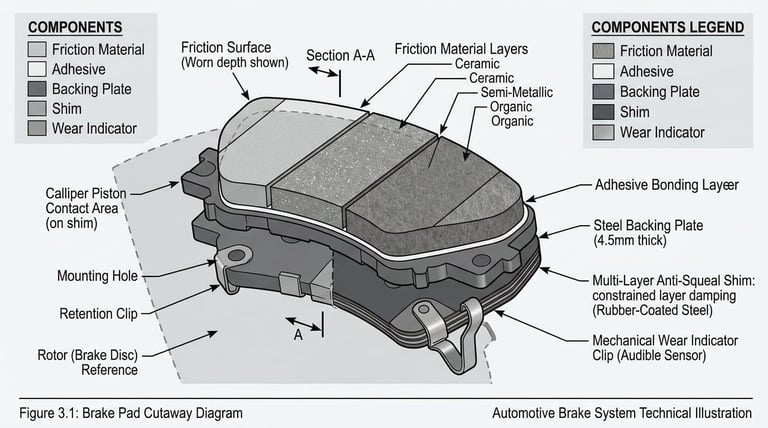
Ceramic brake pads utilize a composite matrix of ceramic fibers, bonding agents, and filler materials that deliver exceptional performance across multiple dimensions. The manufacturing process involves precision molding at controlled temperatures, creating a dense, uniform friction surface that resists thermal degradation.
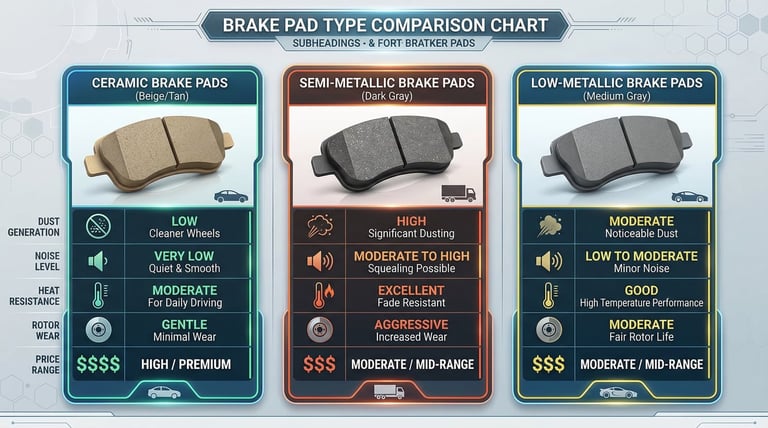
Performance characteristics that matter to your customers include remarkably quiet operation—ceramic formulations naturally dampen vibration frequencies that cause brake squeal. Dust generation drops by 60-70% compared to semi-metallic alternatives, keeping wheels cleaner and reducing customer complaints. Heat dissipation remains consistent across temperature ranges from -40°C to 650°C, preventing the performance fade that plagues lower-grade materials during aggressive driving or mountainous terrain.
Cost considerations for wholesale buyers typically position ceramic pads at 25-35% premium over semi-metallic equivalents. However, this price differential translates into higher retail margins and attracts customers willing to pay for premium performance. Your target market includes luxury vehicle owners, performance enthusiasts, and fleet operators prioritizing reduced maintenance intervals.
Wholesale pricing dynamics: At volume orders exceeding 500 sets, expect factory-direct pricing between $12-18 per set for passenger vehicle applications. European and Japanese vehicle fitments command premium pricing due to tighter tolerance requirements and more complex backing plate geometries.
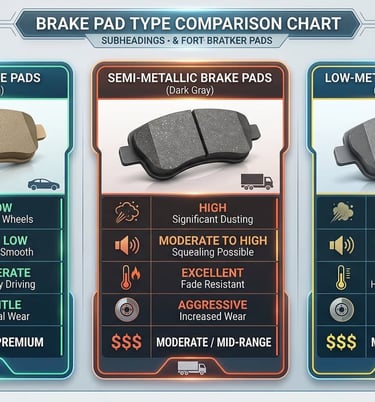
Semi-Metallic Brake Pads: The Workhorse Solution
Semi-metallic formulations incorporate 30-65% metal content—typically steel, copper, or iron fibers—embedded in organic resin matrices. This composition delivers aggressive stopping power and exceptional heat transfer, making semi-metallic pads the preferred choice for commercial vehicles, trucks, and high-performance applications.
Thermal management represents the primary advantage. Metal fibers create efficient heat conduction pathways, rapidly dissipating thermal energy generated during braking events. This characteristic proves critical for vehicles operating under heavy loads, frequent stop-and-go conditions, or sustained high-speed braking scenarios where brake fade poses genuine safety risks.
Trade-offs your customers should understand include increased rotor wear—the harder friction material accelerates disc surface degradation by approximately 15-20% compared to ceramic alternatives. Noise generation increases, particularly during cold starts or wet conditions. Dust production remains moderate to high, though modern formulations have improved significantly over earlier generations.
Market positioning for distributors: Semi-metallic pads occupy the mid-tier segment, offering compelling value propositions for cost-conscious customers who prioritize stopping power over refinement. Wholesale pricing typically ranges $8-14 per set at volume, with healthy margins available for distributors serving commercial accounts and repair shops.
Low-Metallic Brake Pads: The Balanced Approach
Low-metallic formulations reduce metal content to 10-30%, striking a deliberate balance between ceramic refinement and semi-metallic performance. This category has gained significant market share in emerging markets where customers seek upgrade paths from basic organic pads without premium pricing.
Performance profile delivers improved heat resistance compared to organic pads while maintaining quieter operation than full semi-metallic designs. Dust generation falls into moderate ranges, and rotor wear remains acceptable for most passenger vehicle applications. The friction coefficient stays relatively stable across normal operating temperatures, though extreme conditions may reveal limitations.
Wholesale strategy considerations: Low-metallic pads serve as excellent portfolio fillers, addressing price-sensitive segments without sacrificing quality reputation. Factory-direct pricing of $6-11 per set enables competitive retail positioning while preserving distributor margins. This category particularly resonates in markets transitioning from basic to mid-tier automotive standards.
Organic (NAO) Brake Pads: Entry-Level Economics
Non-Asbestos Organic (NAO) brake pads utilize organic fibers, rubber, and resin compounds without significant metal content. While largely displaced in developed markets, NAO pads retain relevance in price-sensitive regions and light-duty vehicle applications where performance demands remain modest.
Application scenarios where NAO pads remain viable include small displacement vehicles, urban-only driving patterns, and markets where initial purchase price dominates buying decisions. The soft friction material generates minimal noise and produces fine dust that's less visible on wheels, appealing to customers prioritizing cosmetic considerations.
Limitations that wholesale buyers must communicate clearly include reduced heat resistance, faster wear rates under demanding conditions, and diminished wet-weather performance. These pads should never be positioned for commercial vehicles, performance applications, or mountainous regions where brake system demands exceed NAO capabilities.
Wholesale economics: NAO pads offer the lowest acquisition costs at $4-8 per set, but thin margins and limited premium positioning constrain profitability. Consider NAO inventory primarily for market completeness rather than profit center development.
Brake Discs (Rotors): Construction, Quality Indicators, and Sourcing Criteria
Brake disc selection carries equal importance to pad specifications, yet many distributors underestimate the technical complexity and quality variations within this product category. Understanding metallurgy, manufacturing processes, and performance characteristics separates successful wholesalers from those competing solely on price.
Solid Disc Rotors: Fundamental Design
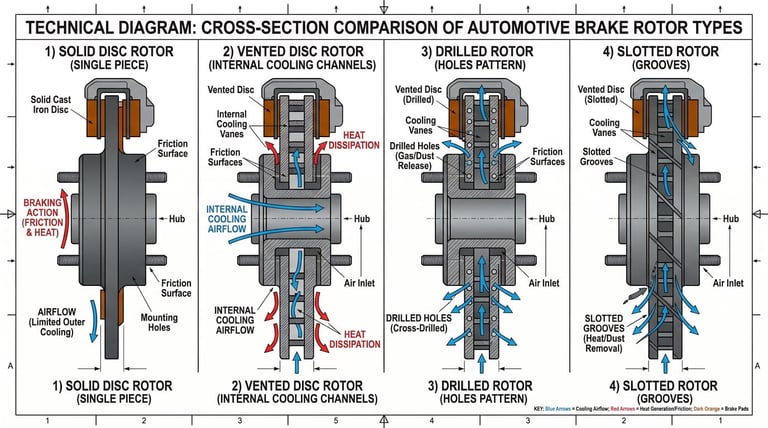
Solid disc construction features a single-piece casting without internal ventilation channels. This straightforward design serves smaller vehicles, rear axle applications, and markets where cost optimization outweighs thermal performance requirements.
Metallurgical considerations begin with cast iron grade selection. High-quality solid discs utilize Grade G3000 or higher cast iron, ensuring adequate tensile strength and thermal shock resistance. Inferior grades below G2500 may exhibit premature cracking, warping, or catastrophic failure under thermal stress—failures that destroy distributor reputations and generate costly warranty claims.
Manufacturing quality indicators include uniform thickness across the friction surface (tolerance ±0.05mm), smooth casting finish without porosity or inclusions, and proper heat treatment to relieve internal stresses. Request metallurgical test reports from suppliers, verifying carbon content (3.0-3.4%), silicon levels (1.8-2.3%), and microstructure uniformity.
Wholesale pricing and positioning: Solid discs represent entry-level inventory with wholesale costs of $8-15 per disc depending on diameter and vehicle application. While margins remain modest, solid discs provide volume opportunities and serve as gateway products for customer relationship development.
Vented Disc Rotors: Enhanced Thermal Management
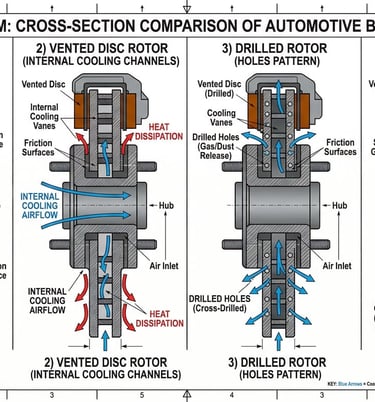
Vented disc designs incorporate internal cooling vanes between two friction surfaces, dramatically improving heat dissipation during sustained or aggressive braking. This construction dominates front axle applications on mid-size and larger vehicles, where braking forces concentrate and thermal loads escalate.
Vane geometry significantly impacts cooling efficiency. Straight vanes offer simplest manufacturing but provide basic cooling. Curved or directional vanes create centrifugal pumping action, actively drawing cool air through internal passages and expelling heated air at the disc periphery. Premium designs feature pillar-vane configurations that optimize structural rigidity while maximizing airflow.
Quality differentiation for wholesale buyers centers on vane casting integrity. Inferior manufacturing produces vanes with inconsistent thickness, partial voids, or weak bonding to friction surfaces—defects that compromise structural strength and cooling efficiency. Demand cross-sectional samples or detailed quality documentation from suppliers before committing to large orders.
Thermal capacity varies substantially based on disc mass and vane design. Heavier discs with efficient vane geometry absorb and dissipate more thermal energy before experiencing fade or warping. For commercial vehicle and performance applications, specify discs with minimum 10% greater mass than OEM equivalents to provide safety margins under demanding conditions.
Wholesale market dynamics: Vented discs command $15-35 per disc at volume, with premium designs reaching $45+ for performance or commercial applications. This category offers healthy margins and positions distributors as quality-focused suppliers rather than commodity vendors.
Drilled and Slotted Rotors: Performance and Marketing Considerations
Drilled rotors feature through-holes penetrating the friction surface, while slotted designs incorporate machined grooves. Both modifications aim to improve wet-weather performance, reduce pad glazing, and enhance heat dissipation—though actual benefits vary significantly based on application and quality execution.
Performance reality versus marketing claims requires honest assessment. Drilling does facilitate gas and water evacuation from the pad-rotor interface, improving initial bite in wet conditions. However, drilled holes create stress concentration points that may initiate cracks under extreme thermal cycling or heavy-duty applications. Quality drilling requires precise hole placement, chamfered edges, and post-machining stress relief.
Slotting provides similar benefits without structural compromise, making slotted designs more suitable for commercial and heavy-duty applications. Slots continuously refresh the pad surface, preventing glazing and maintaining consistent friction coefficients throughout pad life.
Wholesale strategy: Position drilled and slotted rotors as premium upgrade options for performance enthusiasts and customers seeking visual differentiation. Wholesale costs of $25-55 per disc enable attractive retail margins, but ensure suppliers provide structural integrity guarantees to avoid warranty nightmares.
Surface Treatment and Coating Technologies
Modern brake discs increasingly incorporate surface treatments that extend service life, improve corrosion resistance, and enhance aesthetic appeal. Understanding these technologies helps distributors differentiate offerings and capture premium market segments.
Zinc plating or coating protects non-friction surfaces from corrosion, particularly important in regions with harsh winters, coastal environments, or high humidity. Quality coatings withstand 500+ hours in salt spray testing without degradation, maintaining appearance and preventing rust jacking that causes noise and vibration.
Geomet coating represents advanced corrosion protection utilizing zinc-aluminum flake technology. This treatment provides superior salt resistance while maintaining thinner coating profiles that don't interfere with wheel fitment or caliper clearances.
Black oxide or phosphate treatments offer basic corrosion resistance at lower cost points, suitable for markets where premium aesthetics matter less than functional protection.
Wholesale positioning: Coated discs command 15-25% premiums over bare cast iron, but reduced customer complaints and enhanced perceived value justify the differential. Consider coated options as standard inventory for premium vehicle applications and upgrade recommendations for all customers.
Quality Standards and Certifications: Navigating Global Requirements
Brake component quality standards vary significantly across global markets, and understanding certification requirements proves essential for distributors serving international customers or expanding into new regions. Compliance failures result in costly recalls, legal liability, and irreparable reputation damage.
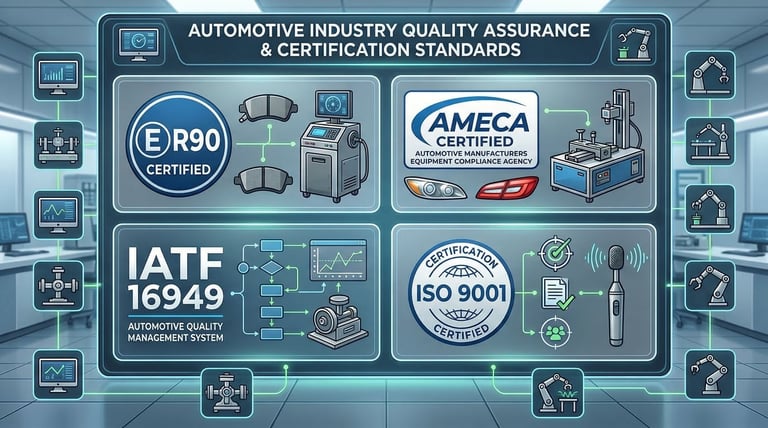
ECE R90 Certification: European Market Gateway
ECE R90 represents the mandatory approval standard for brake friction materials sold in European Union member states and many other countries recognizing ECE regulations. This certification requires rigorous testing protocols that verify performance, safety, and environmental compliance.
Testing requirements include friction coefficient verification across temperature ranges, fade resistance under sustained braking, mechanical strength testing, and chemical composition analysis. Products must demonstrate consistent performance through 15,000+ brake applications simulating real-world usage patterns.
Certification process involves third-party testing at approved laboratories, comprehensive documentation submission, and factory audits verifying production consistency. Expect 4-6 months and $15,000-25,000 investment per product line for initial certification.
Wholesale implications: ECE R90 certification represents non-negotiable requirements for European distribution. Verify suppliers maintain current certifications and provide documentation with each shipment. Counterfeit or expired certifications expose distributors to severe legal consequences and financial liability.
AMECA Certification: Chinese Market Standard
AMECA (Automotive Maintenance Equipment & Tools and Spare Parts Association of China) certification serves as the recognized quality standard for aftermarket brake components in Chinese markets. While not legally mandatory, AMECA certification signals quality commitment and facilitates market acceptance.
Testing protocols mirror many ECE R90 requirements while incorporating specific provisions for Chinese vehicle populations and driving conditions. Certification demonstrates friction performance, durability, and safety compliance suitable for Chinese market demands.
Strategic value for distributors targeting Asian markets extends beyond China—many Southeast Asian buyers recognize AMECA as credible quality indicator, facilitating regional expansion strategies.
IATF 16949: Manufacturing Quality Systems
IATF 16949 represents the automotive industry's quality management system standard, superseding the earlier ISO/TS 16949. This certification addresses manufacturing processes, quality control systems, and continuous improvement methodologies rather than specific product performance.
Supplier evaluation should prioritize IATF 16949 certification as fundamental quality indicator. Certified manufacturers demonstrate systematic approaches to defect prevention, process control, and quality assurance that translate into consistent product quality and reduced field failures.
Audit requirements for IATF 16949 include comprehensive quality manual documentation, statistical process control implementation, corrective action systems, and supplier management protocols. Certification requires annual surveillance audits and complete recertification every three years.
Wholesale due diligence: Request current IATF 16949 certificates from suppliers and verify certification scope covers brake component manufacturing. Certificates should display accredited certification body logos and include specific site addresses matching your supplier's production facilities.
ISO 9001: Baseline Quality Management
ISO 9001 provides foundational quality management system requirements applicable across industries. While less stringent than IATF 16949, ISO 9001 certification indicates suppliers maintain documented quality processes, management commitment, and customer focus.
Minimum threshold: Distributors should consider ISO 9001 certification as absolute minimum requirement for brake component suppliers. Non-certified suppliers lack systematic quality approaches and present unacceptable risk levels for safety-critical products.
Material Compliance: RoHS, REACH, and Copper-Free Regulations
Environmental regulations increasingly constrain brake component material compositions, particularly in developed markets where legislative bodies mandate hazardous substance reductions.
RoHS (Restriction of Hazardous Substances) limits lead, mercury, cadmium, and other toxic materials in automotive components. Brake pads and discs must comply with RoHS thresholds to access European markets and many other jurisdictions adopting similar standards.
REACH (Registration, Evaluation, Authorization, and Restriction of Chemicals) imposes comprehensive chemical substance registration and disclosure requirements for products sold in EU markets. Suppliers must provide REACH compliance declarations identifying all substances of very high concern (SVHCs) present in brake components.
Copper-free legislation in California and Washington State mandates progressive reduction of copper content in brake friction materials, with complete phase-out by 2025. While specific to these jurisdictions, copper-free formulations increasingly become market standard as manufacturers consolidate product lines.
Wholesale compliance strategy: Obtain material compliance declarations from all suppliers, including RoHS certificates, REACH declarations, and copper content specifications. Maintain documentation for minimum seven years to address potential regulatory inquiries or customer requests.
Sourcing Strategies: Direct Manufacturing vs. Trading Companies vs. Distributors
Wholesale brake component sourcing involves strategic decisions between direct manufacturer relationships, trading company intermediaries, and established distributor networks. Each channel offers distinct advantages, limitations, and risk profiles that align differently with business models, volume requirements, and market positioning.
Direct Manufacturer Sourcing: Maximum Control and Economics
Establishing direct relationships with brake component manufacturers provides optimal pricing, quality control access, and customization flexibility. However, direct sourcing demands significant investment in supplier development, quality assurance, and logistics management.
Economic advantages become compelling at scale. Eliminating intermediary margins reduces acquisition costs by 15-30%, directly improving gross margins or enabling competitive retail pricing. Volume commitments of 10,000+ sets annually typically unlock preferential pricing tiers and priority production scheduling.
Quality control access represents equally important benefit. Direct manufacturer relationships enable factory audits, in-process inspections, and collaborative quality improvement initiatives impossible through trading intermediaries. You can specify material grades, manufacturing processes, and inspection protocols aligned with your quality standards.
Customization capabilities flourish in direct relationships. Manufacturers accommodate private label packaging, custom friction formulations, and specialized applications that differentiate your offerings from commodity competitors. OEM-equivalent quality with your branding creates powerful market positioning.
Challenges and requirements include minimum order quantities typically starting at 500-1,000 sets per SKU, extended lead times of 45-60 days for production and shipping, and need for sophisticated quality management systems to monitor supplier performance. Language barriers, cultural differences, and time zone complications add operational complexity.
Optimal scenarios for direct manufacturing relationships include established distributors with predictable volume, businesses targeting premium market segments where quality differentiation matters, and companies with quality assurance capabilities to manage supplier relationships effectively.
Trading Company Intermediaries: Flexibility and Convenience
Trading companies aggregate products from multiple manufacturers, offering one-stop sourcing convenience, lower MOQs, and reduced operational complexity. These intermediaries serve valuable roles for distributors prioritizing flexibility over absolute cost optimization.
Operational simplicity represents primary advantage. Trading companies handle supplier identification, quality coordination, logistics management, and documentation—services particularly valuable for distributors entering new product categories or lacking resources for direct manufacturer management.
Flexibility benefits include lower minimum order quantities (often 100-300 sets), mixed container capabilities combining multiple product lines, and faster response to market demand shifts. Trading companies maintain inventory buffers and established production relationships that accelerate order fulfillment.
Cost implications involve 10-20% price premiums compared to direct manufacturing, reflecting trading company margins and services. For distributors with modest volumes or diverse product portfolios, this premium may prove economical compared to managing multiple direct manufacturer relationships.
Quality considerations require careful attention. Trading companies vary dramatically in quality standards and supplier vetting rigor. Demand detailed supplier information, quality certifications, and inspection reports. Consider trading companies as extended supply chain partners requiring ongoing performance monitoring rather than passive vendors.
Ideal applications include market testing for new product categories, supplementing direct manufacturing relationships for low-volume SKUs, and accessing specialized products where direct manufacturer relationships prove impractical.
Established Distributor Networks: Market Entry Acceleration
Sourcing through established automotive parts distributors provides immediate market access, proven product quality, and operational simplicity—at the cost of compressed margins and limited differentiation opportunities.
Speed to market represents compelling advantage for new entrants or businesses expanding geographically. Established distributors offer immediate inventory access, proven product-market fit, and logistics infrastructure that would require years to develop independently.
Risk mitigation through distributor relationships includes warranty support, technical assistance, and market knowledge that reduce new market entry risks. Established distributors understand local regulations, customer preferences, and competitive dynamics that guide product selection and positioning.
Margin compression constitutes primary limitation. Distributor pricing typically incorporates 30-50% margins above manufacturer direct costs, constraining your profitability and competitive positioning. This channel works best for premium market segments where service and reliability justify price premiums.
Strategic positioning: Consider established distributor relationships as transitional strategies while developing direct manufacturing capabilities, or as permanent solutions for low-volume specialty products where direct sourcing economics don't justify investment.
Supplier Evaluation Framework: Due Diligence Beyond Price
Price negotiations dominate many wholesale sourcing discussions, but comprehensive supplier evaluation requires systematic assessment across quality, reliability, financial stability, and strategic alignment dimensions. Implementing structured evaluation frameworks prevents costly supplier failures and builds sustainable competitive advantages.
Manufacturing Capability Assessment
Production capacity verification begins with factory audits documenting equipment, staffing, and throughput capabilities. Request production line videos, equipment lists, and capacity utilization data. Suppliers operating above 85% capacity lack flexibility to accommodate volume growth or respond to urgent requirements.
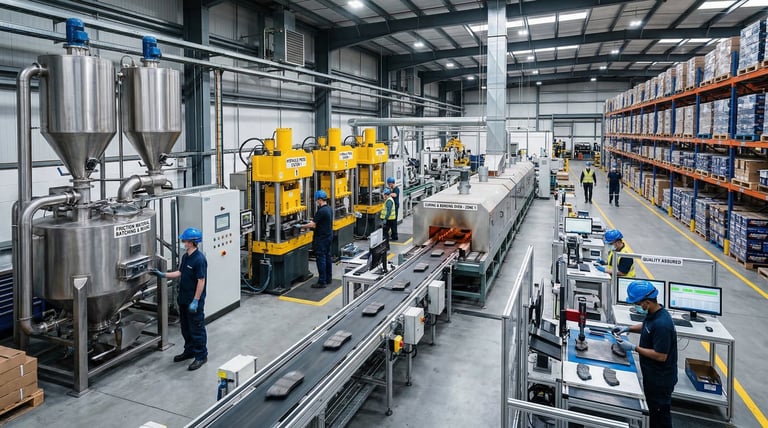
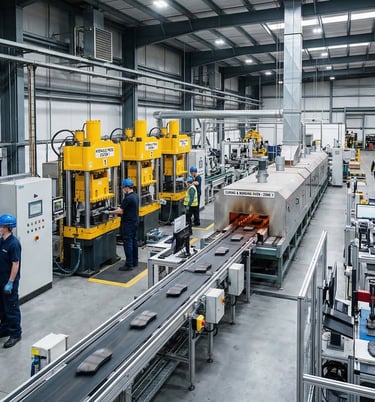
Technology and equipment quality directly impacts product consistency. Modern friction material mixing equipment, automated pressing systems, and computerized curing ovens produce superior consistency compared to manual or outdated machinery. Observe equipment maintenance practices and modernization investments indicating commitment to manufacturing excellence.
Process control systems separate sophisticated manufacturers from basic operations. Look for statistical process control (SPC) implementation, automated inspection systems, and documented process parameters. Manufacturers lacking systematic process control generate higher defect rates and batch-to-batch variations.
Quality Management Evaluation
Incoming material inspection protocols reveal supplier commitment to quality at the source. Comprehensive programs include material certifications, chemical composition analysis, and physical property testing before production. Suppliers accepting materials without verification introduce uncontrolled variables that compromise final product quality.
In-process inspection frequency and rigor indicate quality priority. Best-practice manufacturers implement inspection checkpoints at each critical process stage—mixing, molding, curing, machining, and assembly. Automated inspection systems using vision technology or dimensional gauges provide objective, consistent quality verification.
Final product testing should include friction coefficient measurement, shear strength testing, and dimensional verification on statistically significant sample sizes. Request test data from recent production runs, examining consistency and compliance with specifications.
Laboratory capabilities distinguish quality-focused manufacturers. In-house testing laboratories equipped with dynamometers, metallurgical analysis equipment, and environmental chambers enable comprehensive product validation and continuous improvement initiatives. Suppliers outsourcing all testing lack rapid feedback loops essential for quality optimization.
Supply Chain and Logistics Capabilities
Raw material sourcing stability affects product consistency and supply continuity. Suppliers utilizing multiple qualified sources for critical materials demonstrate supply chain resilience. Single-source dependencies create vulnerability to disruptions that cascade to your business.
Inventory management sophistication impacts order fulfillment reliability. Suppliers maintaining safety stock for popular SKUs and implementing demand forecasting systems respond faster to orders and accommodate volume fluctuations. Just-in-time systems without buffers create fulfillment risks during demand spikes.
Logistics partnerships with reputable freight forwarders, customs brokers, and shipping lines indicate operational maturity. Experienced suppliers navigate international shipping complexities, documentation requirements, and customs clearance efficiently—capabilities that prevent costly delays and demurrage charges.
Lead time reliability matters more than absolute duration. Suppliers consistently delivering within quoted timeframes enable accurate inventory planning and customer commitments. Track record analysis across multiple orders reveals true reliability beyond optimistic promises.
Financial Stability and Business Continuity
Financial health assessment protects against supplier bankruptcy or sudden closure. Request audited financial statements, credit reports, and bank references. Warning signs include declining revenues, increasing debt levels, or frequent ownership changes indicating distress.
Business continuity planning demonstrates professional management and risk awareness. Suppliers with documented contingency plans for equipment failures, natural disasters, or supply disruptions prove better prepared to maintain supply continuity during crises.
Customer references from established buyers provide invaluable insights. Contact multiple references, asking specific questions about quality consistency, communication responsiveness, problem resolution, and long-term relationship satisfaction. Suppliers refusing reference contacts raise immediate red flags.
Pricing Dynamics and Negotiation Strategies
Wholesale brake component pricing reflects complex interactions between raw material costs, manufacturing efficiency, quality specifications, order volumes, and competitive dynamics. Sophisticated buyers understand these factors and leverage them strategically during negotiations.
Cost Structure Understanding
Raw material costs represent 35-45% of manufacturing costs for brake pads and 50-60% for brake discs. Steel, friction materials, resins, and cast iron prices fluctuate with commodity markets. Understanding current material pricing enables realistic cost discussions and identifies unrealistic quotes indicating quality compromises.
Manufacturing costs including labor, equipment depreciation, energy, and facility overhead contribute 25-35% of total costs. Labor-intensive processes like manual inspection or hand assembly increase costs, while automated production reduces per-unit expenses at higher volumes.
Quality assurance costs for testing, inspection, and certification add 5-10% to manufacturing costs. Suppliers offering suspiciously low prices often reduce quality control investments—savings that generate expensive field failures and warranty claims.
Profit margins for manufacturers typically range 10-20% depending on market positioning, competitive intensity, and customer relationship value. Trading companies add another 10-15% margin. Understanding typical margin structures helps identify negotiation opportunities versus unrealistic price expectations.
Volume-Based Pricing Strategies
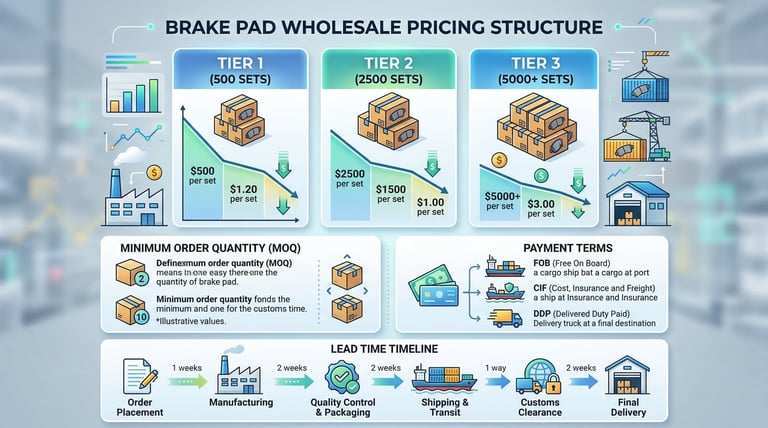
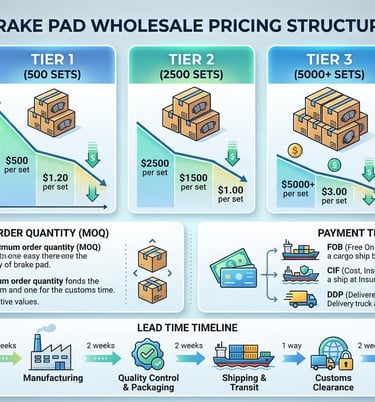
MOQ thresholds trigger significant price breaks. Initial quotes typically assume minimum order quantities of 500-1,000 sets. Volume commitments of 2,500+ sets often unlock 8-12% discounts, while 5,000+ set commitments may achieve 15-20% reductions compared to MOQ pricing.
Annual volume commitments provide suppliers with demand visibility that justifies preferential pricing. Negotiating annual purchase agreements with quarterly delivery schedules combines volume pricing benefits with inventory flexibility. Expect 5-10% additional discounts for annual commitments versus spot purchases.
SKU consolidation reduces supplier complexity and manufacturing setup costs. Focusing purchases on fewer, higher-volume SKUs rather than extensive low-volume variety enables better pricing and supply chain efficiency. Consider 80/20 analysis identifying SKUs generating majority of revenue and negotiate aggressively on these core products.
Payment Terms and Financial Incentives
Payment terms significantly impact supplier economics and negotiation leverage. Standard international terms of 30% deposit with 70% balance against copy of documents reflect supplier risk management. Established relationships may achieve net 30-60 day terms that improve your cash flow.
Early payment discounts of 2-3% for payment within 10 days provide win-win opportunities. Suppliers improve cash flow while buyers reduce effective costs. Calculate whether early payment discounts exceed your cost of capital before committing.
Letter of credit costs add 0.5-1.5% to transaction costs but provide payment security for suppliers and delivery assurance for buyers. For new supplier relationships or large orders, LC costs prove worthwhile insurance against performance failures.
Quality-Based Negotiation Approaches
Specification clarity prevents misunderstandings and enables accurate pricing. Provide detailed specifications including friction coefficient ranges, material requirements, certification needs, and inspection criteria. Vague specifications invite quality compromises that generate problems later.
Quality incentives linking payment to performance metrics align supplier interests with your requirements. Consider holdback provisions releasing final payment after quality verification, or bonus payments for zero-defect deliveries. These structures prove more effective than post-failure penalties.
Warranty terms reflect supplier quality confidence. Standard warranty periods of 12-24 months indicate normal quality expectations. Suppliers offering extended warranties or performance guarantees demonstrate superior confidence—or understand their warranties rarely get claimed. Analyze warranty claim procedures and historical response to gauge true commitment.
Packaging, Branding, and Private Label Opportunities
Packaging and branding strategies transform commodity brake components into differentiated products that command premium pricing and build customer loyalty. Understanding packaging options, customization capabilities, and branding economics unlocks significant value creation opportunities.
Packaging Options and Considerations
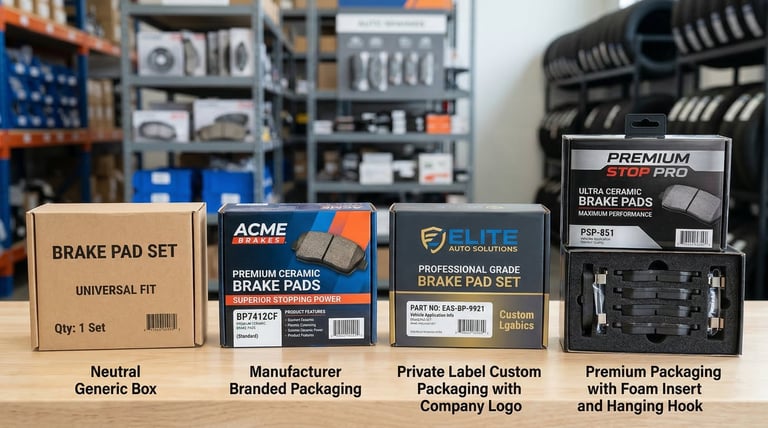
Neutral packaging provides basic protection using generic boxes without branding. This economical option suits distributors planning to repackage products or serving price-sensitive markets where packaging aesthetics matter minimally. Neutral packaging reduces costs by $0.30-0.60 per set compared to branded alternatives.
Manufacturer branded packaging features supplier logos and branding. While economical, this approach positions you as reseller rather than brand owner, limiting differentiation and customer loyalty development. Consider manufacturer branded packaging only for established brands with market recognition that enhances your credibility.
Private label packaging displays your branding, creating product differentiation and customer loyalty. Setup costs typically range $800-1,500 per SKU for packaging design and printing plates, but per-unit costs add only $0.40-0.80 compared to neutral packaging. Private labeling makes economic sense for SKUs exceeding 500 sets annually.
Premium packaging incorporating enhanced graphics, product information, and protective features positions products in quality-focused segments. Features like foam inserts, hanging hooks, and multi-language instructions add $1.00-2.00 per set but enable 15-25% retail price premiums in appropriate markets.
Branding Strategy Development
Brand positioning decisions fundamentally shape packaging design, pricing strategies, and marketing messages. Consider whether your brand emphasizes value economy, quality reliability, or performance excellence—each positioning requires consistent execution across all customer touchpoints.
Visual identity including logos, color schemes, and typography creates brand recognition and perceived quality. Professional design investment of $2,000-5,000 for comprehensive brand identity development pays dividends through enhanced market positioning and customer recall.
Product information on packaging serves both marketing and technical functions. Include vehicle applications, installation instructions, warranty terms, and certification logos. Comprehensive information reduces customer confusion and support inquiries while demonstrating professionalism.
Multi-language support expands market reach and demonstrates customer commitment. For distributors serving diverse markets, packaging with English, Spanish, and French (or other relevant languages) accommodates broader customer bases without inventory complexity.
Customization Capabilities and Economics
Friction formulation customization enables performance optimization for specific markets or applications. Manufacturers can adjust friction coefficients, noise characteristics, or dust generation to match customer preferences. Custom formulations require minimum volumes of 2,000-5,000 sets and development costs of $3,000-8,000, but create genuine product differentiation competitors cannot easily replicate.
Backing plate customization including logo stamping or color coating provides visual differentiation and brand reinforcement. Setup costs of $500-1,200 per SKU add minimal per-unit costs ($0.15-0.30) while creating distinctive products.
Accessory inclusion such as shims, anti-squeal lubricant, or hardware kits enhances perceived value and installation convenience. While adding $0.80-2.50 per set in costs, complete installation kits justify 20-30% retail price premiums and reduce customer complaints about missing components.
Logistics, Shipping, and Import Considerations
International brake component sourcing involves complex logistics, customs procedures, and import regulations that significantly impact total landed costs and supply chain reliability. Mastering these operational elements separates successful importers from those struggling with delays, unexpected costs, and regulatory complications.
Shipping Methods and Economics
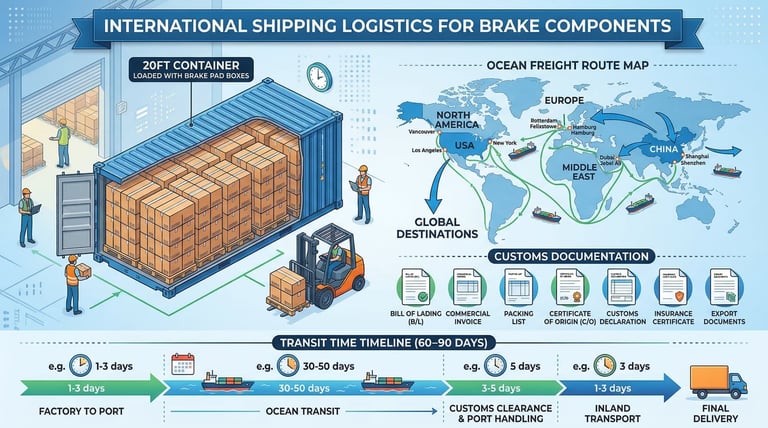
Sea freight represents standard shipping method for brake components, balancing cost efficiency with reasonable transit times. Full container loads (FCL) of 20-foot or 40-foot containers provide optimal economics for established distributors with sufficient volume. A 20-foot container accommodates approximately 15,000-20,000 brake pad sets or 3,000-4,000 brake disc pairs, with shipping costs from Chinese ports to US West Coast ranging $2,000-4,000 depending on market conditions.
Less than container load (LCL) shipping suits smaller orders or diverse product mixes. LCL costs calculate by cubic meter, typically $80-150 per CBM from Asia to North America. However, LCL involves consolidation and deconsolidation processes that extend transit times by 5-10 days and increase handling risks.
Air freight provides rapid delivery for urgent replenishment or high-value products, with transit times of 3-7 days versus 25-40 days for ocean freight. Air freight costs of $4.50-8.00 per kilogram make this option economical only for emergency situations or lightweight, high-margin products. A typical brake pad set weighing 2-3 kg incurs $9-24 in air freight costs alone.
Transit time planning should incorporate production lead times (25-35 days), ocean transit (25-40 days), customs clearance (2-5 days), and domestic delivery (3-7 days). Total cycle times of 60-90 days from order placement to warehouse receipt require sophisticated inventory planning and demand forecasting.
Incoterms and Cost Allocation
FOB (Free On Board) terms place responsibility and risk transfer at the origin port. Buyers arrange and pay for ocean freight, insurance, and destination handling. FOB provides maximum control over shipping arrangements and carrier selection, but requires logistics expertise and forwarder relationships.
CIF (Cost, Insurance, and Freight) terms include ocean freight and insurance in the supplier's quoted price, with risk transferring at destination port. CIF simplifies logistics management for buyers lacking international shipping experience, though suppliers' freight arrangements may not optimize for your specific needs.
DDP (Delivered Duty Paid) places maximum responsibility on suppliers, who handle all logistics, customs clearance, and delivery to your specified location. DDP provides ultimate convenience and cost certainty but typically includes 15-25% premiums over FOB pricing. Consider DDP for initial orders while developing logistics capabilities, transitioning to FOB for cost optimization.
Customs Classification and Duty Rates
Harmonized System (HS) codes classify brake components for customs purposes, determining applicable duty rates and regulatory requirements. Brake pads typically classify under HS 8708.30 (brakes and parts thereof), with US duty rates of 2.5% for most origins. Brake discs fall under the same classification with similar duty treatment.
Trade agreements may provide duty reductions or exemptions. USMCA (formerly NAFTA) offers duty-free treatment for qualifying North American products. GSP (Generalized System of Preferences) provides duty benefits for eligible developing countries, though China's GSP eligibility has been removed.
Customs valuation must reflect actual transaction value including all costs up to the port of entry. Undervaluation to reduce duties constitutes customs fraud with severe penalties including fines, merchandise seizure, and criminal prosecution. Maintain accurate documentation supporting declared values.
Import Compliance and Documentation
Commercial invoice provides customs authorities with transaction details including buyer and seller information, product descriptions, quantities, values, and payment terms. Accurate, detailed invoices prevent customs delays and valuation disputes.
Packing list documents shipment contents, dimensions, and weights. Detailed packing lists facilitate customs inspection and warehouse receiving processes.
Bill of lading serves as shipment receipt, cargo title document, and contract of carriage. Ocean bills of lading transfer ownership upon endorsement and presentation, requiring careful handling to prevent fraud or delivery errors.
Certificate of origin documents manufacturing location and may be required for preferential duty treatment under trade agreements. Suppliers must provide accurate origin certificates; false certificates constitute fraud with serious legal consequences.
Product certifications including ECE R90, AMECA, or other quality certifications should accompany shipments. Customs authorities increasingly scrutinize safety-critical automotive components, and certification documentation prevents clearance delays.
Market Trends and Future Outlook
The brake component wholesale market continues evolving under influence of technological advancement, regulatory pressures, and shifting vehicle populations. Understanding emerging trends enables distributors to position inventory, develop supplier relationships, and capture growth opportunities.
Electric Vehicle Impact on Brake Component Demand
Electric vehicles' regenerative braking systems reduce brake component wear by 30-50% compared to conventional vehicles, fundamentally altering replacement demand patterns. However, this trend unfolds gradually—EVs represent only 8-10% of global vehicle population in 2026, and existing conventional vehicle fleets ensure robust brake component demand through 2035.
Strategic implications for distributors include monitoring EV adoption rates in your markets and gradually adjusting inventory projections. Conventional brake components remain core business for the next decade, but long-term planning should anticipate demand moderation as EV penetration accelerates.
Specialized EV brake requirements create niche opportunities. EVs' heavy battery weight increases brake system loads when friction braking occurs, requiring higher-performance pad formulations. Additionally, infrequent brake use on EVs increases corrosion susceptibility, driving demand for premium coated rotors.
Copper-Free Friction Material Evolution
Regulatory mandates eliminating copper from brake friction materials drive significant formulation changes. California and Washington State copper-free requirements, effective 2025, influence national and international formulations as manufacturers consolidate product lines rather than maintaining region-specific variants.
Performance challenges in copper-free formulations include maintaining friction stability, noise control, and wear characteristics previously achieved through copper's beneficial properties. Early copper-free products exhibited increased noise and reduced performance consistency, though recent formulations show substantial improvement.
Wholesale implications include ensuring suppliers provide copper-free certifications for US-bound products and understanding that copper-free formulations may carry 5-10% price premiums reflecting reformulation costs and potentially more expensive alternative materials.
Autonomous Vehicle Considerations
Autonomous vehicles' sophisticated sensor systems and predictive braking algorithms promise to reduce brake system stress through optimized braking patterns. However, autonomous vehicle market penetration remains minimal through 2030, limiting near-term impact on wholesale brake component demand.
Long-term perspective suggests autonomous vehicles may extend brake component service life by 20-40% through optimized braking behavior, but this impact emerges gradually over decades as autonomous technology matures and fleet penetration increases.
Sustainability and Circular Economy Initiatives
Environmental consciousness drives increasing interest in sustainable brake component manufacturing and end-of-life recycling. Friction material manufacturers explore bio-based fibers and recycled content, while brake disc producers implement closed-loop casting processes reducing waste and energy consumption.
Market positioning opportunities exist for distributors emphasizing environmental responsibility. Products with recycled content, sustainable manufacturing certifications, or take-back programs appeal to environmentally conscious customers and fleet operators with sustainability mandates.
Regulatory trajectory suggests environmental requirements will intensify. Proactive engagement with suppliers on sustainability initiatives positions distributors ahead of regulatory curves and captures growing environmentally-focused market segments.
MakexCar: Your Trusted Brake Component Wholesale Partner
MakexCar brings two decades of automotive component manufacturing and export expertise to the global wholesale market. Our commitment to quality, reliability, and customer success has established long-term partnerships with distributors across six continents.
Manufacturing Excellence and Quality Assurance
Our IATF 16949 certified manufacturing facilities in China's Yangtze River Delta automotive cluster combine advanced automation with rigorous quality control. Every brake pad undergoes 100% pressure and seal testing before packaging, ensuring consistent performance that meets or exceeds OEM standards.
Production capacity of 1.0-1.5 million filter units monthly (with brake component expansion underway) demonstrates scale and reliability for growing distributor partnerships. Modern equipment including automated friction material mixing systems, computer-controlled curing ovens, and precision grinding machines deliver consistency that builds your reputation.
Quality testing encompasses friction coefficient verification across temperature ranges, shear strength testing, dimensional inspection, and noise evaluation. Our in-house laboratory equipped with dynamometer testing capabilities validates every production batch against stringent specifications.
Competitive Advantages for Wholesale Partners
Source-direct pricing eliminates intermediary margins, providing 15-25% cost advantages compared to trading company sourcing. Our integrated supply chain from raw materials to finished products optimizes costs while maintaining quality control throughout manufacturing.
Flexible customization supports your branding and market positioning strategies. We accommodate private label packaging, custom friction formulations, and specialized applications with minimum order quantities of 500-1,000 sets—lower than many competitors requiring 2,000+ set commitments.
Comprehensive product range currently focuses on premium filtration products, with strategic expansion into brake systems, lighting, and other wear components. This diversification enables one-stop sourcing that reduces your supplier management complexity and consolidates logistics for cost efficiency.
Responsive communication in English, with team members experienced in international trade, ensures clear understanding of your requirements and rapid response to inquiries. We understand wholesale distributors need reliable partners who communicate proactively and solve problems efficiently.
Global Market Experience
MakexCar products reach customers across North America, Europe, Middle East, Southeast Asia, South America, and Africa. This international experience means we understand diverse market requirements—from ECE R90 certification for European customers to copper-free formulations for California compliance.
Logistics expertise accumulated through thousands of international shipments enables smooth customs clearance, accurate documentation, and reliable delivery. We work with established freight forwarders and offer flexible Incoterms (FOB, CIF, or DDP) matching your logistics preferences and capabilities.
Partnership Approach
We view wholesale customers as long-term partners rather than transactional buyers. This philosophy manifests in transparent communication, consistent quality, reliable delivery, and collaborative problem-solving when challenges arise.
Technical support helps you select optimal products for your market, understand application requirements, and address customer questions. Our team provides product training, installation guidance, and troubleshooting assistance that enhances your customer service capabilities.
Market development collaboration includes sharing market insights, competitive intelligence, and growth strategies. Your success drives our success—we invest in understanding your business and supporting your growth objectives.
Contact MakexCar today to discuss your brake component wholesale requirements. Let's build a partnership that delivers quality products, reliable supply, and mutual success.
Contact Information:
Website: www.makexcar.com
Email: sales1@makexcar.com
Phone/WhatsApp: +86 199 4123 4680
WeChat: Sgxwtxa
Conclusion: Building Sustainable Wholesale Success
Wholesale brake component sourcing requires balancing multiple priorities—cost competitiveness, quality assurance, supply reliability, and market positioning. Success comes not from optimizing any single factor, but from systematic excellence across all dimensions.
Quality focus provides foundation for sustainable business. Short-term savings from inferior products generate long-term costs through warranty claims, customer defections, and reputation damage. Invest in supplier relationships that prioritize quality and maintain rigorous standards.
Strategic supplier partnerships create competitive advantages competitors cannot easily replicate. Move beyond transactional relationships toward collaborative partnerships where suppliers understand your business, anticipate your needs, and invest in your success.
Market knowledge about technical specifications, regulatory requirements, and customer preferences enables intelligent product selection and positioning. Continuous learning about brake technology, industry trends, and competitive dynamics sharpens your market edge.
Operational excellence in logistics, inventory management, and customer service differentiates successful distributors. Reliable delivery, accurate order fulfillment, and responsive support build customer loyalty that transcends price competition.
The brake component wholesale market offers substantial opportunities for distributors combining technical knowledge, supplier relationships, and customer focus. By implementing the strategies, evaluation frameworks, and best practices outlined in this guide, you position your business for sustainable growth and market leadership.
Your journey toward wholesale brake component success begins with informed decisions, quality partnerships, and unwavering commitment to customer value. The road ahead presents challenges, but also remarkable opportunities for those prepared to excel.
Related Articles
For comprehensive information about other automotive filter types and sourcing strategies, explore our related guides:
Whatsapp: +86 19941234680
Phone:+86 19941234680
© 2025. All rights reserved.
Email:sales1@makexcar.com
Wechat:Sgxwtxa