Automotive Lighting Wholesale Guide: Headlights, Tail Lights & LED Technology for Distributors (2026)
Complete automotive lighting wholesale guide for distributors. Learn ECE, DOT, SAE standards, LED technology, and bulk sourcing from certified manufacturers.
2/21/2026
The global automotive lighting market has reached $35.8 billion in 2025, with projections indicating continued expansion driven by LED technology adoption, safety regulations, and the aftermarket replacement cycle. For distributors, wholesalers, and auto parts retailers, understanding the technical specifications, regulatory requirements, and sourcing strategies for automotive lighting components is critical to capturing market share in this rapidly evolving sector.
This comprehensive guide synthesizes industry expertise, regulatory frameworks, and practical sourcing intelligence to help you make informed wholesale purchasing decisions. Whether you're expanding into lighting products, optimizing your supplier relationships, or navigating complex certification requirements, this manual provides the actionable insights necessary for success in the competitive automotive lighting wholesale market.
Understanding Automotive Lighting Systems: Types and Technologies
Modern automotive lighting systems have evolved from simple incandescent bulbs to sophisticated electronic assemblies incorporating advanced optics, thermal management, and intelligent control systems. Understanding these components is essential for wholesale buyers evaluating product quality and market positioning.
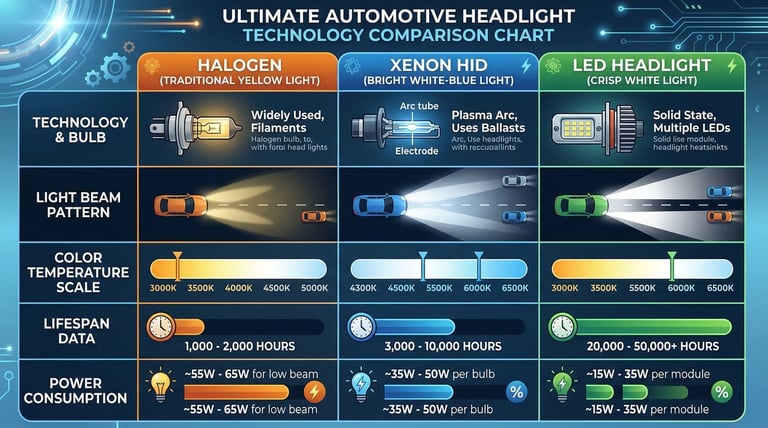
Headlight Technologies: Halogen, Xenon, and LED
Halogen Headlights
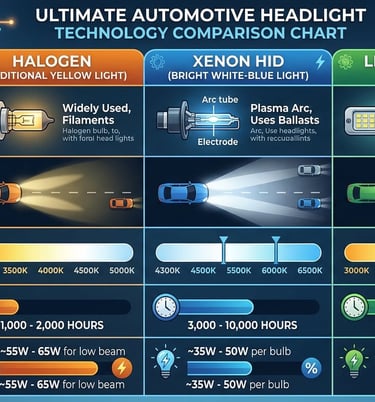
Halogen technology represents the traditional baseline for automotive lighting, still accounting for approximately 45% of global headlight installations in 2025. These systems use a tungsten filament within a halogen gas-filled envelope, producing light through incandescence.
Technical Specifications:
Color temperature: 3,000-3,500K (warm yellow-white)
Luminous flux: 1,000-1,500 lumens per bulb
Average lifespan: 500-1,000 hours
Power consumption: 55-65W per bulb
Operating voltage: 12V (passenger vehicles), 24V (commercial vehicles)
Wholesale Considerations:
Halogen headlights offer the lowest unit cost ($8-$15 wholesale per assembly) and universal compatibility, making them ideal for price-sensitive markets and older vehicle applications. However, declining OEM adoption and shorter lifespan present long-term market challenges.
Xenon HID (High-Intensity Discharge) Headlights
Xenon HID technology creates light through an electrical arc between tungsten electrodes in a xenon gas-filled chamber, producing significantly higher luminous output than halogen systems.
Technical Specifications:
Color temperature: 4,000-6,000K (bright white to cool white)
Luminous flux: 2,800-3,500 lumens per bulb
Average lifespan: 2,000-2,500 hours
Power consumption: 35W per bulb (plus ballast overhead)
Warm-up time: 15-30 seconds to full brightness
Wholesale Considerations:
HID systems command mid-range pricing ($45-$85 wholesale per assembly) and appeal to performance-oriented customers. The requirement for ballast modules and igniters increases complexity but also creates opportunities for accessory sales.
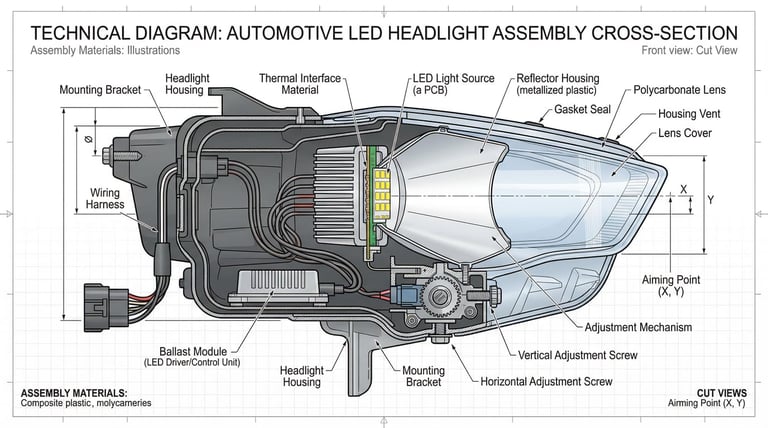
LED Headlights
LED (Light-Emitting Diode) technology has rapidly become the premium standard, with adoption rates exceeding 60% in new vehicles produced in 2025. LED systems offer superior efficiency, longevity, and design flexibility.
Technical Specifications:
Color temperature: 5,000-6,500K (daylight white)
Luminous flux: 3,000-4,500 lumens per assembly
Average lifespan: 15,000-30,000 hours
Power consumption: 15-25W per assembly
Instant-on capability: Full brightness immediately
Wholesale Considerations:
LED assemblies represent the highest initial investment ($85-$250 wholesale per assembly) but offer the strongest value proposition through extended lifespan, lower power consumption, and premium market positioning. The aftermarket LED upgrade segment presents significant growth opportunities.
Tail Lights and Signal Lamps
Rear lighting assemblies serve critical safety functions including position indication, braking signals, turn signals, and reverse illumination. LED technology has achieved near-universal adoption in tail light applications due to faster response times and design flexibility.
Key Components:
Brake lights: High-intensity red LEDs (typically 21-27W equivalent)
Turn signals: Amber LEDs with sequential or standard flash patterns
Reverse lights: White LEDs (typically 16-21W equivalent)
Position lights: Low-intensity red LEDs for night visibility
Wholesale Pricing:
Complete LED tail light assemblies: $35-$120 per unit
Replacement LED bulb modules: $8-$25 per set
OEM-equivalent assemblies: Premium 20-40% over aftermarket
Fog Lights and Auxiliary Lighting
Fog lights utilize specialized beam patterns designed to illuminate the road surface immediately ahead without creating glare in foggy or adverse weather conditions.
Technical Requirements:
Beam pattern: Wide, low cutoff (typically 10-15 degrees below horizontal)
Color temperature: 3,000K (yellow) for traditional fog lights, 4,000-5,000K for modern LED systems
Mounting height: Typically 250-400mm above ground level
Power output: 35-55W (halogen), 15-25W (LED)
Regulatory Considerations:
Many jurisdictions restrict fog light usage to specific weather conditions and require automatic deactivation with high beams. Ensure products comply with local regulations in target markets.
Quality Standards and Certifications for Automotive Lighting
Automotive lighting products face stringent regulatory requirements across global markets. Understanding these standards is essential for wholesale buyers to ensure legal compliance and minimize liability risks.
ECE Regulations (European Standards)
The United Nations Economic Commission for Europe (ECE) establishes lighting standards recognized across Europe, Asia, and many other markets.
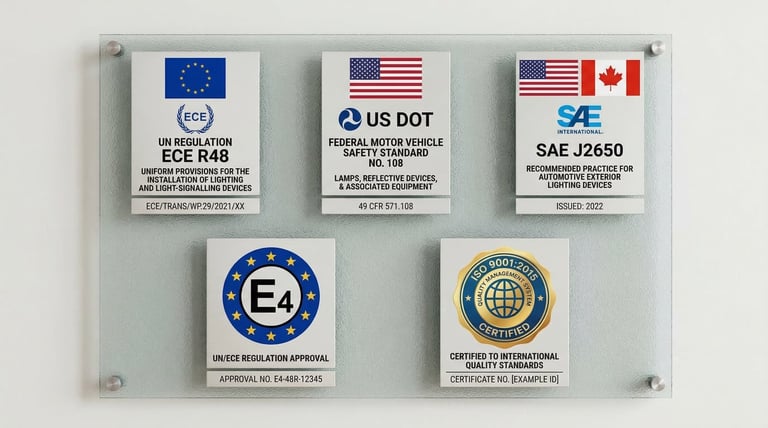
ECE R48: Installation of Lighting Devices
ECE R48 specifies the installation requirements, positioning, geometric visibility, and electrical connections for all lighting devices on vehicles.
Key Requirements:
Headlight mounting height: 500-1,200mm above ground
Minimum separation between headlights: 600mm (passenger cars)
Symmetry requirements: ±400mm from vehicle centerline
Activation interlocks: Specific requirements for daytime running lights, fog lights
Wholesale Implications:
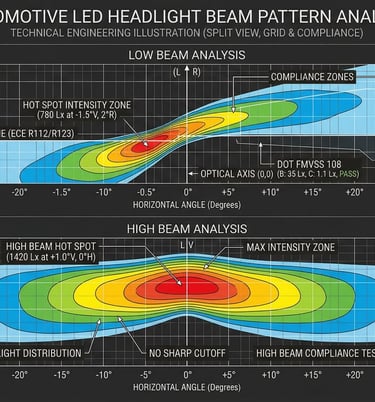
Products certified to ECE R48 demonstrate compliance with installation standards, but individual lamp assemblies must also meet component-specific regulations (R112 for headlights, R7 for position lights, etc.).
ECE R112: Headlamp Systems
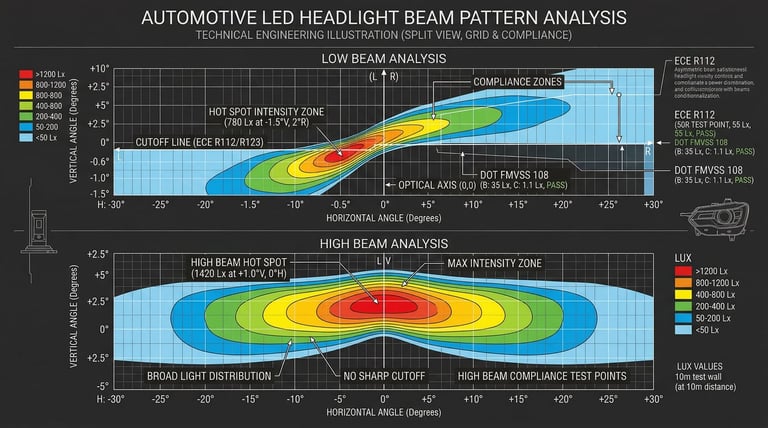
ECE R112 governs the photometric performance, beam pattern, and construction requirements for headlamp assemblies.
Testing Requirements:
Beam pattern verification at 25 meters
Luminous intensity measurements at specified test points
Cutoff line sharpness and positioning
Glare control verification
Photometric stability after environmental testing
Certification Process:
Products must be tested by ECE-approved laboratories and receive E-mark certification (e.g., "E1" for Germany, "E9" for Spain) displayed on the lamp housing.
DOT FMVSS 108 (United States Standards)
The U. S. Department of Transportation's Federal Motor Vehicle Safety Standard 108 establishes lighting requirements for the American market.
Key Differences from ECE:
Beam pattern requirements: Different photometric specifications
Color requirements: Stricter amber specifications for turn signals
Sealed beam provisions: Legacy requirements for older vehicles
Side marker requirements: Mandatory in U. S., not required in Europe
Compliance Marking:
Products meeting FMVSS 108 must display "DOT" marking along with manufacturer identification code.
SAE Standards (North American Technical Standards)
The Society of Automotive Engineers publishes technical standards that complement DOT regulations and provide detailed engineering specifications.
SAE J2650: LED Light Sources
SAE J2650 establishes performance requirements specifically for LED light sources used in automotive applications.
Key Specifications:
Luminous intensity maintenance: Minimum 70% after 5,000 hours
Color shift limits: Maximum ±150K from initial color temperature
Thermal management requirements: Junction temperature limits
Electrical characteristics: Voltage tolerance, current regulation
Wholesale Relevance:
Products meeting SAE J2650 demonstrate superior LED quality and longevity, justifying premium pricing and reducing warranty claims.
ISO 9001 and IATF 16949 Quality Management
While not product-specific certifications, these quality management system standards indicate manufacturer capability and process control.
ISO 9001:
General quality management system requirements
Applicable to all industries
Focus on customer satisfaction and continuous improvement
IATF 16949:
Automotive-specific quality management system
Builds upon ISO 9001 with additional automotive requirements
Includes PPAP (Production Part Approval Process) requirements
Mandates continuous improvement and defect prevention
Supplier Evaluation:
When evaluating potential suppliers, prioritize manufacturers with IATF 16949 certification, as this demonstrates automotive-specific quality management capabilities and reduces supply chain risks.
Sourcing Strategies for Automotive Lighting Wholesale
Successful wholesale sourcing of automotive lighting products requires balancing quality, cost, regulatory compliance, and market positioning. This section provides practical frameworks for supplier evaluation and procurement strategy.
Supplier Types and Positioning
Tier 1 OEM Suppliers
Tier 1 suppliers manufacture lighting systems for original equipment manufacturers (vehicle producers) and often offer aftermarket versions of their OEM products.
Advantages:
Highest quality standards and reliability
Complete regulatory compliance documentation
Strong warranty support and technical resources
Brand recognition in premium markets
Disadvantages:
Highest wholesale pricing (typically 40-60% above Tier 2)
Minimum order quantities often 500-1,000+ units
Limited customization or private labeling options
Longer lead times (8-12 weeks typical)
Best For: Premium market positioning, OEM-equivalent replacement parts, customers prioritizing quality over price.
Tier 2 Specialized Manufacturers
Tier 2 manufacturers focus exclusively on automotive lighting, offering strong technical capabilities without OEM premium pricing.
Advantages:
Excellent quality-to-price ratio
Moderate MOQs (typically 200-500 units)
Customization and private labeling available
Faster response times than Tier 1 suppliers
Disadvantages:
Less brand recognition than Tier 1
May require more thorough quality verification
Technical support may be less comprehensive
Best For: Balanced quality and pricing strategy, private label development, growing wholesale operations.
Tier 3 General Auto Parts Manufacturers
Tier 3 suppliers produce a wide range of automotive components, including lighting as one product category among many.
Advantages:
Lowest wholesale pricing (30-50% below Tier 1)
Low MOQs (sometimes as low as 50-100 units)
Flexible terms and rapid order fulfillment
One-stop sourcing for multiple product categories
Disadvantages:
Variable quality control
Limited technical expertise in lighting specifically
Certification documentation may be incomplete or questionable
Higher defect rates and warranty claims
Best For: Price-sensitive markets, testing new product lines, supplementary inventory for low-margin segments.
Geographic Sourcing Considerations
China
China dominates global automotive lighting manufacturing, accounting for approximately 65% of worldwide production in 2025.
Key Manufacturing Regions:
Guangdong Province (Guangzhou, Shenzhen, Foshan): LED technology specialists, premium quality
Zhejiang Province (Ningbo, Wenzhou): Mid-range products, excellent value proposition
Jiangsu Province (Changzhou, Wuxi): OEM suppliers, high-volume production
Sourcing Advantages:
Widest product selection and customization options
Most competitive pricing across all quality tiers
Established export infrastructure and logistics
Strong LED technology development
Sourcing Challenges:
Quality verification requires due diligence
Intellectual property protection concerns
Communication and time zone differences
Longer shipping times (4-6 weeks sea freight)
Taiwan
Taiwan specializes in premium LED components and high-quality lighting assemblies, positioned between Chinese and Japanese quality/pricing.
Strengths:
Excellent LED chip quality (many Chinese manufacturers use Taiwanese LEDs)
Strong engineering capabilities and technical support
Reliable quality control and consistent production
English language proficiency in business communications
Considerations:
Pricing typically 15-25% higher than comparable Chinese products
Smaller production scale may limit availability
MOQs similar to Tier 2 Chinese manufacturers
South Korea
South Korean manufacturers focus on premium and innovative lighting technologies, particularly advanced LED systems.
Strengths:
Cutting-edge LED technology and design
Excellent build quality and longevity
Strong OEM relationships and automotive expertise
Considerations:
Premium pricing (comparable to Tier 1 suppliers)
Limited availability in aftermarket channels
Higher MOQs and longer lead times
Europe (Germany, Italy, Czech Republic)
European manufacturers represent the premium segment, emphasizing quality, innovation, and regulatory compliance.
Strengths:
Highest quality standards and reliability
Complete regulatory documentation and certification
Advanced technology (adaptive LED, matrix lighting)
Strong brand reputation
Considerations:
Highest wholesale pricing (often 2-3x Chinese equivalents)
Very high MOQs (1,000+ units typical)
Limited product range focused on premium segments
Supplier Verification and Quality Assurance
Factory Audits
Before committing to significant orders, conduct on-site factory audits or hire third-party inspection services.
Key Evaluation Criteria:
Production capacity: Verify claimed output capabilities
Quality control processes: Inspect testing equipment and procedures
Certifications: Confirm ISO 9001, IATF 16949, and product certifications
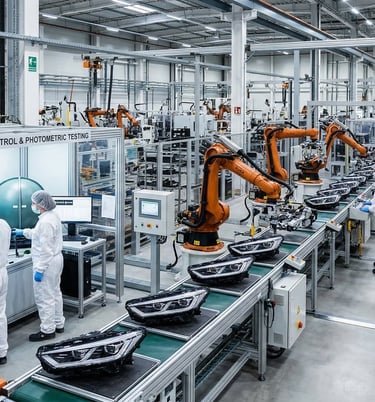
Equipment: Modern automated assembly lines indicate quality investment
Workforce: Stable, trained workforce suggests consistent production
Sample Testing Protocol
Establish a rigorous sample testing process before placing bulk orders:
Stage 1: Initial Samples (3-5 units)
Visual inspection for build quality and finish
Basic functionality testing (all lighting modes)
Packaging evaluation
Documentation review (certifications, specifications)
Stage 2: Extended Testing (10-20 units)
Photometric testing (if equipment available)
Thermal testing (operating temperature measurement)
Vibration and shock testing
Accelerated aging (extended operation test)
Stage 3: Pre-Production Samples
Final verification before bulk order
Confirm any customizations or modifications
Verify packaging and labeling
Certification Verification
Never rely solely on supplier-provided certification documents. Verify authenticity through:
ECE certifications: Check with issuing authority or laboratory
DOT compliance: Verify manufacturer ID code with NHTSA
ISO certifications: Confirm with issuing certification body
Test reports: Request reports from recognized third-party laboratories
Pricing Dynamics and Margin Optimization
Understanding automotive lighting pricing structures enables effective negotiation and margin optimization.
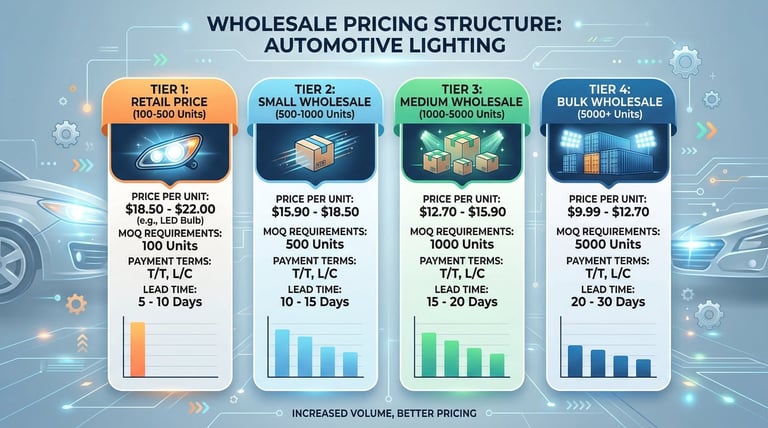
Wholesale Pricing Tiers
Pricing varies significantly based on technology, quality tier, and order volume:
Halogen Headlight Assemblies
Tier 3 (Basic quality): $8-$12 per unit (MOQ 500+)
Tier 2 (Good quality): $12-$18 per unit (MOQ 300+)
Tier 1 (OEM equivalent): $18-$30 per unit (MOQ 1,000+)
Xenon HID Headlight Assemblies
Tier 3 (Basic quality): $35-$50 per unit (MOQ 200+)
Tier 2 (Good quality): $50-$75 per unit (MOQ 200+)
Tier 1 (OEM equivalent): $75-$120 per unit (MOQ 500+)
LED Headlight Assemblies
Tier 3 (Basic quality): $65-$95 per unit (MOQ 100+)
Tier 2 (Good quality): $95-$160 per unit (MOQ 200+)
Tier 1 (Premium/OEM): $160-$280 per unit (MOQ 500+)
LED Tail Light Assemblies
Tier 3 (Basic quality): $28-$45 per unit (MOQ 200+)
Tier 2 (Good quality): $45-$75 per unit (MOQ 200+)
Tier 1 (OEM equivalent): $75-$140 per unit (MOQ 500+)
Volume Discount Structures
Typical volume discount progression from Chinese and Taiwanese manufacturers:
Base price: 100-199 units
5-8% discount: 200-499 units
10-15% discount: 500-999 units
15-20% discount: 1,000-2,499 units
20-25% discount: 2,500+ units
Negotiation Strategy:
Consolidate orders across multiple SKUs to reach higher volume tiers. Many manufacturers calculate discounts based on total order value rather than per-SKU quantities.
Payment Terms and Pricing Impact
Payment terms significantly affect wholesale pricing:
100% advance payment: Base price (0% premium)
50% deposit, 50% before shipment: +2-3% typical
30% deposit, 70% against documents: +3-5% typical
Letter of Credit: +4-6% typical
Net 30-60 terms: +8-12% typical (established relationships only)
Cost Optimization:
For established supplier relationships, negotiate extended payment terms while maintaining competitive pricing through volume commitments or multi-product orders.
Total Landed Cost Calculation
Wholesale price represents only one component of total landed cost. Consider all expenses:
Direct Costs:
Wholesale unit price
International shipping (sea freight: $0.50-$2.00 per unit depending on volume)
Customs duties (varies by country, typically 2-8% for automotive lighting)
Import taxes and fees
Indirect Costs:
Quality inspection (third-party: $300-$800 per shipment)
Warehousing and handling
Financing costs (if using credit)
Currency exchange fees and fluctuation risk
Example Calculation (LED Headlight Assembly):
Wholesale price (Tier 2, 500 units): $120.00
Shipping (sea freight): $1.50
Customs duty (4%): $4.80
Import processing: $0.80
Quality inspection (allocated): $0.60
Total landed cost: $127.70
Suggested retail price: $255-$320 (100-150% markup)
Packaging and Branding Options
Packaging significantly impacts market positioning, customer perception, and logistics efficiency.
Packaging Tiers
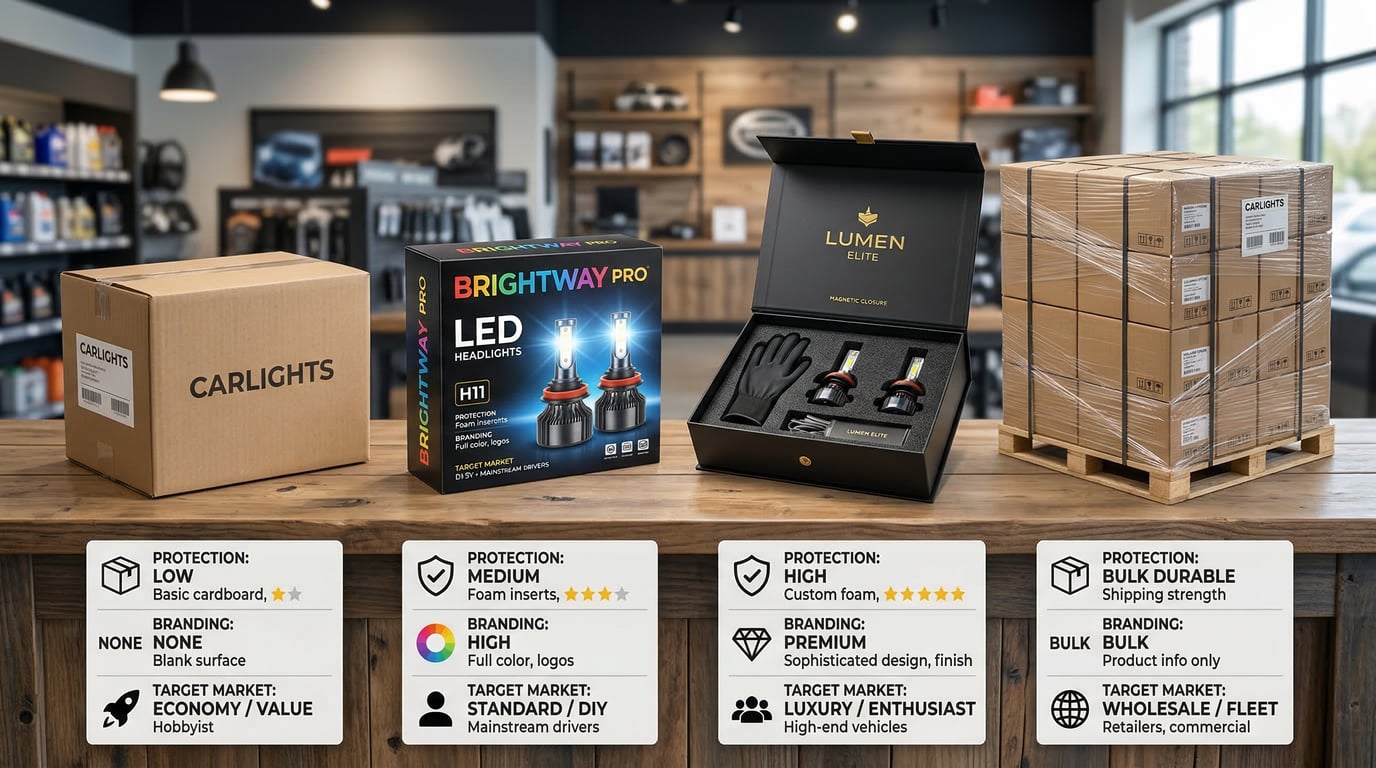
Neutral/Generic Packaging
Characteristics:
Plain brown or white boxes
Minimal printing (basic product identification only)
No branding or marketing materials
Basic protective materials (bubble wrap, foam inserts)
Wholesale Price Impact: Base price (no additional cost)
Best For:
Maximum margin optimization
Customers who repackage products
Bulk sales to installers and repair shops
Semi-Branded Packaging
Characteristics:
Printed color boxes with product images
Basic product specifications and features
Generic brand name (not manufacturer's brand)
Improved protective packaging
Wholesale Price Impact: +$0.80-$2.50 per unit
Best For:
Retail distribution channels
Online marketplace sales
Balanced cost and presentation
Premium Retail Packaging
Characteristics:
High-quality printed boxes with professional graphics
Comprehensive product information and installation guides
Warranty cards and customer support information
Premium protective packaging
Wholesale Price Impact: +$2.50-$5.00 per unit
Best For:
Retail store shelf presence
Premium market positioning
Building brand value and customer trust
Private Labeling Considerations
Many Tier 2 and Tier 3 manufacturers offer private labeling services, enabling brand development without manufacturing investment.
Typical Requirements:
Minimum order quantity: 500-1,000 units (varies by manufacturer)
Setup fees: $300-$1,500 for packaging design and printing plates
Lead time: Add 2-3 weeks to standard production time
Ongoing cost: +$1.50-$4.00 per unit depending on packaging complexity
Private Label Development Strategy:
Start with semi-branded packaging for initial market testing
Gather customer feedback on product performance and preferences
Invest in premium packaging once sales volume justifies the cost
Develop brand identity across multiple product categories for economies of scale
Packaging Compliance Requirements
Ensure packaging meets regulatory requirements in target markets:
United States:
Product labeling must include DOT compliance statement
Country of origin marking required
California Proposition 65 warnings if applicable
FTC guidelines for performance claims
European Union:
CE marking required
Multilingual labeling for EU distribution
WEEE (Waste Electrical and Electronic Equipment) symbol
Compliance with Packaging and Packaging Waste Directive
General Best Practices:
Include clear installation instructions (with diagrams)
Provide warranty information and customer support contact
List technical specifications (voltage, wattage, lumens, color temperature)
Include compatibility information (vehicle makes/models or universal fitment)
Logistics and Shipping Strategies
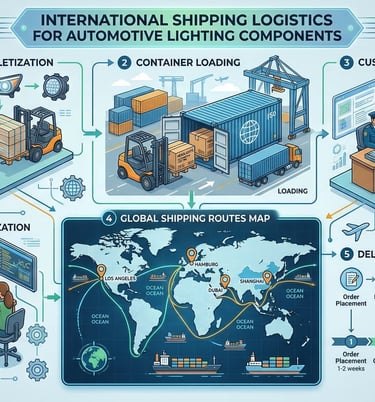
Efficient logistics management directly impacts profitability and customer satisfaction in automotive lighting wholesale.
Shipping Methods Comparison
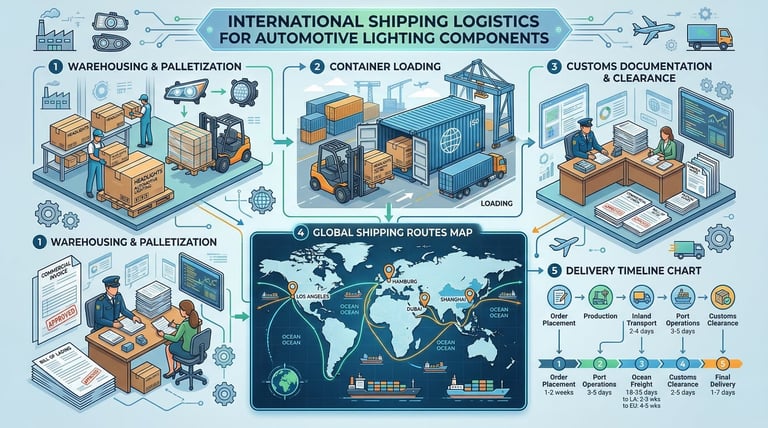
Sea Freight (Ocean Shipping)
Characteristics:
Transit time: 25-45 days (Asia to North America/Europe)
Cost: $0.40-$2.00 per unit depending on volume
Minimum practical volume: 100+ units (LCL), 500+ units (FCL optimal)
Advantages:
Lowest per-unit cost for large volumes
Suitable for heavy or bulky products
Established infrastructure and reliability
Disadvantages:
Long transit times require advance planning
Port delays and customs processing add uncertainty
Requires larger working capital investment
Best For: Established product lines with predictable demand, large volume orders, non-urgent replenishment.
Air Freight
Characteristics:
Transit time: 5-10 days door-to-door
Cost: $4.00-$8.00 per unit (varies significantly by route and volume)
Practical for any quantity
Advantages:
Rapid delivery enables responsive inventory management
Lower working capital requirements
Reduced warehousing needs
Disadvantages:
Significantly higher per-unit cost
Weight and size restrictions may apply
Environmental impact considerations
Best For: New product launches, urgent replenishment, testing market demand, high-value LED assemblies where speed justifies cost.
Express Courier (DHL, FedEx, UPS)
Characteristics:
Transit time: 3-7 days door-to-door
Cost: $8.00-$15.00+ per unit
Ideal for small quantities (under 50 units)
Advantages:
Fastest delivery option
Simplified customs clearance
Door-to-door tracking and reliability
Disadvantages:
Highest per-unit cost
Economical only for small shipments
Customs duties and taxes may be collected at delivery
Best For: Sample orders, emergency shipments, small-scale testing, high-value premium products.
Container Loading Optimization
Maximizing container utilization reduces per-unit shipping costs.
20-Foot Container (20' FCL)
Capacity:
Volume: 33 cubic meters
Maximum weight: 28,000 kg (varies by shipping line)
Typical automotive lighting capacity: 2,000-4,000 units depending on product type
Cost:
Asia to North America: $2,500-$4,500 (varies by season and route)
Asia to Europe: $3,000-$5,500
40-Foot Container (40' FCL)
Capacity:
Volume: 67 cubic meters
Maximum weight: 28,000 kg (weight limit often reached before volume)
Typical automotive lighting capacity: 4,000-8,000 units
Cost:
Asia to North America: $3,500-$6,500
Asia to Europe: $4,500-$8,000
Optimization Strategy:
Mix product types to maximize container utilization
Coordinate orders with other product categories if possible
Consider consolidated shipping with other importers (freight forwarder services)
Customs and Import Considerations
Harmonized System (HS) Codes
Automotive lighting products fall under various HS codes depending on specific product type:
8512.20: Lighting equipment for motor vehicles (general category)
8512.20.20: Headlights and headlight assemblies
8512.20.40: Other lighting equipment (tail lights, fog lights, etc.)
Importance:
Correct HS code classification ensures accurate duty calculation and smooth customs clearance. Misclassification can result in delays, penalties, or shipment holds.
Duty Rates by Market
United States:
Most automotive lighting: 2.5% duty rate
Certain LED assemblies: Duty-free under specific classifications
Additional Section 301 tariffs may apply to Chinese products (verify current status)
European Union:
Standard automotive lighting: 4.5% duty rate
Preferential rates available under various trade agreements
VAT (varies by country): 19-27% applied to (CIF value + duty)
Canada:
Automotive lighting: 6.1% duty rate
CUSMA (formerly NAFTA) may provide duty-free treatment for qualifying products
Australia:
Automotive lighting: 5% duty rate
Goods and Services Tax (GST): 10% applied to (CIF value + duty)
Import Documentation Requirements
Essential documents for customs clearance:
Commercial Invoice: Detailed product description, quantities, values, HS codes
Packing List: Carton-by-carton contents, weights, dimensions
Bill of Lading (B/L): Proof of shipment and title document
Certificate of Origin: May be required for preferential duty treatment
Product Certifications: DOT, ECE, or other regulatory compliance documents
Import License: Required in some jurisdictions for automotive parts
Best Practice:
Work with experienced customs brokers who specialize in automotive parts to ensure smooth clearance and minimize delays.
Market Trends and Future Outlook
Understanding emerging trends enables strategic positioning for long-term success in the automotive lighting wholesale market.
LED Technology Advancement
Adaptive LED Systems
Adaptive LED headlights dynamically adjust beam patterns based on vehicle speed, steering angle, and oncoming traffic, optimizing visibility while minimizing glare.
Market Impact:
Premium segment growing at 18% CAGR (2025-2030)
Aftermarket retrofit opportunities emerging
Higher wholesale prices ($280-$450 per assembly) with stronger margins
Wholesale Opportunity:
Early positioning in adaptive LED systems captures premium market segment before mass-market commoditization.
Matrix LED Technology
Matrix LED systems use individually controllable LED segments (typically 12-84 segments per headlight) to create precise beam patterns that automatically adapt to road conditions and traffic.
Current Status:
Primarily OEM installations in luxury vehicles
Aftermarket availability limited but growing
Regulatory approval expanding (now permitted in U. S. as of 2022)
Future Outlook:
Matrix LED technology will cascade to mid-market vehicles by 2027-2028, creating significant aftermarket replacement and upgrade opportunities.
Smart Lighting Integration
Automotive lighting increasingly integrates with vehicle systems for enhanced functionality:
Communication Functions:
Turn signal projection onto road surface
Welcome lighting sequences
Pedestrian warning projections
Vehicle-to-vehicle communication via light signals
Wholesale Implications:
Smart lighting features command premium pricing and appeal to technology-focused customer segments, but require more sophisticated technical support and installation expertise.
Sustainability and Environmental Considerations
Environmental regulations and customer preferences increasingly influence product selection:
Key Trends:
Energy efficiency requirements: LED adoption driven by regulatory mandates
Recyclability standards: EU regulations requiring 85% recyclability by weight
Hazardous material restrictions: RoHS compliance mandatory in most markets
Packaging waste reduction: Pressure to minimize packaging materials
Strategic Response:
Emphasize LED products' environmental benefits (energy savings, longevity, reduced waste) in marketing and customer communications. Source from manufacturers with documented environmental management systems.
Aftermarket vs. OEM Dynamics
The relationship between aftermarket and OEM channels continues evolving:
Aftermarket Growth Drivers:
Aging vehicle fleet (average age 12.5 years in U. S., increasing)
LED upgrade demand (consumers retrofitting older vehicles)
Cost-conscious consumers seeking alternatives to dealer pricing
Online sales channels expanding market reach
OEM Competitive Factors:
Increasing OEM parts availability through online channels
Extended warranty programs encouraging OEM parts usage
Advanced technologies (adaptive, matrix LED) initially OEM-exclusive
Wholesale Strategy:
Maintain diverse product portfolio spanning value-oriented replacements (competing on price) and premium upgrades (competing on features and performance) to capture both market segments.
Regional Market Opportunities
Emerging Markets (Southeast Asia, Latin America, Africa)
Characteristics:
Rapidly growing vehicle populations
Price-sensitive customers
Limited regulatory enforcement (variable)
Developing distribution infrastructure
Opportunity:
High-volume, value-oriented products (Tier 3 and lower Tier 2) with focus on reliability and competitive pricing.
Developed Markets (North America, Europe, Japan)
Characteristics:
Mature vehicle populations with aging fleet
Stringent regulatory requirements
Quality-conscious customers
Established distribution networks
Opportunity:
Premium LED products, technology upgrades, and OEM-equivalent replacements emphasizing quality, compliance, and performance.
Electric Vehicle (EV) Market
Characteristics:
Rapidly growing segment (18% of global sales in 2025)
Emphasis on energy efficiency
Technology-forward customer base
Unique lighting requirements (aerodynamic designs)
Opportunity:
Specialized LED lighting optimized for EV applications, emphasizing energy efficiency and modern aesthetics. Partner with manufacturers developing EV-specific product lines.
MakexCar: Your Trusted Automotive Lighting Manufacturing Partner
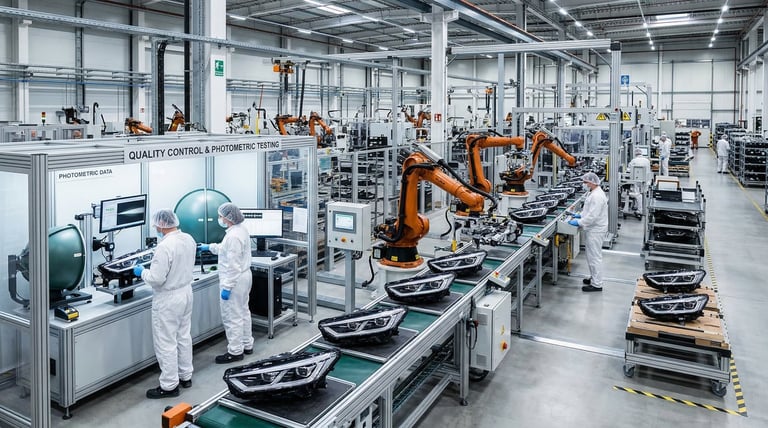
MakexCar operates as a specialized automotive lighting manufacturer with comprehensive capabilities spanning LED headlight assemblies, tail light systems, fog lights, and auxiliary lighting products. Our manufacturing facility integrates advanced LED technology, automated production lines, and rigorous quality control systems to deliver reliable, certified lighting solutions for wholesale distributors worldwide.
Manufacturing Capabilities
Production Capacity:
Monthly output: 50,000+ lighting assemblies across all product categories
LED headlight assemblies: 15,000 units/month
Tail light assemblies: 20,000 units/month
Fog lights and auxiliary lighting: 15,000 units/month
Technology Infrastructure:
Automated SMT (Surface Mount Technology) LED assembly lines
Photometric testing laboratory with ECE/DOT-compliant equipment
Environmental testing chambers (temperature, humidity, vibration)
Optical design and simulation capabilities
Quality Management:
ISO 9001:2015 certified quality management system
IATF 16949 automotive quality certification (in progress, completion Q3 2026)
100% functional testing before shipment
Comprehensive traceability systems for quality assurance
Product Range
LED Headlight Assemblies:
Halogen-to-LED upgrade kits for popular vehicle models
Complete LED headlight assemblies (projector and reflector designs)
Adaptive LED systems (select models)
Color temperature options: 5,000K, 6,000K, 6,500K
Tail Light Assemblies:
LED tail light assemblies for passenger vehicles and light trucks
Sequential turn signal options
Smoked, clear, and red lens variants
OEM-style and custom designs
Fog Lights and Auxiliary Lighting:
LED fog light assemblies (3,000K and 5,000K options)
LED light bars and auxiliary driving lights
Daytime running light (DRL) modules
Certifications and Compliance
MakexCar products meet international regulatory standards for global market access:
Current Certifications:
ECE R48, R87, R112 (European standards)
DOT FMVSS 108 (United States standards)
SAE J2650 (LED light source standards)
ISO 9001:2015 (Quality management)
Testing and Validation:
Photometric testing per ECE and DOT requirements
Environmental durability testing (temperature cycling, humidity, salt spray)
Vibration and shock testing per automotive standards
Accelerated aging testing for LED longevity validation
Wholesale Partnership Advantages
Flexible Order Quantities:
Minimum order quantity: 100 units (mixed SKUs acceptable)
Volume discounts: Tiered pricing structure rewards larger commitments
Sample orders: Available for product evaluation (5-10 units)
Customization Services:
Private labeling and custom packaging
Product modifications for specific market requirements
Custom beam patterns and color temperatures
Packaging design and printing services
Logistics Support:
FOB, CIF, and DDP terms available
Consolidated shipping for mixed product orders
Experienced export team managing documentation and compliance
Partnerships with reliable freight forwarders for competitive shipping rates
Technical Support:
Pre-sales technical consultation for product selection
Installation guides and technical documentation
After-sales support for warranty and technical issues
Product training for distributor sales teams
Competitive Positioning
MakexCar occupies the Tier 2 quality segment, offering excellent value proposition for wholesale distributors:
Quality: Comparable to Tier 1 suppliers through rigorous testing and quality control, but without premium brand pricing.
Pricing: Competitive with upper-tier Chinese manufacturers while maintaining superior quality standards. Typical pricing 15-25% below Tier 1 equivalents.
Service: Responsive communication, flexible terms, and genuine partnership approach. English-speaking sales and technical teams ensure clear communication.
Innovation: Continuous product development incorporating latest LED technology and market trends. Regular new product introductions expand distributor catalog options.
Contact and Ordering Information
Get Started with MakexCar:
Website: www.makexcar.com
Email: sales1@makexcar.com
Phone: +8619941234680(International sales team)
Request Information:
Product catalogs and specification sheets
Sample orders for evaluation
Custom quotations for specific requirements
Technical consultation for product selection
Partnership Opportunities:
Exclusive distribution agreements for specific territories
Private label development programs
Joint product development for unique market needs
MakexCar welcomes wholesale distributors, auto parts retailers, and online sellers seeking reliable automotive lighting manufacturing partner. Contact our team to discuss how we can support your business growth with quality lighting products, competitive pricing, and responsive service.
Conclusion
The automotive lighting wholesale market presents substantial opportunities for distributors who understand the technical requirements, regulatory landscape, and sourcing strategies essential for success. LED technology continues driving market transformation, creating demand for both replacement parts and performance upgrades across all vehicle segments.
Successful wholesale operations balance multiple factors: product quality and certification compliance ensure legal market access and minimize liability risks; competitive pricing and margin optimization enable sustainable profitability; reliable supplier relationships provide consistent inventory and responsive support; effective logistics management controls costs and maintains customer satisfaction.
As the market evolves toward advanced LED systems, smart lighting integration, and increasing environmental requirements, distributors who stay informed about emerging trends and maintain relationships with capable manufacturing partners will be best positioned to capitalize on growth opportunities.
Whether you're expanding into automotive lighting for the first time or optimizing an existing product line, the frameworks and insights provided in this guide offer practical foundations for informed decision-making and strategic planning.
Related Articles
For comprehensive information about other automotive parts and sourcing strategies, explore our related guides:
Brake Pads & Brake Discs Wholesale Guide: Complete Sourcing Manual for Distributors (2026)
Oil Filter Wholesale Guide: OEM Quality Standards & Specifications
Fuel Filter Wholesale Guide: Gasoline & Diesel Specifications
About MakexCar: MakexCar is a specialized automotive parts manufacturer focusing on filters, lighting systems, and brake components for wholesale distribution. With ISO 9001 certification and comprehensive quality control, we provide reliable products and responsive service to distributors worldwide. Contact us to discuss your wholesale requirements.
Whatsapp: +86 19941234680
Phone:+86 19941234680
© 2025. All rights reserved.
Email:sales1@makexcar.com
Wechat:Sgxwtxa
Quick links