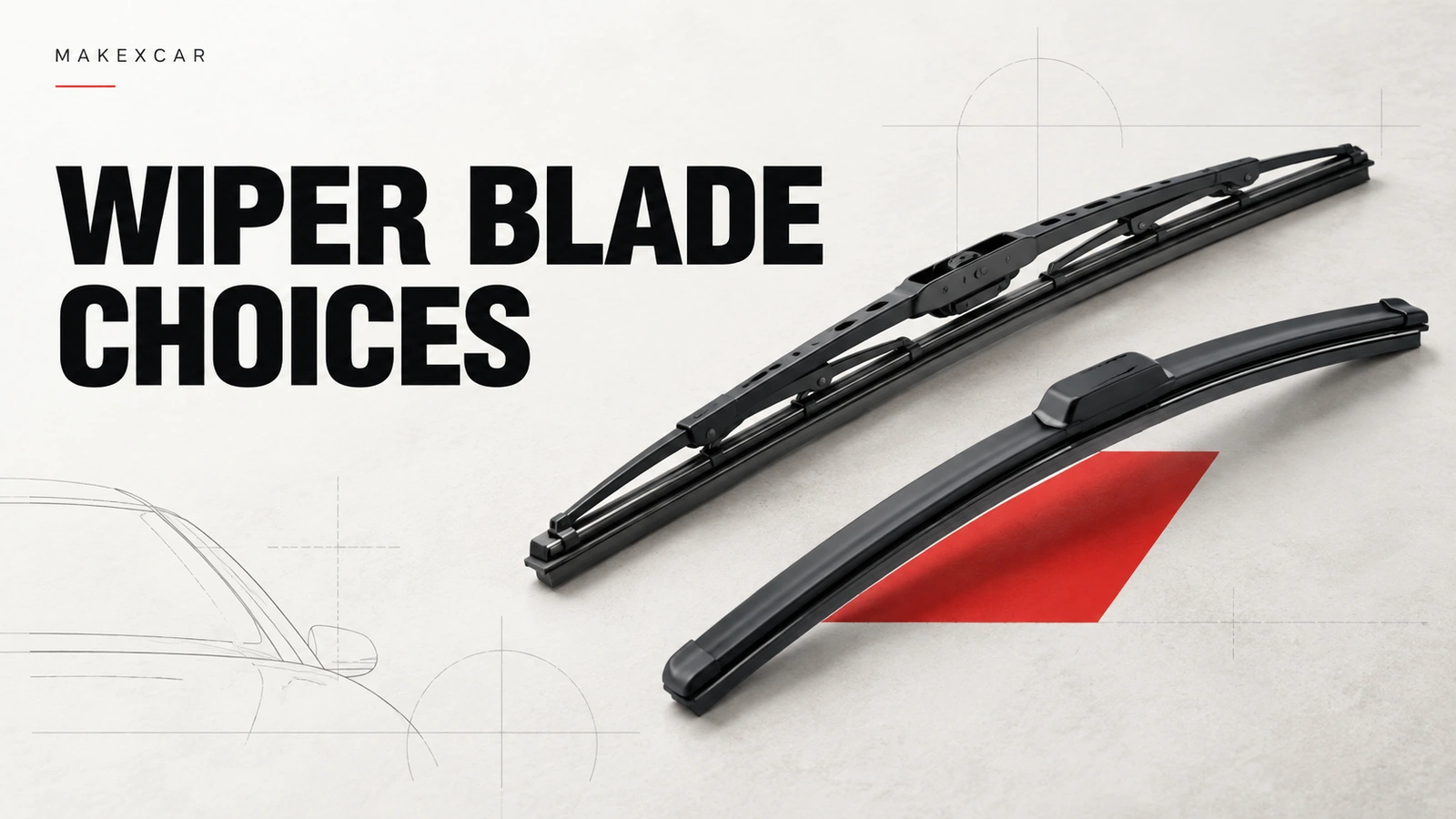
Which type should a distributor stock?
Give each proposed SKU a clear order route before comparing suppliers. Separate a direct replacement from a requested retrofit, then record the demand behind the line. The matrix below is a buying method: it identifies the starting candidate and the evidence needed to approve it; it does not certify any part as compatible.
| Order situation | Starting candidate | Approval evidence and next step |
|---|---|---|
| Customer needs a conventional replacement | Conventional blade matching the documented application | Confirm the catalogue entry, connector and length. If the match is unresolved, hold the line for clarification. |
| Customer needs an original flat-blade replacement | Beam / flat blade listed for that application | Confirm the replacement reference and supplied connection. Keep a different connector proposal as a separate pending offer. |
| Customer requests an upgrade from conventional to beam | Documented retrofit option for that application | Request explicit retrofit coverage, adapter identification and fitting instructions. Without them, retain the direct replacement as the enquiry basis. |
| Your customers require more than one of these routes | A mixed range with each SKU assigned to its route | Use enquiry or sales records to set quantities. Keep unverified coverage outside the approved order. |
Add the selected order route to the RFQ alongside the application reference and quantity. This lets the supplier distinguish a routine replacement request from a retrofit evaluation, and prevents an alternative pack from silently becoming the basis of the order.
Separate two decisions in your buying sheet: whether the proposed blade fits the intended vehicle, and whether its price, sample results and supply terms meet your commercial requirements. Resolve fitment first. A lower unit price has little value when the application entry is unclear or the supplied adapter differs from the approved sample.
What changes between conventional and beam construction?
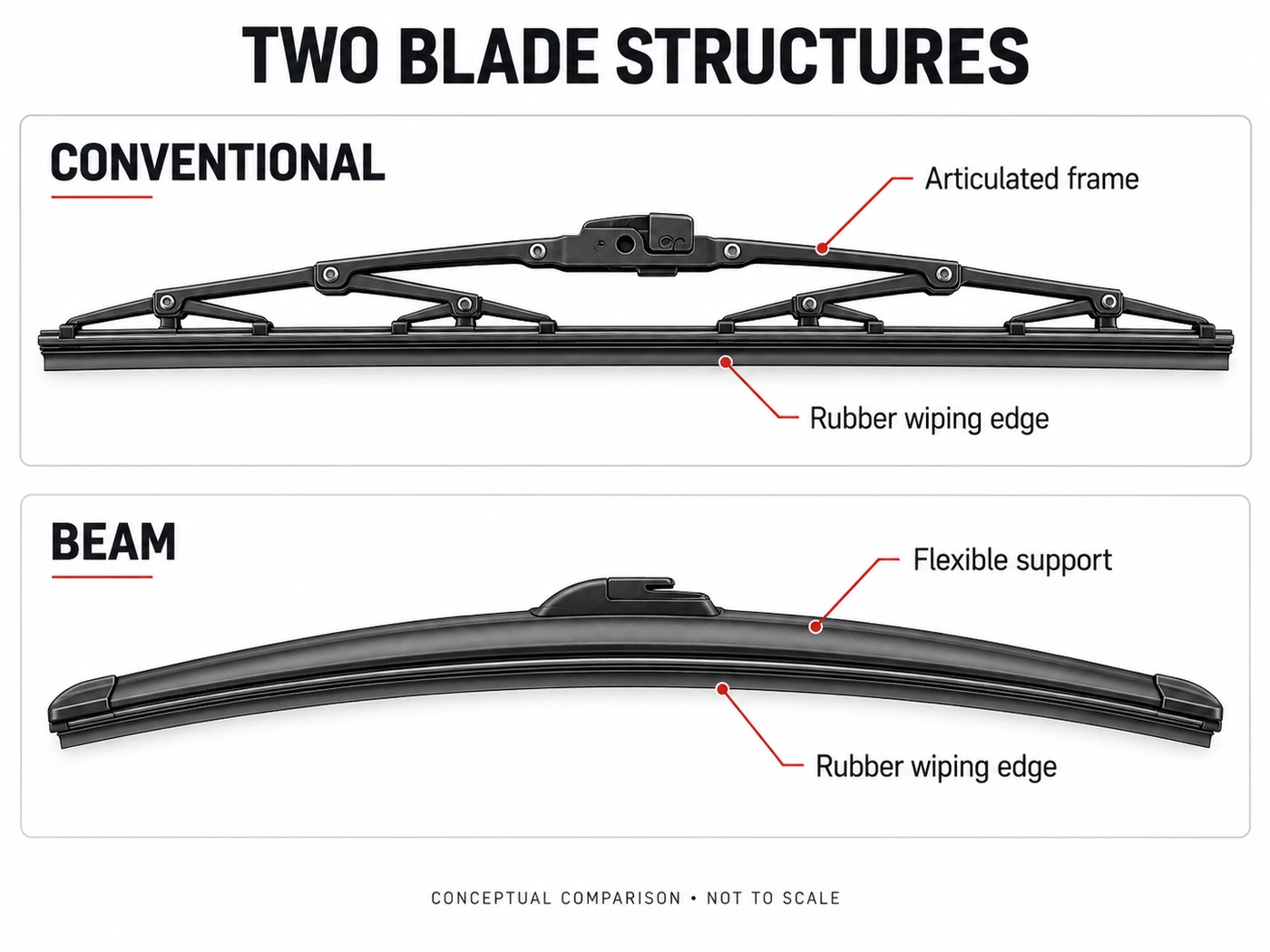
A conventional blade has an articulated frame supporting its wiping element. DENSO describes this family as a bracket design and explains that its contact points support the wiping edge. Its product information also stresses matching the windscreen curvature. These are useful structural reference points when reviewing a supplier sample. See DENSO’s conventional blade explanation.
A beam blade, often described as a flat blade, has a lower-profile support structure without the conventional exposed bracket arrangement. DENSO’s flat-blade description identifies the supporting vertebrae and an integrated spoiler, while emphasising an exact application match. The visible shape therefore tells only part of the story; the proposed part still needs its own fitment evidence. See DENSO’s flat blade explanation.
| Comparison point | Conventional blade | Beam / flat blade |
|---|---|---|
| Visible structure | Articulated external frame | Low-profile body without the conventional exposed frame |
| Sample identification | Record frame, wiping element and connector | Record body, support profile and connector |
Keep hybrid blades identified separately. DENSO describes its hybrid design as a frame concealed inside a streamlined body. A covered profile can therefore resemble a flat blade while using a different construction. Ask the supplier to name the design and provide a clear sample photograph before assigning the item to a range. See DENSO’s hybrid blade description.
Verify fitment before comparing the quotation
Start with an application record
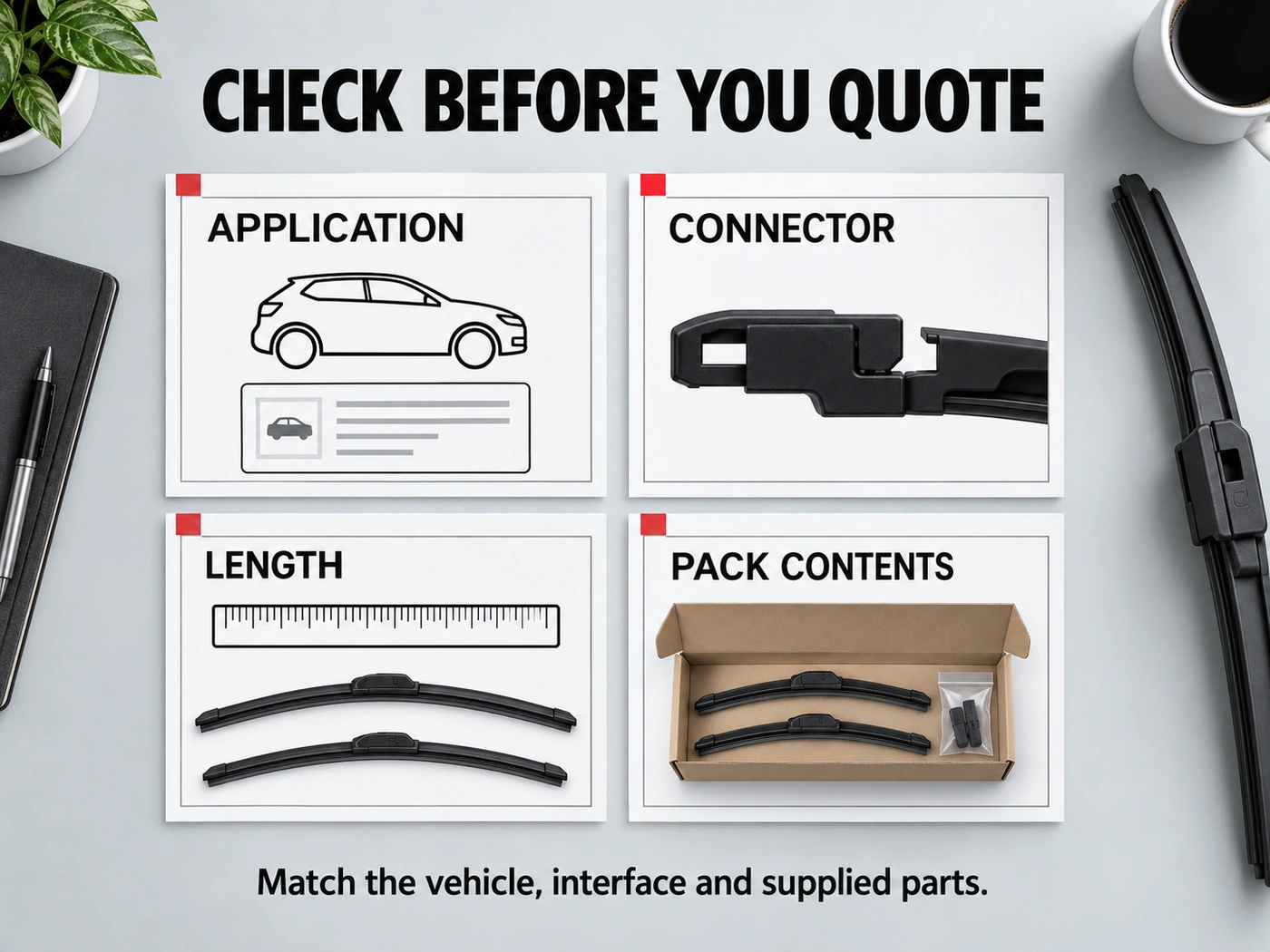
Give every quotation line a target market, vehicle make, model, production period and relevant variant. Record front or rear position and the side where applicable. Add the original reference or a traceable catalogue reference when available. Keep the catalogue revision or retrieval date with the record so a later change can be investigated.
If two catalogues disagree, record both references and ask the supplier which entry supports the offer. Assign the open question to a reviewer and keep the line pending until the application-specific sample review resolves it.
Confirm length and connection together
DENSO’s selection guidance says blade size is specified for the vehicle and should be checked before purchase. It also distinguishes its U-hook retrofit flat blades from its original flat-blade replacement applications. That distinction belongs to the product programme described; it should not be converted into a compatibility promise for another supplier. See DENSO’s blade types and sizes guide.
Request a connector drawing or clear photographs from multiple sides, the supplied adapter identification and the fitting instructions for that part. Cross-check these against the sample and application entry. Record driver and passenger lengths separately where a pair uses different blades. Confirm whether a quote is for one blade, a front pair or a vehicle kit; use the same unit when comparing prices.
Treat retrofit coverage as a documented claim
Some product ranges offer a route from conventional to flat blades. Valeo, for example, describes a dedicated upgrade connection system within HydroConnect and directs buyers to a selector for the correct part. This demonstrates why a retrofit needs an identified product and application. It does not establish that every beam blade can replace every conventional blade. See Valeo’s HydroConnect product information.
For the retrofit route in the matrix, ask the supplier to mark applications and exclusions in the coverage file. Pass those limits to the sales team so workshop customers receive the same description used to approve the order.
Build the range around demand and delivered cost
Use recent enquiries, sales and returns to identify the applications your customers actually need. Group the demand by documented blade type, connection and length. This produces a more useful opening order than choosing a large collection of lengths and assuming it covers the market. Keep the demand assumption visible beside each proposed SKU.
For example, a workshop customer may need a direct replacement for a recurring application, while a retail customer may want a clearly explained upgrade choice. Those are different reasons to stock an item. Give each line a role: routine replacement, approved retrofit or a specific coverage gap. Review slower lines against that role when replenishing.
Compare quotations on the same basis: saleable units, included adapters, packaging, order quantity and delivery term. Add the handling work needed to make each item ready for your sales channel. A multi-adapter pack may suit one channel, while another buyer may prefer application-specific packaging. Decide from customer requirements and documented coverage; avoid assuming that fewer part numbers automatically mean fewer selection errors.
Request MOQ, lead time and warranty terms in writing for the actual offer. If a supplier proposes a lower-cost alternative after sample approval, record the changed component, adapter or packaging and review the effect before accepting it. The approved sample should remain identifiable throughout quotation, ordering and receipt.
Ask for evidence that belongs to the offered SKU
A construction comparison cannot establish service life, noise, cold-weather performance or wiping quality for an untested product. Treat such statements as supplier claims requiring evidence for the offered SKU and revision. Ask what was tested, how it was tested, which conditions applied and what acceptance criteria were used. An impressive claim without those details is difficult to compare.
- Application evidence: a dated coverage file with the proposed part number, vehicle details and relevant exclusions.
- Physical evidence: photographs, dimensions, connector identification and a sample labelled to match the quotation.
- Performance evidence: a report identifying the tested product, method, conditions, results and any limits on the claim.
- Shipment evidence: an agreed packing specification, label artwork and a way to connect received goods to the order and batch.
For sample review, write the observations down before giving approval. Check that the delivered connector and accessories match the paperwork, that the part is identifiable, and that instructions are understandable for the intended channel. Application and functional checks should follow the relevant vehicle and blade instructions, with a competent installer where required. A successful check on one application does not validate the rest of a supplier’s coverage file.
When investigating a complaint, capture the vehicle details, blade reference, installation record, photographs and operating conditions. DENSO’s fault-finding guidance lists contamination, wear, deformation and arm-related issues among possible causes of poor wiping. This supports collecting observations before attributing a complaint to blade construction. See DENSO’s installation and fault-finding guidance.
Use one RFQ sheet for both blade types
A shared request-for-quotation format makes differences visible. Ask each supplier to complete the same fields and flag unknowns. The sheet below is a buyer checklist; it does not assign specifications or commercial terms to any MAKEXCAR product.
| RFQ field | What to request |
|---|---|
| Application | Market, vehicle, production period, position and reference source |
| Order route | Direct conventional replacement, original beam replacement or retrofit evaluation |
| Blade definition | Type, part number, length and revision |
| Connection | Connector identification, included adapter and fitting instructions |
| Evidence | Coverage file, sample identification and reports for claimed performance |
| Packaging | Single blade or set, contents, label, barcode and carton quantity |
| Commercial terms | Quantity, price basis, MOQ, lead time and warranty terms |
| Approval record | Sample reviewed, open questions, decision and responsible reviewer |
Return incomplete offers with specific questions. For example: “Please identify the adapter supplied with this part and the application file supporting the quoted coverage.” That is easier to answer and verify than asking whether the product is high quality. Keep the supplier’s response attached to the quotation used for the order.
Common distributor questions
Are beam blades always the better purchase?
The purchasing case depends on the approved application, evidence, customer demand and commercial terms. Construction alone does not establish that one offered SKU will perform better or produce fewer returns than another. Compare the actual products against the same requirements.
Should a retrofit offer share the same buying line?
Keep the offers separate until their connector, contents and application records have been reconciled. The same vehicle application does not make two packs commercially identical. Describe what each quoted line includes so the sales team can explain the choice and the warehouse can identify the approved pack.
What should a buyer send with an enquiry?
Send the target applications or traceable references, required quantities, destination market and packaging expectations. Add connector photographs when the existing application is unclear. Mark whether you need a direct replacement or want a documented retrofit option evaluated.
Prepare your wiper blade enquiry
Use the MAKEXCAR wiper blades category as the starting point for a product enquiry. Send your application list and RFQ requirements through Contact MAKEXCAR, and request confirmation of the proposed part numbers and supporting documents. Confirm availability, specifications and terms against the actual quotation before placing an order.