

Define the connection before comparing filter bodies
Fuel filters can be sold as inline units, canisters or elements within a larger module. The connection being checked may be a rigid tube stub on the filter, a separate hose-side coupling, or another fitting arrangement. A catalogue listing that simply says “quick connector” does not identify which half the supplier will ship or whether a retaining clip and seals are included. Name each interface at the inlet and outlet separately before asking for a replacement quote.
The current SAE J2044_202505 scope page explains that its recommended practice covers quick-connect couplings for supply, return and vapor/emission fuel connections, defines male tube end forms and sets functional requirements. It says vehicle OEM specifications can impose additional requirements. The publicly visible scope does not prove that any particular MAKEXCAR filter, connector or assembly complies with the standard. Ask for the supplier's applicable controlled drawing and test evidence rather than adding an unsupported “SAE approved” badge to a listing.
Parker's SAE J2044 push-to-connect fittings listing illustrates why the complete part reference matters: its product filters distinguish end forms, hose sizes, connector configurations and lock information. Those are Parker-specific commercial examples, not a MAKEXCAR interchange table. They show the kinds of fields a buyer should request from the offered supplier.
Bosch's fuel-filter construction flyer illustrates how filter families can differ in hose connections, sealing points, drains and even sensor interfaces. It is a design overview, not an application chart for the filter in your quote. Use it to frame the questions, then return to the offered SKU and the vehicle-side parts for the answer.
| Interface question | Document or image to request | Do not approve from |
|---|---|---|
| Which mating halves are supplied? | Inlet/outlet drawing with each filter stub and vehicle-side coupling identified | A single three-quarter product photo |
| Which end form and size? | Controlled dimensions, nominal family and applicable standard or OE reference | Hose outside diameter guessed from a photograph |
| How does it retain? | Clip or latch design, state when engaged, service instruction | Similar colour or click sound alone |
| Where is the seal? | Section view, seal count/material specification and replacement rule | Assumption that every connector has the same O-ring |
Record the application and both ends of the filter
Start with the vehicle market, model, engine, production period and original equipment filter reference. Record whether the proposed part is for a feed, return or another line position. Fuel-system layouts vary; even a filter with the correct body shape may have a different connector at one end. Do not combine inlet and outlet dimensions in one field. Mark the intended flow orientation from the manufacturer's documentation, not from a generic image.
Ask the supplier for straight-on and side photographs of both filter ports, a dimensioned drawing and a labelled physical sample. Have the buyer photograph the mating vehicle-side couplings and nearby clearance. A useful photograph includes a scale or known reference, but an image is still supporting evidence rather than a controlled measurement. If the vehicle reference is unavailable, flag the fitment claim as unverified instead of reverse-engineering the application from a photograph alone.
A genuine OE cross-reference can narrow the candidate list, but it does not itemise the supplied seals or prove the latch form of an aftermarket variant. Link the cross-reference to the exact seller SKU and drawing revision. If several suppliers use one broad interchange number for different connector configurations, keep their offers as separate lines until every mating interface is documented.
Check the male end form and nominal size
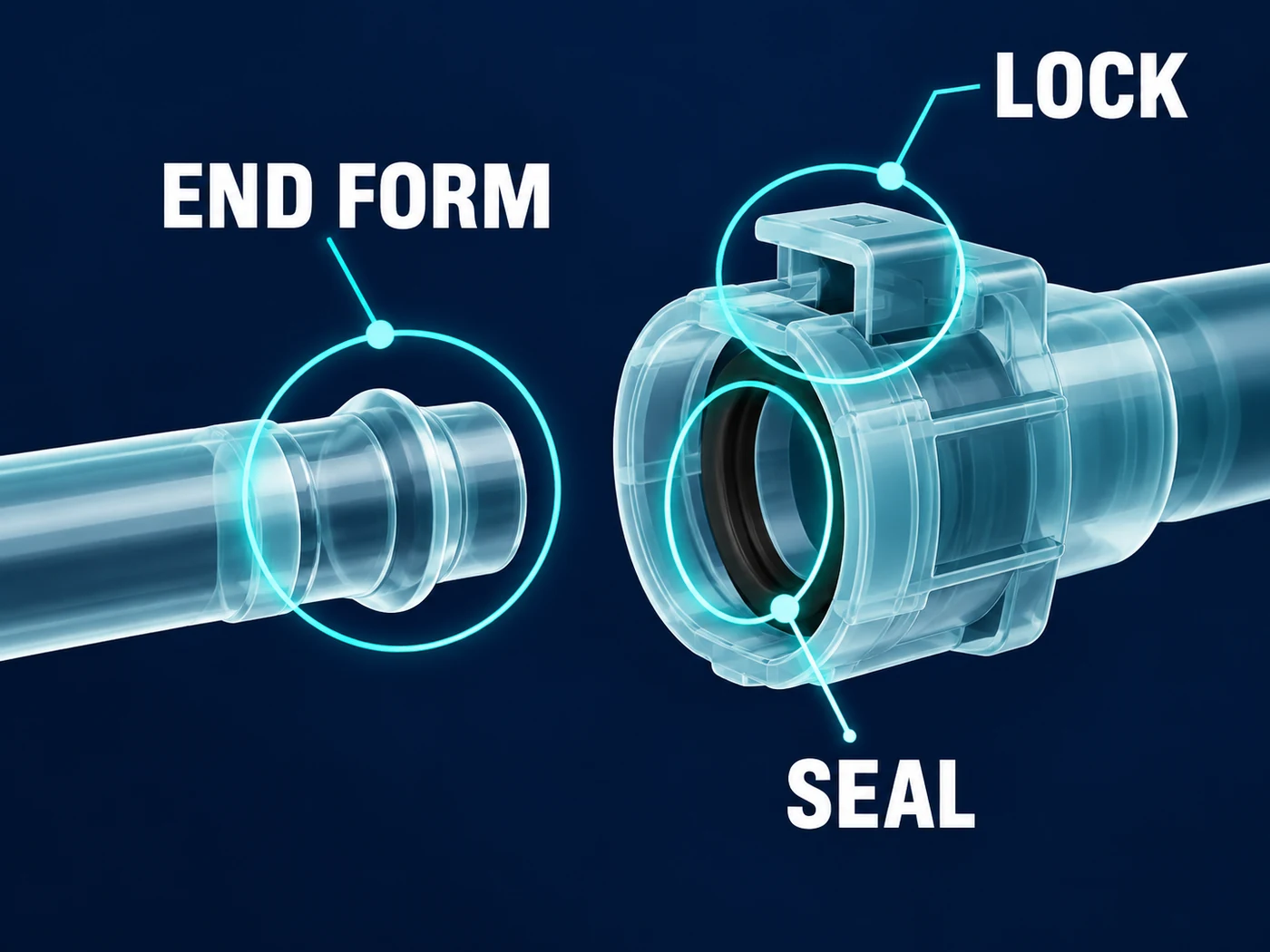
The male tube end form is more than the largest outside diameter. Its bead or retaining profile, insertion length, surface condition and tolerances affect how a compatible connector locks and seals. A nominal size is useful for selecting the correct family, but it is not sufficient by itself to approve a filter. Ask which standard end form or vehicle specification is claimed, and request the drawing that shows the dimensions and datum for the offered part.
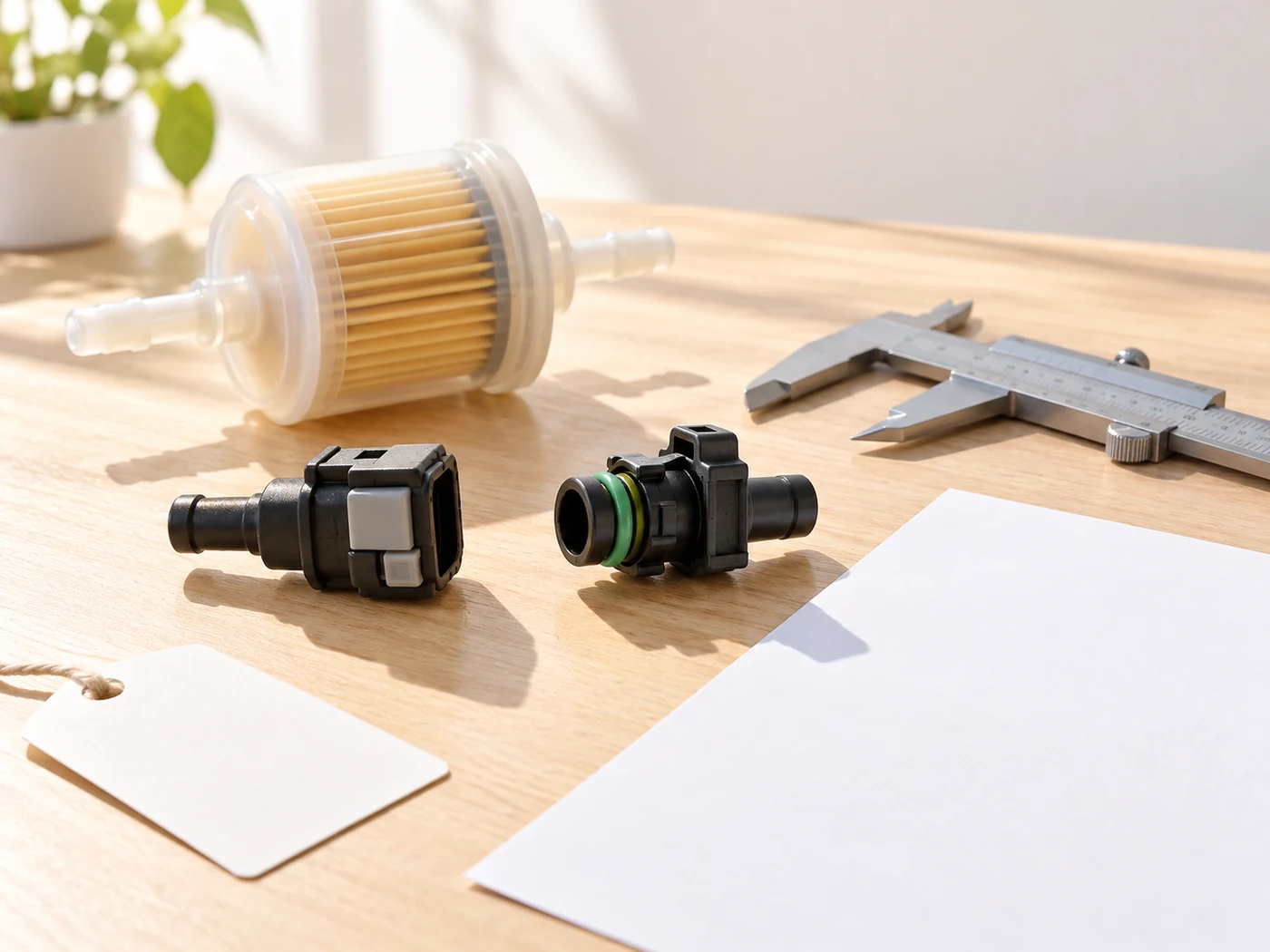
Do not transcribe a catalogue's hose ID, filter stub OD and connector nominal size as if they were the same measurement. Parker's catalogue separates those commercial fields. If a supplier gives only one size number, ask what physical feature it describes and how it was measured. A photo with calipers held near a part can demonstrate the location being discussed but cannot establish a tolerance or the finished production revision.
Inspect the sample end forms for damage, burrs, plating issues or deformation that could affect the coupling. Note the location and photograph the condition; do not declare a leak from appearance alone. If a metal stub and a moulded plastic stub are offered as alternatives, require the supplier to document both configurations and the relevant material/compatibility evidence. The presence of a nominal J2044 size does not erase vehicle-specific restrictions.
Identify the locking mechanism, not just the tab colour
Quick-connect fittings can use different retainers and service-release arrangements. Ask whether the lock is integrated into the vehicle-side coupling, supplied with the filter, or sold as a separate clip. Record the latch geometry, visible engagement position and any secondary retainer that the vehicle procedure requires. A supplier sample without a separate clip may still be complete for one system and incomplete for another; the pack list and application decide.
A light pull-back check after connecting is described in the public SAE J2044 scope, but the exact service procedure and test force for an application must come from the applicable manufacturer instruction. Do not define your own pull force or treat a single audible click as proof of sealing. A connector can appear retained while a seal is damaged, or it can resist movement because it is jammed rather than correctly locked.
Ask for a demonstration using the intended mating part in a controlled sample review, with identification of both halves. If the supplier substitutes a convenient bench connector, record that it was not the target vehicle coupling. Note whether the lock can be released and reconnected according to the service instructions without damage. A one-time dry fit may expose interference but cannot stand in for a complete functional qualification.
Locate and specify the seal
A seal may be carried inside the female connector, on an associated component or in another design-specific position. Confirm where the sealing element sits and whether it is part of the offered filter sales unit. Ask for its material specification, count and controlled section drawing if the supplier makes a sealing claim. Do not infer seal material from colour, and do not assume a green ring in an illustration identifies a universal fuel-compatible compound.
Fuel compatibility, temperature and pressure conditions are application-specific. The J2044 scope describes a defined class of couplings and operating conditions, but a buyer still needs the target vehicle requirement and evidence for the exact parts. Avoid applying the scope values as guaranteed ratings to an untested filter or connector. If a supplier claims leak-tight performance, request a report that identifies the filter SKU, mating end form, sealing material, test medium, pressure or vacuum, temperature and acceptance criterion.
Clarify the service replacement rule. Some vehicle procedures may require a connector, retainer or seal to be replaced after disconnection; others may permit reuse under stated conditions. The blog cannot set that rule generically. Ask for the vehicle or connector maker's procedure and make the customer-facing pack description state what consumables, if any, are actually included.
Use a controlled sample rather than a catalogue shortcut
For a buyer-side review, start with an identified filter sample, the current drawing, a representative mating connector and the approved application reference. Photograph the pack label and both ports before joining anything. Inspect the retainer and visible seal without scratching the contact surfaces. Follow the manufacturer service procedure for any actual assembly. A purchasing team should not improvise a pressurised fuel test on a desk; qualified personnel and the supplier's controlled method are needed for functional testing.
Record the sequence and result separately. The sample may enter the coupling, the retainer may engage, and the joint may still need a validated leak or retention test. Conversely, a failure to join could be due to a wrong connector, damaged sample or incorrect application record. Write the observed fact and the unresolved cause in different columns. Preserve the parts and photographs so the supplier can investigate without guessing from “does not fit.”
| Sample record field | Buyer entry | Supplier response if unclear |
|---|---|---|
| Application | Market, vehicle, engine, period, OE filter reference | Current fitment line and exclusions |
| Inlet and outlet | Separate photographs and drawing references | Controlled end-form dimensions and orientation |
| Retention | Actual clip/latch and engagement observation | Approved mating part and service method |
| Seal | Location, count, sample condition | Material specification and replacement rule |
| Qualification | Report IDs, revision, test conditions | Part-specific leak and retention evidence |
Resolve mismatches before publishing a fitment claim
When a supplier drawing, sample and catalogue disagree, hold the line. A drawing may show one retainer while a sample carries another; a pack may include a clip that the sales image omits. Request a corrected revision and a new labelled sample when the difference affects what customers receive. Keep the old record so a later complaint can be traced to the exact version sold.
Do not solve a mismatch by describing the filter as “universal” or by replacing a precise connector name with “fits most vehicles.” A distributor needs a usable application list and exclusions. If a connector family is claimed to be standardised, ask for the exact claimed end form and the remaining vehicle requirements. The standard's published scope itself says OEM specifications can take precedence.
Questions buyers ask about fuel-filter connectors
Is the same nominal diameter enough to approve a quick connector?
No. Confirm the male end form, bead or retaining profile, mating connector, latch, seal and application. A nominal diameter helps group candidates, but it does not describe all of those interfaces or the supplier's production tolerances.
Does an audible click prove the filter is safe to sell?
No. It is one possible engagement observation. Follow the correct service method, identify the mating part and review the supplier's retention and sealing evidence. A real approval record keeps mechanical engagement and leak qualification as distinct questions.
Can a connector shown in a product photo be treated as included?
Not unless the SKU's packing list and approved sample confirm it. Product images may show a vehicle-side mating part or a demonstration assembly. Ask what is physically included with each sales unit, including loose clips and seals.
Next step: request the mating-interface record
Review the current MAKEXCAR fuel-filter category and send a connector-specific enquiry. Include the target market, vehicle, engine, OE reference, required quantity, photographs of both vehicle-side connections and any existing filter label. Ask for the proposed SKU, inlet/outlet drawings, retainer and seal details, pack list, labelled sample and applicable test reports. Approve a catalogue fitment only when those records refer to the same configuration.
Further Technical Reading
For background on the roles of oil, fuel, engine air and cabin filters, see Bosch Mobility Aftermarket’s filter overview. These resources explain general product principles; they do not certify MAKEXCAR products or establish fitment for a particular SKU. Follow the vehicle manufacturer’s service instructions and confirm part references before ordering.

