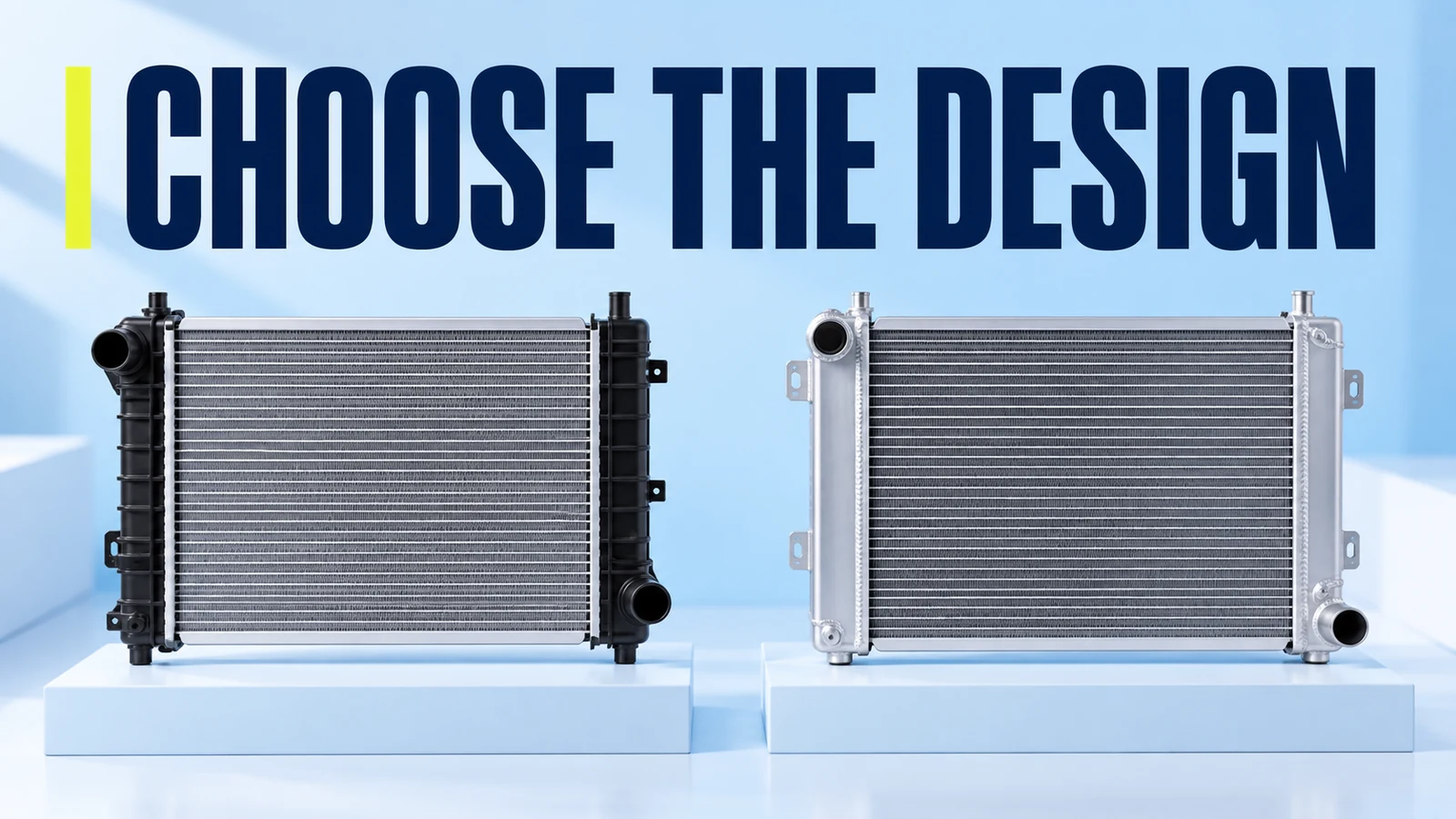
This guide gives buyers a disciplined set of questions for plastic-tank versus all-aluminum radiator proposals. It does not claim that an all-aluminum design is always lighter, stronger or better at cooling, and it does not state that a particular MAKEXCAR SKU is available in either construction. Those judgments require evidence for the actual parts and operating conditions being compared.
Understand what the material labels describe
In a conventional aluminum-core/plastic-tank radiator, the core transfers heat to incoming air while molded polymer tanks route coolant into and out of the core. MAHLE describes conventional water tanks made from glass-fiber-reinforced polyamide and notes that all-aluminum radiators are also available. Nissens likewise presents aluminum-core/plastic-tank and full-aluminum constructions within its radiator range. These are legitimate design families, not quality grades.
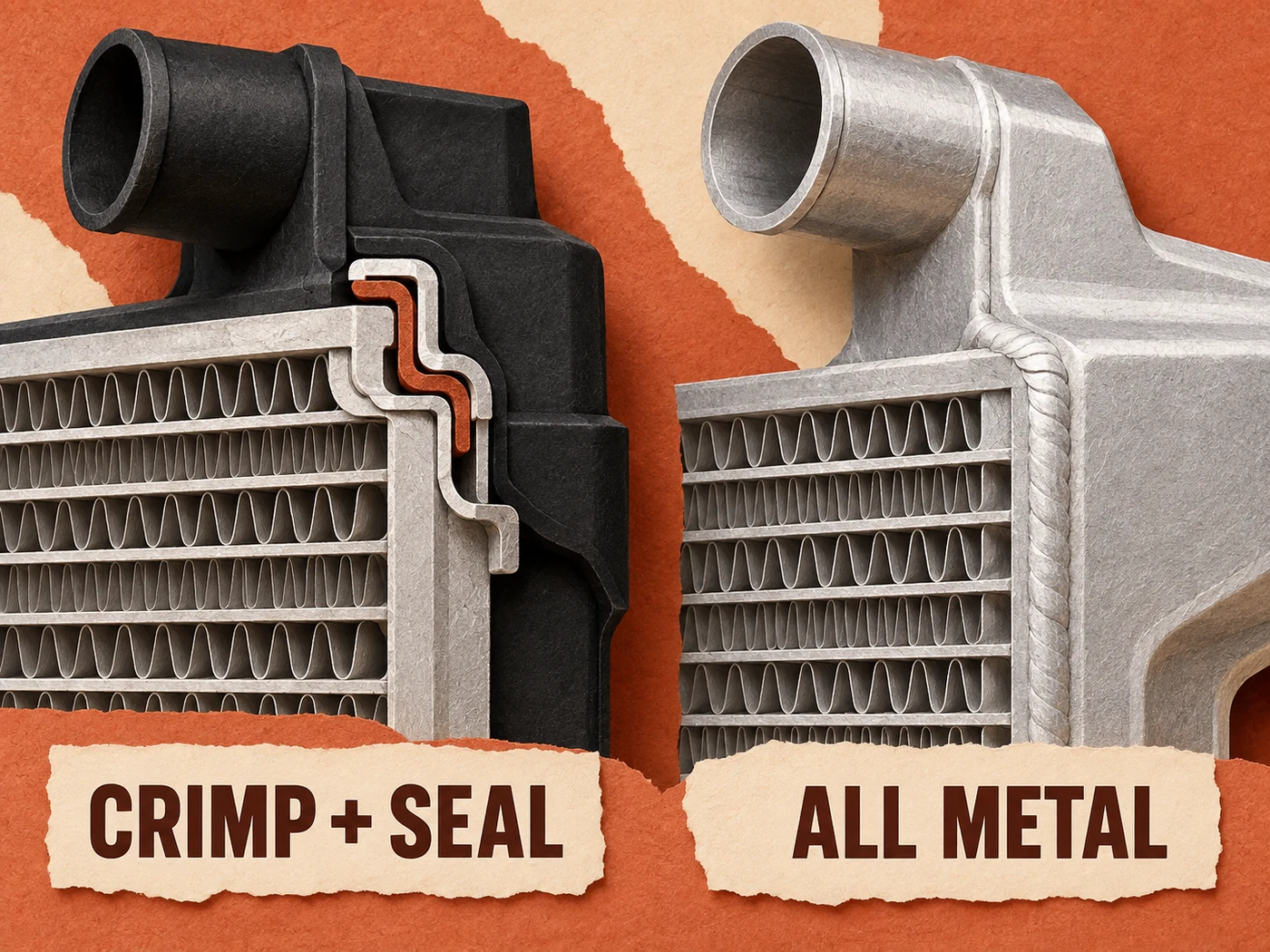
The joint between tank and core is a major structural difference. A conventional plastic tank is commonly mechanically secured to the aluminum header with a seal at the interface. Nissens describes its full-aluminum option as a construction based on brazed aluminum components without plastic parts or gaskets. The exact joint details of a offered product still need its drawing and maker's documentation; do not infer a seam or repair method from the broad material label.
Several other factors affect performance and durability: tube and fin geometry, core depth, side-plate design, mounting isolation, coolant chemistry, thermal expansion and manufacturing quality. A two-word material description cannot collapse these variables into a ranking. Ask for the full part number and the maker's current specification before comparing marketing descriptions.
Compare the exact vehicle application first
Record the destination market, vehicle make and model, production range, engine, transmission, original radiator reference and any supersession. The design selected by the vehicle maker may be integrated with a fan shroud, condenser, intercooler, frame or expansion arrangement. A visually attractive all-metal replacement is irrelevant if its brackets or connections do not match that assembly.
Compare the core envelope and overall packaging depth separately from the mount and hose geometry. A deeper or shallower design may change clearance to the fan or neighboring heat exchanger even when the visible face size looks similar. MAHLE describes all-aluminum designs with reduced depth in some applications and gives an Audi A8 example. That manufacturer example is not a universal rule: no buyer should transfer its weight or depth figures to an unidentified aftermarket radiator.
Use the manufacturer's application listing to confirm the offered part and, where a material change is proposed, ask for the maker's written interchange statement. If only a generic catalog image is available, request drawings of both tank ends and attachment faces. A workshop's ability to bend a bracket or reroute a hose is not evidence that the substitute meets the original application.
Which features commonly reveal a false match?
Check lower locating feet, upper retainers, fan-shroud tabs, condenser attachments, inlet and outlet neck positions, filler and overflow arrangements, sensor bosses, drains and integrated transmission-cooler connections. MAHLE defines the radiator as core plus tanks, connections and fastening elements. An alternative material can change how those interfaces are formed; the final assembly must still provide the required connections and mounting positions.
Ask what the proposed design changes in the joint
A purchaser may assume a metal tank eliminates every leak path. It may remove the particular tank-to-core gasket used in some plastic-tank designs, yet the radiator still has joints, tube-to-header interfaces, fittings and service connections. Each design needs appropriate validation. A blanket promise of “leak proof” is not credible without a defined test method, specimen, conditions and result for the offered part.
The thermal expansion behavior of the assembly also matters. The core, side structures and vehicle mountings experience temperature changes and vibration. Nissens discusses thermal-expansion and pressure-impulse testing within its product range, while noting construction details that help accommodate stresses. These are manufacturer-specific design and validation practices, not evidence that every product in one material family lasts longer than every product in the other.
Ask what changed between the OE design and the candidate. Has the tank-to-core interface been replaced by a different joined structure? Are the brackets and isolators the same? Does the supplier's drawing show the required hose neck and auxiliary connections? If the proposed design is a custom all-metal unit, confirm who bears responsibility for fitment and validation rather than treating the word “upgrade” as an approval.
Compare cooling claims on equal conditions
Cooling performance depends on more than tank material. Airflow, core area, tube and fin design, coolant flow path and installation within the vehicle module all influence the result. Nissens' radiator page publishes performance figures for particular designs and configurations, but those figures should not be turned into a general statement that all-aluminum or plastic-tank units always outperform the other family.
When suppliers claim a cooling advantage, ask for the test report and identify the exact specimens, air and coolant conditions, pressure loss and performance metric. Determine whether the comparison uses the same vehicle envelope and the same test method. A thicker core may have a different airflow or packaging cost; a thinner assembly may be more suitable for one module but not another. Without comparable conditions, the percentages are promotional context rather than a purchasing conclusion.
Distinguish thermal capacity from material durability. A radiator can reject heat effectively but fail the application's vibration or corrosion requirements, or it can be robust yet unable to fit the cooling module. Ask for separate evidence for heat-transfer performance, pressure integrity, thermal cycling and mounting durability if those claims are material to the order.
Review supply scope and service implications
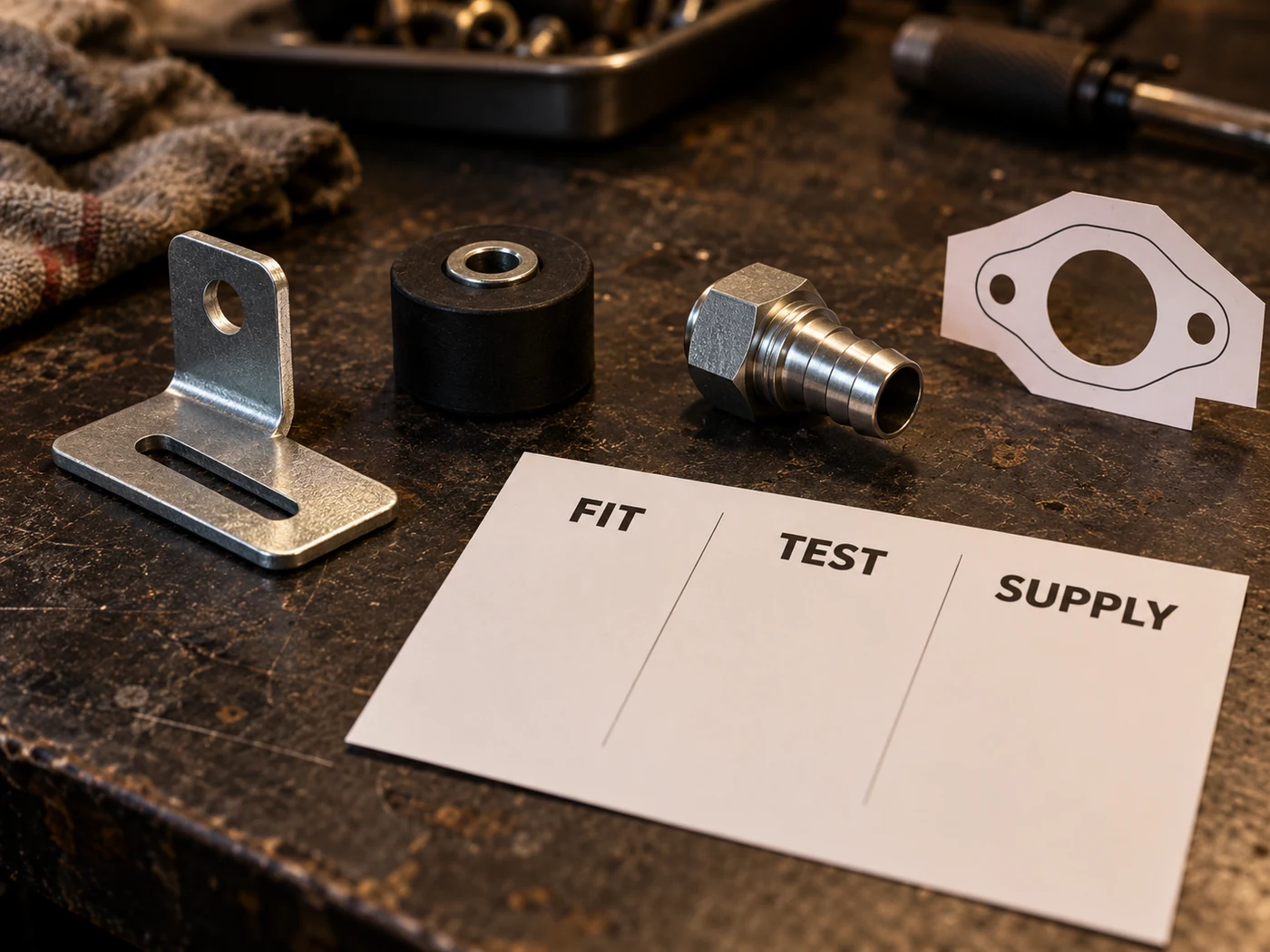
Confirm whether the offered assembly includes mounts, grommets, caps, plugs, transmission-cooler fittings, sensors, seals and hardware. A supplier can sell a bare radiator while the OE assembly included pre-mounted components. The resulting installation gap is a supply-scope issue, not a verdict on plastic or aluminum. Ask for a packing list and note which parts may be transferred from the removed unit.
Check the expected service procedure. A revised neck or fitting can require a different hose or connector, and a metal tank may use a different attachment method for adjoining hardware. Obtain the manufacturer's installation instructions and applicable vehicle service data. Do not assume that an all-aluminum replacement can be repaired or welded in the field without affecting its qualification or warranty; ask for the actual service policy.
Consider the order economics only after fit and evidence are established. Purchase price, freight damage risk, packaging, service parts and expected availability can differ by supplier and route. The material family alone cannot establish landed cost or lifecycle value. A comparative quotation should identify what is included and the currency, incoterm and lead time, rather than using a generic “premium” label.
Use a part-specific comparison sheet
The table below is an editorial checklist, not a material ranking. Fill it with values and documents for two actual candidates. If one column remains blank, the comparison is unresolved. The strongest decision is an approved application supported by a drawing and relevant test record, not an image of two shiny radiators.
| Decision field | Plastic-tank candidate | All-aluminum candidate |
|---|---|---|
| Vehicle and OE reference | Current maker application and supersession | Current maker application and interchange approval |
| Envelope and interfaces | Core, tanks, mounts, necks and ports drawing | Equivalent controlled drawing and clearance check |
| Tank-to-core construction | Joint and seal description for exact part | Joining method for exact part |
| Performance claim | Test specimen, setup and metric | Comparable specimen, setup and metric |
| Durability claim | Relevant pressure, cycling and vibration evidence | Relevant pressure, cycling and vibration evidence |
| Included parts | Packing list and transfer instructions | Packing list and transfer instructions |
| Commercial terms | Price, lead time, packaging and service policy | Price, lead time, packaging and service policy |
If the two candidates use different test methods, request an explanation before ranking their results. If one is simply listed as “aluminum” without specifying whether the tanks are metal, clarify the construction. An aluminum core with plastic tanks is not an all-aluminum radiator. Precise material language keeps the comparison fair to both suppliers.
Frequently asked buyer questions
Is an all-aluminum radiator automatically an upgrade?
No. It may be a valid design for an approved application, but material alone does not prove better fit, cooling, weight or lifetime. Compare the actual part's application, packaging and controlled test evidence. Do not replace a listed OE assembly solely on an “upgrade” claim.
Are plastic tanks inherently unreliable?
No general conclusion follows from the presence of a molded tank. MAHLE and Nissens both describe aluminum-core/plastic-tank construction as an established radiator design. Reliability depends on the complete product design, manufacturing, operating conditions and maintenance. Ask for part-specific validation and the applicable warranty terms.
Can the two types use the same hoses and mounts?
Sometimes a maker approves an alternative design for the same application, but the buyer must check the supplied part's hose necks, brackets and adjoining-module connections. A shared core size or close front-view photo is not enough. Request the exact drawing and installation note.
Request a comparison grounded in the vehicle
To compare a MAKEXCAR radiator offer, send the vehicle market, engine, transmission, production range and OE reference with the required quantity. Ask whether the quoted unit uses plastic tanks or all-metal construction, then request a current application listing, interface drawing, included-parts list and relevant test evidence. Browse the published Radiators category for the product family and contact MAKEXCAR with the exact application. The answer should name an actual offered part; the material label is only one field in that decision.