This guide helps distributors and aftersales teams prepare a focused warranty inquiry. It explains which records to collect and how to keep customer observations separate from sample-test conclusions. It does not supply a diagnosis, a cleaning recipe, an arm-adjustment procedure or a promise that a particular claim will qualify for credit.
Identify the blade and the complaint timeline
Record the order line, supplied reference, batch information available and installation date. Identify the vehicle and the blade position involved. If a pair was supplied, state whether the complaint concerns one blade or both. Do not combine two positions into one generic symptom entry when the observations differ.
Keep the customer's original description and a clarified timeline. Ask when the streaking was first noticed, what conditions were reported and whether any work occurred before the evidence was recorded. Treat these statements as reported facts until corroborated. A newly installed blade is not necessarily an untouched sample at the time of review.
Connect each image or video to the case and blade identity. If the supplied reference cannot be established, mark the identity question open. A package photograph from a different purchase or an assumed reference based on appearance should not be presented as verified identity for the complaint unit.
Document the wiping pattern without declaring a cause
Request a video or sequence that shows the reported pattern clearly enough for review. Record the observation conditions and which blade or position is involved. Preserve the original file and label later annotations separately. Avoid editing out context that the reviewer may need to understand when and where the streak appears.
Describe what is visible: the location of the reported streak, whether it persists in the recorded sequence and whether the observations differ between positions. Do not convert the description into a conclusion such as defective rubber, insufficient pressure or incorrect orientation without supporting assessment. The record should make the symptom identifiable while leaving the cause for review.
If the evidence is unclear, ask for a better record rather than making a stronger claim from a blurred image. Explain the specific missing context to the customer or supplier. This creates a practical follow-up request and avoids accumulating more files that still cannot be linked to the complaint.

Retain glass and blade-condition evidence
Request relevant photographs and a factual account of the glass and blade condition when the symptom was recorded. Include any known cleaning, treatment or contamination history that the reviewer asks for. Do not guess a treatment or residue from reflections in a photograph. Keep an unknown condition explicitly unknown.
HELLA's wiper-care guidance discusses cleaning and glass condition in relation to smearing, including with new wipers. This supports collecting condition records rather than attributing a symptom to the new blade alone. It does not diagnose this complaint or establish an approved cleaning method for every MAKEXCAR blade.
Any cleaning or other intervention should follow the applicable product and vehicle instructions, with qualified advice where required. Record what was actually done and when. This article does not prescribe chemicals, coatings or treatment frequency. If the condition changes before another video is made, retain both records with their separate descriptions.
Confirm the installation and arm records
Request the blade and adapter references, the relevant fitting instructions and the available installation record. Ask the reviewer which photographs are needed to confirm the applicable arrangement. Do not assume that counting visible connectors or recognising a generic attachment shape proves that the correct assembly was fitted.
Keep installation orientation and mounting observations tied to the actual instructions. If a question remains about the adapter, application or position, make it an open item in the file. This guide does not show fitting steps or define a universal orientation. The exact reference and vehicle context determine which information is relevant.
Ask for the arm-condition information required by the responsible reviewer. Record an actual assessment and its source instead of declaring the arm correct because the blade is new. Equally, do not assign blame to the arm without evidence. The purpose is to preserve the context needed to evaluate the reported wiping behaviour.
Keep before-and-after records traceable
If the reviewer requests further observation after an authorised intervention, identify the change and retain its record. Keep the blade identity, position and observation conditions clear in each file. A before-and-after comparison can be useful only when the differences in context are disclosed.
Do not present an improved observation as proof of the sole original cause. More than one condition may have changed, or the recording conditions may differ. Ask the reviewer to state what the comparison supports. The warranty file should retain both the observation and the technical interpretation as separate entries.
Likewise, if the symptom persists, describe the result without expanding it into an unsupported batch-wide failure. One complaint unit does not establish the performance of every blade delivered under the same reference. Record the affected quantity and the evidence for each unit involved.
Separate field complaints from controlled sample tests
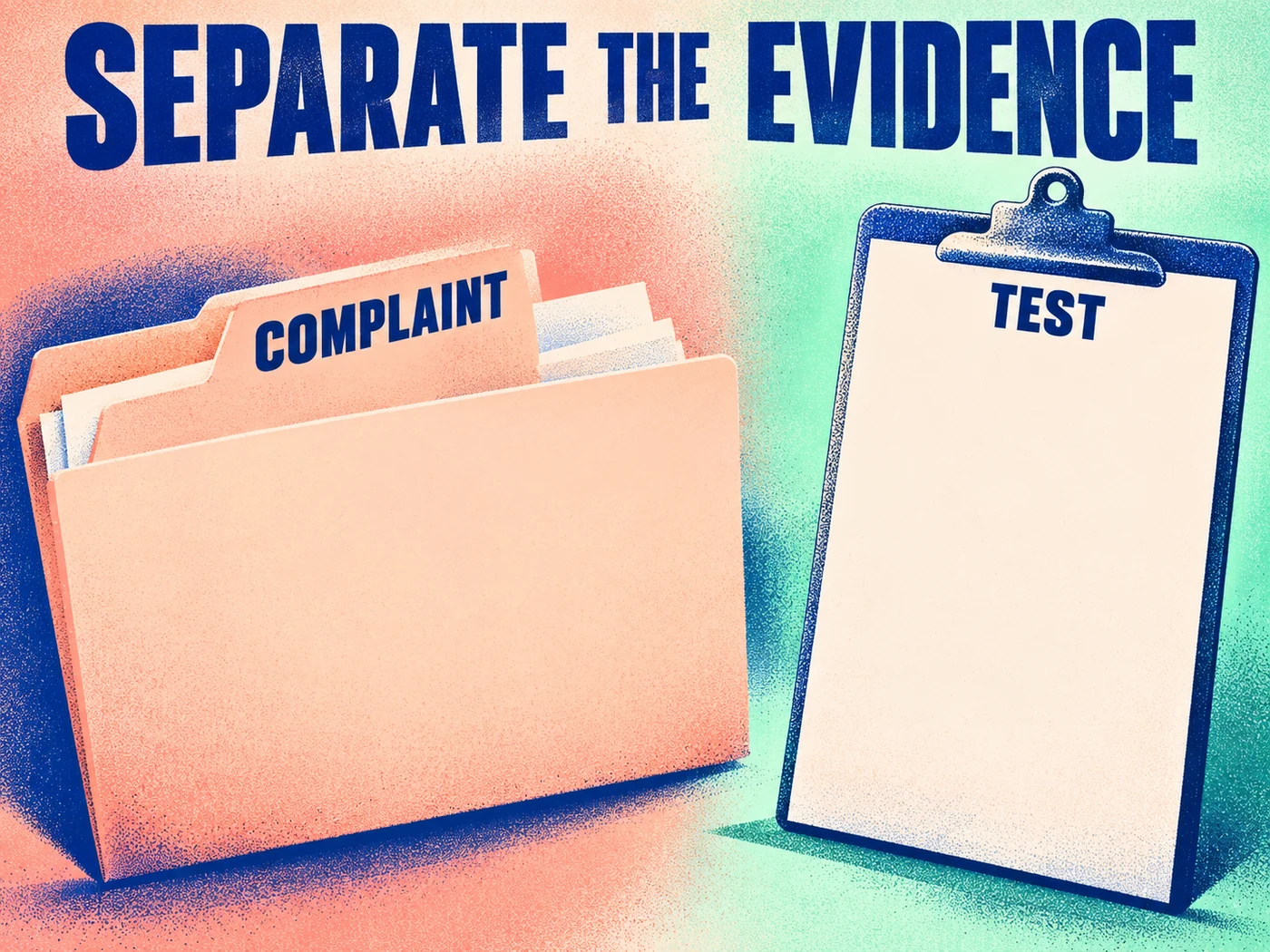
A customer video and a supplier sample test answer different questions. Request the sample identity, test method, conditions, acceptance requirement and result when a test is offered as evidence. Ask how that report relates to the complaint blade and its application. Do not use an unrelated test as automatic rejection of the customer observation.
Conversely, a field symptom does not replace a defined performance-test report. Keep the scope of each record visible. The responsible reviewer may use both sources while retaining limitations in the final conclusion. Purchasing should record the actual supported finding rather than choosing whichever attachment favours a preferred commercial outcome.
If the supplier requests the physical complaint blade, document its condition and transfer. Identify any changes already made during investigation. A returned unit can still be reviewed, but its history matters to the interpretation. Do not describe a cleaned or altered blade as an unmodified production sample.
Use a warranty evidence register
Populate the following fields with actual reports and attachment references. They organize the inquiry without supplying a diagnosis or defining warranty entitlement.
| Field | Record to request | Review purpose |
|---|---|---|
| Identity | Order, blade reference, batch and position | Link the complaint to supply |
| Timeline | Installation, symptom and intervention dates | Retain the sequence |
| Pattern | Original video and observation conditions | Describe the reported symptom |
| Glass | Condition and relevant treatment history | Record the context |
| Installation | Adapter, instructions and mounting record | Clarify the application |
| Arm | Reviewer-requested condition assessment | Keep supporting evidence |
| Test | Sample, method, requirement and report | Define the test scope |
| Decision | Technical conclusion and commercial status | Control follow-up |
Review the register for missing identities and unclear conditions before sending it. A supplier can respond more precisely when the request identifies the questioned observation and the evidence behind it. Keep files indexed so that a later clarification does not detach the conclusion from its supporting record.
Request a bounded warranty decision
Ask the supplier to state which reference and evidence were reviewed, what conclusion is supported and which questions remain open. Include the applicable warranty terms or ask for them when they are missing. Technical interpretation, warranty eligibility and a proposed commercial remedy should have separate status entries.
A replacement offered to resolve a customer concern is not automatically an admission of a manufacturing cause. Likewise, a request for further records is not a final rejection. Preserve the wording of the actual response and ask for clarification if the decision is ambiguous. This keeps the purchasing file useful for both technical follow-up and customer communication.
Before closing the case, identify the person responsible for each remaining action and retain the evidence version used for the decision. If additional observations arrive later, add them as a dated update rather than replacing the earlier conclusion without explanation.
Common streaking-review questions
Does streaking from a new blade prove a defective product?
Document the symptom and relevant conditions first. The reviewer needs the application, installation and condition evidence before assigning a cause.
Can a video replace the installation record?
It shows the recorded behaviour, but may not establish the actual adapter, reference or mounting arrangement. Retain both sources when they are needed for review.
Does one complaint establish a batch problem?
Record the affected units and supporting evidence. Do not extend a single-unit observation to the entire delivery without an accepted investigation basis.
Can a supplier test settle every warranty question?
Ask what sample and conditions the report covers. Warranty terms and the field case still need their own review and a clearly stated decision.
Send a focused wiping-complaint inquiry
Browse the current MAKEXCAR Wiper Blades category for related listings. For a complaint, send the order reference, blade identity, vehicle details and indexed observation records. Include the installation context and any separate sample-test question. A traceable file helps the supplier address the reported symptom without inventing a diagnosis or warranty outcome.