
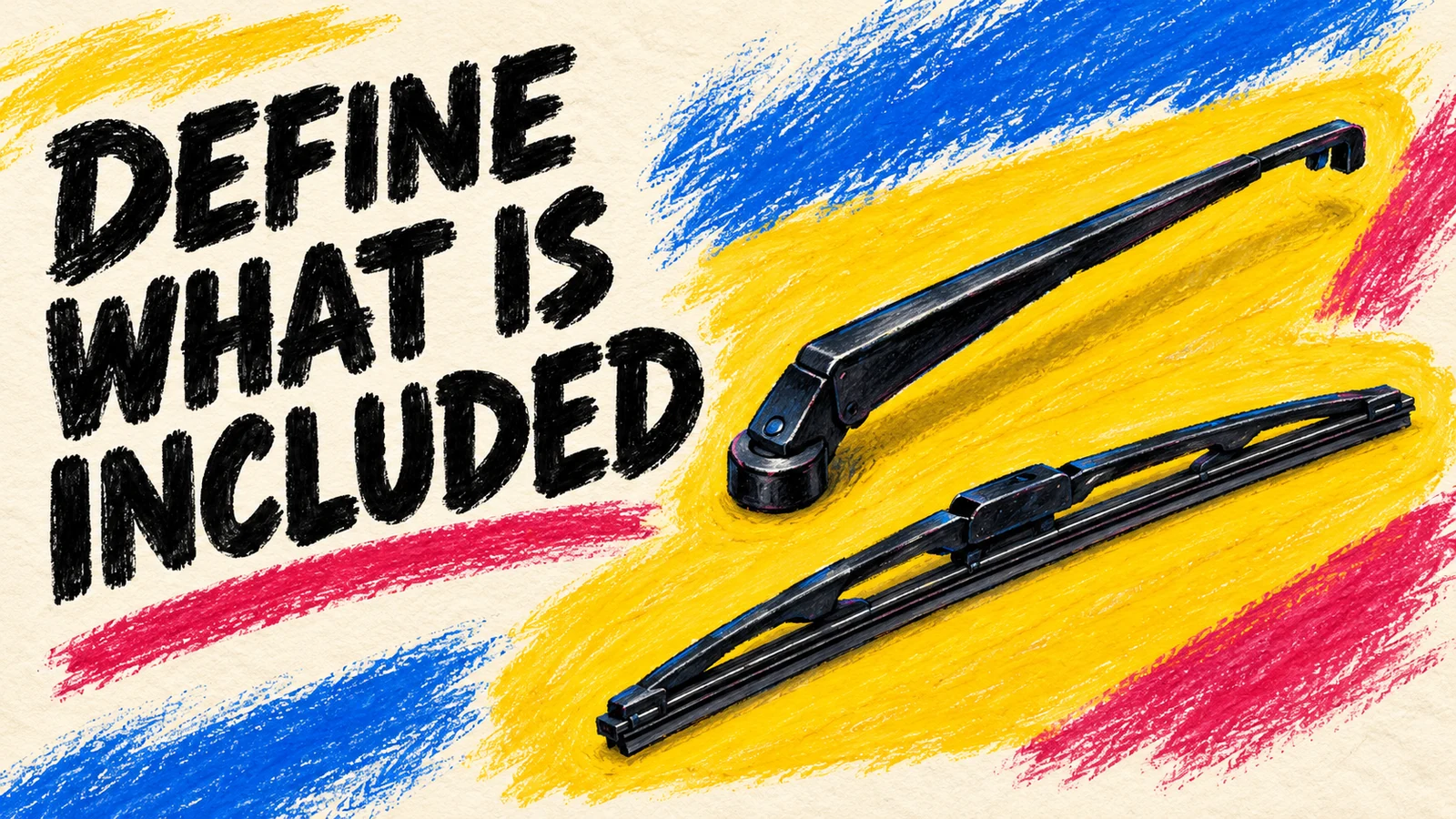
This guide helps purchasing teams compare supply scope. It does not establish that a particular arm, blade or adapter fits a vehicle. No MAKEXCAR arm-and-blade set is assumed to be available, and no connection dimensions or installation instructions are supplied. The relevant product records and actual supplier confirmation must settle those questions for the offered reference.
Start with the purchasing requirement
Write down the part you need to replace, the application and the information already available. If the requirement is a replacement arm, say whether the blade will be retained or sourced separately. If the requirement is a complete commercial bundle, identify what your team expects the bundle to contain. This makes the inquiry more useful than asking for the cheapest “wiper assembly.”
Include the known reference number and clear identification photographs where possible. Record the vehicle details needed for the supplier’s actual application lookup, rather than substituting a visual resemblance. If a reference is uncertain, mark it as unconfirmed and explain its source. A number from an old invoice and a number physically marked on a sample should not be presented as equally verified.
Separate the requirement from the supplier’s proposed scope. Your request may call for an arm and blade, while the reply may offer only an arm. Neither description should disappear during quotation comparison. Keep a requirement column and an offered-content column so the person approving the purchase can see exactly where clarification remains necessary.
What an arm-only offer needs to define
Ask the supplier to state which arm reference is offered, its intended application and the quantity basis. Confirm whether any attachment pieces or other accessories are included; do not infer their presence from a catalogue photograph. An image can contain objects used for illustration, and a quotation can refer to a component that is sold separately from those objects.
If a blade will be retained, request confirmation of the relevant connection information for both parts. If the blade will be purchased elsewhere, identify the evidence the responsible reviewer needs to check the intended combination. A purchase order for an arm does not itself establish compatibility with an independently selected blade. Keep the separate sourcing decision visible.
For replacement inquiries, explain whether an existing component is being used only as an identification aid or is intended to remain in service. Those are different review situations. The supplier should respond to the actual question instead of assuming that every photographed component is part of the order or part of the proposed final assembly.
What an arm-and-blade offer needs to define
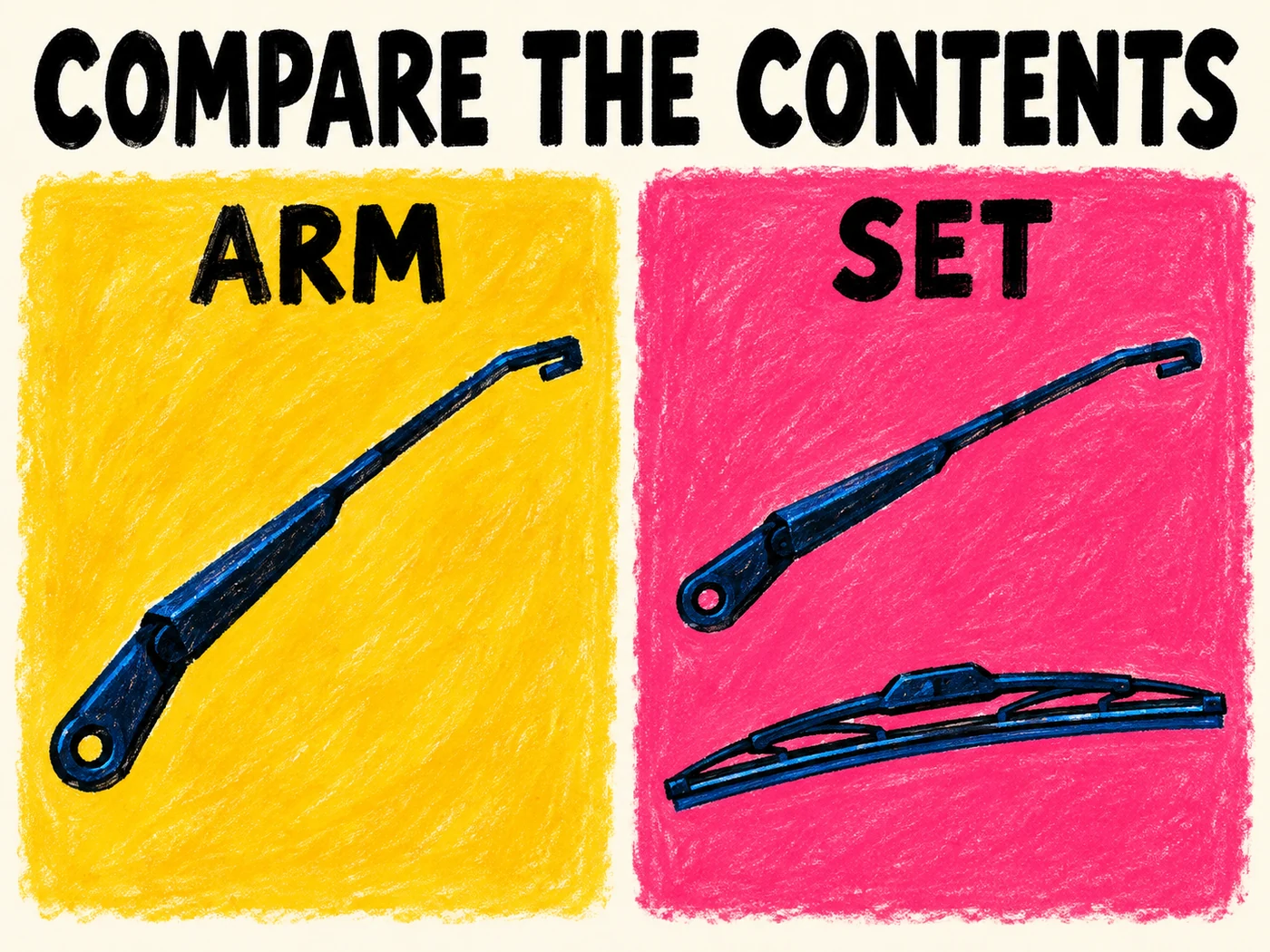
Request the arm reference, blade reference, any included adapter or accessory and the quantity of each item per order unit. Ask whether the items arrive together as a commercial bundle, separately within one shipment or in another stated arrangement. Confirm the offered packaging rather than interpreting the word “assembly” as proof of preassembly.
Ask for a photograph of the actual offered contents or an identified packing illustration that matches the written list. The list and picture should agree. If the supplier provides only a representative image, record that limitation and request the information needed to settle scope. A representative image can help explain a product family but should not become the final packing commitment.
Do not let a vehicle-specific blade set become an assumed arm-and-blade bundle. HELLA’s public FAQ describes a vehicle-specific wiper set as two suitable flat blades with their matching adapters. That example illustrates why “set” needs a component definition: it does not state that arms are included. See the HELLA wiper FAQ for the source description; it is not a definition of a MAKEXCAR offer.
Compare the two offers on the same basis
An arm-only price and a bundle price cannot be compared as if the contents were identical. First align the quantities and the stated components. Then record any separately sourced items needed to meet your requirement. Keep currency, quantity tier, packaging and other commercial conditions visible in the actual quotation comparison without inventing missing terms.
The following table organizes scope questions. The answers must come from the offered references and supplier documents. It is not a product specification or a statement that one option is always better. A narrowly defined arm-only order may suit one sourcing plan, while a clearly documented bundle may suit another.
| Question | Arm-only offer | Arm-and-blade offer |
|---|---|---|
| Contents | Identify the arm and included accessories | Identify every included arm, blade and accessory |
| Quantity unit | Confirm pieces per quoted unit | Confirm sets per unit and pieces per set |
| Connection review | Identify the separately retained or sourced blade | Request evidence for the offered combination |
| Packing | Match written scope to the packing record | Confirm combined or separate packing arrangement |
| Open items | Record components still needed elsewhere | Record any expected components excluded |
Make exclusions explicit even when they seem obvious to the salesperson. If a component is outside the offer, name it in the scope record. If it is pending confirmation, leave that status visible. The purpose is to prevent an assumption from crossing into the purchase order as if it were a confirmed supply commitment.
Name the interface-review responsibility
Ask who will confirm that the offered references correspond to the intended application and connection. The supplier may provide a documented application allocation or request further information. Your technical reviewer may need to approve a combination assembled from different sources. Record which documents were used and who reviewed them, rather than assigning responsibility through a vague statement such as “complete set.”
Request the actual connection information needed for the review. Depending on the offered items, this may be a reference allocation, an identified photograph or a relevant drawing. The responsible reviewer should determine the necessary evidence. This article does not infer compatibility from arm length, blade appearance or a generic adapter name.
If a substitution is proposed, ask the supplier to identify the substituted item and explain the supporting allocation or document. A change to one component should remain visible in the complete scope record. Do not carry the earlier review conclusion to the new combination without the reviewer determining whether the supporting evidence still applies.

Use the sample to check the scope commitment
When a sample arrives, compare its contents with the agreed sample list. Record the reference and quantity of each received item, and retain photographs showing the contents clearly. If a sample contains fewer or different components than the production offer, ask the supplier to explain the difference. A sample is useful evidence only when its relationship to the offered order is clear.
Keep a contents check separate from a technical fitment conclusion. You can confirm that the listed components arrived without declaring that they fit the application. Conversely, a reviewer may evaluate an interface while a missing accessory remains a commercial issue. Separate decisions allow the purchasing team to resolve the right question with the right person.
If production packing is not represented by the sample, request a packing record or an appropriate confirmation for the production offer. Do not mark packing as accepted solely because the sample looks complete. The required evidence should correspond to the scope your team is approving, including how quantities and references will be identified in the shipment.
Carry the agreed definition into the order
Use the supplier’s confirmed references and component quantities in the order description. Identify the relevant quotation revision and the agreed scope document. If the supplier uses a bundle code, retain the itemized definition associated with that code. A short commercial code becomes easier to review when it points to a clear component record.
Keep unresolved application or interface questions outside the list of accepted conclusions. Record what is still needed and who will resolve it before the relevant approval. This does not require pausing every commercial discussion; it requires making the decision status accurate. Purchasing, logistics and technical review should be able to read the same record without guessing its meaning.
Common questions about order scope
Does “wiper set” mean that arms are included?
Not without an explicit contents definition. Request the itemized list, references and quantities. A supplier may use the word for blades, for a different combination or for a particular commercial code. The written offer must identify the actual scope.
Is buying the arm and blade together always simpler?
It can consolidate a purchasing arrangement, but the offered components and application evidence still need confirmation. Compare the actual scope and review responsibility. No universal cost, fitment or lead-time advantage is established here.
Can the product photograph settle the contents?
Use it alongside the written list and ask whether it represents the actual offer. If accessories are visible, confirm whether they are included. An illustration without a scope commitment is not enough to define an order unit.
What should be recorded if the blade is sourced separately?
Identify that sourcing boundary, the intended blade reference and the evidence needed to review the combination. Name the person responsible for the interface decision and retain the documents supporting it.
Request a quotation with a clear contents record
Browse MAKEXCAR’s published Wiper Arms references and, where relevant, its Wiper Blades category. These are separate navigation categories, not a guarantee that any selected items form a compatible bundle.
Send the reference, application details, required quantity and desired arm-only or arm-and-blade scope through the MAKEXCAR contact page. Request an itemized contents list, identified photographs, quantity basis and application or interface confirmation. That gives you a quotation your team can compare and an order description it can verify.