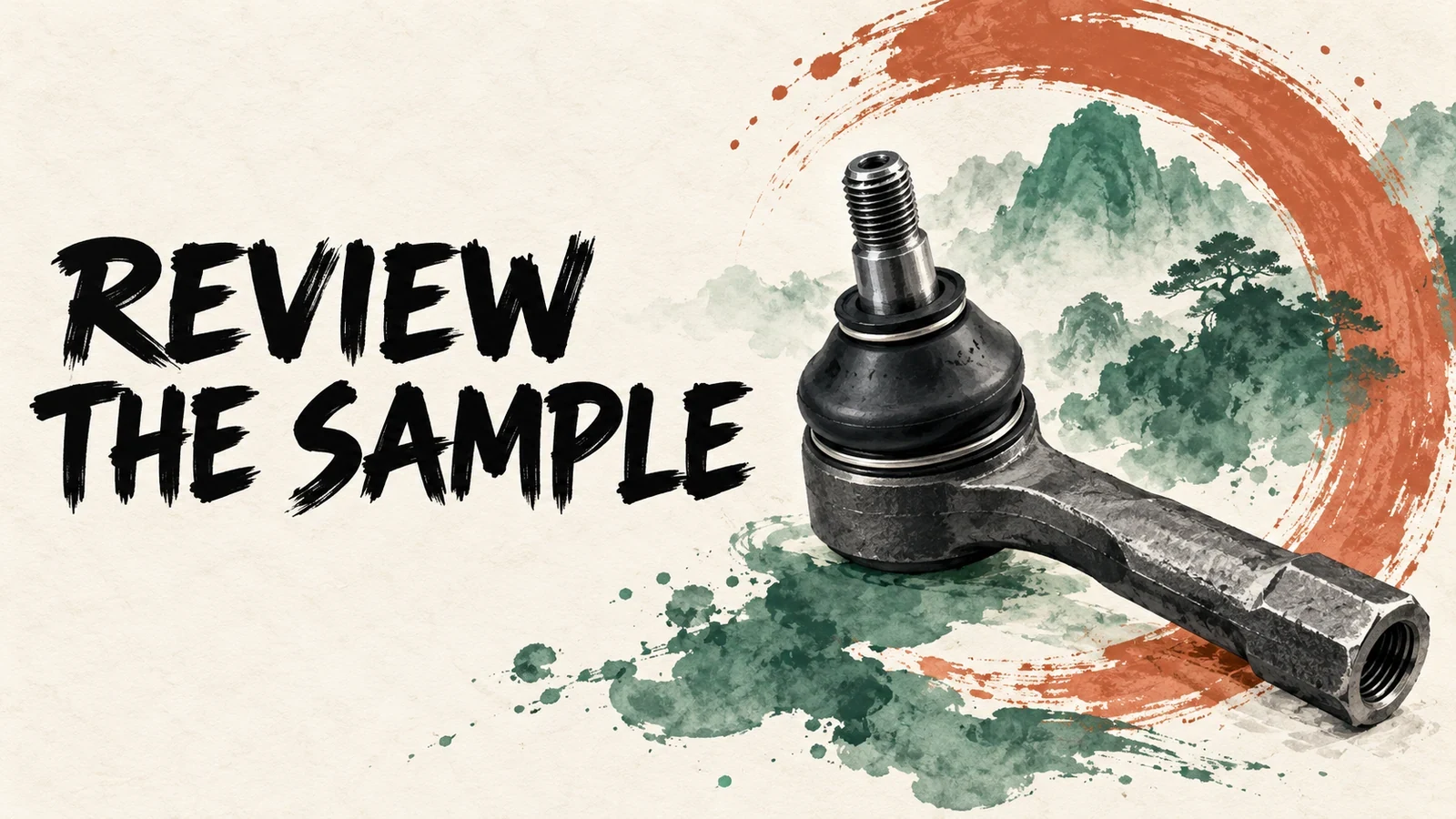
For an importer, the useful outcome is a sample file that shows what was observed, what was measured and which requirement supports each decision. This guide organizes that file. It supplies no universal movement resistance, play limit, boot material specification or vehicle repair procedure.
Establish which sample is being reviewed
Record the supplier reference, proposed application and sample identity before reviewing close-up images or results. Link the sample to the quotation and stated configuration. A photograph of a similar joint from another reference should not silently become evidence for the item being ordered.
Ask whether the sample represents the quoted configuration, including any stated accessories or service features. Preserve the supplier's answer. The sample record should identify the actual item under review rather than a general product-family illustration.
Keep application matching separate from sample condition. A visually sound sample may still have an unresolved reference mapping. Conversely, a documented application does not prove that the individual sample meets the agreed quality requirements.
Why the boot deserves a distinct evidence record
MOOG's official tie-rod information explains that damage to the protective boot can allow dirt and debris into the joint. This supports treating boot condition as a specific review topic. It does not provide a new-sample acceptance threshold or prove that a particular MAKEXCAR boot has a stated sealing performance.
Ask the supplier what visual and functional requirements apply to the exact boot arrangement. Record the relevant drawing or inspection instruction and any agreed criteria. Do not infer material, temperature capability or lifetime from colour, texture or a marketing photograph.
Keep the observations factual. Describe the location and appearance of a visible concern and link it to the sample image. Avoid calling every crease a crack or every surface mark a leakage failure without the applicable evidence and reviewer decision.
Review coverage and retention under the agreed criteria
Request clear contextual views of the boot and its interfaces as supplied. Where the governing record specifies coverage, retention or another visual feature, ask for evidence that addresses that feature. This article does not define a universal retaining arrangement for all tie rod ends.
A close-up should remain connected to a whole-item view and sample identity. The reviewer needs to know where the observation sits on the actual part. Images taken from several references cannot be combined into one sample approval without explaining their scope.
Preserve any distinction between an observed condition and an acceptance conclusion. “A gap is visible at this location” is a reportable observation; whether that condition meets the product's requirement needs the relevant specification. Ask the supplier to resolve the question before accepting or rejecting on appearance alone.

Request the stud-movement record with its method
If movement behavior is part of the agreed sample review, ask which test the supplier performed and what it measures. Keep its method, units, sample condition and applicable requirement together. A result described only as “tight” or “smooth” is not an interpretable test record.
Different reported quantities should retain their original names. A supplier may discuss movement resistance, torque or play in different contexts; do not convert them into one quality score or assume they are equivalent. Ask the report author to explain the result and the requirement it is intended to address.
This article does not prescribe hand-force checks, an improvised fixture or a numerical pass limit. Sample manipulation and testing should follow the applicable method with the appropriate reviewer. The purchasing team can request a complete record without inventing the method.
Use a manufacturer example without transferring its design
MOOG's specific bulletin for ES800781 and ES800782 discusses boot protection and socket-torque retention in the context of those designs. It is a useful example of why a manufacturer can describe several joint characteristics separately. Its construction features and claims are not specifications for every tie rod end.
Do not copy its part-specific service features or performance claims into a MAKEXCAR sample approval. Ask for the actual reference's documentation. This guide transfers no force value, bearing design, preload mechanism, lubrication instruction or durability promise from the bulletin.
The buyer's practical question is whether each requested characteristic has its own applicable evidence. A boot photograph does not establish movement-test performance, and a movement result does not establish the boot's material or sealing capability.
Build a sample-review worksheet
The following editorial worksheet organizes the review file. It is not a laboratory standard or a universal sampling plan. Agree the actual criteria and review scope with the supplier and responsible technical reviewer before treating any result as a pass.
| Review record | Evidence to retain | Decision boundary |
|---|---|---|
| Sample identity | Reference, sample code and quoted configuration | Do not reuse unrelated reference evidence. |
| Application | Documented mapping and its restrictions | Condition alone does not establish fitment. |
| Boot observation | Contextual images and specific noted condition | No material or leakage inference from colour. |
| Boot requirement | Applicable visual or functional criterion | Do not invent a universal design rule. |
| Movement method | What was measured and under which procedure | No subjective feel substituted for a report. |
| Movement result | Values, units and relevant conditions | Keep different quantities distinct. |
| Acceptance source | Reference-specific requirement and revision | No copied limit from another design. |
| Review conclusion | Supported decision, gaps and reviewer | State only the approved sample scope. |
Compare reports on a consistent basis
Before comparing two suppliers, confirm that their records address the same characteristic and compatible conditions. Identical-looking report headings may hide different methods or units. Ask for the definitions rather than ranking suppliers from a number whose meaning is unclear.
Keep the original result beside the review note. If a supplier clarifies a unit or method, preserve that clarification with the report revision. Do not silently replace the source value or invent a conversion where the relationship is not established.
A more complete report is useful evidence, but it is not a guarantee of overall quality. The approval still depends on the agreed requirements and the actual sample scope. This guide provides no supplier ranking or universal resistance range.
Resolve an incomplete sample claim
Consider a hypothetical sample file containing a clear boot photograph and a note saying the stud feels stiff. The photograph may support a visual observation, but the note does not identify a movement quantity, method, unit or criterion. The reviewer should request the missing record rather than declare the sample superior.
If the supplier later supplies a sourced test report, connect it to the same sample and review it against the agreed requirement. If the report concerns another reference, retain that limitation. A polished report format does not establish that its evidence covers the sample on the desk.
The example contains no actual test result or rejection. It shows how to turn an incomplete claim into a specific request. The supported conclusion may be limited while further evidence is pending; that is more useful than a pass label based on appearance and subjective feel.

Preserve sample condition and review history
Follow the agreed handling process while the sample is under review. Record any authorized test or intervention that could change its condition. Images and results collected at different stages should identify their sequence rather than appearing to describe one unchanged item.
This guide does not instruct buyers to remove boots, add lubricant, alter retainers or open the joint. Such changes require applicable instructions and would change the evidence being reviewed. Ask the supplier or qualified reviewer for the appropriate next action where the condition is uncertain.
If a revised sample is supplied, give it a separate identity and link it to the earlier concern. Preserve the original observations and the claimed change. That makes the new review traceable without assuming the revised item resolves every question from the first one.
Keep sample approval distinct from batch acceptance
An approved sample is evidence about that sample under the reviewed scope. Ask how the agreed requirements will be applied to the actual order and what production or inspection records will accompany it. Do not treat one attractive sample as proof that every future item has identical results.
Any lot inspection or sampling plan needs its own agreed basis. This article supplies no sample count, acceptance number or defect percentage. Retain the supplier's actual plan and the reviewer who approved it where those records are part of the order requirements.
At receiving, connect the delivered reference and configuration with the approved file. If they differ, request clarification using the same evidence fields. A difference should remain visible until the responsible reviewer decides whether the earlier approval still applies.
Prepare the inquiry and final review note
Send the exact reference or application details, quantity and requested sample scope. Ask for identified boot images, the applicable criteria and any movement-test report with its method and units. State which question remains unresolved rather than requesting a generic “quality certificate.”
In the final note, separate accepted observations, reviewed results and pending evidence. Identify the reviewer and the approved configuration. For example, a visual boot review can be complete while a movement report remains pending; do not merge those statuses into an unsupported overall pass.
Browse the published MAKEXCAR Steering Links category and use the MAKEXCAR inquiry page to discuss a particular tie rod end and its available records. Category membership alone does not establish sample quality or fitment.
Make separate decisions when the evidence differs
The photograph is clear but the drawing revision is missing
Keep the observation open against a named requirement. A clear image may show the boot edge, but the reviewer cannot decide whether that arrangement matches the quoted configuration without the applicable record. Obtain the drawing number and revision, then identify the feature being reviewed. If the supplier offers a later drawing, establish whether the sample was made to that version before closing the question.
Two reports use the same word for different quantities
Suppose one file labels a value “torque” without saying which operation it concerns, while another describes movement resistance. These descriptions do not yet form a comparison. Ask the authors to identify the measured quantity, method and sample state. Installation tightening and resistance measured while moving the joint have different purposes; a shared torque unit would not make the results interchangeable. Retain the complete definitions before considering a supplier comparison.
Only one item in a paired offer has a sample record
The specific MOOG bulletin identifies ES800781 as LH and ES800782 as RH. Those are two separately identified references within that bulletin, not MAKEXCAR ordering codes or current fitment confirmation. This bounded example illustrates why a paired offer needs an explicit evidence-to-reference mapping. A left-side sample record cannot silently approve a different right-side reference.
For the actual offer, list each quoted SKU and its sample code. Mark which review questions have evidence for each item. Shared documents can be useful where their stated scope covers both; individual observations still need to identify the actual sample. Close the supported reference only, or keep the offer pending until the missing scope is resolved. This is a documentation choice, not a universal requirement to test a fixed number of pieces.
A visual review is complete while the movement record is pending
Issue a scoped status rather than an overall quality pass. Name the visual criteria reviewed, the sample identity and the unresolved movement question. The buyer can then discuss whether an order decision must wait for that remaining evidence under the agreed approval terms. A completed photograph review does not answer an unperformed measurement, and an open measurement does not erase a valid recorded observation.
Fill in the sample-review handoff
Supplier SKU/sample code/quoted configuration: ___; application evidence and restrictions: ___; evidence for paired references separately mapped: ___.
Boot image filenames and dates: ___; observed location/condition: ___; applicable drawing or inspection record/revision: ___; responsible review decision or pending question: ___.
Movement quantity and unit: ___; procedure/version and sample state: ___; original report ID/result: ___; applicable criterion/source: ___; reviewer finding: ___.
Handling changes and sequence: ___; revised sample identity if any: ___; approved scope: ___; unresolved item and requested evidence: ___; separate order/lot acceptance basis: ___.
Use these fields to request the exact missing evidence through the published MAKEXCAR contact page linked above. Retain the supplier's reply with the sample file so the next reviewer can follow why each question was closed or kept open.
Sources and scope
MOOG tie-rod information supports the narrow boot-protection context. MOOG bulletin 216001 is a part-specific example of distinct boot and socket characteristics. The worksheet and sample scenario are editorial. No limits, materials, test results, durability, lubrication procedure, fitment or MAKEXCAR certification is invented.