Name both ends before comparing a replacement
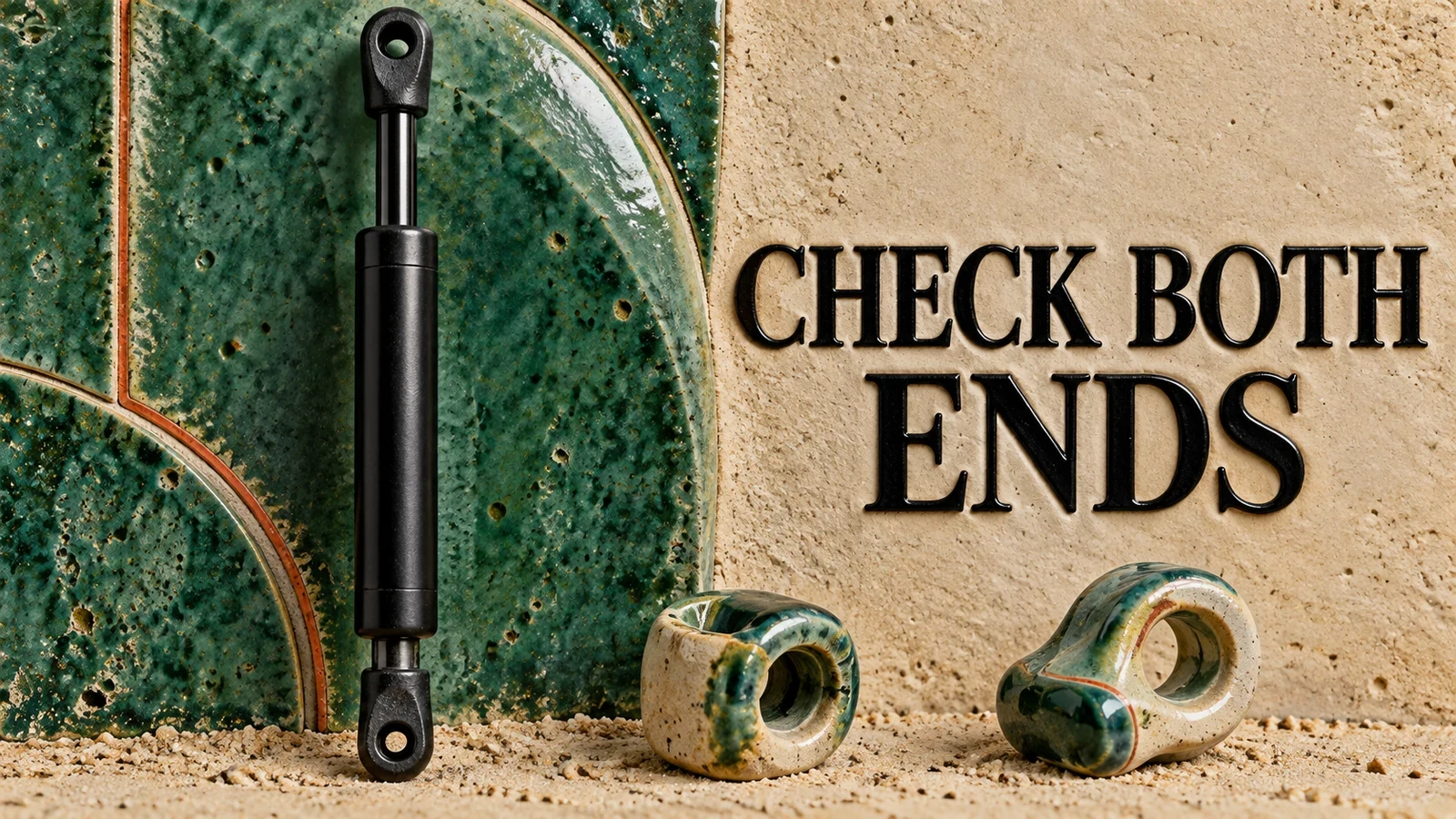
A buyer may correctly identify a gas strut reference yet leave its attachments unclear. Record the tube-end fitting and rod-end fitting as separate fields. Use the supplier's own end designation when it is documented, and explain how it maps to those two positions instead of assuming that every catalog uses the same letters.
Retain the full assembly reference, vehicle market, model, production interval and the specified installation location. Link the OE reference and supplier SKU to the catalog entry used for selection. End-fitting information complements that application record; it cannot replace it.
If the available photographs show only one end, mark the other unconfirmed. A similar-looking unit or a remembered attachment from a previous order cannot provide the missing field. Ask for the selected drawing or product record before treating the quoted assembly as a complete replacement.
Ball sockets need a defined mating interface
For a ball-socket design, request the selected socket reference and the documented mating ball information. Keep the socket, ball stud and retaining component identities separate. The word “socket” does not identify all three items, and an apparent visual fit is not a documented compatibility decision.
SUSPA's fittings table for its 16-4 and 16-6 series lists selected ball sockets, ball studs and safety clips as distinct entries. This is a useful naming and traceability example. Its references, dimensions and materials belong to that manufacturer's fittings, not to an unspecified MAKEXCAR unit.
Ask the supplier which mating parts are required for the selected assembly and which are included in the quote. A vehicle may already have a mating component, but the purchasing record should not assume its identity or suitability. Record the applicable source used by the responsible reviewer.
Eye fittings require more than a hole description
An eye fitting should be identified through the selected drawing or product information. Request the relevant hole, width and connection details defined there, together with any specified bushing or associated hardware. Keep the units and drawing revision attached to those fields.
Stabilus' gas spring and damper brochure describes a range of attachment choices, including hinge eyes and angle joints. It demonstrates that attachment selection is part of a gas spring specification. It does not approve an eye fitting or mounting arrangement for a MAKEXCAR order.
Do not treat a matching hole dimension as the entire attachment match. The selected fitting, its mating hardware and the application still need confirmation. If the customer cannot provide a drawing, ask for the existing reference and available photographs to define the inquiry rather than guessing the missing geometry.

Confirm what the clip or retainer description means
When a quote mentions a clip, ask for its exact reference and its relationship to the selected fitting. A small retaining item can be difficult to identify in a catalog image. A similar shape does not establish that the item is the correct one or that it can be substituted.
Separate “fitted to the assembly,” “supplied loose” and “not included” in the packing record. Ask the supplier to describe the actual supply arrangement rather than copying a general image. If the retainer is a separately ordered item, keep that line tied to the corresponding end-fitting reference.
This article provides no clip-release, installation or reuse procedure. Those actions require the applicable instructions and a responsible person for the selected assembly and application. A distributor should not turn a request for part identification into advice to remove or alter a retaining component.
Read dimensions with their defined reference points
End-fitting information may include a connection thread, an eye dimension, a mating-ball specification or another defined feature. Ask which field describes which interface. A thread used to attach an end fitting to the strut is a different question from the fitting's connection to the vehicle or bracket.
Store the selected drawing and its version with the quotation. If a sample measurement is available, record how it relates to the drawing's defined feature. Do not infer hidden dimensions from an AI illustration or a perspective photograph. Unknown details should become focused questions for the supplier.
Keep assembly length definitions with their source as well. A change to an end fitting can raise a dimensional question that needs review, but this guide does not prescribe an allowance or a way to recalculate the selected assembly. Ask for the supplier's documented assembly information instead of adding estimated fitting lengths.
An end-fitting specification record
| Field | Record for the selected item | Common ambiguity to resolve |
|---|---|---|
| Application | Vehicle details, installation location and catalog source | A family listing mistaken for confirmed fitment |
| Assembly identity | OE reference, supplier SKU and drawing revision | An image or loose fitting standing in for the complete unit |
| Tube-end fitting | Exact fitting reference and documented interface | One end assumed to represent both |
| Rod-end fitting | Exact fitting reference and documented interface | A supplier letter used without a position definition |
| Mating component | Selected ball, hardware or bracket reference where specified | Matching appearance treated as compatibility |
| Retention item | Reference and applicable fitting relationship | An unidentified clip treated as interchangeable |
| Supply arrangement | Fitted, loose or excluded items, with quote lines | Everything pictured assumed to be included |
| Dimensional source | Defined features, units and selected drawing version | A number copied without its endpoints or interface |
Use this record to make the supplier's answer specific. It should describe the quoted assembly and the documented accessories for that order. It contains no universal dimensions, force, material grade or retention specification. Approval remains tied to the exact product and application information supplied for review.

Keep force and attachment questions separate
A gas strut quote also needs the selected force and dimensional information appropriate to its application. Identifying a ball socket or eye does not confirm those other fields. Keep the attachment review linked to the complete specification so a purchasing team does not approve an assembly from one visible feature.
Likewise, a matching force marking does not answer the end-fitting question. Ask for the complete reference and application record, then review the selected connections and supply scope. Avoid grouping different attachments under one stock description merely because another field happens to match.
If a supplier proposes an alternative fitting or assembly, request the documented basis for that proposal. A catalog example from a different manufacturer may help explain terminology, but it cannot approve the substitution. Preserve the responsible review and any unresolved interface question with the order.
Review an illustrative packing discrepancy
Suppose a buyer receives gas struts with the expected assembly labels but reports that a photographed clip is missing. The original quote says “gas strut,” while the catalog picture contains a socket, mating stud and small retainer. The picture alone does not resolve what was ordered or packed.
Compare the confirmed quote scope, the selected assembly record and the packing information. Ask whether the questioned item was specified as fitted, loose or separately supplied. Keep the delivered photographs tied to the shipment so the review concerns the actual items rather than a generic catalog presentation.
If the agreed scope included the item, the supply discrepancy can be addressed on that evidence. If the scope was unclear, record the clarification for the next order. The case is hypothetical; it does not establish the contents of a MAKEXCAR shipment or authorize use of an incomplete assembly.
Make repeat orders and stock labels unambiguous
Retain both end-fitting references and the agreed loose-item scope in the approved order record. If a supplier changes the fitting reference or packing arrangement, ask for the revised product information before carrying the old description forward. A small naming change may require clarification rather than a silent catalog edit.
For warehouse labels, use the complete assembly SKU and keep accessory lines connected to it. Do not mix loose clips or fittings based on resemblance. When an unidentified item appears in a return, record its source and ask for identification instead of assigning it to the nearest-looking stock entry.
Resolve three end-fitting evidence gaps
These hypothetical cases show how the identification record changes a purchase decision. None establishes real MAKEXCAR packing contents or authorizes assembly changes.
The replacement has an identified tube end but no rod-end record
Do not complete the second field by copying the first. Compare the quotation against the application drawing's position labels and obtain the missing fitting reference. If the supplier confirms two different ends, retain both in the assembly description. If it confirms the same fitting at both positions, record the supporting drawing rather than assuming symmetry from one photograph. A complete answer specifies the selected ends without requiring purchasing staff to invent the catalog's position convention.
The drawing matches one dimension but uses another mating part
Matching one visible dimension can narrow an inquiry while leaving the interface unresolved. Identify which feature the measurement describes and compare the mating-component reference separately. If that reference differs, obtain the documented substitution basis and its application scope. A photo showing two apparently similar sockets cannot settle the alternative. Keep the proposed replacement separate from the approved reference until the responsible reviewer addresses the differing interface record.
The order quantity is clear but the loose-item quantity is not
Assume an invented order for 50 complete assemblies, with the agreed packing specification requiring two separately bagged retention items per assembly. The loose-item requirement is 50 × 2 = 100 items. If the shipment record shows 80 individual items, the difference is 100 − 80 = 20 items for investigation. This is quantity reconciliation under a stipulated packing scope, not a universal clip count or an instruction to operate an incomplete assembly. Confirm the item reference and packaging unit before comparing the count. If 80 means bags rather than individual items, first resolve the bag contents; otherwise the subtraction compares different units.
Send a complete gas strut fitting inquiry
Use the following fields as an inquiry attachment. They separate assembly identity from the interface and packing details that a general fitting name leaves unanswered.
Application and assembly: [vehicle/location; full OE and supplier references; catalog source and revision]
Tube end: [selected fitting reference; interface drawing; definition of supplier end designation]
Rod end: [selected fitting reference; interface drawing; unconfirmed fields]
Mating and retention items: [references tied to each end; technical source; proposed substitutions awaiting review]
Supply and quantity: [fitted/loose/excluded lines; individual item or package units; quantity per assembly; total; packing document]
Browse the MAKEXCAR Gas Struts category, then send the fitting inquiry with these records and clear photographs. Ask the reply to identify which fields it confirms and which require application information. A response that supplies a fitting-family name but omits the mating reference leaves an interface question open; resolve that field before carrying the description into the approved order.