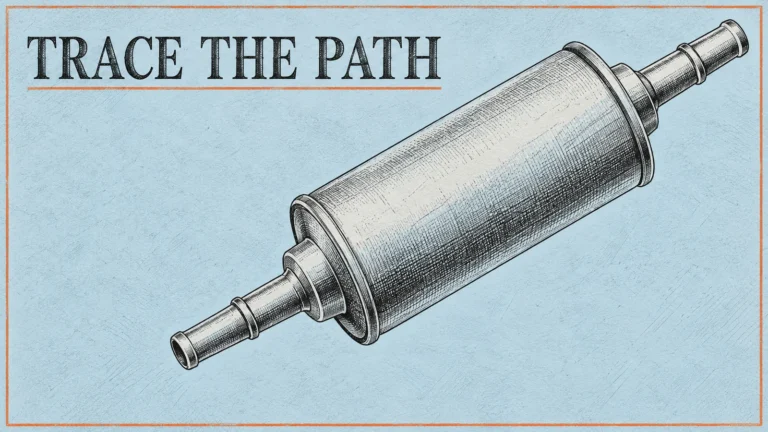
Confirm the separation design before asking for a percentage
A fuel-filter category can contain products with different functions and applications. Do not assume that every item in the category separates water, or that similar-looking canisters have the same internal design. Start with the exact offered reference and ask which technical document describes its intended duty.
When a listing mentions a separator, preserve that wording as an identification clue. It is useful for directing the inquiry, but it is not a measured performance result. Request confirmation of the offered configuration, applicable fuel and system role before comparing laboratory percentages.
If the separation design cannot be confirmed, leave that performance field open. Do not attach a water-separation figure to the item merely because another filter from the same supplier has one. The next sourcing step is to resolve product identity and function, not to select an attractive number.
Separate design wording from measured performance
Keep the offered reference and its design description together. Separator wording can direct a question to the supplier while leaving the actual configuration and performance unresolved. Ask which technical record confirms the intended separation duty and how it relates to the item being quoted.
A missing separator field in a catalog is not a physical inspection or proof that no additional documentation exists. Conversely, the presence of the word separator is not a measured efficiency, flow range or droplet-size result. Record the design confirmation and test evidence as separate entries so the sales description does not become a rating.
Keep water separation and particle filtration separate
Donaldson's fuel-system explanation discusses water-separator functions and particulate-filtration roles separately. We use that general distinction to organize the inquiry. Its product ranges, micron figures and system-position descriptions are not specifications for the MAKEXCAR references above.
When a supplier says “efficiency,” ask which result it means. A particle-removal measurement, a water-separation result and a pressure-strength test answer different questions. Keep each claim connected to its own source rather than treating the word efficiency as interchangeable across all documents.
A micron figure alone does not provide a water-separation percentage. Nor does a water-separation statement establish the filter's particulate performance. If both functions matter to the intended application, request separate applicable evidence and retain the tested configuration for each result.
Read the method's stated water-droplet context
The official ISO 16332:2018 summary describes a comparison test for fuel/water separators under defined, simplified laboratory conditions. It distinguishes fine droplets for pressure-side separators and coarse droplets for suction-side separators. This is method-scope information, not proof that a candidate item has either role or was tested.
The summary gives an intended rated-flow range of 50–1,500 litres per hour and notes that use outside that range can involve agreement and modifications. These values belong to the method's published scope. They are not MAKEXCAR product limits, operating recommendations or a proposed flow setting for any vehicle.
Record the actual method and edition named in a report, together with its stated droplet condition. Ask whether the tested object's role and the cited method are applicable to the offered configuration. Do not replace missing droplet information with a description borrowed from a different report.
Preserve flow and fuel details with the result
A percentage should travel with the conditions that produced it. Ask for the reported test flow, fuel description, water condition and sample identification. Preserve the units exactly. If a report uses litres per hour, do not copy the numerical value into a litres-per-minute column without converting it.
As a unit example only, 120 litres per hour equals 2 litres per minute. That arithmetic supplies no product rating, recommended test point or installation requirement. Its purpose is to show why a comparison sheet must include units rather than storing a bare number.
Where reports use different fuels or conditions, retain those differences in a notes field and request a technical explanation of comparability. A larger percentage does not resolve a mismatched test basis. Do not describe two results as directly comparable until their scope and conditions support that statement.

A hypothetical worksheet without performance rankings
Imagine two invented report summaries. Row A identifies a separator sample and records a test flow of 100 litres per hour. Row B identifies another sample and records 200 litres per hour. Both omit the water-droplet condition and fuel description. These are teaching rows, not real supplier data.
| Hypothetical row | Reported flow | Droplet condition | Fuel description | Comparison status |
|---|---|---|---|---|
| A | 100 L/h | Missing | Missing | Unresolved |
| B | 200 L/h | Missing | Missing | Unresolved |
The numerical flow difference is 100 litres per hour, and B's value is twice A's. That does not establish higher separation efficiency, a larger permitted operating range or better replacement suitability. The missing conditions remain missing even though the unit arithmetic is straightforward.
Do not fill those gaps with the ISO scope values above or with conditions from a third supplier. Ask for the complete report. If percentages arrive later, attach each one to its own sample and conditions rather than ranking them while leaving the context blank.
Request a traceable report instead of a headline
Use the evidence fields below to connect the result to the offered separator. They organize the purchasing exchange and identify the next clarification, rather than creating a test protocol or mandated certification checklist.
| Report field | Why it matters | Request if unresolved |
|---|---|---|
| Design/specimen configuration | Connects the duty and tested object to the quotation | Obtain assembly/element mapping and separation-design confirmation |
| Method and edition | Defines the comparison context used | Request the actual named method and deviations |
| Fuel and droplet condition | Preserves the test basis behind the percentage | Obtain the source definitions rather than copying another report |
| Flow value and units | Identifies the tested operating condition | Keep original units and obtain missing value definitions |
| Result/stage and source revision | Distinguishes observation from target or general guarantee | Request the result page, stage/summary definition and applicable version |
Ask whether the report covers a complete assembly, replacement element or material sample. Preserve that scope; similar product names do not establish that another housing or configuration is covered. Keep sample identity, report date and declared deviations beside the quoted result.
If several observations are supplied, retain their stages and the author's summary definition. Do not select the strongest early percentage and describe it as performance throughout the test. A proposed specification or acceptance target is also distinct from an actual sample result; label each attachment by the question it answers.
Separate laboratory results from operating decisions
A laboratory comparison does not establish that the product is approved for a particular fuel system, nor does it determine a service interval. Keep vehicle application, connections, pressure requirements and maintenance instructions in their own documentation fields. Do not use the method's scope as installation guidance.
This article provides no draining, priming or fuel-system modification instructions. When a sourcing inquiry concerns an actual replacement, use the applicable manufacturer information and ask the supplier to confirm the offered configuration. Avoid allowing a separation percentage to stand in for the remaining requirements.
When preparing a product claim, state only what the applicable evidence supports. Do not upgrade a result under specified conditions into a promise of complete water removal in every fuel or throughout every service period. If the supplier revises the tested sample or conditions, reopen the wording review before reusing the earlier claim.
Three incomplete separation submissions and the next request
The efficiency sheet concerns particles rather than water
Keep the particulate result in its own evidence field and request the water-separation report for the confirmed duty. Ask which result and test basis the quotation's efficiency wording intends. Do not change a micron field into a separation percentage. A useful particle report can remain part of the file while the water-separation question is still open.
The percentage arrives without fuel or droplet information
Send the report reference and identify both missing fields. Ask for the applicable definitions and any relevant method notes, then retain the answer with the result. Do not fill the blank from ISO's public method scope or from another supplier's sheet. The percentage may be correctly copied while still lacking the basis needed for a direct comparison.
The attachment lists an acceptance target but no actual outcome
Record it as a requirement rather than a completed test. Ask for the sample result, configuration mapping and source page that address that target. Keep target and measured columns separate when updating the purchasing sheet. This prevents a planned value from becoming a published product claim merely because it arrived in a professional-looking document.
These are editorial sourcing scenarios, not actual test outcomes or customer incidents. They identify the next evidence request without prescribing a test medium, flow setting, acceptance percentage or fuel-system procedure.
Send the unresolved conditions with your inquiry
Browse the current Fuel Filters category and send the candidate reference through MAKEXCAR's contact page. Five fields make the separation request specific:
Offered configuration: [reference], [assembly or element], [application], [quantity], [design-confirmation source].
Tested object: [sample identifier], [configuration mapping], [method and edition], [reported deviations].
Conditions: [fuel description], [flow and original units], [water-droplet definition], [fields not supplied].
Result: [water-separation quantity], [source page/report revision], [observation stage or summary], [target versus measured status].
Decision requested: [which comparison needs support], [missing design/condition/result evidence], [separate application or maintenance questions].
Save the response with the original report and quotation. A useful separation comparison shows what was tested and the conditions behind its result. It keeps a method's public scope, catalog wording and actual sample performance distinct rather than using any one of them to fill the others.