What a force label leaves unanswered
A buyer may receive two offers with the same force label and assume they provide the same opening assistance. That comparison leaves out the hinge, the force direction and the mounting relationship. It may also leave out the conditions under which the stated force applies.
The useful purchasing question is therefore more specific: what force acts along the proposed strut at the defined position, and what torque contribution does the approved geometry produce there? The complete application also includes other loads and motion requirements that a single number does not resolve.
This article explains the quantities and evidence request. It does not provide drilling positions, an automotive retrofit plan or a force-selection approval. Actual mounting and vehicle suitability require the applicable drawing and qualified application assessment.
Keep three catalog references as separate inquiry lines
Connect the proposed part to its force definition and mounting arrangement. The MAKEXCAR Gas Struts category is an enquiry starting point, not a force-curve or mounting-coordinate source. A related reference string cannot establish a matched pair or equal assistance.
State whether the enquiry concerns an existing replacement or a new arrangement. Keep the exact reference, supplied end connections and application record together so the force comparison addresses the proposed assembly. If those records are missing, identify the specific gap rather than importing another manufacturer's rating into the item row.
Torque uses the perpendicular distance to the force line
The NASA Glenn torque explanation defines the moment through force and the perpendicular distance to a pivot. For the simplified magnitude calculation here, torque contribution equals force multiplied by that perpendicular distance.
Keep “perpendicular” in the definition. The strut's overall length, the distance along a panel and the perpendicular distance from the hinge to the force line are different quantities. Multiplying a force by an arbitrary measured length does not automatically calculate the relevant hinge torque.
In an application record, identify the hinge or axis, the force line and the panel position used for the evaluation. The distance must belong to that geometry. Its unit must also be retained before multiplication.
A hypothetical example separates force from torque
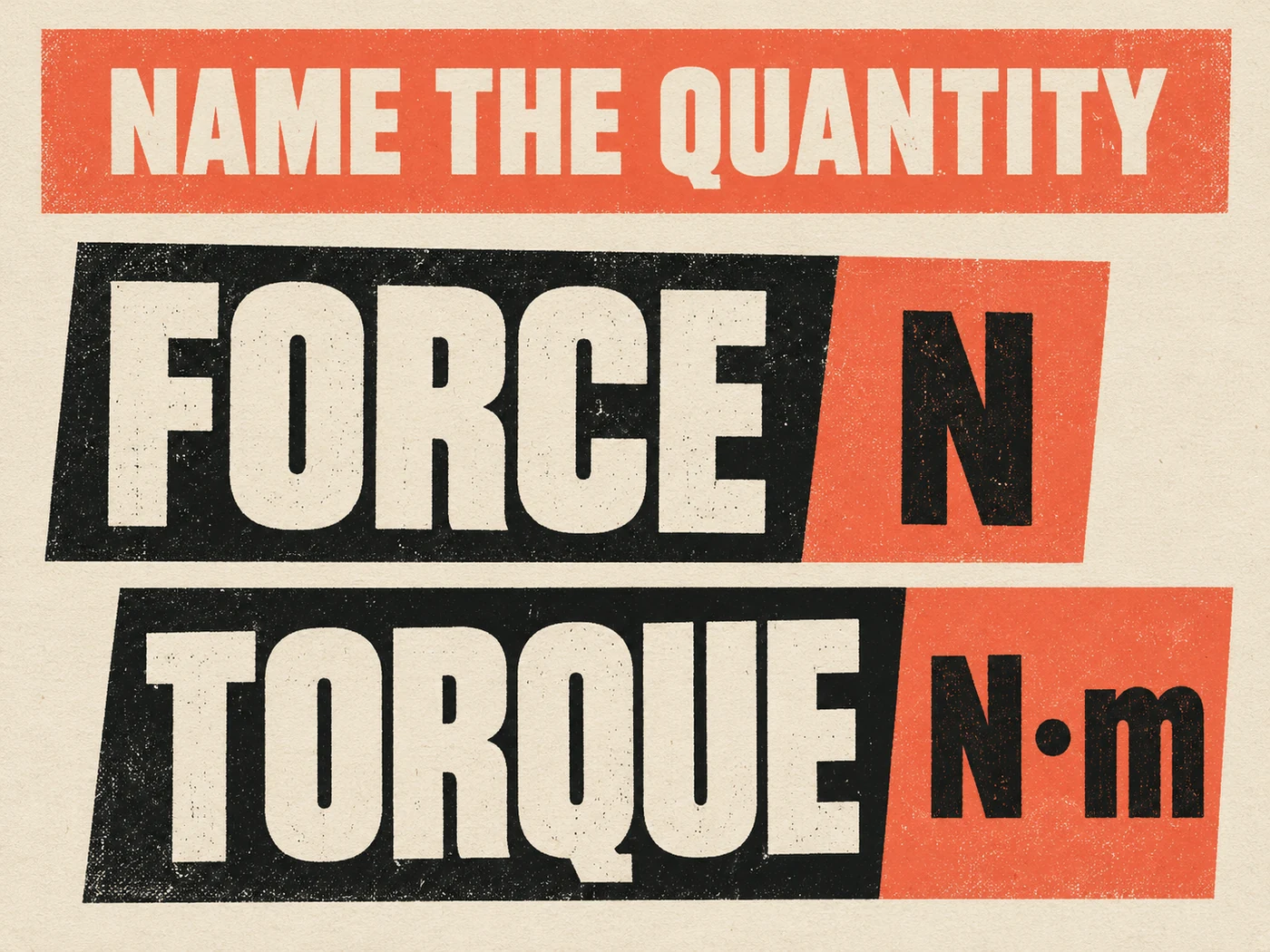
Consider two invented geometry records. Both assume one axial force contribution of 400 N at the evaluated position. They differ only in the stated perpendicular lever arm. These are teaching assumptions, not actual strut ratings, mounting recommendations or approved automotive geometry.
| Hypothetical case | Assumed force | Perpendicular lever arm | Torque contribution |
|---|---|---|---|
| A | 400 N | 0.10 m | 40 N·m |
| B | 400 N | 0.15 m | 60 N·m |
The calculations are 400 N × 0.10 m = 40 N·m and 400 N × 0.15 m = 60 N·m. The assumed force is unchanged; the different lever arm produces a different calculated contribution. Therefore matching 400 N labels would not establish equal torque assistance even in this simplified comparison.
Neither result is the net opening torque of a real panel. The example omits gravity, friction, other struts, motion-dependent force and application constraints. It cannot establish how much force an operator needs or whether a panel remains supported.
Do not describe case B as a better installation. A larger torque contribution at one position is not a complete handling or suitability judgment. The example only shows why identical force labels can accompany different geometric contributions.
Preserve the length unit before doing the arithmetic
The hypothetical 0.10 m lever arm can also be written as 100 mm. If a worksheet uses millimetres in the multiplication, its immediate product is in N·mm rather than N·m. Keep that intermediate unit visible before conversion.
For example, 400 N multiplied by 100 mm is 40,000 N·mm, which is 40 N·m. That is the same simplified result as case A, not a thousand-fold increase. Retain the original distance, its unit and the converted value in separate fields.
These calculations are arithmetic demonstrations. They do not validate that a distance read from a photograph is the correct perpendicular lever arm or that the assumed force applies to a particular supplied item.
One panel position does not describe the whole travel
Ask the application reviewer which positions are evaluated and how the geometry is recorded across the required travel. Do not carry the perpendicular distance from one position into every other position without the corresponding geometric evidence.
Retain the force basis as well. A nominal label, a measurement at a stated extension and a complete force characteristic are different evidence records. If the proposed comparison relies on a force value at a particular position or condition, ask for that definition.
The official Stabilus gas-spring page describes its LIFT-O-MAT products as providing extension-direction force and offers application-specific selection. This is manufacturer-specific context, not proof of the construction, force curve or suitability of MAKEXCAR references.
Separate the strut contribution from the other loads
A real application assessment needs to distinguish the strut contribution from the panel's gravity-related moment and other relevant effects. Ask the reviewer which loads and constraints are included in the conclusion. The single contribution in the example should not be renamed as the complete balance.
Where more than one strut is involved, record the number, identity and geometry of each. Do not assume that multiplying one contribution by two represents a different application unless the actual arrangement supports that calculation.
Likewise, an operator force depends on its own application point and direction. A torque value alone does not become a hand-force value without that additional definition. Keep the quantity names distinct in the quotation discussion.
Use an evidence worksheet rather than an isolated force column
Place the following fields beside the reported force. Each supports a different part of the comparison. The last column indicates what must be resolved before the number can be used for the claimed decision.
| Field | Why it matters | Action when unresolved |
|---|---|---|
| Part and supplied assembly | Identifies which force evidence applies | Obtain the reference/configuration link before comparing labels |
| Force direction, position and conditions | Defines the force input at the evaluated state | Keep an unspecified nominal value separate from a position-specific result |
| Hinge axis, force line and panel position | Defines the geometry for the perpendicular distance | Request the applicable geometry rather than use overall strut length |
| Distance unit and calculated contribution | Makes the moment calculation reproducible | Correct unit/quantity labels before interpreting the numerical result |
| Other loads, travel and review conclusion | Separates one contribution from complete application behavior | Keep net balance and selection approval open until supported |
A blank distance is not zero, and a missing force characteristic is not evidence of constant force. Preserve those gaps in the comparison. The worksheet helps organize an application review; it does not supply a strut-selection calculation for an unspecified vehicle.
Interpret two common quotation differences
If two offers use the same force unit but one provides only a nominal label while the other names a position and condition, their documentation is not yet equivalent. Identify the missing force definition for the first offer. A more detailed record is not itself proof of a better product; it makes the stated input easier to interpret.
If the force inputs match but the perpendicular-distance records differ, retain both geometries and the evaluated positions. The hypothetical 40/60 N·m table explains the effect within one simplified calculation, but the review still needs the other loads and motion scope. Do not resolve the difference by selecting the larger result without that application evidence.
Keep replacement and redesign requests distinct
For a replacement inquiry, send the existing confirmed part identity and the relevant vehicle or assembly information. Ask which documents establish the proposed match. Do not change an original mounting relationship to make a conveniently available force label appear suitable.
A new or modified application needs a reviewed geometry and defined motion requirements. Keep that engineering request explicit. A part quotation does not by itself approve changes to hinge locations, brackets, attachment points or surrounding structure.
If the supplier changes the proposed item after the geometry review, confirm which conclusions remain applicable. Link the accepted evidence to the actual order line and preserve the revision of both the part record and application assessment.
State the quantity and direction in the comparison sheet
The table above gives magnitudes of one contribution. A real assessment must also identify the direction in which each contribution acts about the defined hinge. A positive number in an unlabeled spreadsheet should not be assumed to mean opening assistance.
Ask the reviewer to explain the sign convention and the position to which it applies. Preserve that explanation beside any summarized result. This prevents an exported magnitude from losing the direction information that the original assessment used.
Keep measured data, calculated values and assumptions under separate headings. The force may come from a product report, the geometry from an approved drawing and the resulting contribution from a calculation. Each needs its own source and revision rather than a single unexplained “rating” field.
When information is corrected, check whether the correction changes the contribution or the application conclusion. Preserve the supplier's response and the revised record together. An update to the force unit or lever-arm definition can change the interpretation even when the displayed digits stay the same.
Send the evidence with the RFQ
Provide the following fields through the MAKEXCAR contact page. Attach the applicable drawing or clearly identified reference images. Identify which input is unknown rather than using a nominal force as a substitute for a completed application assessment.
| Request field | Buyer entry |
|---|---|
| Supply identity and purpose | [Reference, configuration, quantity; replacement or new application] |
| Force basis | [Direction, evaluated position, conditions and supporting record] |
| Mounting geometry | [Axis/force-line drawing, revision and positions covered] |
| Required application decision | [Other loads, motion requirements and scope of review] |
| Open question and owner | [Missing input or mismatch and responsible technical contact] |
The response should distinguish the documented force, geometric input, calculated contribution and complete application conclusion. Keep their source records connected to the final quoted item. A change in part or mounting arrangement requires review of the affected inputs before any earlier conclusion is carried forward.