Make the complete interface the comparison unit
A purchasing sheet that says only thread size can conceal several unanswered questions. Which thread standard applies? Is the thread internal or external? How is pitch stated? What part of the connection provides the seal? Which drawing defines the mating geometry? The supplier needs this context to answer the intended request.
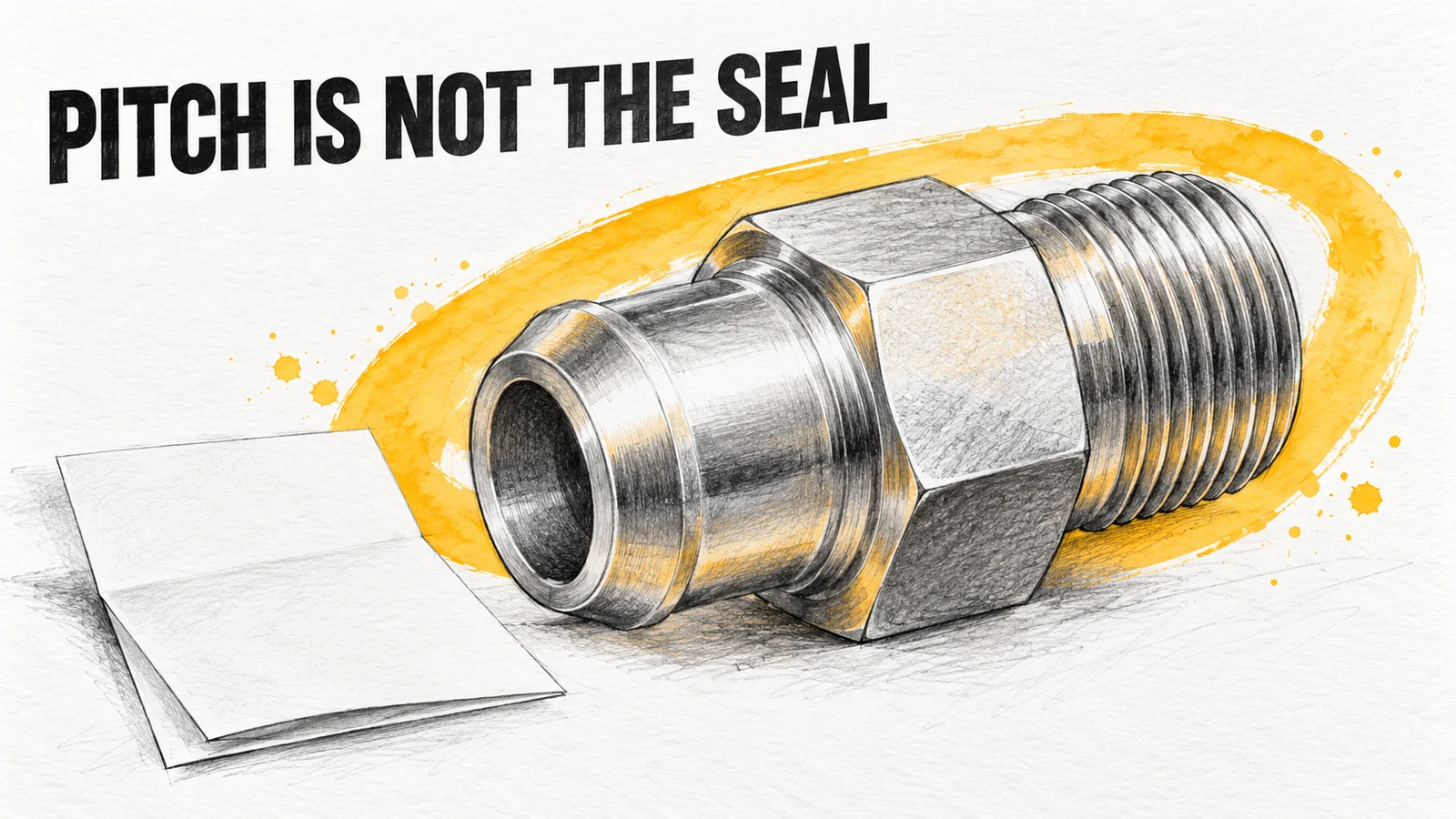
Keep the thread and the end connection in the same record, but give each its own fields. A thread can participate in retaining components while the seal depends on another documented feature. A fitting that appears to engage is therefore not automatically evidence of a suitable sealing interface. Avoid trial assembly as a purchasing identification method.
Begin with the existing part reference and application documentation. If the reference is missing, say so and supply clear identification photographs for investigation. Do not present an estimated thread designation as a verified fact. A provisional candidate should remain provisional until the relevant interface record supports it.
Use general thread guidance within its limits
Swagelok's thread identification introduction distinguishes thread pitch, diameter, angle, and end-connection features. Its discussion also separates straight-thread retention from sealing features such as a gasket, O-ring, or metal contact. These are general identification concepts, not specifications for any MAKEXCAR automotive A/C fitting.
The source explains that pitch can be expressed in millimeters or threads per inch. Record which expression the actual drawing uses and which standard it identifies. Do not copy the source's unrelated pressure examples, installation methods, or sealant advice into an automotive purchase specification. The offered part and its intended application need their own applicable records.
General guidance can help a buyer ask the right question. It cannot assign a thread standard, seal material, seat geometry, pressure rating, or tightening requirement to a photographed item. When the supplier replies, ask for the reference connecting that answer to the offered SKU rather than treating an educational diagram as product evidence.

Understand the unit without inventing a product pitch
A numerical comparison can clarify units while staying separate from real product specifications. Consider two hypothetical single-start thread descriptions: one with 20 threads per inch and another with 24 threads per inch. These invented inputs illustrate pitch conversion only. They are not measurements or designations for a MAKEXCAR item.
| Hypothetical description | Calculation | Distance between adjacent threads |
|---|---|---|
| 20 threads per inch | 25.4 mm divided by 20 | 1.270 mm |
| 24 threads per inch | 25.4 mm divided by 24 | Approximately 1.058 mm |
The conversion uses 25.4 millimeters per inch. It shows why two different threads-per-inch values cannot be treated as the same pitch. It does not establish either thread's diameter, angle, class, tolerance, sealing arrangement, or suitability. The rounded second result is an explanatory calculation, not an acceptance limit or a preferred replacement dimension.
For a real part, preserve the drawing's complete designation and original units. If a conversion is useful for discussion, show the calculation alongside the original value. Do not replace a specified designation with a rounded metric number and then search for the nearest available fitting. The governing interface record must remain identifiable.
Keep the sealing seat separate from the thread label
A sealing-seat question asks where and how the documented connection establishes its seal. Ask for the relevant section or detail of the application-specific drawing, with its revision. The answer should identify the mating feature and any specified sealing component. Do not infer the seat geometry from a shiny surface or a visible recess in a photograph.
Where the supplier lists a seal, ask whether it is included in the quotation and which reference defines it. A generic statement that an O-ring is supplied does not establish the correct dimensions, material, or application suitability. Preserve the declared record and any unresolved questions instead of adding a familiar seal specification from another connection.
Likewise, do not assume that a threaded interface requires tape or a liquid sealant. The intended sealing method belongs to the applicable documentation. This article provides no sealant, lubrication, tightening, or assembly instructions. Those decisions should follow the relevant technical process for the actual system and component.
Connect each missing interface field to a next request
Preserve the complete interface description when comparing suppliers. If the offered description differs from the buyer's record, identify the precise difference instead of treating the nearest nominal size as a substitute. The worksheet below connects each gap to its next question.
| Field to retain | Why it matters | Action if unresolved |
|---|---|---|
| SKU, variant and drawing revision | Identifies the supplied interface | Request the drawing linked to the actual quotation |
| Complete thread designation and standard | Defines more than nominal diameter | Ask for internal/external context and the governing designation |
| Pitch and original units | Preserves spacing without a rounded substitute | Clarify whether the field is mm or threads per inch |
| Sealing seat and mating detail | Identifies the documented sealing feature | Obtain the applicable section or end-connection record |
| Sealing method and included component scope | Explains what must match and what is supplied | Request the specified arrangement and seal reference |
This is a sourcing aid, not a dimensional standard. Recording the document does not establish application approval or installed leak-tightness. Keep the technical comparison attributed to the applicable record and responsible reviewer.
A thread designation can be complete while its sealing arrangement remains unanswered. Conversely, naming an included O-ring does not complete the thread standard or pitch field. Preserve each question independently so an apparently detailed reply cannot conceal the unresolved interface.

What the current catalog can establish
The published M30400628 listing identifies an A/C pipe-fitting reference and includes R134a and high and low pressure wording in its title. The checked product body does not provide a thread-pitch or sealing-seat specification. That absence leaves these fields unresolved for this article; it does not establish that the component lacks a defined interface.
Use the exact reference to request the missing technical information. A title-level description cannot supply a numerical thread designation, an allowable connection length, or a seal specification. If additional documents become available, connect them to the offered variant and revision. Avoid carrying an answer about one reference into another simply because both sit in the same product category.
The current A/C Valves & Fittings category is a useful sourcing entry point. It groups a component family; it does not establish a common thread or sealing interface across its listings. Compare candidates through their own records and the intended application.
Resolve discrepancies before turning them into an order
If a buyer's drawing and a supplier's description differ, record the exact difference and its source. Examples include a pitch expressed in another unit, a different drawing revision, or an unspecified sealing component. Ask for clarification rather than silently choosing whichever entry looks closest to the existing part.
A unit conversion may resolve a presentation difference, but it cannot resolve a different standard, tolerance, or sealing arrangement. Keep the original designation available for the technical reviewer. If a supplier proposes an alternate reference, request the evidence supporting that alternative in the intended application.
At receipt, reconcile the delivered identity, declared contents, documents, and visible condition against the purchase order. Do not turn a matching label into proof of installed leak-tightness. Service suitability and verification belong to the applicable qualified process, with findings recorded separately from the commercial delivery check.
If the inquiry includes a sample measurement, identify who recorded it and which feature was measured. Keep that observation separate from a drawing requirement and from the permitted tolerance. A measured value can help describe a received sample without establishing the design limit for future deliveries. Ask the technical reviewer how the observation relates to the governing record, and preserve the answer with the quotation. This prevents a sample value from being copied into an order as an unsupported production specification.
Resolve three incomplete thread replies
A pitch arrives in another unit
Keep the original value and show any conversion explicitly. Ask whether both values describe the same governing thread designation. A unit conversion may explain presentation, but it does not resolve a different standard, tolerance or mating feature.
The drawing identifies the thread but omits the seat
Ask for the applicable end-connection section and sealing record. Do not assume that an engaged thread creates the intended seal. The missing seat or sealing arrangement remains a separate question even when the designation and pitch are documented.
A sample measurement is proposed as the order specification
Record which sample and feature were measured, then request the governing drawing requirement and tolerance. A measured observation is not automatically the nominal value or permitted variation for future deliveries. Keep source status visible before copying the number into an order.
Send an inquiry with the complete available interface record
Use these fields with your drawing or current quotation. Keep unknown entries visible so the supplier can resolve the actual interface question.
Candidate: Offered or existing reference, variant, application information, supplied scope and quantity.
Thread: Complete available designation, governing standard, internal/external context, pitch and original units. Identify which field is missing or provisional.
Seal: Relevant seat or mating detail, specified sealing arrangement and included seal reference. Ask for the applicable section if absent.
Source: Drawing number and revision, supplier description or identified sample measurement. Separate observations from requirements and tolerances.
Difference to resolve: State the exact unit, designation, revision or scope discrepancy. Request the explanation connecting the offered interface to the intended application.
Contact MAKEXCAR with the inquiry and clear identification photographs where available. Confirm the governing interface and seal records before treating a nominal thread match as the basis for an order.