This article provides an original record checklist for buyers and distributors. It is not an approval form issued by an automotive manufacturer, a substitute for a customer's required process or permission to release a part. Use the applicable requirements and authorized reviewers for the actual decision.
Define the decision the sample review should support
Start by describing why the sample was requested. A review of visible packaging, a dimensional assessment and a functional evaluation answer different questions. Identify the intended scope before combining their findings into a broad approval statement.
Keep commercial agreement separate from technical acceptance. A buyer may agree a price or package format while a fitment question remains open. The record should show which decision was made and which outstanding question still needs evidence.
Identify the person or function responsible for the decision under the actual purchasing process. A supplier's internal check, a buyer's receipt acknowledgment and an authorized technical conclusion should not be treated as interchangeable simply because each appears in the same email conversation.
Connect the physical sample to the record
Record the offered product reference and the identifier of the sample assessed. When several samples are present, keep their individual identities with the relevant observations. Do not use a convenient photograph of one item to represent a different item without an explicit supported relationship.
Retain any lot or production-context information actually supplied where it is relevant to the requirement. Mark missing information as unresolved. Do not create a fictitious lot code or infer the manufacturing process from packaging appearance.
Keep photographs and measurement records connected to the same sample. A close-up label should retain enough context to identify the item it describes. If a sample is replaced, record the replacement and explain which earlier evidence, if any, remains applicable.
Freeze the specification revision used for review
Identify the drawing, specification, agreed contents list or other requirement used by the reviewer. Preserve its document identity and revision. A record cannot explain an acceptance decision clearly if the requirement later changes and the earlier version disappears.
List relevant documents rather than relying on a folder called latest. When a buyer and supplier use different reference names, establish the documented relationship. Do not assume that two similarly titled files specify the same product.
Keep clarification messages with the requirement they clarify. If an email changes an offered scope, request an explicit record of that change. A scattered conversation can be difficult to interpret when another reviewer needs to understand the agreement months later.
Retain the actual measurement evidence
For dimensional review, connect the reported feature, sample, method and result to the applicable requirement. Preserve the original result record and any qualification. A list of numbers without the feature definitions may not explain what the reviewer compared.
Keep the measurement method and relevant equipment information required by the actual process. This article does not set a universal instrument, sample count or tolerance for automotive parts. Ask the technical reviewer to specify the evidence appropriate to the decision.
Do not replace an actual result with a decorative pass icon. If a record says a feature is within a limit, the supporting report should make the basis available. Where information is missing or inconsistent, request clarification rather than completing the worksheet with assumed values.
Use formal supplier examples within their scope
Bosch's Supplier Quality Requirements, Edition 3 links documented measurement results to identified samples and describes recording and communicating initial-sample evaluation results. This is a supplier-specific example of connecting evidence and decisions. Its requirements do not automatically govern a MAKEXCAR purchase or turn this checklist into a formal production approval submission.
For your order, establish which customer or purchasing requirements actually apply. If a formal submission is requested, obtain its required scope and documentation from the responsible customer process. Do not label an informal sample exchange as that submission merely because some records look similar.
Write the approval scope in plain language
State what the decision covers using the actual review conclusion. Identify the sample, reference and specification revision, then record the assessed aspects. Avoid expanding a limited visual review into a general claim about performance or vehicle compatibility.
Keep any limitation visible next to the decision. An outstanding application question should not be hidden in a separate message while the main record says approved without qualification. The purchasing team should be able to locate the unresolved issue before relying on the record.
If the decision concerns a particular order, lot or configuration, retain that scope as stated. Do not assume it authorizes every future shipment or a revised product. The applicability of a later order needs the actual agreement and review process.
Use an original sample agreement worksheet
Use the following editorial worksheet to identify a gap in the agreement and request the missing record. It is not a completed approval form. The actual customer's process determines the required evidence and decision authority; these prompts help the purchasing team understand the result without relying on the original author's memory.
| Record element | Why it matters | Request if unclear |
|---|---|---|
| Sample and offered reference | A photograph or report may describe a different item from the current offer. | Assessed sample identifier, offered SKU and an explicit link to each observation/report. |
| Requirement revision | A result has meaning against the requirement actually reviewed. | Document identity/revision and any clarification incorporated into that basis. |
| Evidence and review scope | A visual check cannot silently become dimensional or functional approval. | Named reports, methods and assessed aspects, with missing assessments visible. |
| Decision and reviewer | Receipt acknowledgment and supplier internal checking are different from the required acceptance decision. | Actual conclusion and the reviewer responsible under the applicable process. |
| Applicability and exception | An authorization may cover a defined configuration rather than every later order. | Recorded scope, stated conditions/limits and any separate exception authorization. |
| Follow-up and current version | A pending request or superseded record can be mistaken for the current agreement. | Outstanding action, responsible party, current record revision and reason for replacement. |
Keep the underlying records available to the people making the order decision. If a document link cannot be opened by the reviewer, supply it through the agreed channel. Do not fill an inaccessible or missing field with a favourable answer merely to complete the worksheet. A record is useful when the next reader can locate both the conclusion and its limits.
Record exceptions separately from the base specification
If a difference is proposed for acceptance, describe it against the actual requirement and retain the supporting evidence. Record who authorized any exception under the applicable process, what it covers and any condition or validity limit stated in that authorization.
Do not quietly edit the base requirement to make a nonconforming observation disappear. Keep a clear distinction between a revised specification, an authorized exception and a request still awaiting a decision. These records can have different effects on an order.
A proposed exception is not an accepted exception. Avoid phrases that imply approval while the technical response is pending. The record should identify the outstanding decision and the evidence needed to address it.

Connect the record to the quotation and receiving review
Link the sample decision to the relevant quotation or order when the actual agreement requires that relationship. Confirm that the offered reference, scope and revision remain consistent. A pricing update should not silently change the technical record.
At receiving, use the agreed identifiers and documentation to compare the shipment with the commercial record. A sample decision should not be used as a reason to ignore a changed reference, unexpected contents or a discrepancy in the supplied documentation.
Keep any receiving finding separate and traceable. Record the actual discrepancy and request clarification through the applicable process. Do not write that all shipped items passed an assessment that was performed only on an earlier sample.
Maintain the agreement when the sample or design changes
Record the change and identify the earlier decision it may affect. Ask the responsible reviewer which evidence must be updated. A new drawing revision, replacement sample or changed configuration should not inherit a prior decision without a supported applicability review.
Retain the old version when it is needed to explain a previous quotation or shipment. Clearly identify the current record and the reason it supersedes the earlier one. Avoid deleting qualifications during a simple formatting update.
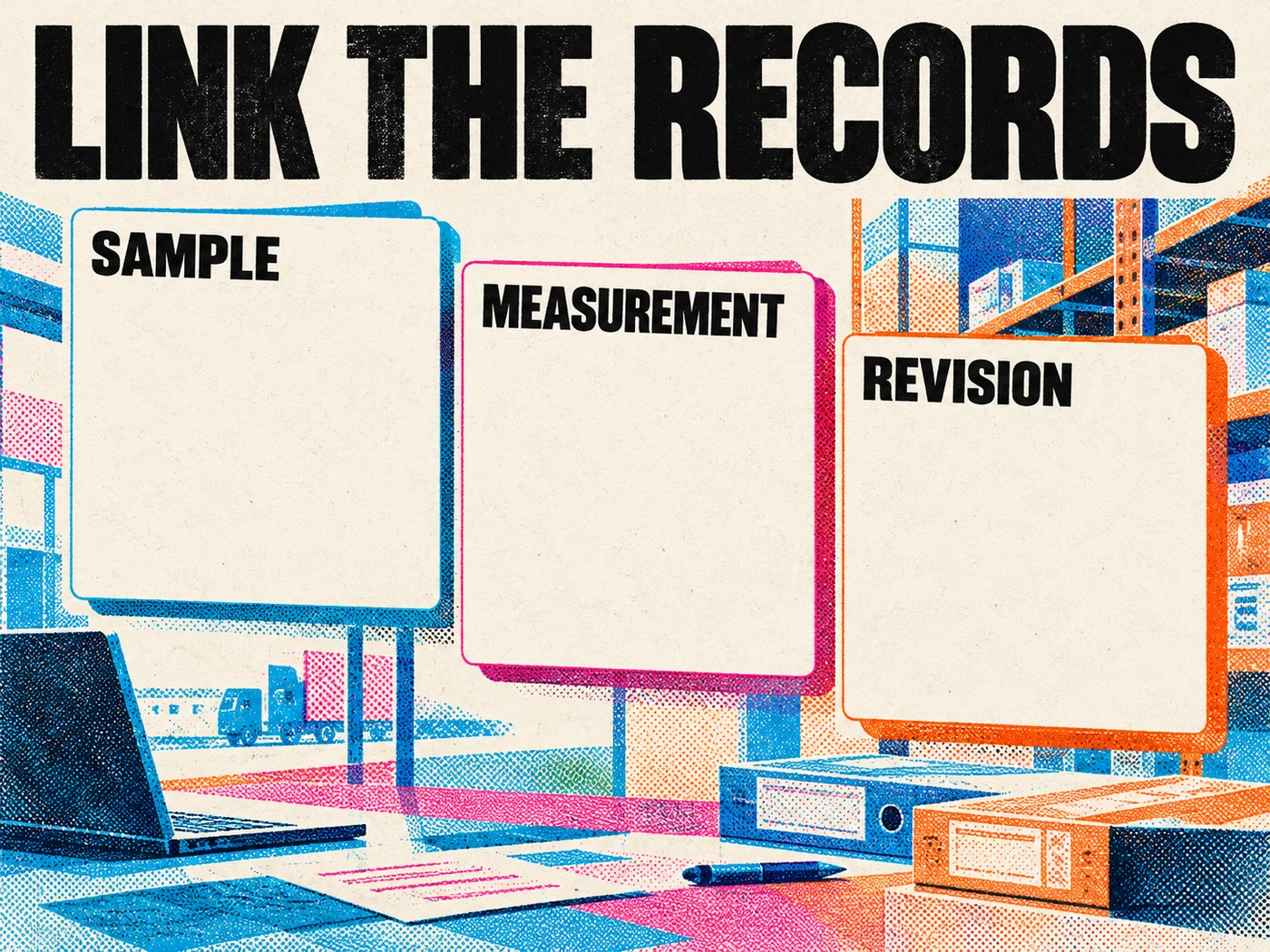
The illustrations in this article are conceptual record aids, not signed forms or test evidence. Actual agreement records should contain the real information and authorization required by the buyer's process.
Common questions about sample approval records
A hypothetical approval covers appearance only
Consider this invented record: sample S-01, offered reference PART-A, drawing revision B, photo set PHOTO-01, decision “appearance reviewed; dimensional and functional acceptance pending.” These labels are illustrative, not real MAKEXCAR records. The useful feature is the scope statement. It identifies which evidence was assessed and which decisions remain open instead of enlarging a photo review into a full product approval.
If the buyer later receives a measurement report, connect it to S-01 and revision B, then obtain the required review of that evidence. Do not rewrite the earlier appearance conclusion as though it already included the measurements. Add the actual subsequent decision and its scope so a colleague can follow what changed.
The drawing changes before the production order
Suppose the hypothetical offer changes from drawing revision B to revision C after the sample review. Ask the supplier to identify the changed requirements and ask the responsible reviewer which prior evidence remains applicable. Two revision labels alone do not quantify the technical change. Keep the earlier record as history and identify the current order basis once the applicability question has been resolved.
An exception is proposed but not authorized
In another hypothetical inquiry, a supplier asks the buyer to accept a stated difference and attaches a photograph. Record the difference against the applicable requirement and request the actual authorization needed by the customer's process. Until that decision exists, label the proposal pending. A photograph of the difference and a commercial agreement on price do not establish an authorized technical exception.
These examples illustrate record relationships, not actual sample inspections, signed decisions or release permission. A useful follow-up says which sample, revision, aspect or authorization is unclear and asks for the evidence that resolves that particular gap.
Prepare a sample-record clarification inquiry
Copy this brief when requesting a clearer sample decision. Brackets are fields for actual records; the form does not grant approval.
Item and sample: [offered reference, assessed sample identifier and any applicable lot/context supplied].
Review basis: [requirement document/revision and relevant clarification].
Evidence: [report/photo identities, assessed aspects and missing review].
Decision: [actual reviewer/conclusion, applicability and separately authorized exception if any].
Follow-up: [outstanding question, responsible party and current record/order reference].
Review the relevant MAKEXCAR product category and collect the offered reference, sample identifier and applicable revision. For an engine and ignition inquiry, retain the same record discipline while specifying the actual product's review requirements.
Send the worksheet and outstanding questions through MAKEXCAR's contact page. Ask for an explicit scope statement and the evidence behind any proposed exception. A traceable agreement helps purchasing and technical teams understand what was decided without enlarging that decision beyond its recorded basis.