Start with the complaint, not the verdict
“Pump faulty” is a conclusion. “Engine cranks but did not start after an overnight stop” describes an observation that another reviewer can investigate. Ask the workshop to state what happened, when it happened and whether it was repeatable. Separate starting, running, noise, leakage and fuel-level indication complaints; these describe different questions even when the same assembly is involved.
Record the installation date, distance or operating time since installation, and the first occurrence of the symptom. Identify who observed it and whether the complaint was reproduced during inspection. If the vehicle started normally when the report was prepared, write that down. An intermittent symptom should remain intermittent in the file rather than becoming a permanent failure through simplified wording.
This guide is a purchasing and return-documentation framework for electric fuel pumps. It does not prescribe vehicle testing, fuel handling or wiring changes. Those activities belong to qualified personnel using the applicable service information. MAKEXCAR product pages and general technical articles cannot replace the procedure or acceptance limits for the identified vehicle.
Keep part identity and application in the same file
Include the seller SKU, order reference, batch or traceability marking if available, and clear photographs of the returned unit. Connect these to the vehicle market, model, production period, engine code and relevant fuel-system variant. An OE reference is useful, but a cross-reference without the application details leaves room for an incorrect selection to be mistaken for a manufacturing defect.
State whether the supplied item was a pump-only replacement, a repair kit or a complete module. Record which surrounding components were reused and which were replaced, without assuming that the quotation included every accessory. A complaint attached to a complete module should identify the function under question; a sender complaint and a fuel-delivery complaint should not share an unexplained “pump failure” label.
Photograph markings before labels are removed or the unit is cleaned. Retain the original customer report and add corrections as dated notes. This gives the distributor and supplier a stable starting point when they compare the delivered reference, installation record and physical return. It also avoids relying on a replacement carton as proof of the returned part's identity.

Electrical evidence needs a measurement context
Delphi's voltage-drop guidance explains that insufficient pressure and flow can also result from low voltage or poor connections. A performance complaint therefore needs electrical context before it is attributed to the pump itself. Delphi directs technicians to the vehicle manufacturer's procedure; its example does not establish a universal limit for every MAKEXCAR reference.
For the file, request the technician's recorded supply measurement, where it was taken, the operating state and the applicable reference. A battery reading and a measurement at the pump are different pieces of evidence. Label each clearly. “Voltage checked” gives the reviewer neither the result nor the conditions needed to understand it.
Record the measurement time relative to the symptom: initial starting attempt, normal running or a later inspection. Include any documented connector or harness finding and the action taken afterward. If a connection was repaired before the second measurement, keep both records. Do not rewrite the first result as though it was collected after the repair, and do not infer a wiring pinout from a photograph.
Describe fuel condition without guessing its chemistry
Motorservice's electric fuel pump fault guide identifies particulate contamination as a possible source of restricted flow, noise or jamming. Its explanation supports documenting the surrounding fuel system. It does not prove that contamination caused a particular returned unit to fail, and it does not make every alternative fuel unsuitable for every pump.
Ask what fuel was specified for the vehicle and what fuel was reported as used. Keep visible deposits, discoloration or debris as observations, supported by photographs and inspection notes. A photograph cannot establish a fuel's exact composition. Where chemistry is relevant to a disputed claim, request a suitable analysis and its sampling record rather than attaching a confident label to an unknown liquid.
Note the documented condition of the tank, strainer and relevant filter, plus recent maintenance or long storage when known. Identify when each component was inspected and whether it had already been changed. Keep “not inspected” separate from “clean.” The absence of a recorded finding is an information gap, not evidence that the surrounding system was satisfactory.
Pressure and flow records must show the test conditions
A number is useful only when the report identifies what it measures. Request pressure units, measurement location, operating condition, test method and the service-data limit used by the technician. For flow or delivered volume, also request the collection interval and conditions documented in the test. Avoid comparing results that were collected at different states as if they were equivalent.
Attach the original report, including the instrument identification or calibration information when available. Keep the actual reading, reference range and reviewer's interpretation in separate fields. If the range is missing, label the result as awaiting comparison. A supplier should be able to see which document supports the acceptance limit and whether it applies to the correct system variant.
For an intermittent complaint, ask whether the symptom occurred during the recorded measurement. A satisfactory reading on another occasion may describe that occasion accurately while leaving the original complaint unresolved. The file should preserve this limitation. It should not manufacture a failure result to match the customer's complaint or a pass result to close the case quickly.
Use a compact evidence matrix
| Record | Information to retain | Question it helps answer |
|---|---|---|
| Part identity | SKU, order, markings and return photos | Is this the supplied reference? |
| Vehicle application | Market, engine, production period and system variant | Was the correct part selected? |
| Symptom timeline | First occurrence, repetition and observation dates | Was the complaint reproduced? |
| Electrical record | Reading, location, operating state and procedure reference | What supply condition accompanied the result? |
| Fuel-system observations | Fuel history, filter notes and dated photographs | What surrounding conditions were documented? |
| Delivery test | Pressure or flow, units, method and applicable limit | Can the result be compared fairly? |
| Return history | Removal, cleaning, opening and assessment authorization | Has the evidence been changed? |
Use the matrix to request missing facts, not to automatically reject a claim with an incomplete file. Some observations may no longer be recoverable after removal. Record that limitation and agree the next feasible assessment with the supplier. A distributor can maintain a consistent intake form while allowing the technical reviewer to decide what additional evidence matters for the actual complaint.
Keep waveform evidence readable and bounded
Delphi's scope-testing article describes how current waveforms can expose issues that pressure and volume checks miss. This supports keeping a technician's waveform evidence when available. It does not justify assigning one current value or waveform shape to every pump, and the article directs readers to service information for current specifications.
Request the original capture with axis units, time scale, instrument settings and the operating condition. Retain the technician's interpretation alongside the trace. A cropped image without scale or context may illustrate that a capture exists but cannot support a detailed comparison. For electronically controlled systems, ask the reviewer to identify the control conditions relevant to their method rather than supplying an assumed constant-voltage benchmark.
Preserve the return and separate technical findings from claim decisions
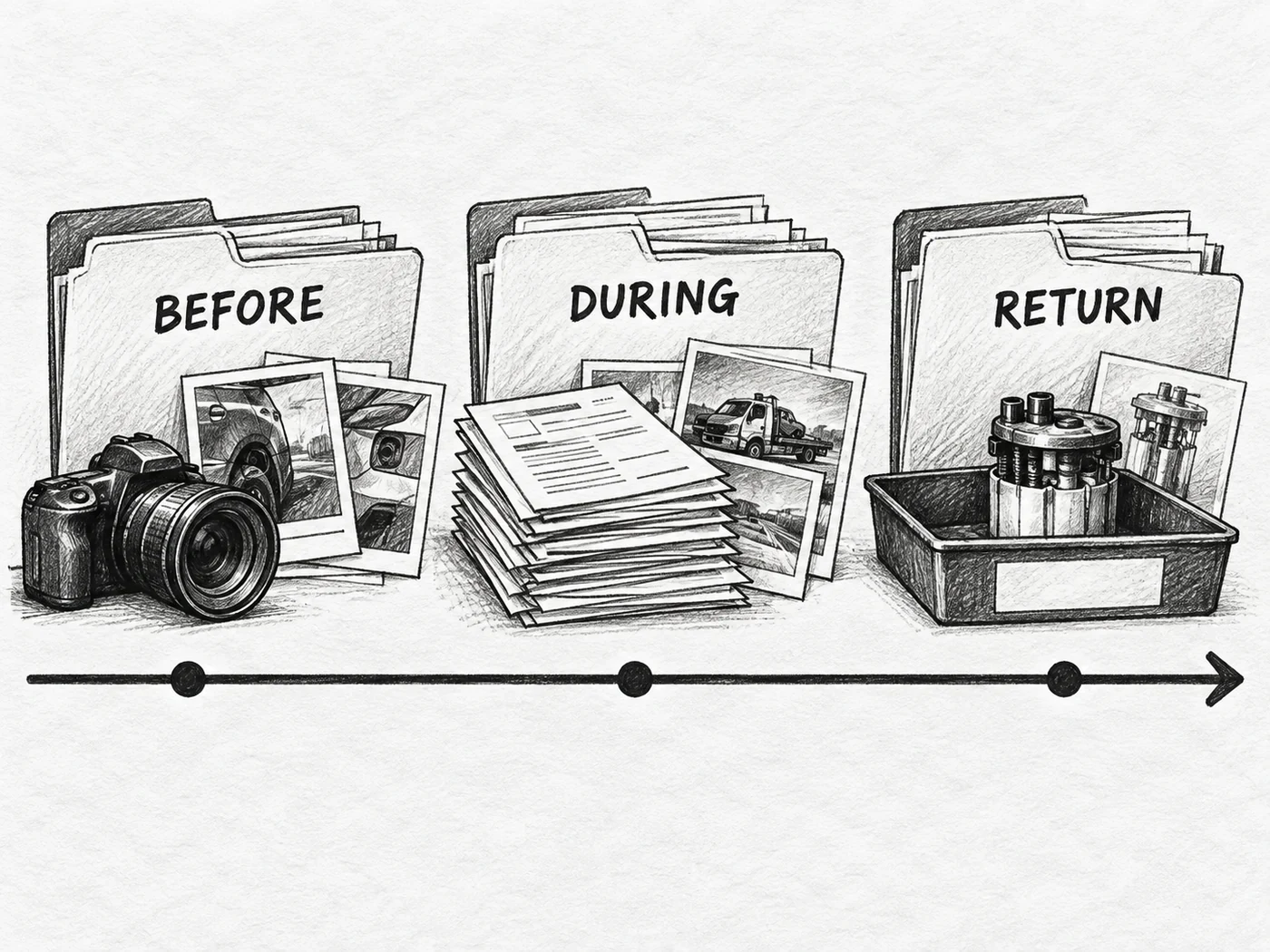
Agree the assessment scope before opening the pump or altering the returned components. Motorservice notes that some internal damage is visible only after opening, which irreparably damages the pump. A destructive examination should therefore be documented and authorized within the return process. External photographs, label records and the unit's received condition should be captured first.
Keep a dated account of removal, inspection and any cleaning or component changes. Ask the supplier for its return preparation and transport requirements; this article does not specify how to ship a fuel-exposed item. Assign a case reference that follows the reports and the physical unit. Record whether the returned item was assessed intact or after an agreed examination.
Finally, distinguish the technical finding from the commercial decision. “Cause undetermined,” “application mismatch documented” and “internal defect confirmed by the assessment” convey different outcomes. The agreed claim terms govern the commercial resolution. A helpful review explains the evidence and remaining limitations rather than treating replacement authorization as proof of a particular failure mechanism.
Resolve missing context without changing the finding
The file contains a volume but no collection interval
Keep the recorded volume and ask for its time basis and test conditions. In a hypothetical report, 600 mL over 30 seconds gives an average of 20 mL per second. These invented inputs illustrate how a collection interval changes the meaning of a delivery record. They prescribe no test operation, pump specification or acceptable result.
A second file giving only 600 mL cannot be ranked against that rate until its interval and conditions are known. Even when both rates are available, different electrical supply, operating state or test boundaries can prevent a fair comparison. Preserve those fields beside the arithmetic instead of treating a normalized number as a complete diagnosis.
The voltage reading was taken after a connector repair
Identify the repair and the measurement sequence. Keep any earlier observation and the later reading separately labelled. The later value may describe the repaired system correctly without showing what supply condition accompanied the first complaint. Ask the reviewer what the evidence can establish about each event rather than rebuilding an earlier measurement from a later result.
The visible debris is identified but its origin is uncertain
Retain the examiner's identification, method and limitation. Ask how the examined material was linked to the unit and when it was collected. A supported particulate finding does not by itself identify which component introduced it or whether it caused the reported symptom. Keep any proposed cause distinct from the recorded condition until the assessment supports that connection.
The return contains a complete module but the complaint concerns fuel level
State the affected function and the documented observation before requesting pump-delivery evidence. A sender or indication concern needs its own application and assessment record. Keep any available fuel-delivery result as evidence for that separate question; it cannot close an unexplained level indication simply because both functions are supplied in one assembly. Clarify the supplier's assessment scope for the exact returned configuration.
Fill in the return evidence request
Case/order/SKU/physical-unit marking and supplied form: ___; vehicle/engine/fuel-system variant and reference source: ___.
Original symptom/function/date and reproducibility: ___; installation/inspection chronology: ___; reused or changed components: ___.
Electrical result/location/operating state/reference limit: ___; connector or harness intervention and measurement sequence: ___; waveform capture/axes/settings/interpretation if available: ___.
Fuel identity/specification and recorded condition: ___; deposit sample/examiner/method/finding/cause limitation: ___; tank/strainer/filter assessment or not inspected: ___.
Pressure or volume/flow quantity/units/interval/method/conditions/source limit: ___; physical-return changes and assessment agreement: ___; technical finding separately from claim response: ___; next requested evidence: ___.
Prepare a traceable inquiry for the exact reference
Review the published MAKEXCAR Fuel Pumps category to identify the relevant reference, then use the contact page to discuss the case. Include the purchase record, application and evidence matrix. Request the applicable assessment process and reference data; do not assume an online category description supplies warranty terms, electrical limits or a confirmed diagnosis.