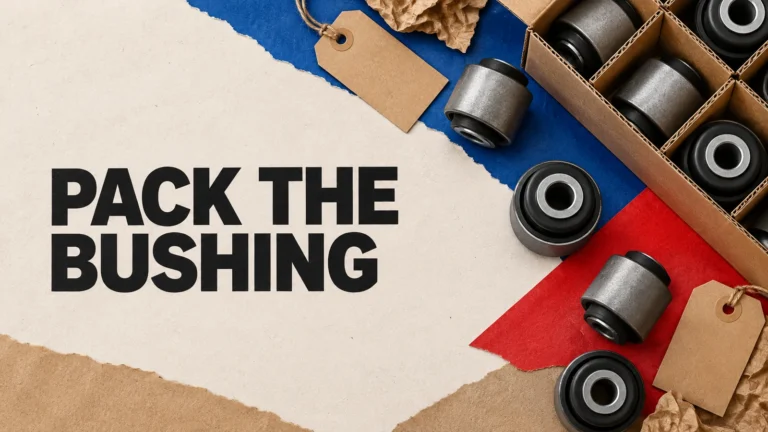

For procurement purposes, a design name is a starting point for clarification. It is not an approval of interchangeability or a numerical performance specification. This guide explains how to read the terminology, ask for the right documents and keep an unverified alternative out of an approved order description.
What hydraulic and solid descriptions mean in an offer
MOOG's hydrobushing overview describes hydroelastic bushings as a development using fluid damping alongside the rubber-to-metal bushing concept. Its explanation addresses damping of high-amplitude, low-frequency oscillations and states that MOOG supplies hydro bushes where that is the vehicle manufacturer's original design technology. This is useful background for distinguishing construction families, not a performance certificate for a MAKEXCAR reference.
In a quotation, ask what the supplier means by “solid.” The word may be used informally to contrast a non-hydraulic design with a hydraulic one. Do not assume it means that every visible area is filled, that there are no molded voids or that the compound has a particular hardness. Obtain the actual construction declaration rather than decoding an ambiguous sales label.
Likewise, “hydraulic” should be tied to a documented offered item. It should not be inferred from a product photograph, an original-reference search result or the shape of the surrounding sleeve. Record the supplier's declaration and the reference to which it applies.
Keep three comparisons separate
First compare application: which vehicle, position and part reference does each offer claim to address? Second compare construction: which design is actually supplied? Third compare the evidence for performance claims. A positive answer in one area does not automatically resolve the other two.
For example, a supplier may provide a detailed drawing that helps review interfaces while saying little about damping. Another may provide a construction description without documenting the application. Both documents can be useful, but neither should be represented as answering a question it does not address.
Organize the review around those three questions instead of starting with a preference for one design name. The right purchasing decision depends on the specified item and the replacement information available, not on a universal ranking of all hydraulic and non-hydraulic bushings.

Do not identify internal construction from the outside
A clean exterior photo helps identify visible features and match an item to its documentation. It does not reveal every internal feature. Ask for a supplier construction statement, a relevant drawing or another appropriate document where internal design matters to the purchase.
Check that the document concerns the quoted reference and current revision. A general brochure for a product family may show a representative construction without establishing which design is supplied for every reference. Record the document's scope and request a specific answer if the connection is unclear.
Avoid asking warehouse staff to cut or dismantle a sample merely to confirm a marketing word. Agree any inspection method with the supplier and responsible technical reviewer. A purchasing guide cannot establish a suitable destructive examination or turn an opened sample into a complete performance assessment.
Read replacement claims against the actual application
If a supplier offers a different construction for a requested replacement, ask for the basis of that proposal. Request the exact offered reference, declared application, position and supporting replacement information. Keep the proposed alternative visible in the comparison rather than retaining the original design wording on the order.
“Fits the same space” is not a complete answer to an application question. Record which interfaces were compared and which technical requirements were reviewed. If the supplier has only confirmed a dimensional match, identify it as that limited statement instead of expanding it into full replacement approval.
Where a vehicle-specific instruction or approved parts source identifies a required design, refer the proposed change to the appropriate technical reviewer. Do not resolve that question solely from a lower quotation price or a phrase such as “upgrade.” The buyer's commercial preference is separate from the evidence supporting a design substitution.
Ask what a damping claim is measured against
When an offer says “better damping,” request the comparison basis. Which reference is compared, under which conditions, and with which recorded result? A claim may be meaningful within a defined test yet remain unsuitable as a general statement about every vehicle application.
Review the actual report for its stated specimen, method, conditions and measured quantities. Use the report's terminology rather than assigning a new meaning to a chart. If a result is directional or condition-specific, preserve that limitation in the buyer summary.
A material hardness statement is also a distinct piece of information. It does not, by itself, establish the complete behavior of the assembled bushing or approve a replacement. Ask the supplier to explain how each submitted document supports the exact claim in its quotation.
If no comparison report is available, remove the unsupported comparative wording from the approved product description. The supplier can still quote a clearly declared construction while the performance question remains open. Avoid replacing missing evidence with a confident editorial statement.
A buyer worksheet for two offers
The worksheet below is an original procurement aid. Complete it from the actual quotation and supporting documents; it is not a manufacturer test specification. Record missing information explicitly so a lower price does not hide a different item definition.
| Question | Offer A record | Offer B record |
|---|---|---|
| Exact reference and revision | Supplier entry and document | Supplier entry and document |
| Application and position | Declared scope and evidence | Declared scope and evidence |
| Construction | Supplier declaration | Supplier declaration |
| Interfaces | Drawing or recorded dimensions | Drawing or recorded dimensions |
| Performance claim | Claim and supporting report | Claim and supporting report |
| Included components | Actual supplied contents | Actual supplied contents |
| Open questions | Unresolved items | Unresolved items |
Use a separate line for each reference if the quotation covers several bushings. A supplier's statement about one item should not be copied to the remainder of a product family unless its scope explicitly covers them. Keep attachments indexed so another buyer can understand what was reviewed.
Compare supplied contents and service information
Check whether the offer concerns an individual bushing, a bracketed component or another assembly. Record the included hardware and components as declared. A photograph containing several objects is not necessarily a packing list, and a familiar reference description may conceal a different supply scope.
Ask for the service information that applies to the actual offered item and application. Do not invent orientation, tightening or pressing instructions from a generic bushing picture. Where an instruction is absent, identify that gap and refer it for clarification before representing the package as complete.
Keep sample approval limited to the recorded checks. An externally inspected sample can demonstrate what those observations show; it does not automatically validate hidden construction, long-term behavior or a replacement claim. Make the approval record clear enough that production orders can reference the same agreed item definition.

Write the order line after resolving the design question
Use the confirmed supplier reference, declared construction, application scope and agreed contents in the order description. Link the relevant document revision and sample record where used. If a proposed alternative was accepted through technical review, record that decision explicitly instead of leaving it in an informal chat.
If clarification remains outstanding, keep that status visible. A purchasing deadline does not turn an ambiguous description into a technical confirmation. Ask the supplier for a direct written response to the unresolved question so the next reviewer can distinguish what is agreed from what is still proposed.
When the supplier later changes its description, request confirmation of whether the item itself or only the wording has changed. Update the comparison with the new explanation and preserve the earlier record. Do not silently merge two different declarations under one approved stock description.
Frequently asked procurement questions
Is a hydraulic bushing always the better purchase?
No universal choice follows from the design name. Match the requested application and reference, then assess the evidence for the actual offered construction. A broad design explanation does not approve a particular substitution.
Can a photo show that a bushing is hydraulic?
An exterior photo alone does not establish the internal construction. Ask for a declaration or appropriate item-specific document and confirm that it applies to the offered reference.
Does solid mean the rubber has no voids?
Do not assume that meaning from a quotation label. Ask the supplier to define the word and provide the actual construction information. Sales terminology should not replace a drawing or explicit declaration.
What supports a claim of improved damping?
Request the actual comparison basis and relevant test report. Keep the specimen and conditions attached to the claim. Without that support, treat the comparative wording as unverified.
Send a reference-specific bushing inquiry
Review the current MAKEXCAR bushings category for the recorded items available to inspect. Send the requested reference, vehicle information, position, quantity and relevant drawings or photos. State whether your question concerns declared construction, supply contents or a proposed alternative so the response can address the actual decision.
The MAKEXCAR contact page can be used to request clarification. Keep application confirmation, performance evidence and commercial approval as explicit entries in your purchasing record. Category membership and a design label are starting information, not a complete approval of an offered replacement.