
Identify the outer end before comparing dimensions
Use the exact part name and reference in the inquiry. An outer tie rod end, an inner rack end and a complete tie rod assembly are different supplied items even when a catalogue groups them under steering links. Ask the supplier to identify the offered component and whether the quotation includes associated hardware.
The current MAKEXCAR Steering Links category brings these component families together, but its description explicitly keeps individual product records distinct. Treat that category as a route to the relevant listing. It does not establish that items with a similar name or picture are interchangeable, or that an assembly and a single end have the same scope.
Record the vehicle market, model, production period, steering-system variant where applicable, OE reference and seller SKU. Include the documented vehicle position as a separate field. If a parts source distinguishes steering position or equipment versions, retain that distinction with its source. Do not invent a left/right variation simply because two catalogue photographs point in opposite directions.
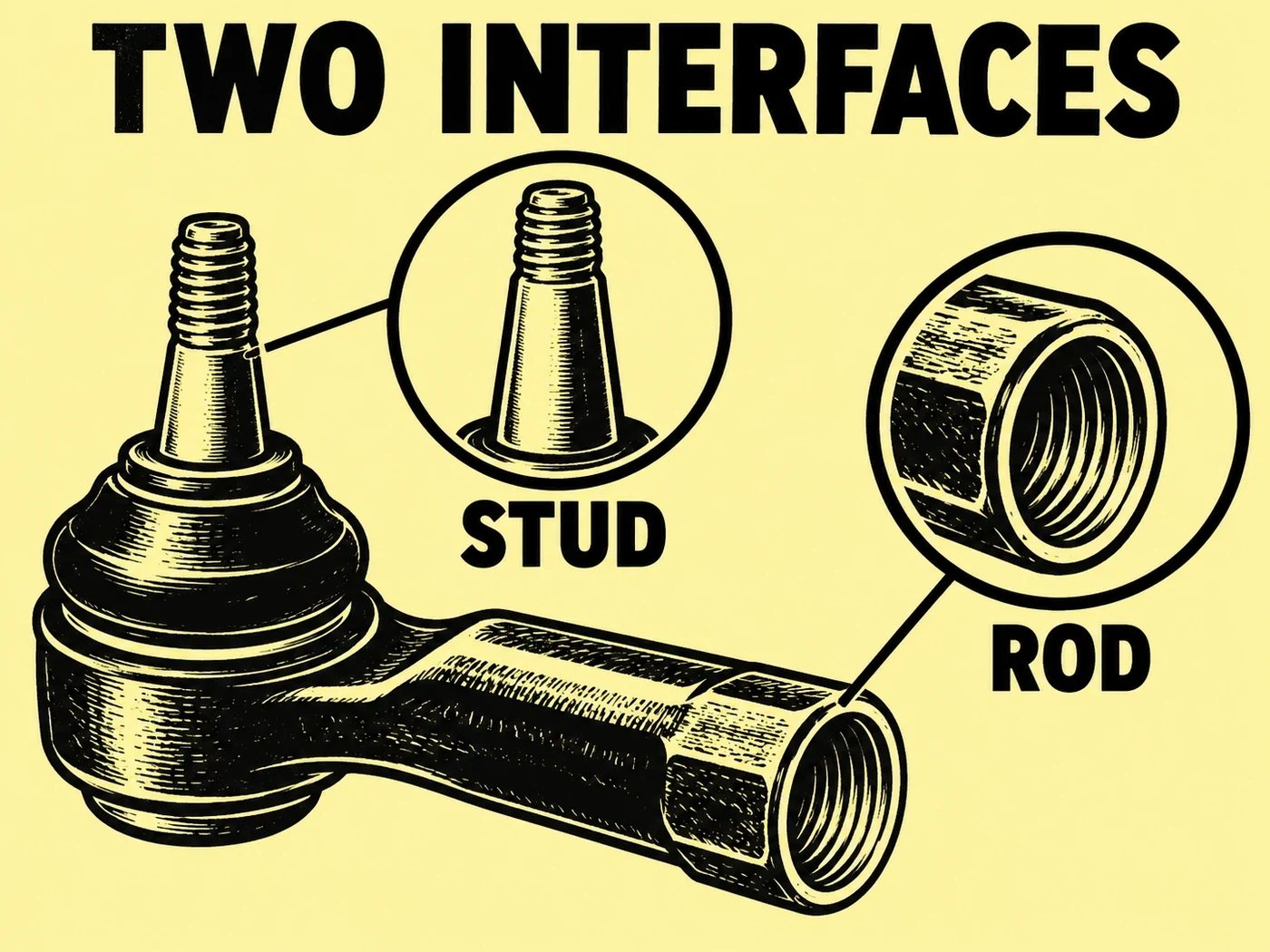
Separate the stud interface from the rod interface
An outer end may present a tapered stud at one interface and a threaded connection to the rod or adjuster at another. Describe each independently. A quotation saying only “thread size” leaves the buyer unsure whether it refers to the stud's fastening thread or the rod connection. Request a drawing with clearly identified features.
For the stud, keep the taper geometry, associated thread and applicable hardware linked to the mating reference. For the rod connection, record whether it is internal or external, the complete thread designation and any documented engagement or adjustment requirements. This comparison sheet is a procurement record; it does not supply those requirements for an unknown part.
Label photographs and sample notes consistently. An oblique image may help identify a feature but should not substitute for a drawing that defines its dimensions. Where a supplier provides only a basic catalogue entry, state which interface remains unconfirmed and request the missing detail before treating the candidate as an approved substitute.
Check the taper against the intended mating reference
MOOG's stud-taper guidance identifies outer tie rod ends among components using tapered studs and calls for checking the stud and receiving taper for wear or damage. It also directs repair work to vehicle procedures. This supports reviewing the complete mating interface; it does not provide a MAKEXCAR taper dimension or a universal installation torque.
Request the supplier's applicable taper detail and identify the reference used for comparison. Depending on the drawing, this may include diameters at defined locations, a length or a stated taper specification. Keep the measurement locations visible. Two diameters without their positions do not give the same information as a controlled geometric definition.
If a workshop reports an apparent fit problem, request the exact part and mating-component identities, observations and photographs. Keep selection and condition questions separate: a damaged receiving component is not the same issue as a wrong new reference. The technical reviewer should evaluate the actual case rather than forcing a conclusion from a catalogue silhouette.
Read the complete thread designation
Record nominal diameter, pitch or threads-per-inch as applicable, thread form or standard when documented, internal/external type and direction. Keep these fields tied to the correct interface. A shared diameter does not resolve missing pitch information, and a short product title may omit important details that appear in a drawing.
Copy the designation exactly from its source and retain the document revision. If one record uses metric information and another uses an inch-based designation, request a technical clarification rather than rounding them into apparent agreement. Do not create a thread equivalence from approximate measurements or a photograph.
For samples, ask the supplier or qualified reviewer to document the method used to confirm the thread. Retain the actual observation and equipment information appropriate to that assessment. This guide does not prescribe a gauge class, tolerance or test setup. A visual resemblance is a useful reason to investigate, not a recorded verification of thread conformity.
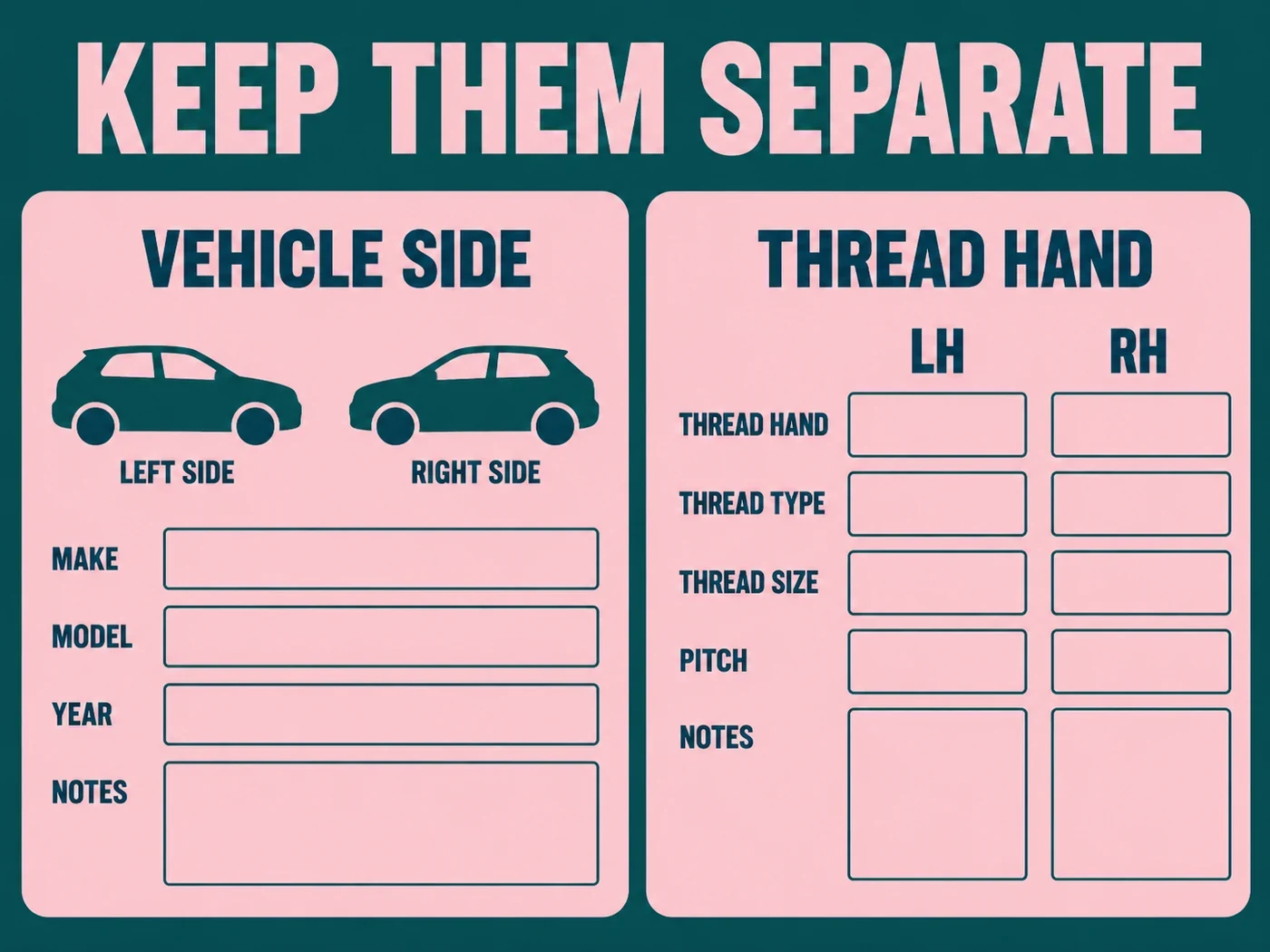
Keep thread hand separate from vehicle side
Left-hand and right-hand thread describe thread direction. Left-side and right-side application describe installation position on the vehicle. Give them separate fields in the comparison sheet. A catalogue's left/right position label should not be automatically translated into LH/RH thread unless the technical record explicitly makes that connection.
Ask which interface the thread-hand notation applies to. A suffix in an aftermarket part number may be a catalogue convention rather than a complete technical designation. Retain the supplier's explanation for that code and confirm the actual drawing field. Do not generalize the meaning of one brand's suffix across all vendors.
Where both positions use one reference, request the applicable catalogue evidence. Where separate references exist, record the specific reason given for the distinction. The buyer's role is to preserve the reference-specific answer. It is not to create a universal rule that all left-side ends have one thread direction or that visually mirrored parts always form a pair.
Review body geometry and hardware scope
After the taper and threads are identified, compare relevant body shape, offset, length and orientation against the applicable reference. Ask the supplier to define the measurement boundaries used. A total length and a distance between functional centers are different fields; the quotation should say which it reports.
Keep boot and joint-body clearances as documented application questions. A similar external profile cannot show the full movement or surrounding clearance needed in a vehicle. If those matters are part of sample approval, agree the relevant drawing or qualified assessment and retain its limitations. Do not prescribe an unverified articulation angle.
MOOG's fitting-nut guidance describes reference variations associated with the mating knuckle material and supplied nut in its own range. For buyers, it is a reason to check the complete applicable hardware specification. It does not mean that all MAKEXCAR references include the same nut or use MOOG's design arrangement.
Request an itemized answer for nuts, locking items and other supplied accessories. Do not assume that a reused fastener or a generic replacement is suitable. The applicable component and vehicle service information governs installation hardware and procedures; the purchasing file should record the supplier's documented supply scope without replacing that information.
Use a comparison sheet with separate evidence fields
| Field | Evidence requested | Issue to resolve |
|---|---|---|
| Component identity | Outer end, SKU and OE reference | Is the offered item the intended component? |
| Application and position | Market, production period and catalogue position | Is the candidate assigned to this application? |
| Stud taper | Drawing definition and mating reference | Is the complete tapered interface identified? |
| Stud thread | Full designation and applicable hardware | Is fastening information distinct from rod data? |
| Rod thread | Diameter, pitch, type and direction | Are all connection fields documented? |
| Body geometry | Defined length, offset and orientation | Are comparable boundaries used? |
| Supplied accessories | Itemized scope for the exact SKU | What is included in the offer? |
Maintain one sheet for each reference and drawing revision. Point each confirmed field to a source, and mark unconfirmed fields clearly. This keeps a useful cross-reference search from turning into an unsupported interchangeability claim. It also gives the supplier a concise list of questions that can be answered with the relevant document or sample evidence.
Resolve discrepancies before sample approval
When a dimension or label conflicts, record both values and their sources. Ask whether the difference reflects a catalogue convention, application variant, revised design or incorrect candidate. Do not silently choose the more convenient value or edit the sheet until the comparison appears to match.
Identify the exact sample used for review, its markings and the drawings supplied with it. If a supplier changes the offered reference, update the relevant comparison rather than carrying over approval from another unit. Keep the change and reviewer decision dated, particularly when left/right application labels or thread direction were clarified.
Limit the sample decision to the checks performed. Dimensional and reference comparison does not establish durability, corrosion resistance or freedom from every installation issue. A performance claim requires its own applicable evidence. Likewise, a correct thread record does not resolve an unknown taper or a conflicting vehicle position.
Turn each discrepancy into a defined review question
The offer gives one thread designation without naming the interface
Return the record for an interface label before comparing it. Ask the supplier to mark whether the entry describes the stud fastening thread or the rod connection, then link that label to the drawing feature. Keeping a number in a generic “thread” column can hide a comparison between different interfaces even when the visible text agrees. This is a record-completeness decision; it does not require the buyer to manipulate the sample.
The two taper records use different dimension locations
Suppose two drawings both state a small and large diameter but locate them at different axial sections. Their values do not yet form an equivalent comparison. Obtain the defined locations, relevant length and revision, and let the technical reviewer compare the actual geometric definitions. The missing question is where each value applies, not which pair of numbers looks closest. No taper angle, diameter or permitted difference is supplied by this example.
If the drawing contains a controlled taper specification instead, preserve that definition and its source rather than substituting a photographic estimate. A complete reference definition can support a review that isolated measurements cannot. The buyer should record the reviewer's explanation and which source feature resolved the uncertainty.
The catalog suffix says left but the thread hand is blank
Ask for the supplier's explanation of the suffix and keep vehicle position separate from each threaded interface. If the suffix means a fitting position, enter it in that field; the thread-hand question remains open. If it identifies a different catalog convention, record that meaning with its source. The clarification should not be generalized to a second supplier's code or to every outer end in the category.
The reference appears correct but the hardware offer changes
Record the new itemized scope and request the applicable hardware documentation for the selected application. The MOOG source illustrates why a supplied nut can distinguish references in its range; it does not approve a substitute nut for this offer. Keep the changed quotation linked to the sample and review decision. An earlier reference check does not silently confirm a later hardware substitution.
Fill in the two-interface comparison handoff
Requested outer-end reference/OE source/application/market/position: ___; offered SKU/sample identity/drawing revision: ___.
Stud taper definition and mating reference: ___; diameter-location or controlled-definition source: ___; stud fastening thread designation and documented hardware: ___.
Rod connection interface/type: ___; complete diameter/pitch-or-TPI/form/direction record: ___; documented engagement requirement if applicable: ___; unresolved field: ___.
Vehicle-side assignment and source: ___; thread hand for each interface independently: ___; supplier suffix meaning/source: ___.
Body geometry definition/source views: ___; offered accessories: ___; conflicting source records: ___; reviewer finding and scope: ___; requested clarification: ___.
Send the exact interface questions with your inquiry
Review the published MAKEXCAR Steering Links category, then use the contact page to discuss the candidate reference. Send the vehicle application, OE number, seller SKU and comparison sheet. Request the taper detail, both thread designations, thread hand, installation position and included hardware so approval follows documented interfaces.