Build one vehicle record before asking for a cross-reference
Collect the make, model, generation, body style, market, model year and, where available, VIN or production date. Record front or rear axle and left or right side using a consistent vehicle-facing convention. If the vehicle has a suspension package code, electronic damping, air suspension or a special chassis variant, capture it from the vehicle record rather than guessing from trim appearance.
Vehicle year alone may be too broad. A production change can divide a catalogue application within one nominal model year. Bilstein's published camper shock catalogue extract shows Volkswagen Transporter applications split by front versus rear axle, production period, standard or off-road chassis, electronic control and PR numbers. This is a concrete manufacturer-specific example of why an application row has more than a model name. It does not identify a MAKEXCAR shock for that vehicle.
KYB's official description of its digital catalogue explains that vehicle selection or VIN input narrows recommended shock and strut part numbers. That supports using a vehicle record to reduce ambiguity; it does not mean a VIN by itself proves the construction or availability of a MAKEXCAR SKU. Ask the supplier to show the resolved application record and its revision.
When requesting a VIN lookup, record who performed it, the data source and the resulting equipment line rather than writing only “VIN checked.” Some catalogues return more than one possible damper until an option is selected. If the source provides a build-date cutoff, compare it with the actual production date rather than registration date. A buyer should be able to reconstruct how the vehicle record became a particular application row, especially when a disputed return is reviewed months later.
Separate front and rear before comparing sides
The first branch in a fitment matrix is the axle. Front and rear dampers can differ in length, mounting arrangement, protective parts and tuning. A catalogue that lists one vehicle line with multiple front and rear columns is not presenting every listed shock as an alternative for every corner. Copy the axle designation into the inquiry and onto the purchase order.
Then check sidedness. Some shock absorbers can use a common part on both sides; others are handed, particularly when a mounting bracket, hose tab or complete strut assembly is involved. Monroe's published shock-and-mount assembly page gives a specific rear-left and rear-right part-number pair. It illustrates a sided application, not a rule that all dampers are handed. Request explicit left/right applicability for the quoted MAKEXCAR part.
Do not infer handedness from a product photo mirrored by a catalogue layout. Ask for the exact SKU, side and part drawing. If the supplier proposes the same SKU for both sides, ask for the application evidence that supports that claim; if it proposes a pair, record the two numbers separately. A single line that says “rear shocks” can hide a one-side shortage in a distributor order.
Read the suspension code and equipment branch
Many vehicle programmes offer more than one suspension configuration. A standard chassis, sport package, off-road package, electronic damping or air system can lead to a different shock or complete module despite a shared engine and body shape. Match the code in the OE or manufacturer application record to the exact vehicle. Do not translate one brand's PR or option code into another vehicle programme.
The Bilstein extract uses PR-number filters and states whether an application has or lacks electronic suspension control. It also separates standard and off-road chassis for some rows. Those conditions are not decorative notes: they are filters attached to the part number. A buyer should ask the supplier to identify which option branch its proposed SKU covers and whether the offered item requires a controller connection or is a passive damper. Without a part-specific drawing or validated cross-reference, the code alone should not be treated as proof of interchangeability.
If the vehicle record lacks the option code, request an OE parts-catalogue lookup or documented VIN decode. A photo of the existing damper label can help, but the label may have been replaced in an earlier repair. Reconcile the current vehicle configuration, original equipment record and installed part history before approving a substitute.

Use the OE number as a traceable bridge
Capture the OE reference exactly, including suffix, spaces and supersession where the OE catalogue supplies one. A missing suffix can merge parts with different dates or equipment. If a supplier lists multiple OE numbers against one aftermarket SKU, ask whether those numbers are genuine supersessions, separate approved applications or broad marketing cross-references. The answer should be tied to a controlled catalogue or fitment report.
Keep the chain visible: vehicle record → OE part or approved successor → supplier cross-reference → exact MAKEXCAR SKU → sample or shipment lot. The last link matters. A product family title can contain several references without proving that every reference maps to every variant inside the family. Ask for the offered SKU and its drawing rather than copying a group heading into the order.
Where OE and supplier catalogues disagree, do not choose the most convenient number. Put the two rows side by side, including axle, side, date and option code, then ask for a corrected application statement. If a physical sample is available, compare its mounting features and envelope, but use that as a second check. A visual match cannot repair an unresolved option-code mismatch.
Check the proposed shock's physical form
After the application row is consistent, review the part drawing or a controlled sample. Compare upper and lower mounting form, body envelope, extended and compressed dimensions if supplied, brackets and electrical connector where present. The purpose is to catch a mismatch between a catalogue record and the item packed. It is not a universal rule to replace a shock solely because two loose units look similar.
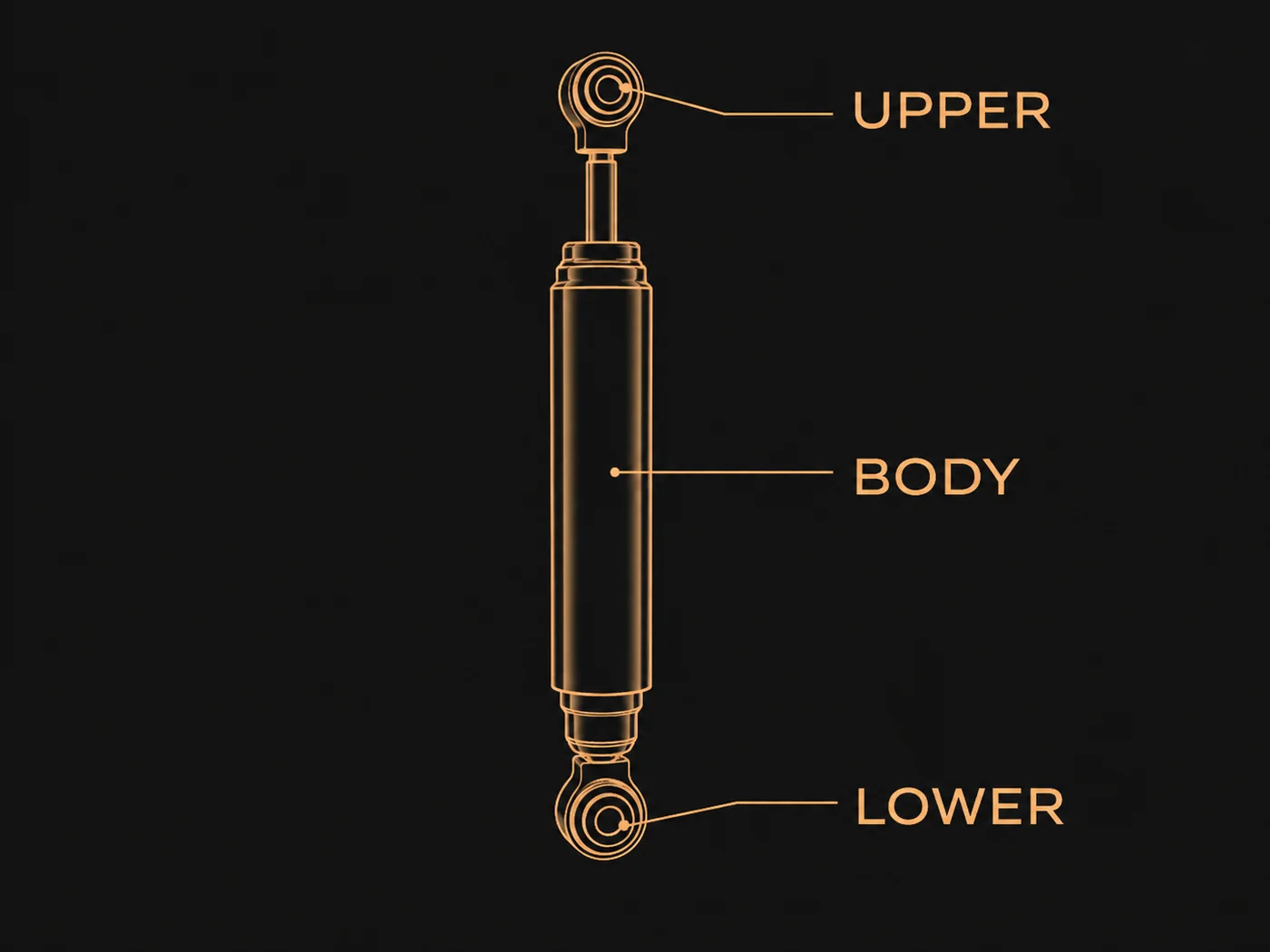
BODY-02 marks UPPER, BODY and LOWER on a generic outline. It is a concept illustration with no dimensional or damping specification. For an actual application, require the supplier's part-specific drawing and compare it with the OE record or an approved sample. If the supplier quotes a complete strut, ask whether spring, top mount, bump stop and ancillary hardware are included; that supply question is different from the damper's OE fit.
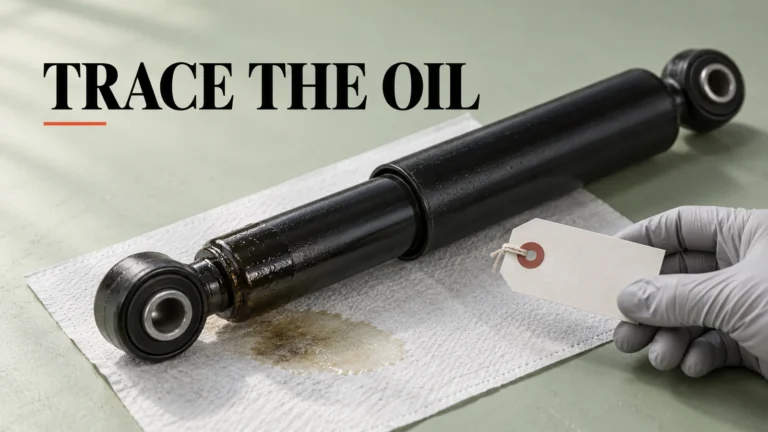
A difference in paint colour, label placement or dust-cover shape is not automatically a fit failure, and matching those features is not automatically a pass. Focus on controlled interfaces and the application record. When a return is reported, collect the actual vehicle, old and new labels, installation corner and photographs before blaming the catalogue or the part.
Make the quotation and sample record auditable
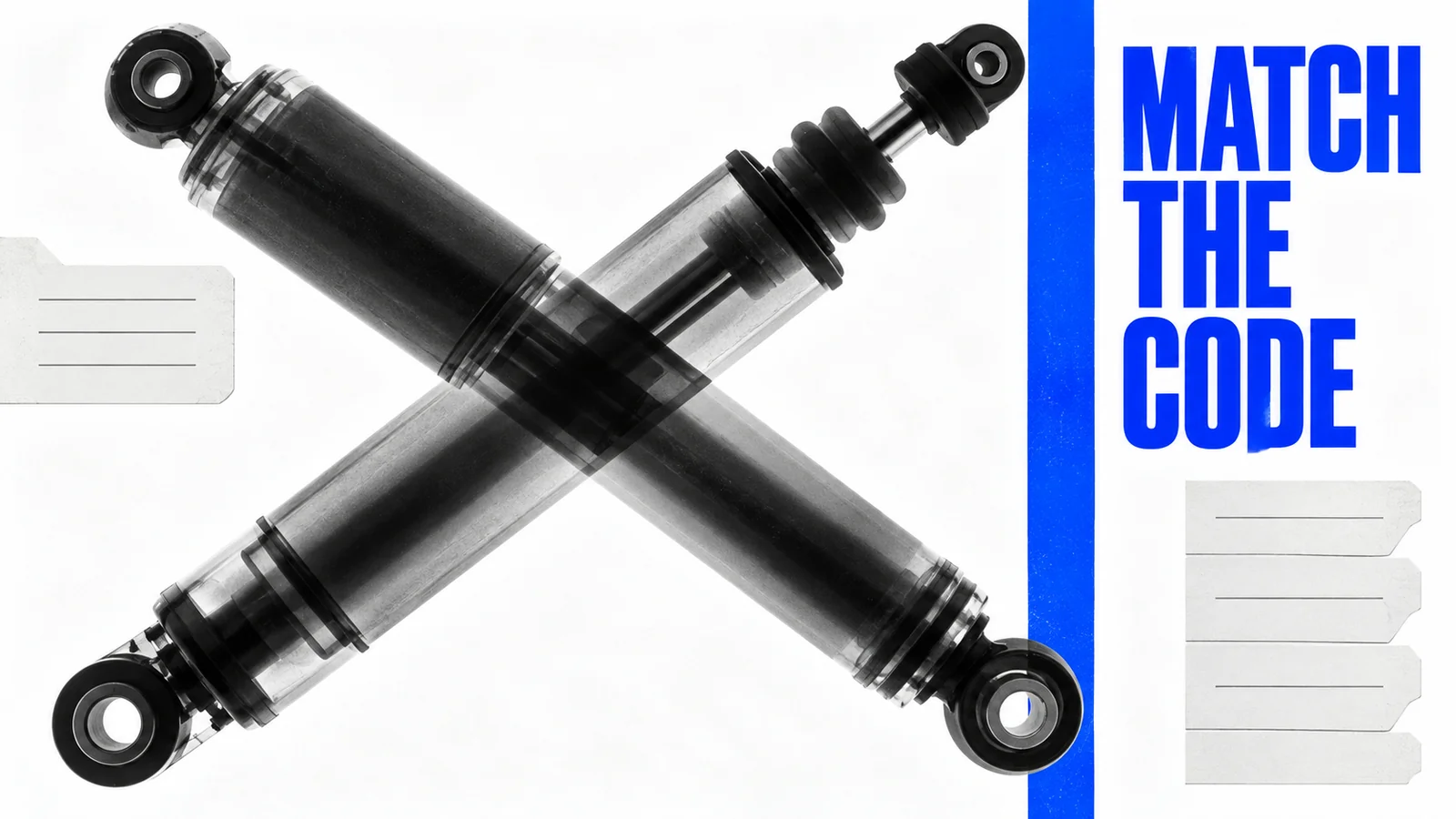
Use one row per proposed SKU and intended corner. If one vehicle needs a different left and right part, create two rows. BODY-01's blank VEHICLE, AXLE, SIDE and CODE cards model the four fields that must accompany the OE reference. They contain no real fitment data or approval.
| Question | Record to retain | Common gap |
|---|---|---|
| Which vehicle? | Model, production range, market, VIN or validated application | Only a broad model-year label |
| Which corner? | Front/rear axle and left/right applicability | “Shock absorber” without position |
| Which suspension? | Option or PR code, electronic or air-system status | Engine and trim used as a substitute |
| Which part? | OE number, supersession, supplier SKU and drawing revision | Family-level cross-reference with no exact SKU |
Attach the source date and catalogue revision to the record. A vehicle may have been built near a production split; a supplier catalogue can also be revised after a correction. If a sample is approved, retain its label, batch and drawing version. This lets purchasing compare the production delivery with the actually reviewed unit, rather than with an undated screenshot.
For a distributor order, request the quantity by axle and side, not just a total number of shocks. If two applications share one warehouse bin label, confirm the SKU printed on each inner box. The paperwork should make a wrong-corner shipment visible before the part reaches a workshop.
Before releasing an order, have the supplier state whether the OE cross-reference was checked against the latest catalogue and whether any listed alternatives require a different mount or electronic connection. Record the response with the quote. If the part arrives with an unexpected upper or lower attachment, quarantine that lot for clarification rather than allowing a workshop to discover the discrepancy during installation.
Buyer questions
Does a matching OE number guarantee the shock fits?
It is strong evidence when the source is current and the suffix, supersession and application context match. Still confirm the vehicle, axle, side and suspension branch, then check that the shipped supplier SKU maps to the same record. An isolated OE number copied into a listing is not the entire fitment proof.
Can the same shock be ordered for left and right?
Sometimes, but do not assume it. Look for explicit side applicability in the manufacturer or supplier catalogue. Brackets and complete assemblies can create handed versions; other designs use one common unit. Record the conclusion for the exact SKU.
What if the suspension code is unavailable?
Keep the match open and request a vehicle-specific OE lookup, validated VIN decode or other authoritative equipment record. An old part label and photos may support the investigation, but they should not silently replace the missing application evidence.
Next step: send a corner-specific inquiry
Review the current MAKEXCAR shock-absorber category, then send a sourcing inquiry with vehicle, year or build date, market, axle, side, suspension code, OE reference, existing part label and required quantity. Request the exact proposed SKU, application row, drawing revision and sample approval route. Order only after those records describe the same corner and suspension configuration.