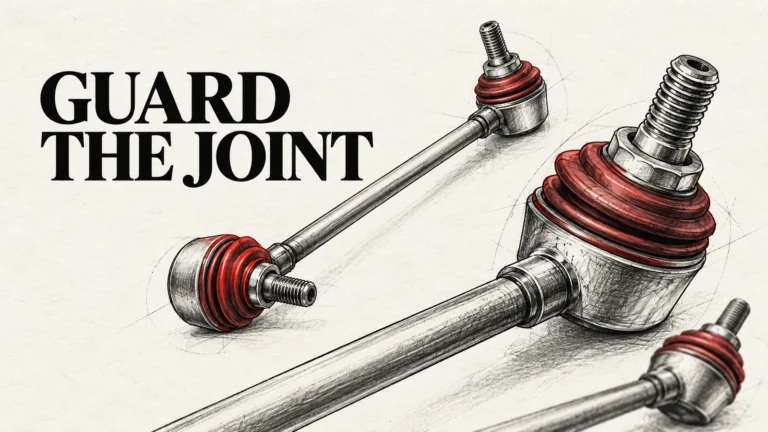
This guide is a purchasing checklist for sample evidence. It is not an on-vehicle diagnosis, an installation procedure or a universal joint-test method. No MAKEXCAR sample has been measured here, and no movement angle, force or play threshold is supplied. Any numerical acceptance requirement must come from the relevant design document or approved specification.
Identify the link and both joint locations
Request the supplier reference, sample identifier and drawing revision. Confirm the intended application and position through the actual product records. If two ends have different features or labels, ask the supplier to identify them clearly. A general photograph of the link may establish the overall appearance while leaving a close-up result associated with the wrong end.
Use a simple location convention in the evidence register, preferably the convention used on the supplier’s drawing. Ask the supplier to keep that identification consistent across photographs and reports. Do not define left or right from an unlabelled camera view when the actual application record uses a different convention. Location clarity makes later follow-up questions more specific.
Keep the sample condition visible in the register. Record whether the evidence concerns the received sample, a stated test specimen or another identified reference. A photograph taken before a test and a result reported afterward should retain their relationship. Do not combine unrelated sample files merely because they share the same product-family description.
Request complete boot photographs
Ask for clear photographs covering the relevant boot surfaces and attachment areas for each joint. Request additional views where a single angle hides an area. The purpose is to document the supplied condition, not to infer a material specification from color or texture. The actual component drawing should identify any features your reviewer needs to examine.
Record visible issues as observations with a location and image reference. If a tear, opening, unusual fold or displaced attachment is reported, ask the supplier for a clearer view and its explanation. A blurred photograph or strong reflection can be ambiguous, so the review should distinguish what is visible from what remains uncertain.
Do not modify the sample simply to make a photograph look complete. If handling or a technical procedure is needed to obtain the evidence, the responsible technician should determine it from the actual method. This article does not instruct the buyer to remove a boot, open a joint or move it beyond a specified range.
Use a manufacturer example carefully
MOOG’s official discussion of its link-stabilizer upper ring describes the ring’s role in retaining a seal around the ball pin against contaminants. That is a useful example of why the boot attachment area deserves identified evidence. It is not proof that every offered link uses MOOG’s design or material. See MOOG’s upper-ring and closing-cap explanation.
Request the actual feature specification for the offered reference. If the supplier claims a particular retention design or material, ask for its source document. Keep that claim separate from the observed condition in a photograph. A visible ring does not establish a corrosion result, sealing performance or a specified material by itself.

Ask for the basis of joint-movement evidence
Request the joint location, applicable method, specimen condition and result for any movement assessment offered by the supplier. Ask how the result relates to the requirement on the identified document. The reviewer needs the actual basis before interpreting a phrase such as “smooth movement” or “no looseness.” Those words do not define a numerical acceptance value.
If the evidence is a video, ask the supplier to identify the sample and explain the recorded arrangement. The video may help show the reported observation, but it should remain tied to the method and any associated result record. Do not estimate a motion angle or a test force from the camera view and enter it as a measured value.
Distinguish movement capability from a play measurement or another test result. A supplier may provide more than one assessment, but each should retain its method, units where relevant and acceptance basis. This guide does not treat those different questions as interchangeable. Ask the reviewer which evidence is required for the actual sample acceptance.
Keep test results separate from hand impressions
A person handling the sample may describe how a joint feels. Retain that observation with its source if it is useful, but do not convert it into a pass result without the relevant method and requirement. Two informal descriptions can differ without explaining whether either person assessed the same condition in the same way.
Ask for a traceable report when a supplier claims that a movement, play, strength or another requirement has been passed. The report should identify the sample, method, relevant result and requirement source. Your reviewer should decide which information is necessary; this article does not invent a mandatory test list for every stabilizer-link design.
If a report contains results for a related reference, ask whether it supports the offered part and on what basis. The supplier’s explanation should remain attached to the report. A product-family relationship is not, by itself, evidence that every joint feature or result transfers to the sample under review.
Build the sample review register
Use the following fields to organize the supplier inquiry. Populate them with actual documents and image references, and keep unresolved entries visible. The worksheet does not contain permissible movement or play limits and should not be presented as a completed inspection report.
| Field | Evidence request | Review question |
|---|---|---|
| Identity | Reference, sample ID and revision | Does the evidence describe this sample? |
| Location | Joint labels tied to a drawing | Can each observation be located? |
| Boot | Complete views and received condition | What is visible and what remains unclear? |
| Attachment | Actual feature specification and views | Is the claimed design documented? |
| Movement | Method, condition and result record | What does the evidence actually assess? |
| Test | Report and acceptance requirement source | Is a pass claim traceable? |
| Decision | Reviewer, conclusion and open questions | Which points are accepted or pending? |
Keep commercial sample receipt separate from technical acceptance. You may confirm that the correct quantity arrived while a report question remains open. Similarly, a technical reviewer may accept one recorded feature while requesting clarification on another. Separate status entries let purchasing follow up on the specific unresolved item.
Compare before and after records when relevant
If a supplier reports a test involving the boot or joint, ask how the before-and-after records relate to that test specimen. Retain the original condition, reported procedure reference and later observations together. The responsible reviewer should determine whether those records address the stated requirement, rather than infer a durability conclusion from two attractive images.
Do not add an exposure duration, cycle count or environmental condition that the supplier has not documented. A report may use a specific method that needs its own interpretation. Record the method as supplied and ask for clarification where necessary. This keeps the evidence objective without creating an unsupported testing claim in the purchasing file.
Review sample changes explicitly
When a supplier offers a revised boot, attachment feature or joint, request the changed reference or revision and an explanation of the difference. Ask which earlier evidence it considers applicable. The responsible reviewer should decide whether that basis is sufficient. An unchanged overall link appearance does not settle every internal or attachment change.
Retain the earlier sample record and the revised files. A short change note should identify the affected review fields and the resulting conclusion. Where a change is administrative, the reviewer may retain previous evidence; where a feature changes, further evidence may be needed. Do not carry acceptance forward automatically.
Common sample-inspection questions
Does an intact-looking boot prove sealing performance?
It documents an observed condition, not a performance result by itself. Request the actual design and test evidence when sealing performance is part of the requirement.
Can joint tightness be accepted by feel?
Keep the hand impression separate from a documented acceptance result. Request the method and requirement used for the actual design before recording a pass conclusion.
Should both ends be photographed?
Request the views needed to cover each relevant joint and attachment area in the offered design. Identify the locations so a hidden or unclear area can be followed up directly.
What if the supplier supplies only a family test report?
Ask how it relates to the offered reference and retain that explanation. The responsible reviewer should determine whether it supports the sample or whether further evidence is needed.
Send a focused sample-evidence inquiry
Browse MAKEXCAR’s current Stabilizer Links references and identify the actual part you need. Category membership alone does not confirm joint design, application or acceptance requirements.
Send the reference, application, quantity and joint-specific questions through the MAKEXCAR contact page. Request complete boot photographs, attachment-feature documentation and the applicable movement or test records. That gives the supplier a clear inquiry and gives your reviewer traceable evidence for the next decision.