
Start with the assembly boundary
Decide whether the enquiry concerns a separate tie rod end, an adjusting component or a complete assembly. This determines which connection the supplier is describing and which other components need identification. The MAKEXCAR Steering Links category provides an enquiry starting point; its product listings do not replace the drawings and requirements for the proposed combination.
Record what is included in each offer before comparing dimensions. If one offer includes the mating parts and another concerns an individual end, a shared length label can conceal different supply scopes. List supplied components and any separate locking items explicitly. Treat an accessory shown in a photograph as an identification clue until the quotation identifies it as included.
For a retained vehicle-side component, record its reference and the intended application. A drawing for a complete replacement assembly may not answer a question about a replacement end paired with a retained component. The useful review asks which exact connection is proposed, rather than whether both offers contain something described as a tie rod.
Give every quoted length a definition
Separate overall component length, assembled length and usable adjustment range into distinct fields. Each needs its measurement reference points. Overall length is not automatically the distance between joint centers, and a nominal assembly dimension is not an endpoint approval. Matching numbers are meaningful only after the buyer knows what those numbers describe.
A drawing callout or marked reference view is more useful than a photograph with an unexplained ruler. It can show which features define the dimension and the configuration to which it applies. Where an offer uses a different reference, leave its value in its original column until the responsible reviewer establishes whether it can be compared with the required dimension.
Keep units, document revision and variant together with the value. A revised drawing can change the meaning of a field even if a catalog title is unchanged. For an order containing several variants, identify the relevant drawing for each line rather than copying the first supplier response across the entire purchasing sheet.
Identify the threaded connection before discussing engagement
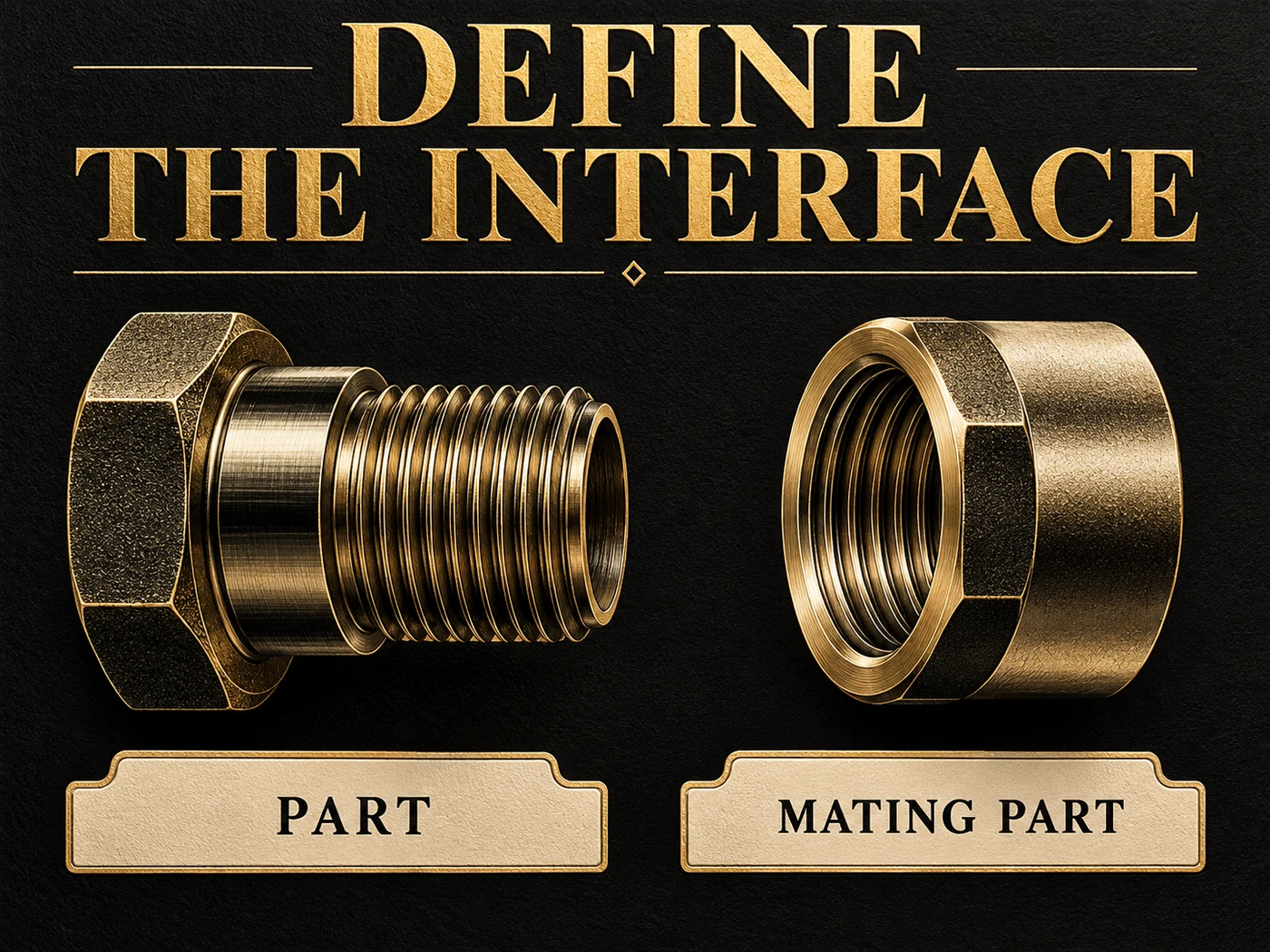
The adjustment interface involves two identified mating parts. Its thread description belongs to that interface, not automatically to the joint stud or another mounting connection. Record the specified thread form, nominal diameter, pitch and handedness with the relevant part references. An isolated diameter cannot describe the full proposed connection.
The information supports an identity check; it does not independently establish interchangeability or strength. A thread description that appears to match is one piece of the review, while the applicable engagement and assembly requirements remain separate evidence. The same distinction applies when a component looks similar to a previously purchased part.
Describe engagement using the governing document's definition. Visible external thread does not reveal all the internal mating geometry. Total threaded length also need not be the usable engagement quantity defined for the design. Where a drawing includes chamfers, incomplete threads or internal features, the responsible reviewer interprets them from that drawing rather than subtracting a generic allowance.
Use a field, reason and response worksheet
The worksheet below separates missing information from an actual product mismatch. A buyer can copy it into a quotation review and attach the supplier's document reference to each resolved field. The response column specifies the next task, avoiding a page of generic requests to confirm suitability.
| Required field | Reason for the field | Response to a gap |
|---|---|---|
| Component set and supply boundary | Defines whether the range belongs to the quoted assembly | Separate individual-end and complete-assembly offers |
| Length reference points and units | Makes the quoted dimension interpretable | Obtain the marked dimension before ranking lengths |
| Both mating references and interface designation | Connects the requirement to the actual threaded pair | Keep an unidentified mating component as an open applicability issue |
| Engagement definition and applicable requirement | States how the connection's permitted condition is established | Do not replace missing requirements with visible thread counts |
| Shortest and longest usable configurations | Defines the endpoint scope rather than mechanical travel alone | Request the supporting drawing or instructions for both endpoints |
| Application and document revision | Identifies which vehicle and configuration the evidence addresses | Resolve scope or revision differences before order approval |
Use an explicit status for each row, such as “defined,” “scope mismatch” or “document outstanding.” A missing engagement requirement is a documentation gap; it is not evidence that a part has failed a specified requirement. Conversely, a reassuring catalog description does not close that gap. The comparison should preserve what is known and what still prevents a decision.
Read the endpoints with their conditions
The longest quoted configuration needs the engagement evidence that applies at that endpoint. A physically reachable extension is not itself an approved usable position. The shortest configuration also belongs to the documented range and any accompanying assembly or clearance conditions. Do not assume that shortening a connection resolves every constraint.
Record whether the endpoints are nominal catalog dimensions, measured sample positions or permitted configurations under an applicable document. Those labels answer different questions. A measured sample can show an observation without establishing an approved range, while a nominal dimension may identify a product without specifying both adjustment limits.
If the design uses a limit marking, obtain the marking's documented meaning and the corresponding item identity. A groove, paint mark or surface transition cannot automatically be treated as an engagement indicator. A labeled photograph of the supplied configuration can support comparison with the drawing; it should not create a limit that the governing documentation does not state.

Make numerical examples answer the comparison question
Consider a hypothetical quotation stating an assembled range of 300–320 mm between identified joint centers. A second hypothetical quotation also states 300–320 mm but describes overall end-to-end length. The identical numerical intervals do not make the offers equivalent because the reference points differ. These invented dimensions are not MAKEXCAR specifications or recommended adjustment settings.
The appropriate purchasing response is to obtain the required dimension definition for the second offer. Calculating the interval width would add no evidence about engagement or applicability. Once the dimensions are defined consistently, the buyer still needs the permitted endpoint conditions for the proposed mating pair. The worksheet keeps those two questions separate.
For another illustrative situation, suppose two offers share the same dimension definition, but one range is supported by the proposed assembly's drawing and the other is only a catalog statement. That is an evidence difference rather than proof that the second product is defective. Keep the unsupported endpoint question open and request its basis before presenting the offers as technically equivalent.
Use manufacturer instructions within their actual scope
MOOG Bulletin 25522 identifies its ES3088S adjusting stud and specified GM applications, and includes an engagement instruction for that arrangement. The document illustrates why an instruction must retain its product and application identity. It is not an engagement requirement for the MAKEXCAR products discussed here.
In the quotation file, place the applicable instructions beside the component references they govern. When research finds an instruction for a similar-looking part, record it as context rather than copying its requirement into the proposed item row. A supplier's explicit link between its component set and governing document is the evidence needed to close that applicability question.
Keep fitment and alignment decisions distinct
A range overlapping the buyer's desired dimension does not establish vehicle suitability. The proposed interfaces, application and other relevant requirements still need the appropriate evidence. Length is one field in that review, not a substitute for the complete application definition.
Similarly, this purchasing worksheet does not establish an alignment setting or installation procedure. Those tasks use the applicable vehicle and product instructions and qualified review. The purchasing enquiry can provide vehicle details and documents so the correct evidence can be identified without turning a hypothetical blog dimension into an adjustment instruction.
Prepare a request that closes the remaining gaps
Send the following entries through the MAKEXCAR contact page with the available drawing or reference view. Enter unknown items as unresolved rather than inventing a dimension or selecting a limit from another product. The response should identify which document answers each open field.
| Enquiry entry | Fillable information |
|---|---|
| Requested supply and quantity | [Individual component or assembly; included parts; quantity] |
| Application and proposed mating components | [Vehicle details and both part references] |
| Required dimension | [Reference points, unit and attached drawing] |
| Missing endpoint evidence | [Usable limits, engagement definition and governing document] |
| Comparison issue and reviewer | [Exact unresolved field and person responsible for applicability] |
Before converting the quotation into an order, retain the agreed component set, dimension definition and supporting document revision together. If a component or drawing changes, identify the affected worksheet rows and reopen those questions. That record lets both parties review the same proposed supply instead of relying on an undefined claim that a part is adjustable.