This guide explains how to turn a broad material claim into a usable purchasing record. Start with the actual control arm reference and identify which component the statement describes. Then check the catalog qualifiers and request evidence for any additional performance claim. Keep the quotation tied to that reference throughout the comparison.
Identify the scope of the material statement
A quotation may use one material name to describe the arm body while the supplied item is an assembly. Ask whether the statement applies to the body, a joint housing, a sleeve or another identified component. Record the supplier's answer in those terms instead of copying a family-level phrase into every field of the product listing.
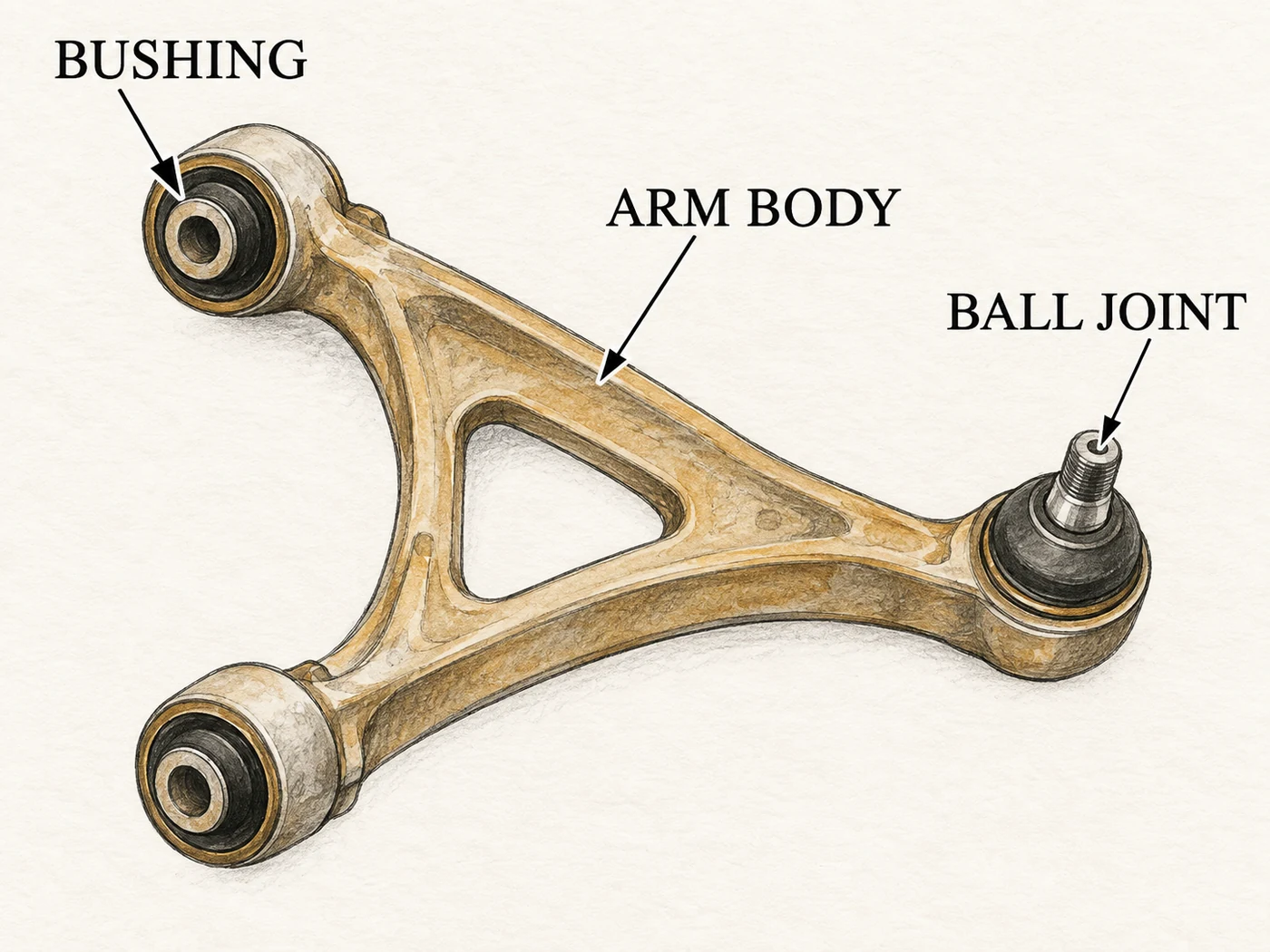
Also establish what is supplied. An arm body, an arm with bushings and a control arm with a ball joint are different offer scopes. Ask for an itemized description and an actual reference photograph or drawing. Do not use an illustrative product-family image as proof of the contents of a particular carton.
This first step prevents a common document error: treating a material description of the principal component as a declaration for the entire assembly. It also gives the buyer a clear place to attach later statements about coatings, joints and included hardware.
Read the manufacturing description separately
Material and manufacturing descriptions answer different questions. A supplier may use terms such as stamped, cast or forged alongside a material name. Preserve both pieces of information as declared, and ask the supplier to clarify an incomplete or inconsistent phrase. Do not fill a missing manufacturing description from the surface appearance of a photograph.
MOOG's control arm overview describes several material and manufacturing combinations within its own application-dependent range. This is an example of why the two descriptions should be read together. It is not evidence that a MAKEXCAR reference uses any particular combination, grade or treatment.
Where a grade, heat treatment or other detailed designation matters to the agreed purchase specification, request a reference-specific declaration and the document revision. A broad name on a sales page should not be expanded into an exact designation in the buyer's catalog without that support.
Let the application qualifiers govern replacement selection
Confirm the vehicle application, position and relevant catalog qualifiers before comparing materials. Ask the supplier to identify the applicable cross-reference and any exclusions. Keep upper or lower position, left or right designation and other selection conditions attached to the actual part number rather than relying on a model-family heading alone.
In its specific GM control arm and ball joint selection bulletin, MOOG presents qualifiers involving arm and steering-knuckle configurations. The example demonstrates that catalog conditions can involve more than an isolated material name. Its particular applications and replacement combinations cannot be generalized to every vehicle or another supplier's part.
Do not decide that an aluminum offer can replace a steel original, or the reverse, because the advertised dimensions look similar. Request an explicit application-supported replacement statement for the offered reference. If that statement is unavailable, keep the proposed substitution unresolved rather than recording it as approved.
Separate material identity from performance promises
Claims such as stronger, lighter, longer-lasting or corrosion-resistant need their own support. Ask what was compared, which product references were involved and what method or report supports the wording. A material declaration establishes what was declared; it does not automatically substantiate every performance phrase placed next to it.
For a claimed weight difference, request actual product weights with a consistent assembly scope. Comparing a bare body with an assembly that includes joints or hardware does not create a useful quotation comparison. Record whether packaging is included and which product revision the figure describes.
For a strength or durability claim, ask for the applicable report and its conditions rather than inventing a test threshold. Preserve the comparator and the scope of the conclusion. If the supplier only provides a general promotional statement, keep it identified as such and avoid converting it into a numerical purchasing requirement.
Compare two offers field by field
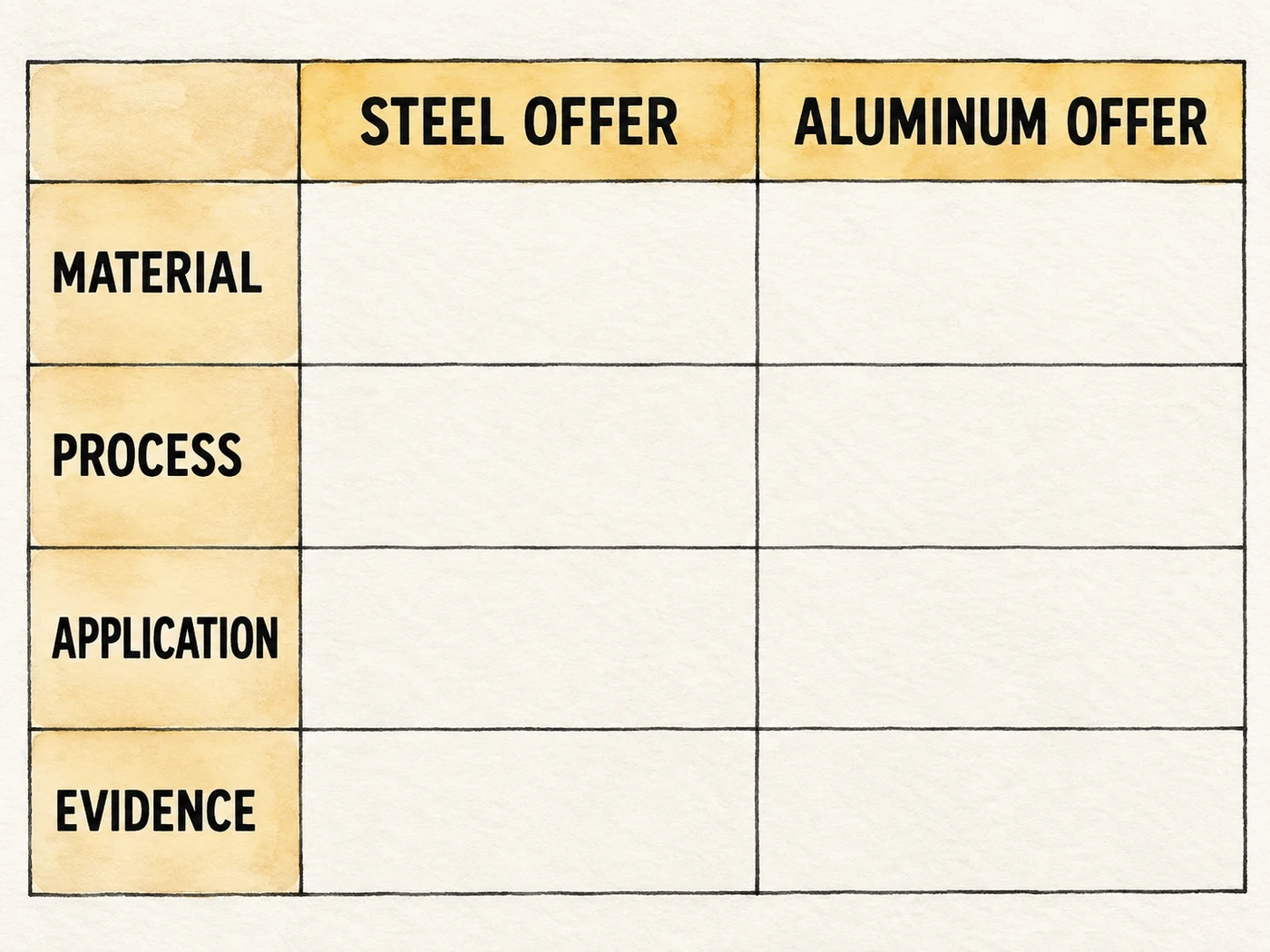
The following worksheet organizes a quotation review. It is not a material test standard or a replacement authorization. Fill the two offer columns using the actual supplier documents; blanks should remain explicit questions until the relevant party answers them.
| Review field | Steel offer | Aluminum offer |
|---|---|---|
| Actual reference | Record offered part number | Record offered part number |
| Declared component | Identify scope of material claim | Identify scope of material claim |
| Manufacturing description | Copy reference-specific declaration | Copy reference-specific declaration |
| Application conditions | List qualifiers and exclusions | List qualifiers and exclusions |
| Assembly contents | List included joints and hardware | List included joints and hardware |
| Claim support | Link applicable report or state missing | Link applicable report or state missing |
| Revision | Record document and sample version | Record document and sample version |
Use the completed worksheet to identify what can be compared and what still needs clarification. A cheaper quote with an unresolved assembly scope is not yet equivalent to a fully specified offer. Similarly, a detailed material statement does not remove an unresolved application qualifier.
Keep coating information in its own record
If a quotation includes a finish or coating claim, ask which surfaces and components it covers. Record the supplier's declared process separately from the base-material field. A dark or bright appearance in a product image should not become a coating designation in the purchase specification.
If corrosion performance is part of the buying decision, request the reference-specific evidence and any stated test conditions or acceptance basis. Do not create an exposure duration, rating or result that the document does not provide. Ask how the tested configuration relates to the offered production reference when that connection is unclear.
The buyer's catalog wording should remain within the approved document scope. A claim about an accessory or a tested sample should not silently become a claim about the complete arm assembly or every item in the supplier's range.
Use samples to check identity and offer scope
A sample review can confirm whether the piece, markings, visible interfaces and included items match the offer documents. Ask the supplier for the appropriate reference drawing or dimensional record if a measurement check is required. Record the sample identifier and the document revision before recording observations.
A visual check cannot establish a complete material grade, internal treatment or fatigue result. Keep those questions connected to the applicable declarations and reports. If an observation conflicts with a document, preserve photographs and request clarification rather than changing the declared specification to match an assumption.
Ask how the approved sample is linked to production supply. Save the resulting agreement with the quotation and keep later revisions visible. Approval of a sample's appearance or packing should be recorded in that scope; it should not become a broad approval of unexamined performance claims.
A practical example of an incomplete comparison
Consider two hypothetical quotations for a stated application. One says “steel arm, complete assembly,” while the other says “aluminum arm” with no contents list. Before choosing between them, the buyer needs the actual references, catalog conditions and supplied components. The two material names do not resolve whether the quotes cover equivalent order lines.
If the second supplier then supplies an assembly list and application confirmation, those documents make the offer easier to review. They still do not establish that one material is stronger or lasts longer. Any such claim remains a separate evidence question with its own comparator and report.
This example is a document-review scenario, not an actual MAKEXCAR product comparison. It illustrates how to make a decision record more complete without recommending a material substitution or creating unsupported performance rankings.
Write a clarification request that the supplier can answer
For each unanswered field, identify the offer reference, quote revision and exact question. Ask separately for a component-scope clarification, an application confirmation and any missing performance support. This lets the supplier route each question to the person who can provide the appropriate document.
When a reply arrives, attach it to the corresponding field and note whether it answers the question fully or leaves an exception. A general brochure may provide useful context while still leaving a reference-specific question open. Keep the proposed catalog wording beside the source so that the reviewer can check what the document actually supports.
Frequently asked questions
Is an aluminum control arm always a better choice?
No material name establishes a universal purchasing preference. Compare the application-supported references, supplied scope and documented claims relevant to the order.
Can a product photograph prove a manufacturing process?
Use it to identify the offered item and visible features. Ask for the supplier's reference-specific process declaration rather than inferring an exact process or grade from appearance.
Should both offers have the same included hardware?
Record what each offer includes and decide the required scope for your order. Do not assume that a family heading such as complete assembly defines every accessory.
What if the material statement and catalog qualifier differ?
Request a corrected or clarified reference-specific document before approving the listing or substitution. Keep the unresolved difference visible in the quotation record.
Request a documented control arm quotation
Browse the current MAKEXCAR control arms category, then send an inquiry with the application, position, existing reference and required assembly scope. Ask for the declared material and manufacturing description, catalog qualifiers and evidence for any performance wording you intend to use. Confirm the actual offer before preparing your purchasing specification or product listing.