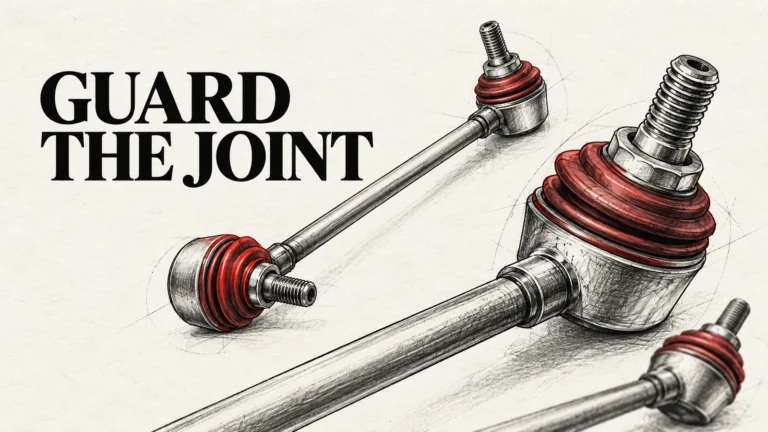
A good catalog keeps one reference-linked product record and preserves the relevant alternate name. This guide explains how to connect buyer language with verified product fields, reduce duplicate entries and answer inquiries consistently. It does not establish that every stabilizer link has the same construction, dimensions or vehicle application.
Recognize the two names in manufacturer usage
The official MOOG sway-bar-link page uses both sway bar links and stabilizer links in its page title. The official ZF stabilizer-link page describes the component connecting a stabilizer to specified chassis components. These sources support the naming context; they do not provide a cross-reference for a particular MAKEXCAR item.
Use that context to understand an inquiry without forcing the customer to learn your internal category label. If the buyer requests a sway bar link while your category is called stabilizer links, continue with reference identification. Ask for the part number, application and relevant position rather than treating the wording as a different product request.
Keep other nearby names separate. A stabilizer bar, a steering stabilizer, a tie rod and a complete assembly should not automatically be merged into a link record. If an inquiry uses only a broad word such as stabilizer, ask which component the customer means before confirming the family.
Keep the alias separate from the SKU
A product name describes a family or item. A SKU identifies the quoted sale record. Record both clearly. Two names for the same family do not establish that two SKU numbers represent the same physical product, and one familiar name does not establish a universal fit.
For the same verified item, retain one main record and store the alternate wording in an alias or description field. Preserve the original supplier term where it helps trace the source. This lets sales staff recognize customer language without creating a second stock position that competes with the first in purchasing and receiving.
If two records already exist, compare the underlying references and evidence before combining their information. Do not delete or merge a record merely because the titles sound alike. A different position, application, package or revision may be the actual reason the entries differ.
Use product fields to settle the actual inquiry
Confirm the exact requested reference and the supplier’s proposed reference. Keep their source relationship visible. An unverified cross-reference should remain an inquiry question instead of becoming a confirmed equivalent in the catalog. Product-family language is not enough to support that decision.
Preserve position and application notes exactly where they are supported. Ask whether the selected record distinguishes front and rear, left and right, or another relevant position. Do not infer those fields from the name sway bar link or from a generic photograph. Where the information is absent, ask for clarification.
Record dimensions and end forms using the selected drawing or product information. Keep material, joint design, greaseability and supplied hardware as reference-specific fields when they matter to the order. The MOOG page presents several design styles within its product family; those manufacturer examples are not a shared construction rule for all links.
A single-record naming worksheet
| Field | How to preserve it |
|---|---|
| Primary family name | One consistent catalog category label |
| Search alias | Relevant customer wording, including the alternate link name |
| Stock reference | Exact SKU and supplier source |
| Cross-reference | Confirmed mapping or visibly unresolved request |
| Application and position | Supported notes attached to that reference |
| Product definition | Documented end forms and relevant specifications |
| Sale contents | One link, pair or stated kit with confirmed pieces |
| Evidence record | Catalog, drawing, supplier answer and revision |
This worksheet is an editorial catalog aid rather than a technical standard. Its purpose is to keep naming, identity and evidence in their own fields. A synonym can be entered as an alias without turning an unresolved application question into an approved substitution.
Make quotation wording match the sale unit
Use a quotation line that identifies the selected reference and sale unit. A description such as stabilizer link, also called sway bar link, may clarify terminology, but it should not replace the part number. If a pair or kit is quoted, state the confirmed contents rather than relying on a photograph with several items.
Ask whether any fasteners, washers, bushings or other pieces are included where the customer needs them. Record the supplier’s actual answer. Do not assume that every item in a family has the same accessories because another manufacturer’s page shows a particular design or package.
Keep alternate names out of quantity fields. A purchase request that repeats the same verified SKU under two synonyms may be a duplicated line, or it may represent a genuine additional quantity. Ask the buyer to confirm the intended order rather than silently doubling or reducing it.
An illustrative duplicate-record review
Consider a hypothetical distributor catalog. One entry is titled sway bar link and another stabilizer link. Both point to the same verified supplier SKU, sale unit and evidence revision. In that case, the naming difference can be represented in one main record with an alternate-name field, while retaining the source information needed by the team.
Now consider two similarly named entries with different references and supported position notes. Their shared family name does not make them duplicates. The correct record structure preserves both items and uses the same alias language where appropriate, without joining their application claims.
These examples describe no actual MAKEXCAR catalog change. They illustrate the review needed before labeling two records identical. Naming is the first clue; the reference, configuration and evidence determine whether the stock records truly concern the same item.

Keep one useful guide for the naming question
When planning buyer education, answer this naming question in one clear guide that uses both terms naturally. Repeating the same explanation under two slightly different article titles gives the sales team two places to maintain the same answer. A single guide can explain the wording and direct readers to reference-specific product information.
Create a separate article only when it answers a distinct question with its own evidence and scope. A dimension review, a joint-test report or a supply-contents question may warrant a different guide. Merely swapping sway bar for stabilizer in the title does not create a new procurement problem.
This is an editorial organization recommendation, not a prediction about search rankings. The purpose is to make the content library easier to maintain and to avoid asking readers to compare two pages that give the same answer. Keep product-specific information in its proper record rather than repeating unsupported general claims across articles.
Give sales and receiving teams the same reference
Make the alternate wording available to sales staff, but use the approved SKU and sale contents for receiving. The warehouse should not have to decide whether sway bar link and stabilizer link refer to different purchases when the order already identifies the same confirmed reference.
For repeat orders, preserve the supplier’s reference and evidence revision. If the title changes while the underlying record remains the same, verify that the change is simply wording. If the reference, package or product information changes, review that actual difference before carrying the previous approval forward.
When answering a customer, acknowledge the name they used and state the exact item being reviewed. If identification is incomplete, ask for the missing reference or application evidence. A concise response can still distinguish a recognized alias from a confirmed product match.
If a buyer searches by another regional term, preserve that wording as an inquiry alias until the component identity is clear. Ask for a photo or reference when the term is broader than your catalog category. The goal is to help the customer reach the correct documented item, while keeping the stock record precise enough for a quote and receiving check.
Frequently asked questions
Are sway bar link and stabilizer link different categories?
They commonly describe the same component family. Use the selected reference to identify the actual item instead of creating a separate product solely because the customer uses the alternate name.
Can every link in the category be substituted?
No reference-specific equivalence is established by family membership. Check the supported application, position, specifications and supply record for the requested item.
Should the alternate name have a separate SKU?
An alias alone does not justify another stock record for the same verified item. Preserve distinct records where references, contents or supported applications actually differ.
Should two nearly identical naming blogs be written?
Use one guide for this naming question. Plan separate articles around distinct buyer questions rather than repeating the same answer under a synonym.
Request a reference-based link quotation
Browse current MAKEXCAR stabilizer-link listings whether your customer calls the part a sway bar link or stabilizer link. Review the individual reference; the category name does not establish interchangeable products.
For a sourcing inquiry, send the requested reference, application, position, quantity and relevant image or drawing. State the required sale unit and contents. Ask for the particular reference match before confirming the quotation, while keeping the customer’s alternate name available for communication.