

This guide helps distributors interpret those terms in product documents and prepare a focused supplier inquiry. It does not identify the joint role of a particular MAKEXCAR reference, prescribe inspection limits or authorize substituting one joint for another. Actual selection needs the applicable application information.
Understand what the role terminology describes
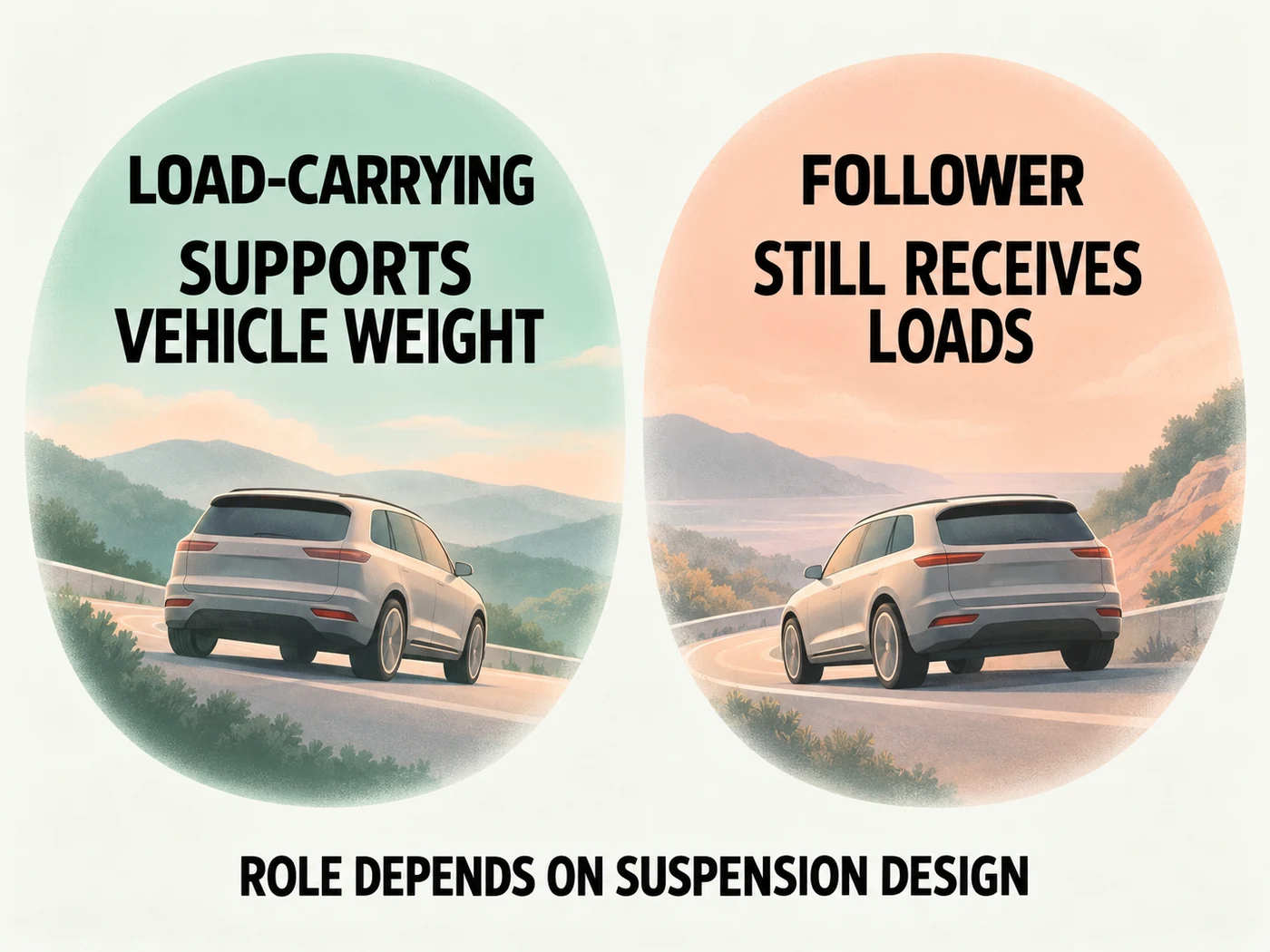
MOOG's ball joint overview distinguishes lower-joint roles according to suspension design. It describes load-carrying joints as supporting vehicle weight in the arrangements discussed, while follower joints still receive loads during vehicle operation. These broad explanations help readers understand the terminology; they do not provide a reference-specific rating.
For a purchasing record, preserve the role as the supplier states it and identify the source. If the source does not declare a role for the offered reference, keep that field unanswered rather than assigning one from a generic illustration. The buyer's next question should ask which application document resolves the issue.
Separate a descriptive role from a claimed performance result. A name in a catalog does not establish a tested load, fatigue life or wear allowance. Those statements require their own applicable evidence and should not be added to a distributor listing just because the terminology sounds technical.
Read suspension examples as examples
MOOG's overview uses short-long-arm and MacPherson strut arrangements to explain why lower-joint roles can differ. In the arrangements it discusses, the load-carrying examples support vehicle weight, whereas the MacPherson lower joint is described as a follower. The point for a catalog reader is the dependence on the suspension arrangement, rather than a rule based only on a lower-position label.
Keep this educational example separate from a proposed replacement. It does not identify the exact suspension configuration of the customer's vehicle, establish a joint's mounting details or confirm an offered reference. Ask the supplier for the applicable selection record instead of applying a general illustration to the order.
Keep position and role in separate catalog fields
Record upper or lower position where the application document identifies it. Keep any left/right or other position qualifier attached to the actual reference. A position label answers where the part belongs; a role description explains its function within the documented arrangement. Do not collapse them into one field.
The buyer should ask how the supplier identifies the correct reference for the requested vehicle, rather than treating the word lower as a universal role definition. If different sources use different wording, preserve the exact phrases and request clarification against the actual application.
Use the supplier's current application record for selection. A general technical article can explain terms, but it cannot confirm the offered piece for every vehicle using a broadly similar suspension description. The purchase order needs the actual reference and its stated conditions.
Do not classify a joint from its outer shape
A photograph can help identify a supplied item, markings and visible mounting features. It should not become the sole basis for assigning a suspension role. An illustrative family image may not even show the offered reference, so confirm that relationship before using it in a warehouse or catalog record.
Ask for the actual supplier reference, applicable drawing or identification views and the application document. Keep the physical identity and the functional description linked, while noting which document supplies each fact. This lets reviewers distinguish an item-identification question from an application-selection question.
If the supplied piece does not match the agreed identification record, report that discrepancy with photographs and pack information. Do not relabel it as a different role based on a guessed resemblance. The supplier should resolve the identity before the buyer updates the listing.
Build a catalog-reading worksheet
The following fields organize the review of an offered ball joint. They are editorial suggestions, not a suspension design standard or a diagnostic procedure. Fill them with actual documents and label missing information explicitly.
| Record field | Information to preserve | Limit to check |
|---|---|---|
| Application | Vehicle identification and supplier selection record | Do not rely on model family alone |
| Position | Actual upper/lower and other stated qualifiers | Keep position separate from role |
| Role wording | Declared term and its source document | Do not infer from appearance |
| Part identity | Offered reference and identification views | Verify image applies to this reference |
| Mounting details | Applicable drawing or product record | No assumed interchangeability |
| Claim evidence | Report supporting any rating or life statement | No universal values from role name |
| Instructions | Reference-specific service information | Keep example procedures out of the order |
| Revision | Approved offer and document versions | Resolve changes before reuse |
Use the worksheet to identify the question the supplier needs to answer. An unresolved role term should remain a role question. An uncertain mounting feature should remain a physical or application question. Keeping those limits visible makes the quotation review more precise.
Read performance and wear statements with their evidence
If an offer includes a strength, durability or service-life claim, ask for its scope and supporting report. Identify the tested reference, comparator and conditions. Do not create an acceptance value by copying a figure from a general article or another brand's test example.
The role label also should not determine a replacement interval in the buyer's catalog. A schedule or inspection rule must come from the applicable service information. Purchasing staff can retain those documents without inventing a universal interval for all follower or load-carrying joints.
Where the supplier supplies only promotional wording, record it as promotional wording and request clarification before using it as a measurable specification. A numerical requirement needs an agreed basis; a broad role name cannot supply that basis by itself.
Keep installation information reference-specific
Ask for the service information applicable to the offered reference and application when it is needed for the order. Do not extend a procedure from a different joint merely because both descriptions include follower or load-carrying. The workshop should use the appropriate vehicle and product instructions.
In particular, do not convert a general role explanation into a torque, orientation or mounting instruction. Keep such details out of the quotation unless the actual applicable document supplies them and the order requires them. If the document cannot be provided, state that limit in the review.
This division keeps procurement useful: the buyer checks that required documentation is available, while qualified workshop staff determine how the actual part is installed and assessed. It avoids creating technical conclusions from an incomplete purchasing description.

Compare two descriptions without assuming equivalence
Consider a hypothetical distributor receiving one offer described as a lower ball joint and another described as a follower ball joint. Those phrases alone do not establish whether the offers address the same request. The buyer needs the application, actual references, position qualifiers and the supplier's declared role information.
If the two suppliers then provide application records, the buyer can review those records and identify remaining differences. If a proposed replacement is still conditional, keep the condition attached to the offer. Do not remove it to make a comparison table look complete.
This is a catalog-reading example, not an actual product comparison. Its purpose is to show that different labels can answer different questions. It does not classify the two imaginary pieces or recommend a substitution between them.
Approve listing wording with a visible source
Before a product description is published, link each technical statement to the applicable supplier document. Keep the part reference and application scope next to the approved wording. If the role is not declared for that reference, a generic educational explanation should remain in the guide rather than becoming an asserted product fact.
When a reference or document revision changes, review the affected fields separately. A new picture, role label or qualifier may need clarification without changing every other field. Preserve the earlier approved record so the warehouse and catalog teams can understand existing stock.
For repeat orders, confirm that the current offer still refers to the approved application and documents. This keeps a familiar shorthand from replacing the evidence originally used to approve the order.
Record a supplier clarification precisely
If the supplier answers a role question, attach the answer to the specific offer reference and application line. Identify whether it confirms a declared role, explains a term or supplies a missing catalog condition. Those answers have different scopes and should not all be summarized as a general approval.
Where the answer remains conditional, preserve the condition in the quote comparison. This allows the colleague approving the purchase to see exactly what still needs resolution.
Frequently asked questions
Does follower mean a joint receives no load?
No. The term should not be read as an absence of operating loads or as a statement of unlimited life.
Can lower position identify the role?
Keep position and role separate and request the applicable suspension and catalog information for the actual reference.
Is a role name a load rating?
No. Ask for reference-specific evidence for any numerical capacity or performance claim.
Can I use another brand's installation example?
Request the appropriate instructions for the offered reference and vehicle. A shared role term does not establish procedural equivalence.
Request a documented ball joint offer
Browse the current MAKEXCAR ball joints category and send an inquiry with the vehicle application, position and existing reference. Ask for the actual offered reference, catalog qualifiers, declared role where available and applicable documents before preparing a purchase specification or listing.

