
Turn a finish label into a surface question
Start with the wording in the quotation. A named coating can identify a process or finish family while leaving its location unresolved. A color photograph may show appearance, but it does not establish every treated surface or the purpose of a layer. Ask the supplier to connect the finish description to a drawing, annotated photograph or other applicable record.
Identify the exact disc reference and revision before reviewing the map. Confirm whether the document describes the item as supplied, a production intermediate or a sample prepared for a particular test. Those conditions should remain visible in the quotation review rather than being merged into a general statement about all coated discs.
A useful purchasing question is specific: which defined regions carry the specified treatment on this quoted configuration? It can be answered without inventing coating thickness, corrosion hours or a universal installation routine.
Connect the finish document to the quoted item
Use the exact reference in the MAKEXCAR Brake Discs category to request its finish documents. Keep the product reference, finish variant and surface-map revision on the quotation line. Dimensional descriptions do not fill an absent coating field or establish that adjacent references have the same treatment.
Identify whether the supporting record describes the commercial item as supplied or a different sample/process stage. If a coating statement applies to a family, ask how the proposed variant is covered. An otherwise complete document can leave the finish question unresolved when the reference mapping is missing.
Do not assume a coating stops before the braking surface
Brembo's Prime rotor overview describes its UV protective varnish as present on the braking surface, outer diameter and hub. This is a manufacturer-specific coverage example. It shows why the word “coated” needs a location description; it does not establish that MAKEXCAR's selected discs use Brembo's treatment or coverage.
For the offered disc, request the actual region labels. If the supplier says the braking surface is covered, ask for the source establishing that statement and the applicable product instructions. If the supplier says it is excluded, retain the stated boundary. Do not substitute an expectation based on another manufacturer's range.
A generic photograph of a uniformly colored disc should not become a coating map. Lighting, reflections and image processing can complicate a visual interpretation. Use the image as an identification aid while asking for the documented surface scope.
Name the regions in the supplier's reference view
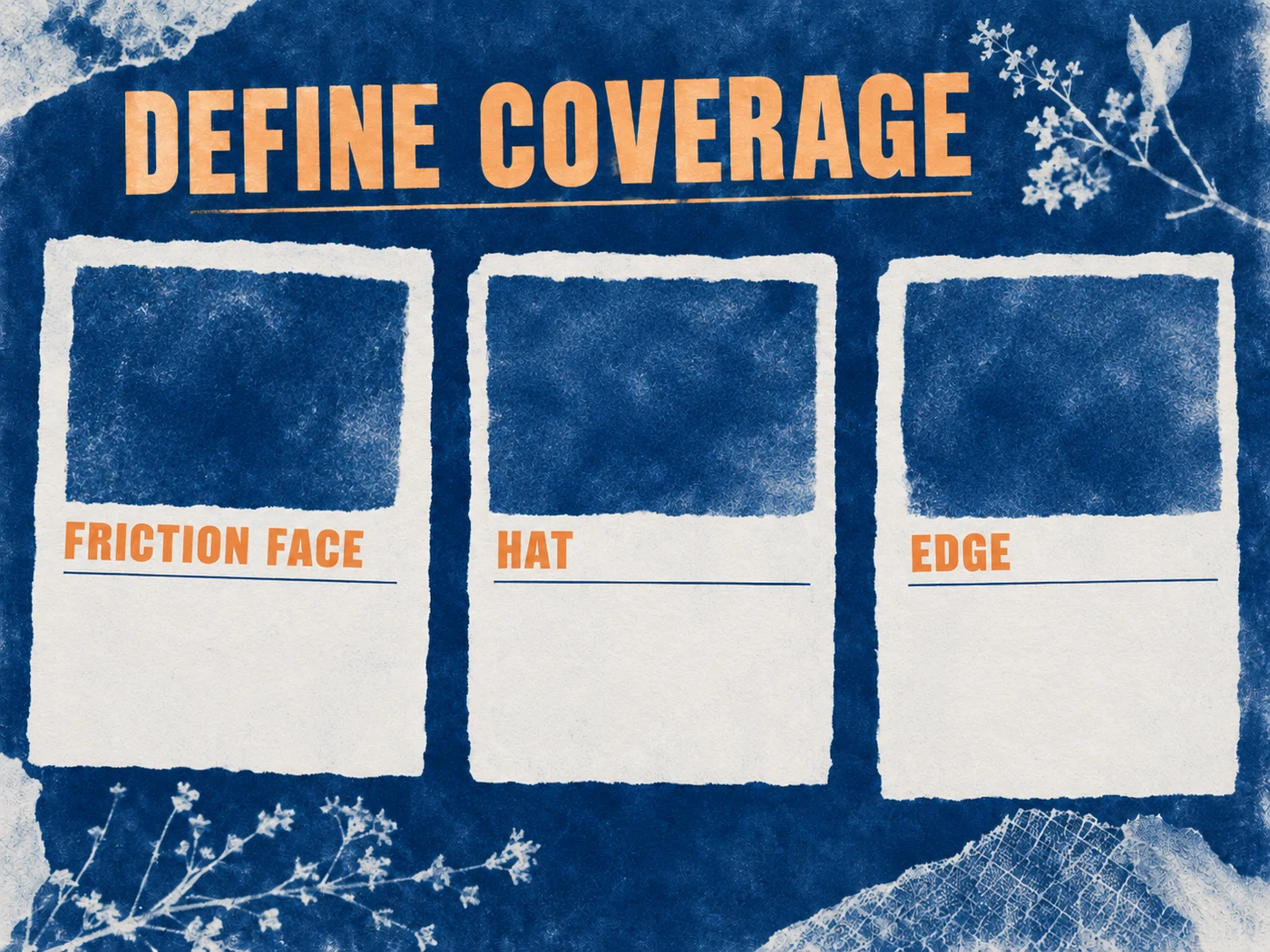
Ask the supplier to identify the friction faces, hat or hub region, outer edge and any other relevant surfaces using the document's own labels. Keep the associated drawing view visible. A label on one view may leave a reverse face or an internal region unresolved.
Use separate rows for each region included in the quotation question. Record whether the treatment is documented as included, excluded or not established. Do not extend an annotated front-face statement to the whole disc simply because the product image shows only one side.
Where a disc configuration has internal surfaces or additional components, ask whether those features are within the finish claim. Their presence and treatment must be established for the exact item rather than inferred from the general name of the product family.
For each region, retain three items together: the stated coverage status, the exact source view/note, and the action needed if scope is unclear. For example, an included hat statement needs its defining note and reference; an excluded region needs the stated boundary; an unseen reverse face needs clarification. This keeps a coverage record actionable rather than merely listing surface names.
A hypothetical three-region evidence worksheet
Imagine an invented quotation file with three review rows: friction face, hat and outer edge. The supplied drawing resolves the hat and outer edge, but the friction-face row has no applicable statement. This example describes documentation, not the finish on a real disc.
| Illustrative review region | Evidence state | Next document question |
|---|---|---|
| Friction face | Not established | Request the applicable face statement |
| Hat | Covered by a stated drawing note | Retain the note and revision |
| Outer edge | Covered by a stated drawing note | Retain the note and revision |
Two of the three inquiry rows are resolved; one remains open. That count is not a measurement of coated area. The regions have no defined areas in this example, and a row count cannot tell you what percentage of the physical disc carries a coating.
Keep the unresolved row visible until the supplier provides its evidence. A broad “coated disc” label should not turn all three rows into confirmed coverage. This worksheet helps ask a precise follow-up while avoiding an invented surface-area or thickness claim.
Separate coverage, thickness and finish identity
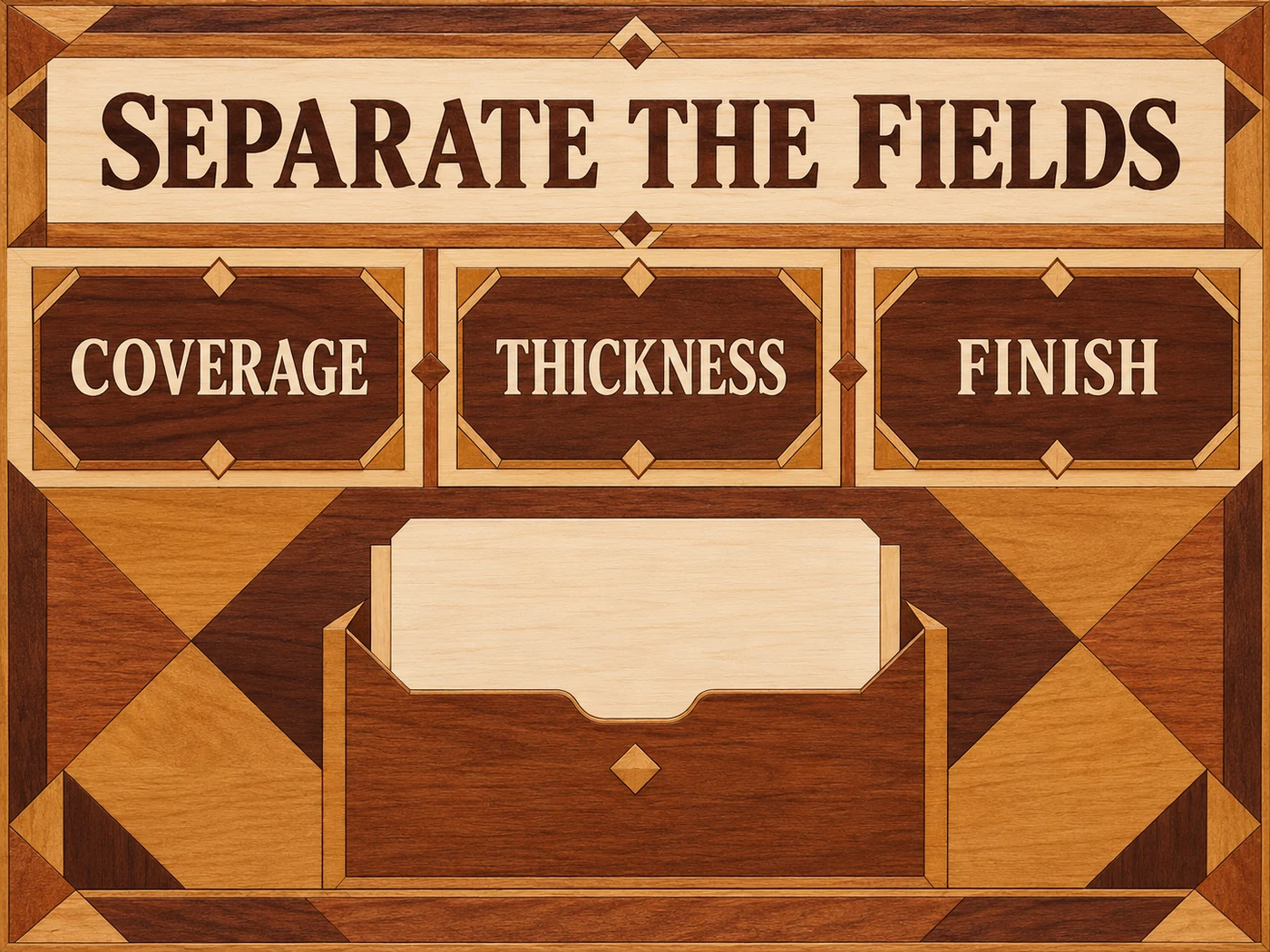
Coverage answers where the specified treatment applies. A thickness entry, if supplied, needs its own unit, measurement location and applicable specification. A finish name identifies a claimed process or product description. Keep these fields distinct so that one does not silently stand in for the others.
If the report includes thickness measurements, retain the recorded location and method with each value. A value for a defined region should not become a uniform thickness for every surface without supporting documentation. Do not insert a generic industry thickness range into a specific quotation.
Ask how any finish variants are distinguished in the commercial reference. If two quotation lines share a dimensional description but differ in treatment, preserve the finish identifier and surface map for each line. Similar dimensions do not resolve a finish mismatch.
Keep temporary protection and specified coating distinct
A supplier may describe a protective layer or storage treatment alongside the specified finish. Ask what each term means for the exact supplied item and which document distinguishes them. Do not identify a layer's role solely from its visible sheen or the word “protection.”
Retain the manufacturer's applicable handling and fitting instructions as a separate document. This procurement review does not authorize cleaning, sanding, painting, removing a layer or running in a disc by a generic routine. Different finishes require their own applicable instructions, and a surface map is not that instruction set.
If the instructions and the quotation appear to describe different finishes, identify the conflict and request clarification. Do not resolve it by borrowing preparation advice from another manufacturer's coated-disc range.
Check corrosion evidence without expanding its scope
If corrosion performance is part of the purchasing requirement, request the applicable test report and acceptance criterion. Match the specimen, evaluated regions, finish revision and recorded result to the quoted treatment. A coverage map locates a finish; it does not by itself establish a numerical corrosion result.
Preserve any excluded regions in the result interpretation. An accepted observation for a specified area should not become a whole-disc corrosion guarantee. Similarly, a corrosion conclusion should not become proof of braking performance, approved fitment or an unlimited outdoor service life.
Keep the report reference next to the claim it supports. If a supplier provides an exposure-hours figure without the specimen and result criteria, record the missing fields rather than adding a guessed rating to the quotation.
Retain the finish revision through ordering and receiving
Once coverage is clarified, record the agreed finish identifier, surface-map revision and exact SKU in the purchase file. When the quotation changes, ask whether the same scope still applies. An amended reference should not inherit a previously reviewed coating statement without an applicability explanation.
At receiving, compare the delivered identification and accompanying finish documents with the agreed record. Record visible observations with their photographs and sample identifiers, keeping them separate from measured coating or test conclusions. A receiving image alone cannot establish a numerical coating thickness.
If a document or sample appears inconsistent, state the conflicting fields and request the current applicable evidence. Keep the earlier source available so another reviewer can see why the clarification was required.
Three incomplete finish submissions and the buyer response
The quotation says fully coated but supplies only a front view
Request a region-by-region statement including the reverse face and any other regions relevant to the exact disc. Ask whether the photograph is an applicable annotated surface view or a general product image. Keep included, excluded and not established as separate statuses. The word fully should not convert an unseen or undocumented region into confirmed treatment.
A thickness result is supplied for one location
Keep its unit, location, method and sample identity with the value. Ask which requirement that measurement addresses and whether the document supports any wider coverage statement. Do not extend one location's result to the whole disc. The buyer can retain useful local evidence while leaving other regions or thickness questions unresolved.
A corrosion figure has no evaluated-region definition
Request the report's specimen, finish revision, assessed surfaces and result criterion. Keep the exposure description separate from the actual outcome. If the supplier cannot identify which regions were evaluated, leave the corrosion claim open rather than adding a whole-disc rating to the quotation. A finish map and a corrosion result need their own evidence links.
These are editorial examples of document review, not actual inspections or customer incidents. They identify the next request without prescribing a coating chemistry, acceptance value or fitting routine.
Ask for a quotation with defined surface coverage
Send MAKEXCAR the brake disc reference and existing finish statement. These five fields make the coverage request specific:
Quoted item: [reference], [finish variant], [quantity], [application identification].
Surface scope: [map or annotated view], [region names], [included/excluded/not-established status], [drawing revision].
Finish evidence: [specified treatment], [supporting document], [sample or supplied-item mapping], [thickness evidence if required].
Separate claims: [corrosion result and assessed regions], [acceptance document], [performance questions still open].
Supply and instruction mapping: [how documents accompany goods], [finish/reference changes], [applicable handling/fitting instruction].
Save the supplier's clarification beside the original quotation and map. A useful finish record shows where treatment is documented, what is excluded and which fields remain unresolved. It supports a specific purchase review without turning a visible color, local thickness value or unrelated corrosion figure into a complete coating claim.