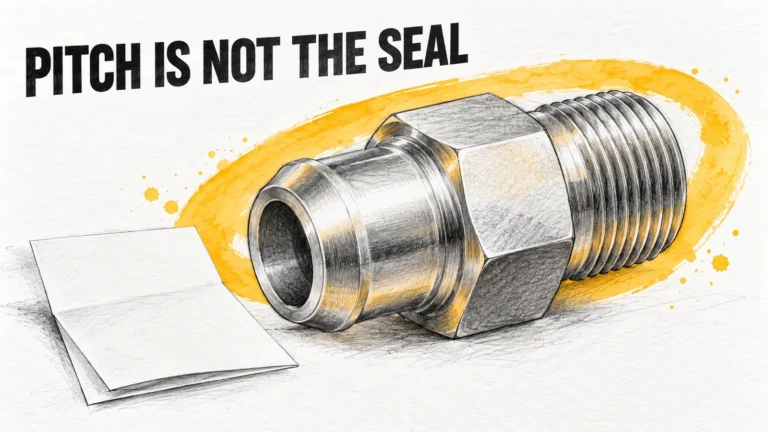
Separate the refrigerant label from the connection question
A fitting inquiry can look simple because the component is small. Yet a short product name may combine several different ideas: component family, refrigerant wording, construction description, and an internal reference. These fields need different evidence. Preserve the original title, then ask the supplier what each relevant field means for the exact offered item.
The refrigerant designation helps identify the intended system context. The connection role tells the supplier what the component must do and where it belongs. Do not replace either field with a photograph alone. A photograph may show an exterior shape without establishing the internal interface, sealing arrangement, application, or permitted service connection.
For this purchasing framework, a service-port role is an identification question rather than a repair instruction. Do not open a circuit, trial-connect a tool, or propose a refrigerant conversion to identify a candidate part. The applicable technical documents and qualified service assessment should establish the role. The RFQ should accurately transmit that established information.
Read three current listings as evidence fields
The following three published MAKEXCAR references were checked in the live WordPress catalog. They provide concrete examples of title wording. The comparison deliberately does not turn those names into an interface specification or a vehicle application claim. Their source references and links let a buyer ask a precise follow-up question.
| Published reference | Refrigerant wording in title | Role wording in title |
|---|---|---|
| M30400628 | R134a | High & low pressure valve |
| M30400634 | R12 | No explicit high/low role in title |
| M30400635 | R134a | No explicit high/low role in title |
The table compares wording in these three titles only. It does not establish catalog-wide coverage, stock availability or market demand. In particular, the high and low pressure wording for M30400628 does not prove universal dual-purpose service fitment. The actual role still needs its applicable technical record.
A title that omits a role leaves that field unresolved in this title-level comparison. It does not establish that the role is absent from the actual component. Ask for the relevant drawing, application description, and offered SKU record. Similarly, preserve the R12 wording without treating it as authorization to use that reference in a different refrigerant system.

What high and low mean in the system context
HELLA's automotive air-conditioning overview distinguishes the high-pressure and low-pressure sides in its expansion-valve circuit explanation. It also emphasizes specialist knowledge and checking installation-relevant characteristics. This supports asking which circuit context and connection the offered fitting addresses. It does not identify the interface or rating of a particular MAKEXCAR SKU.
Keep circuit-side terminology separate from a numeric pressure specification. The words high and low do not provide a working-pressure value, test pressure, temperature condition, or acceptance criterion. If the purchase requires any of those quantities, request an applicable supplier specification or test record with its stated conditions. Do not add a generic number from an unrelated system diagram.
Also distinguish a vehicle service port from other fittings in the A/C circuit. A family category can contain parts with different connection purposes. Ask whether the requested item is the actual port component, another line connection, or a supplied assembly containing several features. The supplier's written scope should resolve that question before the buyer compares alternatives.
Identify the required interface without a trial fit
Begin with the existing reference and the intended application documentation. Clear exterior photographs can support the inquiry, particularly when they show the part identity and connection area. Label photographs as observations. They do not independently establish dimensions, tolerances, or compatibility with a service tool.
Where a drawing is supplied, confirm its reference and revision. Ask which connection details apply to the offered SKU, which dimensions define the interface, and which seal or associated part is included. A drawing for a wider component family may need an explicit variant selection. Keep that selection linked to the quotation rather than assuming every pictured option is supplied.
If a dimension is essential, retain the unit and datum with the value. A measurement across an unidentified feature cannot resolve a connection specification. Do not infer threads, port dimensions, or seal material from a perspective image. Missing technical information should become a written supplier question, not an estimated specification in the purchase order.
Make each unresolved field lead to an evidence request
Send the same application context with each supplier inquiry. Ask which role and interface the offered reference actually covers and retain the evidence for the answer. The worksheet below turns missing information into a specific next request.
| Field to retain | Why it matters | Action if missing |
|---|---|---|
| Application and documented refrigerant | Defines the system context | Request the responsible source rather than assume a refrigerant from appearance |
| Service-port or circuit connection role | Identifies the required component purpose | Ask for the function and relevant application drawing |
| Offered SKU and drawing revision | Connects the description to the shipment | Obtain the exact candidate record and variant |
| Connection and sealing interface | Defines the features that need comparison | Request the applicable detail, units and reference context |
| Included fitting, seals, caps or assembly parts | Makes commercial scope comparable | Ask for explicit included and excluded contents |
This worksheet organizes procurement evidence, not service approval. A refrigerant designation may be documented while the port role remains unresolved. Keep those states distinct. Filling the table does not validate a refrigerant change or prove the completed circuit's performance.
When a supplier repeats the listing title, identify which question that reply actually answers. The reference may be confirmed while interface geometry remains unknown. Ask for the missing record directly instead of treating an unchanged title as confirmation of every field.

Compare quotations with the same stated scope
Two quotations can describe different purchases even when both say A/C fitting. One may include protective caps or seals while another provides only a body. One may identify a specific drawing revision while another relies on a broad catalog description. Compare those differences before treating the prices as equivalent.
Ask whether quoted refrigerant wording belongs to the exact supplied reference or to a general product family. Then ask how the stated port role is documented. A repeated title is not a substitute for an answer connecting the offered part to the buyer's application. Preserve any exclusions and the technical questions that the supplier has referred back to the buyer.
When a supplier changes the offered SKU, revisit the relevant records. A lower price or similar appearance does not establish that the connection role, interface, or included components remain the same. Retain the earlier quotation and identify the changed reference. The comparison should show what evidence supports the revised offer.
Separate delivery identity from service suitability
At receipt, check the declared reference, package identity, supplied contents, visible damage, and technical documents against the order. These checks can establish that the shipment matches the commercial record. They cannot demonstrate that the fitting is suitable for installation or that the completed circuit has passed its applicable service checks.
A qualified service process should address installation and verification using the correct system requirements. This purchasing article does not provide charging quantities, pressure readings, evacuation times, conversion methods, or connection instructions. Keep service findings attributed to the responsible technical party and the applicable procedure, rather than turning a receiving checklist into a service approval.
If the delivered reference or contents differ, preserve the evidence before requesting a supplier response. Send the order reference, package markings, photographs, and the exact discrepancy. Describe an observed mismatch rather than diagnosing a performance failure that has not been established. An accurate record helps distinguish a delivery question from a technical suitability question.
Resolve three ambiguous fitting replies
The refrigerant is named but the port role is not
Keep the refrigerant wording and ask which documented service-port or circuit connection role the offered part covers. A matching medium label does not establish that the connection serves the required location or tool interface.
High and low wording is offered as a numeric rating
Request the actual pressure specification and conditions if the purchase requires a quantity. Preserve circuit-side labels separately. Do not invent working or test pressures from a general diagram, and do not treat two words as a universal dual-side fitment claim.
The revised price excludes a cap or seal
Record the changed delivery scope beside the earlier quotation. Ask which interface record and included items now apply. A lower price for a different set of contents is a different commercial offer; it does not resolve the application question.
Send the documented context and the exact missing role
Use these fields with your current quotation and available technical records. They help the supplier investigate the correct candidate and connection question.
Candidate: Exact offered or existing reference, variant, required quantity and application information.
Refrigerant: Documented designation and its source. State any difference between title wording and the intended system record.
Role: Required service-port or circuit connection purpose and its supporting record. Mark the role unresolved if not yet established.
Interface: Applicable connection and sealing drawing, revision and relevant labelled features. Attach photographs as identification observations rather than scaled specifications.
Scope and gap: Included and excluded fitting, seal, cap or assembly items. State the specific unanswered interface or function question.
Browse the current A/C Valves & Fittings category and contact MAKEXCAR with the inquiry. Connect the supplier's answer to the exact offered item before treating refrigerant wording as application approval.