This guide helps buyers assemble a useful return dossier. It does not provide a universal workshop test sequence, operating pressure or warranty decision. The aim is to make the evidence reviewable and to identify the questions that remain open before approving replacement stock or assigning responsibility.
Describe the event before naming the failed part
Begin with what was observed and when. Did the complaint concern a parked-height change, a warning message, an unusual operating sound or a reported inability to reach the requested height? Preserve the customer's description, then add the workshop's observations separately. A record headed “bad bag” can hide the very information needed to determine what happened.
Record the sequence: installation or prior service, first reported symptom, inspection, any component changes and the condition after those changes. Use actual dates or elapsed times available in the case. If the sequence is unknown, state that. A tidy narrative reconstructed from assumptions is less useful than a short timeline with explicit gaps.
Use a neutral initial case title such as air suspension height complaint, with the affected location and vehicle identifier. The title can be updated when the evidence supports a component finding. Keeping the initial title neutral allows the reviewer to consider the supplied part without treating the return label as a proven cause.
Identify the installed assembly and application
Attach the supplier SKU, original reference used for the match, batch or shipment record and installed position. State whether the supplied item was an air spring bag, a complete assembly or another named component. A return involving a complete assembly should not be recorded as a rubber-bag complaint without explaining which portion was inspected.
Preserve the vehicle and equipment information that the application catalog requires. Broad model names alone may leave the suspension version unresolved. If the workshop selected the part using a cross-reference, attach that reference evidence and the version used. Record whether the installed item matches the order and the catalog position.
Photograph labels and the complete item as found. A close-up of one surface is useful for a particular observation but insufficient for identity. Keep a separate overall view so that another reviewer can relate the detail to the correct assembly. When markings cannot be read, describe the uncertainty rather than creating a replacement identification from appearance.
Why system evidence belongs in the bag complaint
Arnott's published installation guidance notes that compressor overload can be consequential damage and advises checking the air suspension system for leaks. That manufacturer guidance supports a bounded point: a complaint involving one component can require evidence about other parts of the system. It does not prove that a particular returned bag leaked or that a compressor symptom has one universal cause.
The Arnott air suspension installation tips provide background for this wider view. The actual investigation must follow the selected vehicle and component procedures. Procurement should request the resulting records, including negative findings and unresolved items, instead of translating a general technical explanation into a case verdict.
This distinction is important for stock decisions. Replacing every component named in a complaint can increase cost without resolving the evidence gap. A distributor needs to know what was checked, what was observed and which conclusion the workshop can support for the supplied item.
Make height observations comparable
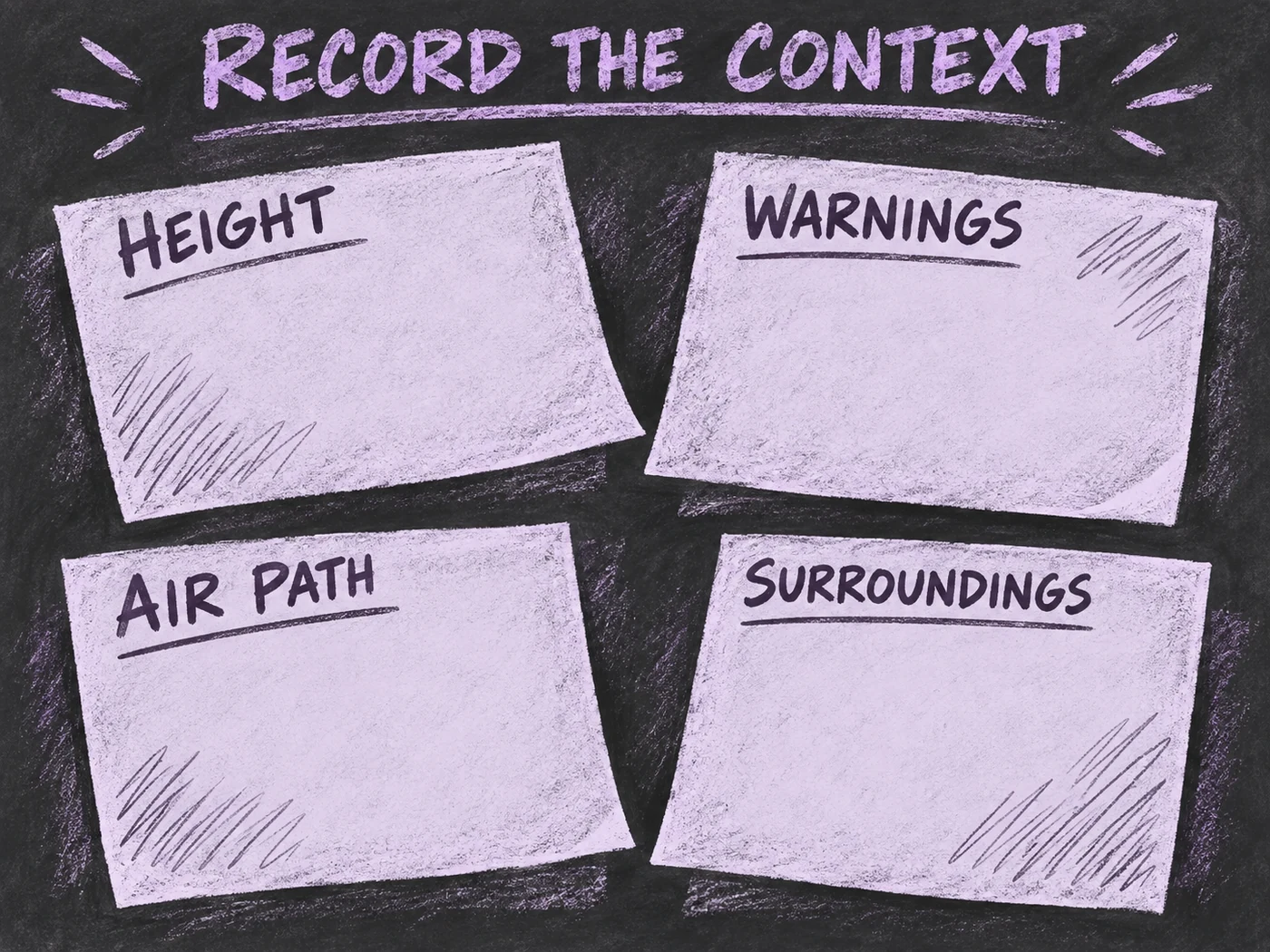
A statement that the vehicle dropped is incomplete without the observed position, reference points and conditions. Request the workshop's recorded measurement method, the corners checked, timestamps and relevant vehicle state. Preserve any documented load or suspension setting that affects interpretation. Do not invent a reference height or use an unrelated vehicle's dimension as the acceptance limit.
If there are several observations, keep them in chronological order with consistent labels. Identify any change in location, measurement method or vehicle condition between them. A before-and-after photograph can support the record, but camera angle alone should not be treated as a numerical measurement.
Where the selected procedure provides expected values, attach that procedure and identify the applicable version. Where the workshop has only a visual observation, retain it as a visual observation. The strength of the record comes from accurate description, not from presenting every note as a completed controlled test.
Keep warning and diagnostic information intact
Request the exact warning text and the diagnostic report when available. Preserve code identifiers, module identification and the relevant recorded context. Do not shorten a diagnostic finding into the name of the part that the buyer expects to return. The original report helps the reviewer see what information actually led to the workshop's conclusion.
Record whether information was captured before any clearing, replacement or adjustment. If it was only captured afterward, state that timing. Also distinguish an active observation from a historical record according to the actual report. Procurement should not reinterpret diagnostic terminology without the applicable service information.
These documents do not automatically decide the commercial claim. They provide context that can be reviewed alongside the part identity, physical findings and service sequence. A code by itself should not replace a documented component investigation in the return dossier.
Request air-path findings with locations and methods
Ask which connections, lines and other relevant air-path components were inspected under the vehicle's procedure. For each finding, request the named location, observation and method. If the workshop reports a leak, it should identify where the evidence places it rather than only writing “system leaking.”
Keep a bag-body finding distinct from a connection finding or an unresolved system loss. Where a measurement or test was performed, attach the report and its conditions. No universal test pressure, holding time, fluid or pass criterion is provided here. Those details must come from the selected method and be appropriate for the actual assembly.
Negative findings also matter. State which locations were checked without a reported finding and which were not checked. A blank field does not mean a successful inspection. This makes the scope of the investigation visible and prevents an incomplete check from being summarized as “everything else is good.”
Record surrounding condition without guessing the mechanism
Request photographs and notes on relevant nearby hardware, routing, clearance and the installed assembly condition. Record any visible contact marks or disturbance precisely. A photograph may show a mark but may not establish when it formed or whether it caused the reported symptom.
Separate the observation from the proposed explanation. For example, “visible mark at this location” describes evidence; “the bracket caused failure” requires additional support. Ask the workshop what application information or physical findings connect the proposed mechanism to the returned item.
Record any prior repair, alteration or component change reported by the buyer. This is contextual information, not an automatic reason to reject a claim. Its role is to help the reviewer understand the installed system and identify whether the original application and service records are still applicable.
| Record | Attach or describe | Keep separate from |
|---|---|---|
| Identity | SKU, reference, label, batch and position | A guessed match from appearance |
| Timeline | Observed events and documented interventions | An assumed order of events |
| Height | Reference points, corners, timestamps and vehicle state | A universal target height |
| Diagnostics | Original report and capture timing | A part verdict based only on a code |
| Air path | Locations, methods and actual findings | An unspecified system leak label |
| Surroundings | Clearance, routing and visible-condition observations | An unsupported damage mechanism |
| Conclusion | Finding supported by the attached evidence | The commercial claim decision |
Preserve the returned item and case history
Record the item's condition as received and link it to the installation case. Keep the relevant packaging or shipment identification available for traceability. If a workshop has already altered, cleaned or separated components, note that history so the inspection report does not imply an untouched assembly.
Use the selected supplier's return and inspection instructions for handling. This article does not prescribe disassembly or pressurization of an unknown item. The purchasing record should state what evidence was preserved and what inspection was authorized or completed under the applicable procedure.
A replacement during the investigation should also be recorded. Document the replacement reference, what else changed and the subsequent observation. An apparent improvement can be relevant, but multiple simultaneous changes may leave responsibility unresolved. Keep that limitation visible in the final case summary.

A scenario: a low corner and an incomplete return label
Consider a hypothetical distributor case with the message “new air bag failed overnight.” The file contains one parked-vehicle photo and an invoice, but no installed reference, height method or air-path report. The complaint may deserve investigation, yet the available file does not establish the supplied bag as the cause.
The useful response requests identity and equipment records, the timeline, comparable height observations and the workshop's findings at named locations. If the resulting evidence documents a defect in the bag body, record that specific finding. If it identifies a different location or leaves the loss unresolved, preserve that outcome without changing the evidence to fit the original label.
This is an editorial example, not a real customer result or a promise about claim acceptance. It shows how an evidence request can progress the case while keeping a symptom, a component finding and a commercial decision distinct.
Frequently asked return questions
Does a low corner prove the air spring bag is defective?
The observation starts an investigation. Request the application-specific findings that identify the relevant component or location. A parked-height photograph alone does not complete that identification.
Should the buyer record only positive leak findings?
Include checked locations without findings and locations not checked. These are different statuses. Recording both lets the reviewer understand the investigation's coverage.
Does replacing the bag settle responsibility?
Record what changed and the observation afterward. Where several items changed together, the result may not isolate one cause. The evidence and applicable claim terms must be reviewed separately.
Can a distributor use a standard pressure for every return?
No universal pressure is provided by this guide. Request the selected component and vehicle method, its recorded conditions and its applicable acceptance criteria.
Prepare a focused evidence request
For a relevant product inquiry, review the published MAKEXCAR Air Spring Bags category and confirm the individual reference and scope. To discuss a supplied-item case, send the part identification, vehicle equipment, location, timeline and available workshop reports through MAKEXCAR contact.
The final summary should say what the evidence supports, what remains uncertain and which document would resolve the next question. That gives purchasing, technical review and the supplier a common starting point without turning a reported symptom into an unsupported verdict.