

Read the words before reading the arrow
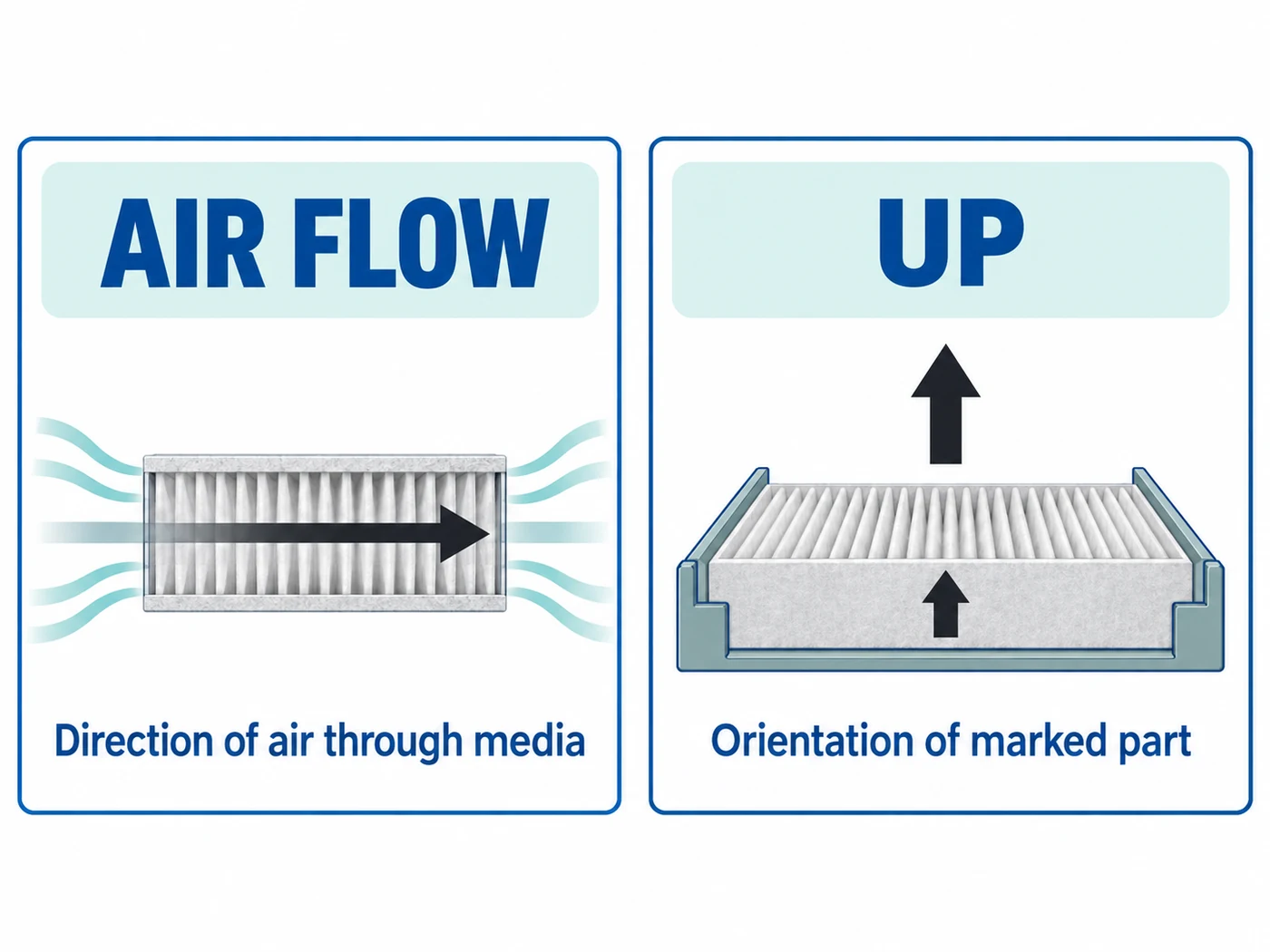
A bare arrow is easy to misinterpret when the filter, its tray and the housing all have different visible faces. Record the complete printed mark, its location and which component carries it. “AIR FLOW” on a filter frame describes the direction in which air passes through the medium when the part is installed. “UP” on a filter or removable tray describes how that marked part should be oriented relative to the vehicle. Those meanings can produce different-looking arrow directions in the same vehicle.
FRAM's cabin filter airflow guide expressly distinguishes air-flow arrows from UP and DOWN orientation marks and tells readers to check the vehicle manual when the marking is absent or unclear. It notes a common downward-flow arrangement, but “common” is not an approval rule for a particular vehicle. A distributor's listing should state what its own SKU says and refer to the target application instruction, rather than giving one universal “arrow always points down” sentence.
Two FRAM product instructions show why the exact application matters: the CF11966 instruction says its airflow arrow points up, while the CF10743 instruction says its airflow arrow points down. These are directions for those named products and applications, not interchangeable advice for an unverified MAKEXCAR filter. Their value here is evidence that a generic direction copied between catalogue lines can be wrong.
| Mark found | What it can tell the buyer | What still needs checking |
|---|---|---|
| AIR FLOW + arrow on filter | Intended air passage through the marked medium | Actual airflow path for the target housing and application |
| UP + arrow on filter or tray | Upright orientation of the marked component | Whether the mark belongs to the filter, removable tray or housing |
| Bare arrow with no words | A direction is indicated, but its meaning is ambiguous | Maker instruction, label legend and vehicle procedure |
| No visible mark | No direction claim can be read from that side | Other faces, packaging insert, fitment guide and supplier explanation |
Identify which component carries the mark
Begin with a clean photograph of the filter's side, top and bottom, plus the outer pack and any instruction insert. If the filter has a rigid frame, note whether the words are printed on the frame or on a removable carrier. Some vehicle service procedures discuss a separate filter case or tray with its own UP marking. A marking on a tray should not be copied into a replacement filter drawing as if it were printed on the filter itself.
For example, a published Toyota owner's manual instructs the user to keep the filter case's “UP” mark pointing up for the vehicle covered by that manual. That source concerns the marked case, not a universal airflow direction for every cabin filter. When making a supplier instruction sheet, quote the part and application accurately and show a photograph of the actual mark location. Do not extract a cropped arrow and lose the word or component around it.
The vehicle identity matters as much as the marking. Record the market, model, model year or production period, HVAC variant if relevant, and the actual filter reference. The same nameplate can have different access positions or cartridge forms over time. A supplier illustration is credible only if its part number, mounting context and revision match the offered pack. A photograph of a similar dashboard opening is not a substitute for that record.
Establish the direction from the application instruction
Find the target vehicle's current service or owner's instruction first. It should specify how the filter or tray enters the slot and, where needed, the intended arrow direction. Use the filter maker's instruction for the exact replacement SKU as a second source. If the two disagree, hold the publication of an installation diagram and ask the supplier to resolve the conflict with the part and application identified. Do not choose the instruction that appears visually easier.
Airflow may pass through a cabin filter in different orientations depending on the HVAC design. The arrow's role is to identify flow relative to the media, not to point toward the driver, passenger seat, floor or sky in every vehicle. A filter may be inserted horizontally even if flow is vertical; the insertion direction is a third concept. The buyer's documentation should therefore keep three separate fields: part insertion, component UP orientation and airflow through the medium.
Observe the entire filter assembly rather than an isolated screenshot. A removable tray can be flipped, and a flexible filter may be folded or twisted for access. The vehicle procedure may specify which face points outward, how the pleats sit and how the door closes. Do not infer those steps from a single arrow on a generic pack. A wrong orientation sentence could be copied across many catalogue entries, so resolve uncertainty before scaling the copy.
Make the supplier artwork unambiguous
Ask the supplier for a flat artwork proof of the filter frame, the outer packaging and any insert. On each, the arrow should have words that state its purpose: AIR FLOW or UP, as appropriate for that part. If the pack contains multiple language versions, confirm the meaning remains consistent. The orientation diagram should name the marked component and show the target part number. Avoid a floating arrow over a generic airbox with no label; it may be read as insertion, airflow or upright direction.
Where a family includes both airflow-marked and UP-marked designs, maintain separate approved artwork or an explicit variant table. A shared master carton label can identify the product family, but it cannot turn distinct vehicle instructions into one universal pictogram. During sample inspection, photograph the actual frame printing, pack label and insert together. The sales page should match what the customer will receive, not an earlier draft or a different supplier's pack.
Use a versioned change record when the marking changes. Record the old and new artwork, the affected SKUs, application evidence, approval date and how existing stock will be distinguished. A new arrow direction may be a correction, a change in media construction, or merely a revised way of labelling an unchanged part; the buyer should not guess which. Ask for the supplier's written explanation before replacing online instructions.

Use a short evidence chain to decide a disputed case
1. Transcribe the mark exactly
Write “AIR FLOW ↑,” “UP ↑,” a bare arrow or “unmarked” as observed, and include a photograph showing its location. Photograph both faces of the element and any tray. Do not convert an UP arrow into an air-flow arrow in a spreadsheet, even if both happen to point in the same physical direction in one vehicle.
2. Match a vehicle and filter reference
Attach the vehicle document or service excerpt for the relevant market and production period. Record the offered filter SKU, any OE reference and the maker's fitment line. If the supplier cites a different market, year or housing, mark the direction claim as pending. A part-number match without the correct instruction revision does not settle an artwork dispute.
3. Confirm the finished pack
Compare the approved instruction with a labelled physical sample or current production pack. Check frame printing, insert and outer label for agreement. If a loose insert contains one direction and the filter frame another, hold the line until the supplier identifies which marking applies and issues corrected documents. A screenshot of a catalogue page cannot prove that the shipped pack has been updated.
| Approval record field | Evidence | Status if absent |
|---|---|---|
| Filter and pack reference | Supplier SKU, revision, sample or lot | Do not generalise to another stock unit |
| Mark wording and location | Clear filter/tray/pack photograph | Meaning remains ambiguous |
| Vehicle instruction | Market, vehicle, year and document revision | Do not publish universal orientation copy |
| Supplier instruction | Exact part-number instruction or signed clarification | Request a corrected version |
| Decision | Approved artwork and reviewer/date | Keep the listing in clarification |
Questions buyers ask about cabin filter arrows
Does AIR FLOW always point down?
No. FRAM's product-specific instructions include both upward and downward airflow-arrow examples. Use the vehicle and filter-maker instruction for the exact application. The general guide describes common arrangements but explicitly directs users to the vehicle manual when the marking is unclear.
Can an UP mark be used to infer airflow?
Not safely. UP describes the orientation of the marked filter, tray or case. Airflow may run in a different direction. Keep the component and label wording visible in the record and request the actual airflow explanation when it is needed for the filter design or installation copy.
What if the new filter has no arrow?
Check every face, the insert, package and vehicle procedure. Ask the supplier whether the part is non-directional or simply unmarked; do not assume either from a blank frame. If the offered part requires a particular orientation, obtain a part-specific written instruction before approving the catalogue entry.
Next step: verify the marked SKU
See the current MAKEXCAR cabin-filter category and send an application-specific enquiry. Include the market, vehicle, year or production period, OE reference, expected quantity, photographs of the housing and any existing filter or tray markings. Ask for the proposed SKU, frame-print artwork, pack insert and vehicle-specific instruction. Approve the direction copy only when those records agree on what the arrow means and which component it marks.
Further Technical Reading
For background on the roles of oil, fuel, engine air and cabin filters, see Bosch Mobility Aftermarket’s filter overview. These resources explain general product principles; they do not certify MAKEXCAR products or establish fitment for a particular SKU. Follow the vehicle manufacturer’s service instructions and confirm part references before ordering.

