
This guide is for buyers coordinating a parts inquiry with the workshop responsible for diagnosis. It organizes the evidence and commercial scope needed for a useful quotation. It does not diagnose a vehicle, prescribe a flushing procedure or define which parts must be replaced on an unidentified system.
Start with the workshop finding, not a replacement guess
Ask for a written description of the reported compressor failure and the observations made during the actual assessment. Identify who supplied the information and when. Keep a reported symptom separate from a confirmed finding, especially when the purchasing team receives information through several intermediaries.
If the report mentions particles, ask where they were observed and how the workshop described them. Preserve that description without converting it into an unsupported laboratory identification. A photograph of dark residue alone should not become a purchasing declaration that a specific metal or failure mechanism has been proved.
Record what is still unknown. The supplier can answer a quotation question more accurately when the inquiry distinguishes documented contamination from an unconfirmed concern. Do not fill gaps with assumptions simply because a condenser is commonly discussed with compressor replacement.
Understand why internal debris deserves a separate question
DENSO's subcool condenser article explains that solid-particle contamination in the condenser design it discusses is not resolved by flushing. It also describes how retained particles can lead to further compressor problems. This manufacturer context supports asking about contamination; it does not establish the condition of your vehicle or the serviceability of every condenser.
Ask the workshop to identify the applicable vehicle and component guidance before deciding the repair scope. A general technical article can explain why a question matters, but it cannot substitute for the instructions and diagnosis relevant to the actual system.
Keep this inquiry distinct from external fin cleanliness. Dirt on the outside of a condenser and particles reported inside the refrigerant circuit describe different observations. A photograph of clean fins does not answer whether internal contamination was found or how it should be addressed.
Connect every photograph to its location and report
Request the images already collected by the workshop together with their descriptive context. Each image should identify the observed component or location and the relevant case reference. Do not request additional disassembly or sample collection solely to satisfy a purchasing checklist.
Retain an unedited original when it is available, plus any annotated copy used to explain the observation. Labels should describe the workshop's finding rather than add a new diagnosis. If a close view lacks context, ask the reporter to identify where it came from.
Link the photographs to the written report and the affected part references. A useful record lets the reviewer connect the observation to the actual repair case. A collection of anonymous images from several vehicles can confuse the supplier and weaken later return discussions.

Identify the vehicle and the condenser before requesting price
Supply the market, vehicle model, relevant year or production range and the identifying codes needed by the applicable catalogue. Include the current condenser reference and the proposed replacement reference. Where a workshop has already selected a part, ask which catalogue or vehicle record supports that selection.
Separate a vehicle identifier, OE reference, supplier SKU and catalogue cross-reference. They serve different purposes in the inquiry and should not be merged into one ambiguous part number. Keep the source and revision of the fitment information with the request.
Ask about connection layout, mounts and any integrated receiver-drier arrangement where they affect the offered assembly. Do not assume two condensers are interchangeable because their outer dimensions look similar. The supplier needs the actual application and interface information to review its recorded product.
Ask for the basis of the proposed repair scope
Request the relevant service-document identity or a written workshop explanation of the plan. The question is which guidance applies to this diagnosed condition and vehicle. Avoid asking the parts seller to approve an undocumented cleaning method based only on a generic photograph.
If the report states that cleaning or flushing was performed, ask what that statement covers and whether the responsible workshop considers it consistent with the applicable guidance. Purchasing should preserve the declaration without presenting it as independently verified proof that every internal passage is free of particles.
Do not specify chemical products, pressures, charge quantities or compressor oil adjustments from this article. Those are service decisions outside this purchasing worksheet. The useful commercial outcome is an identifiable replacement request supported by the responsible technician's actual assessment.
Use a contamination-context worksheet in the RFQ
The following fields are an original purchasing aid, not a diagnostic test or mandatory repair schedule. Populate them from the workshop's records and the agreed supply request. An unanswered field should remain visible until the relevant party can resolve it.
| RFQ field | Record to request | Purpose |
|---|---|---|
| Vehicle identity | Market and applicable vehicle codes | Review the correct application |
| Part identity | Existing and proposed references | Separate diagnosis from offered SKU |
| Reported failure | Workshop finding and case date | Retain the actual observation |
| Contamination location | Reported component or circuit location | Keep images in context |
| Evidence | Photo identities and linked report | Trace the described condition |
| Service basis | Applicable document or workshop explanation | Identify responsibility for the plan |
| Supply declaration | Included and excluded items | Compare offers on the same scope |
| Open question | Unresolved issue and responding party | Avoid turning uncertainty into approval |
Send a concise case summary with the worksheet rather than an unexplained file bundle. State the part you want quoted, the evidence available and the questions requiring confirmation. The supplier should be able to distinguish its product information from the workshop's service conclusions.
Separate the service plan from the parts order
A repair plan may identify several components, while a quotation may cover only one condenser. Name the actual order line and its quantity. A document headed AC repair kit is not sufficient if it leaves the component references and contents unspecified.
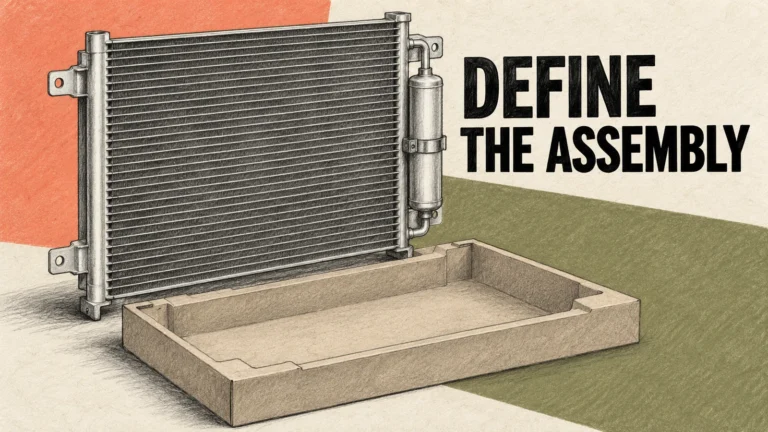
For the condenser line, ask whether a receiver-drier or related element is part of the named assembly, separately offered or excluded. Record the exact declaration for the offered reference. Do not infer the contents from a general catalogue image or the existence of an integrated design elsewhere in the range.
Keep other workshop-requested parts on their own identifiable lines. A supplier's price does not certify the complete repair plan, and a workshop's replacement recommendation does not confirm what a seller has packed. Each party should answer the question within its actual information and responsibility.

Compare responses by what they actually answer
One supplier may confirm a catalogue reference, another may provide assembly contents and a third may ask for additional application information. Record these responses separately. A detailed product quotation can still leave the contamination-related service question unresolved.
Compare matching references and declared contents before comparing price. If a proposed alternative changes an interface or included item, ask for the basis of that change. Keep any technical approval with the actual revision of the offer rather than applying it to later substitutions.
Do not translate a statement such as supplied new into a guarantee that the existing vehicle circuit is suitable for installation. Equally, do not imply that a supplier has accepted responsibility for the failure investigation merely because it received the workshop's photographs.
Preserve the case for receiving and later questions
At receiving, reconcile the shipment identity and declared contents with the approved order line. Record packaging condition and any discrepancy through the normal receiving process. These checks confirm what arrived; they do not measure internal contamination or approve installation.
Keep the quotation, selected reference, workshop report and relevant service basis together. If a later complaint arises, the record can distinguish the new component supplied from the earlier reported failure and the work performed by others.
A later symptom should not automatically be assigned to the original debris or the replacement condenser. Record the new observation and refer diagnosis to the responsible workshop. The purchasing file helps trace the case without predetermining the technical cause or warranty outcome.
Common questions before condenser supply
Does compressor failure always prove condenser contamination?
No purchasing conclusion should be based on the failure label alone. Ask for the actual observations and the application-specific guidance supporting the workshop's plan.
Does a flushing declaration settle the question?
Ask what it covered and which guidance the workshop followed. DENSO's cited discussion explains why flushing is not an answer to the solid-particle contamination described there.
Can a photo identify the particle material?
Preserve the workshop's description and any supporting analysis. An image alone should not be rewritten as a confirmed material identification.
Will a condenser quote include every repair component?
Only the named supply declaration answers that question. Identify each included, separately quoted or excluded item and keep the service plan distinct.
Prepare a specific condenser inquiry
Review the current MAKEXCAR condenser category and identify the recorded reference you want to discuss. Send the vehicle information, required quantity, existing reference and relevant workshop case summary.
Use the MAKEXCAR contact page to ask about the proposed product reference and declared assembly contents. Keep the contamination assessment and applicable service plan with the responsible workshop so the inquiry gives the supplier a clear, evidence-based parts question.