
For replacement buyers, the decision is whether the offered assembly matches the requested application and agreed supply scope. This guide explains how to clarify that scope before comparing prices or approving an order. It does not prescribe refrigerant handling, drier replacement or condenser installation.
Use the design description as background
DENSO's condenser overview describes super-cool, also called subcool, designs as multi-flow condensers with an integrated gas-liquid separator or modulator. The overview distinguishes condensing and super-cooling sections. This is an example of an integrated design description, not confirmation of the components inside a MAKEXCAR quotation or a service instruction for a particular vehicle.
Ask the supplier what “integrated drier” means in its actual offer. Record the answer against the quoted reference. Do not silently substitute a general design term for a contents declaration, especially where the quotation, catalogue and packaging description use different wording.
The relevant question is what arrives as the supplied item. A product-family description may discuss a function without listing every included component, fitting or service part. Keep those questions separate so the supplier can answer each directly.
Identify the exact assembly being quoted
Start with the requested reference and the offered reference. Include the vehicle and engine information used for the replacement inquiry, along with the relevant application record. A condenser category or a photograph of a similar rectangular component is not enough to establish the correct assembly.
If the supplier offers an alternative, keep it visible as a proposal rather than rewriting the requested item description as though no change occurred. Ask which application and assembly requirements support the proposal and route unresolved technical questions to the appropriate reviewer.
Record document revisions where provided. A drawing or contents sheet should be tied to the actual item being quoted. If several references appear on one document, ask which entries apply to the order line under review.
Request a contents declaration that names the supplied parts
Ask for a clear written list of the supplied assembly and any included accessories. Identify drier-related components using the supplier's actual terminology and document references. Do not invent a generic list and treat it as the expected contents for every integrated design.
Where a catalogue image shows attached or loose objects, confirm whether they are supplied, shown for illustration or belong to another order line. A product photograph is useful for reviewing visible features, but it is not automatically an agreed packing list.
For each item described as included, ask whether it is part of the supplied assembly or separately packed. This can affect how receiving staff check the shipment and how the order description should be written. Preserve the supplier's response without inferring an installation sequence.

Separate inclusion from serviceability
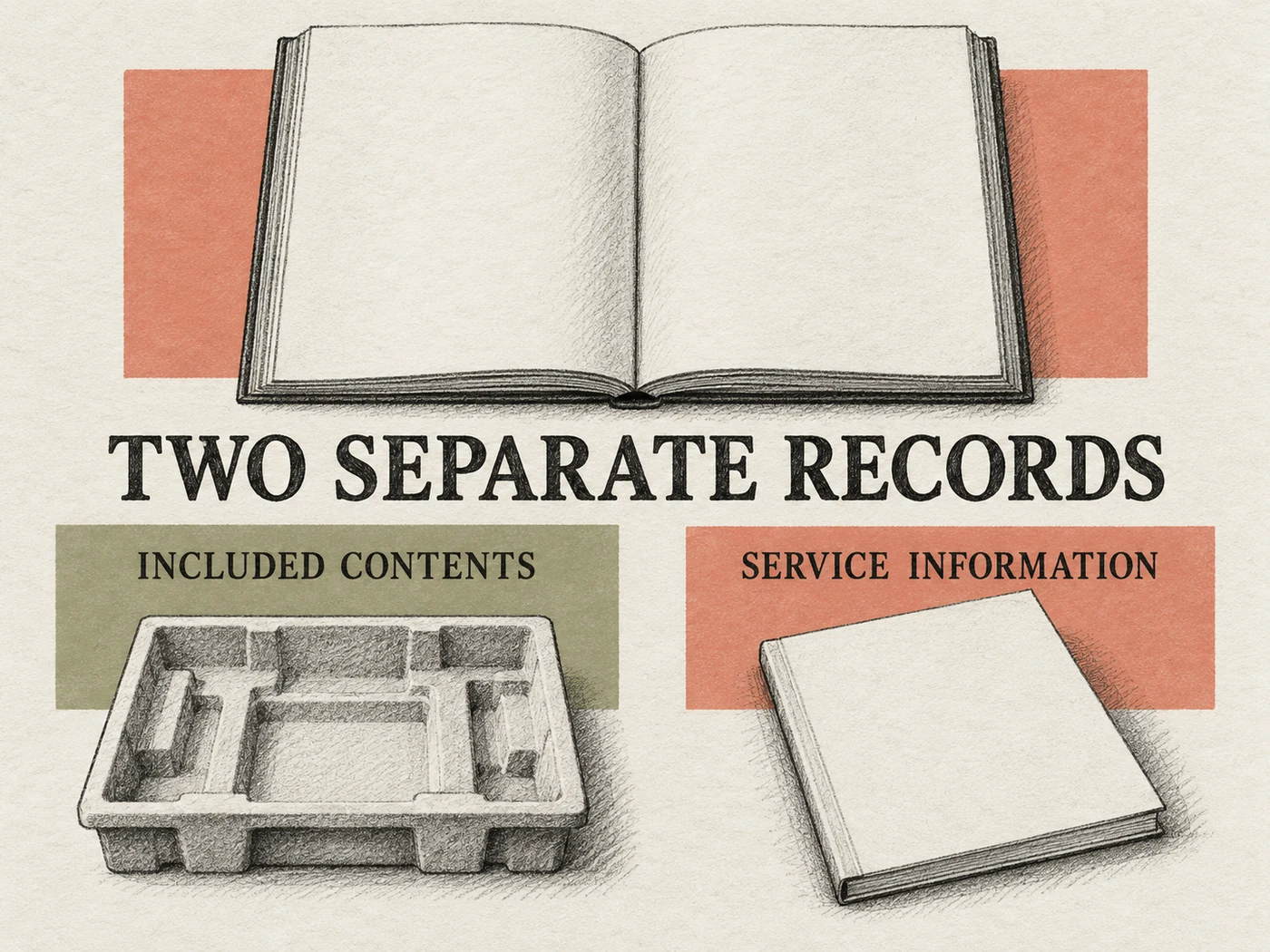
A statement that a component is included does not answer whether it can be serviced separately. Ask for the applicable assembly and service information if that question matters to the purchase. Do not infer replaceability from a visible seam, cap or cylindrical housing.
Likewise, a separately listed service item does not prove that it is appropriate for every condenser using a similar design name. Match the actual references and supporting information. Record the scope of the supplier's confirmation rather than expanding it to an entire product family.
This article supplies no procedure for opening a housing, changing a cartridge or handling the system. Those activities require the relevant component and vehicle instructions. The buyer's task is to obtain the documents and clarify what the order covers.
Check interfaces and assembly envelope
Request the item-specific connection and mounting information needed for review. Establish the orientation used in drawings and photographs. A side component may change the assembly envelope even where a core dimension appears similar, so compare the defined overall measurements as well as the core measurements provided.
Ask the supplier what each dimension includes. Does the quoted envelope include the relevant projections and attached components? Retain the actual definition and drawing locations. A sales table with ambiguous headings should not be treated as a fully defined dimensional comparison.
Keep interfaces, dimensions and application confirmation as separate entries. A useful drawing can support geometry review without proving complete replacement suitability. Do not approve the assembly solely because two visible outlines appear close.
Compare two prices using the same declared scope
Before comparing offers, place their actual contents beside each other. One price may cover a defined assembly while another excludes an accessory or uses different terminology. Resolve those differences before treating the totals as prices for identical supply.
The worksheet below is an original buyer aid, not a manufacturer's component list. Populate it from the actual offers. Unknown entries should remain open questions rather than assumed included parts.
| Review item | Offer A declaration | Offer B declaration |
|---|---|---|
| Actual condenser reference | Quoted item and document revision | Quoted item and document revision |
| Application claim | Declared vehicle scope and evidence | Declared vehicle scope and evidence |
| Integrated design wording | Supplier definition | Supplier definition |
| Included components | Named contents and packing scope | Named contents and packing scope |
| Interfaces and envelope | Relevant drawing entries | Relevant drawing entries |
| Service information | Applicable document and scope | Applicable document and scope |
| Exclusions | Explicitly excluded items | Explicitly excluded items |
If the supplier changes the scope after answering, update the comparison and retain the explanation. Do not leave an earlier contents statement attached to a revised price where the new offer concerns a different assembly.
Ask about protective condition and documentation
Request the supplier's stated delivery and inspection requirements for the actual item. Identify which protective features and documents receiving staff should expect from that declaration. Do not invent a universal packaging specification from a generic condenser image.
Where a component is delivered with protected connections or other specified packaging features, check what the supplier actually requires and record the condition received. A missing feature should be described factually and referred for clarification rather than interpreted immediately as a technical failure.
Keep any condition photographs connected to the shipment and reference. They can document the delivered state, but they do not replace a construction declaration or a complete internal assessment. The record should identify what was visibly checked and what remains unverified.
Approve a sample only for the checks actually performed
Agree the sample review scope before recording approval. It may include documented identity, visible interfaces, declared contents and selected dimensions. State the actual observations and the document used for comparison rather than giving the sample a broad approval with no recorded basis.
A visual inspection does not establish every internal component or performance characteristic. If a question requires further evidence, record the required document or assessment and leave that point unresolved. The existence of a sample does not eliminate the need for a reference-specific answer.
Connect the approved sample record to the supplier's item definition and revision. If later production supply differs from that definition, receiving staff need enough information to identify the difference and raise a precise inquiry.
Write a clear order line
Use the actual offered reference and agreed assembly description. Link the contents declaration, relevant drawings and exclusions. If separate items are ordered alongside the assembly, give them their own unambiguous lines or identify their inclusion explicitly according to the agreed quotation.
Avoid phrases such as “complete kit” unless the agreement defines what complete means. The word can conceal different expectations between purchasing, receiving and the supplier. A named contents record is more useful than an expansive label.
Keep the order wording aligned with the final supplier response. An unanswered question about a drier-related component should not disappear when the quotation is converted into a purchase order. Record the clarification before treating the assembly scope as approved.
Common questions about integrated drier offers
Does a side canister prove everything is included?
No. It is a visible feature of the photographed object. Request the actual contents declaration and confirm which item the photograph represents before relying on it for supply scope.
Does integrated mean the component can be replaced separately?
That word alone does not define serviceability. Obtain the applicable item-specific service information and supplier confirmation. Do not infer a procedure from the external appearance.
Can two condensers with the same core size be compared directly?
Define the measured areas, then compare the assembly envelope, interfaces, application and declared contents. A core dimension does not resolve the complete assembly question.
What should be listed as excluded?
Record the supplier's actual exclusions and any separately ordered items relevant to your request. Do not create a universal exclusion list for all integrated designs.
Prepare an assembly-specific condenser inquiry
Review the current MAKEXCAR condensers category for the recorded references available to inspect. Send the requested reference, vehicle information, quantity and relevant drawing or photo. Ask for the actual integrated design definition and contents declaration where those points affect the order.
Use the MAKEXCAR contact page to request clarification. Keep application, included components and service information distinct so the response can answer the actual purchasing question without treating an assembly label as a complete specification.