This guide explains the three geometry questions behind a spark plug reach and seat type check. It provides a repeatable request for supplier evidence, not a universal dimension chart. No MAKEXCAR plug is assigned to a vehicle here without model-specific documentation.
Start with the exact engine and OE reference
Record the vehicle market, manufacturer, model, model year or production period, engine code and original spark plug reference. The nameplate alone can conceal engine changes during a production run. A catalog may list more than one plug for a model because cylinder heads, ignition layouts or service revisions differ. The engine identifier and OE reference narrow the question before anyone compares physical parts.
Ask the supplier for the complete manufacturer part number of the offered plug and the current application listing that connects it to the target engine. If the OE number has been superseded, request the service or catalog note showing the replacement chain. A cross-reference is a candidate-finding tool; the final approval still needs a match to the head interface and the maker's installation instructions.
Keep all evidence on one revision-controlled sheet. Note the source name, publication or access date, full part number and whether a measurement comes from an official drawing, catalog field or a physical sample. This makes it possible to explain a later fitment complaint without relying on a buyer's memory of how two plugs looked on a desk.
Thread size is only the first check
A spark plug thread is defined by more than its apparent outside diameter. The thread diameter, pitch and usable threaded length need to correspond to the cylinder head and the OE design. NGK's installation guidance explicitly calls for the correct thread reach and seat type. A part that starts into the hole by hand is not thereby proven suitable; engagement alone cannot establish the final electrode position or sealing interface.
Ask for the thread designation exactly as the manufacturer states it. Compare it with the OE specification instead of inferring it from a photograph or caliper reading across the shell. Check the hex and access envelope separately, because the tool must reach the plug well and seat without damage. The hex size is a service-access field, not proof that the combustion-end geometry matches.
Do not use installation force as a fitment test. If the thread designation or head application is uncertain, stop the selection and obtain the controlled specification. The potential cost of damaged head threads is far greater than the cost of resolving an ambiguous catalog entry before ordering.
What thread reach actually measures
Thread reach describes the axial length of the shell's threaded section intended to enter the cylinder head. It affects where the plug's firing end sits relative to the combustion chamber and how the shell bears against the head. It should be taken from a manufacturer's dimensioned drawing or an unambiguous catalog field. A photograph can distort this length through camera angle, gasket compression, or a shell feature that is not part of the installed threaded reach.
A plug with too little reach may leave unused head threads exposed to deposits and position the spark differently from the specified design. Too much reach can put threads or the firing end farther into the chamber than intended. NGK's technical Q&A warns that incorrect reach or projection can create piston or valve interference. The risk depends on the particular engine and part geometry; this guide does not claim that a given sample will hit any particular component.
Do not combine reach with the length of the ceramic insulator, the total shell length or the visible distance from a gasket before installation. These are different measurements. If a drawing uses a datum that is unclear, ask the plug maker to identify the installed seat plane and the reach dimension referenced to that plane. Document the answer in writing before accepting the substitute.
Gasket and tapered seats are different interfaces
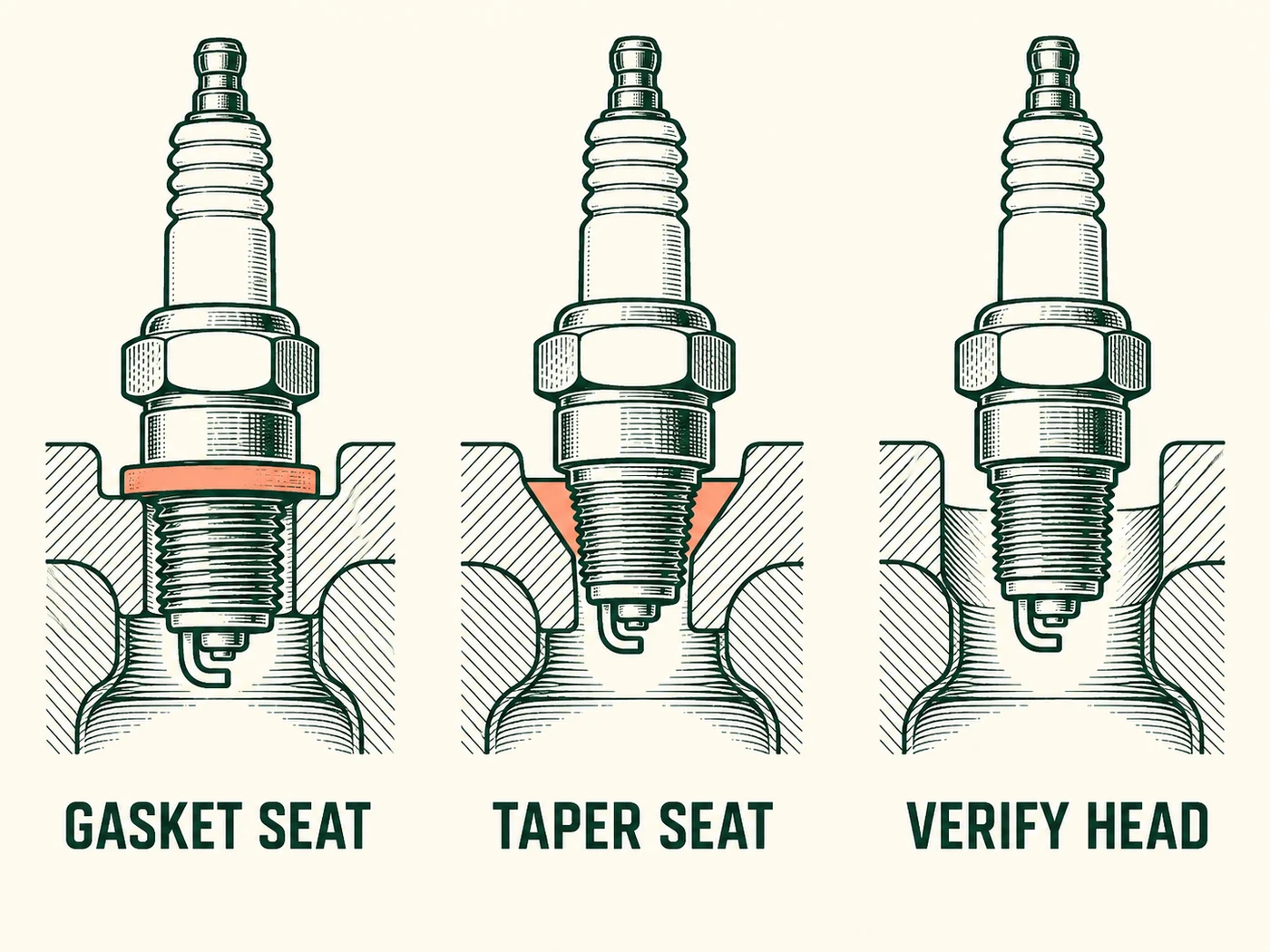
The seat is the surface that seals the plug against the cylinder head. Common arrangements include a flat seat with a sealing gasket and a conical or tapered seat. The head is machined for a specific interface; a gasket-seat plug should not be assumed interchangeable with a taper-seat plug simply because the threads match. NGK's power-equipment guidance names seat style alongside thread size, reach and projection as a critical fitment characteristic.
Compare the seat description in the OE reference, cylinder-head documentation and offered part drawing. Check whether a gasket is part of the intended plug assembly and whether the listed drawing depicts the supplied state. A generic illustration of a taper or gasket is useful for explaining the distinction, but it is not a dimensional proof of fit for an offered SKU.
The installation procedure also depends on the specified seat and plug design. NGK notes that incorrect tightening can impair heat transfer and plug performance. Use the plug maker's current instructions and the engine maker's service information for the exact application. Do not transfer a torque figure from another engine or a different seat type into a purchase specification.
How to resolve an ambiguous catalog label
Some catalog entries abbreviate the seat field, while aftermarket listings may omit it altogether. Ask for a full part-number decoding guide and the drawing for that exact part number. DENSO's official part-numbering material separates thread, reach and seat information rather than collapsing them into a single “fits” field. Where the source does not specify the seat clearly, mark the line as unresolved. A visual guess made after receiving inventory should not become a supplier approval record.
Projection is separate from reach
Firing-end projection concerns how far the electrode and insulator nose extend relative to the shell and chamber. Two plugs can have the same thread reach and different firing-end designs. Conversely, two visibly similar noses can be attached to shells with different reaches. The separate fields in manufacturer numbering systems are a reminder to compare both, not to use one as a substitute for the other.
Ask whether the proposed plug is a projected or non-projected design in the manufacturer's terminology and whether the engine application approves that design. Where a drawing provides an electrode-position dimension, identify its datum. The document should be tied to the exact part number and revision being supplied. An unlabelled side-by-side photograph can show a difference but cannot establish a safe installed clearance.
Do not infer combustion clearance from a general illustration. If the engine maker or plug maker does not document interchange, escalate the candidate to the application engineer. The potential for mechanical interference is why a superficial “same thread, same gap” comparison is not enough.

Build a geometry evidence sheet before ordering
A short, repeatable comparison sheet prevents one attractive catalog match from hiding a missing fitment field. Put the OE part and proposed part in adjacent columns and attach the actual source for each claim. Treat a blank cell as an open decision, not a presumed match. The table below describes the minimum questions; it deliberately provides no universal dimensions.
| Field | Evidence to request | Decision question |
|---|---|---|
| Application identity | Engine code, OE reference, current catalog entry | Is this exact engine listed? |
| Thread | Maker's diameter and pitch designation | Does it match the head specification? |
| Reach | Dimensioned drawing and measurement datum | Is installed threaded length the specified value? |
| Seat | Gasket or taper designation and supplied state | Does it seal on the head's intended surface? |
| Projection | Firing-end design and application approval | Is the installed tip position approved? |
| Service details | Installation instruction, terminal, gap policy | Can it be installed as the engine maker requires? |
Record the supplier's exact document title and date next to each answer. If an OEM catalog and a supplier sheet disagree, do not average their dimensions or let a marketing listing overrule the technical source. Request written clarification that identifies the exact offered part and the target engine. A purchase order can then cite the approved reference and revision, reducing the chance of an unintended substitution at shipment.
Questions to put in an RFQ
Ask the supplier to confirm the full part number, OE cross-reference, vehicle application, thread designation, reach, seat, projection, terminal configuration and current installation instruction. Request a drawing or authoritative catalog page for each geometric field. If samples are required, label them against the same part number and compare them with the documentation; samples should support the record rather than replace it.
Also ask how a later supersession will be communicated. A supplier may ship a revised number that is genuinely approved, but the buyer needs the new catalog link and interchange statement before the change is accepted. Put the effective revision and approval owner in the order file, especially where several markets or engine versions share a similar vehicle name.
Common shortcuts that produce bad matches
The first shortcut is a photograph match. Plugs photographed at different angles can hide the seat shape, reach datum or tip projection. The second is a partial number match. Manufacturer codes encode multiple fields, and a shared prefix may still leave the geometry different. The third is equating a threaded fit with an application fit: a part may screw in yet seal, project or transfer heat incorrectly.
Another shortcut is using one engine's service torque for every plug of a similar size. Tightening depends on the exact seat, construction and service guidance. Improper installation can damage threads, alter sealing or affect heat transfer. The buying team should collect the correct instruction and pass it with the approved part to the installer rather than putting a generic number on a distributor spreadsheet.
Finally, do not treat a supplier claim of “universal” fit as evidence across an engine family. Require the target engine and OE reference. Where fitment remains uncertain, a clear “not approved yet” status protects both purchasing and the supplier from an avoidable complaint.
Frequently asked questions
Can two plugs with the same thread and reach be exchanged?
Only after the seat, firing-end projection, terminal, thermal specification and exact engine application are also confirmed. Matching two fields narrows the candidates but does not prove interchange. Obtain the current manufacturer application listing or written engineering approval for the offered part number.
Can a gasket-seat plug replace a taper-seat plug?
Do not approve that substitution from the thread designation alone. The cylinder head and plug must use the same intended sealing interface. If a catalog claims a replacement, obtain the part-specific documentation explaining that application before placing an order.
Is projection the same as reach?
No. Reach concerns the installed threaded shell length; projection concerns the firing-end position and design. Ask for both fields separately. A drawing should make clear which reference plane is used for each measurement.
Send a fitment request with the evidence attached
For a MAKEXCAR quotation, send the engine code, production range, OE plug reference, quantity and destination market with the proposed part number if known. Ask for confirmation of thread, reach, seat and projection in the same reply, with the catalog or drawing revision attached. Browse the published Spark Plugs category for the product family, then contact MAKEXCAR with the application details. An identified engine and documented geometry make the answer actionable; an image of a loose plug alone does not.