This guide covers purchasing and receiving evidence, not a field cleaning, flushing or charging procedure. The method and acceptance limit for internal contamination must come from an approved product specification. No MAKEXCAR condenser SKU is assigned a cleanliness grade, factory gas fill or test result here without its own document.
Why the open connection matters
The condenser is part of a circuit that depends on clean refrigerant, lubricant and internal passages. Moisture and debris entering through an open connection can compromise other components. Valeo advises capping or plugging disconnected refrigerant lines immediately during replacement to limit moisture and dust entry. That guidance concerns service handling, but it illustrates why the receiving team should treat an unprotected new component as an exception requiring investigation.
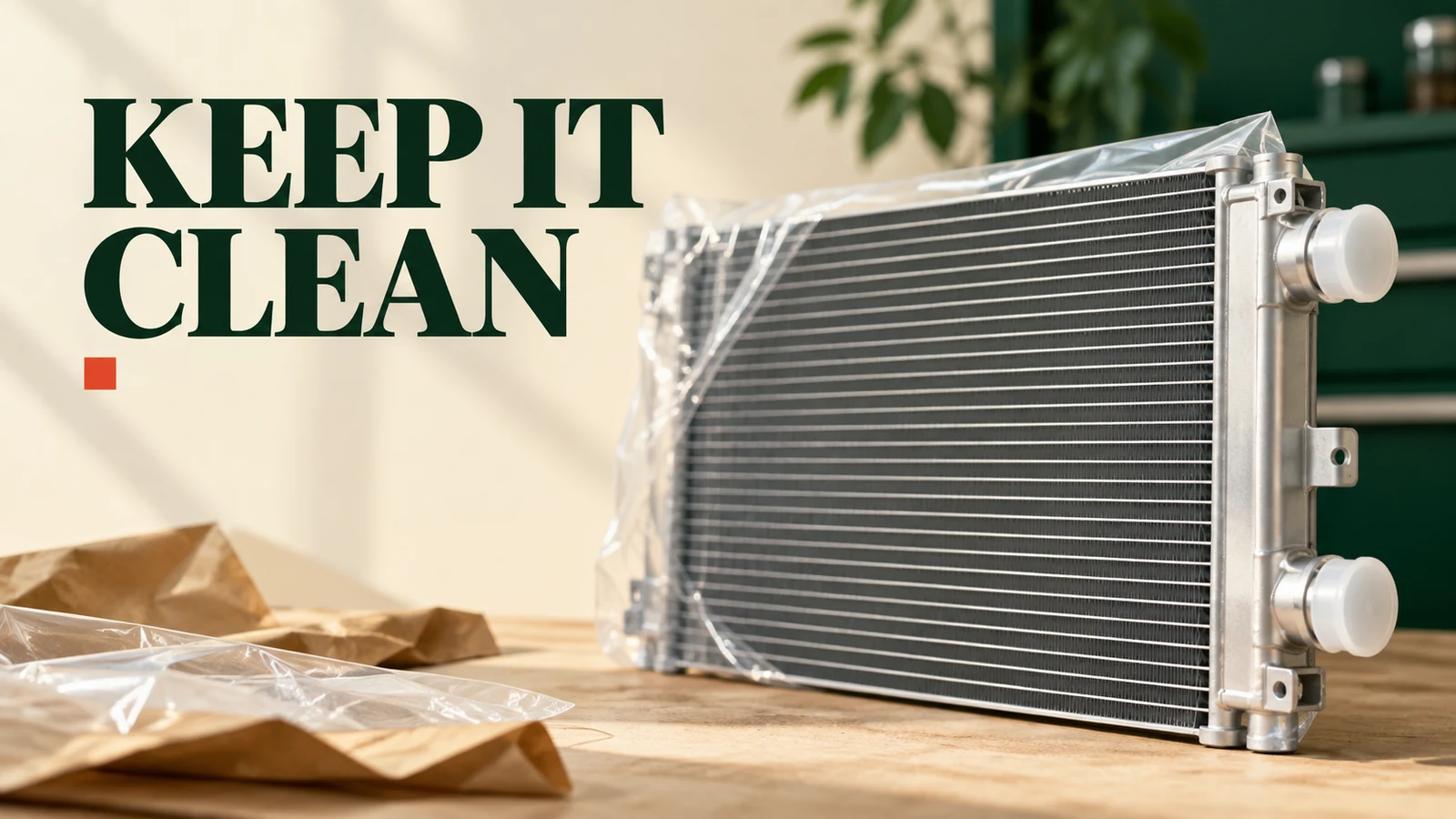
Nissens describes some of its condensers as factory filled with neutral gas and sealed with tight caps to keep dirt and moisture out. This is a product-line claim by Nissens. It does not establish that every condenser, or any MAKEXCAR condenser, has the same preparation. Ask the supplier what protective method applies to the exact offered part and how that state can be checked on arrival.
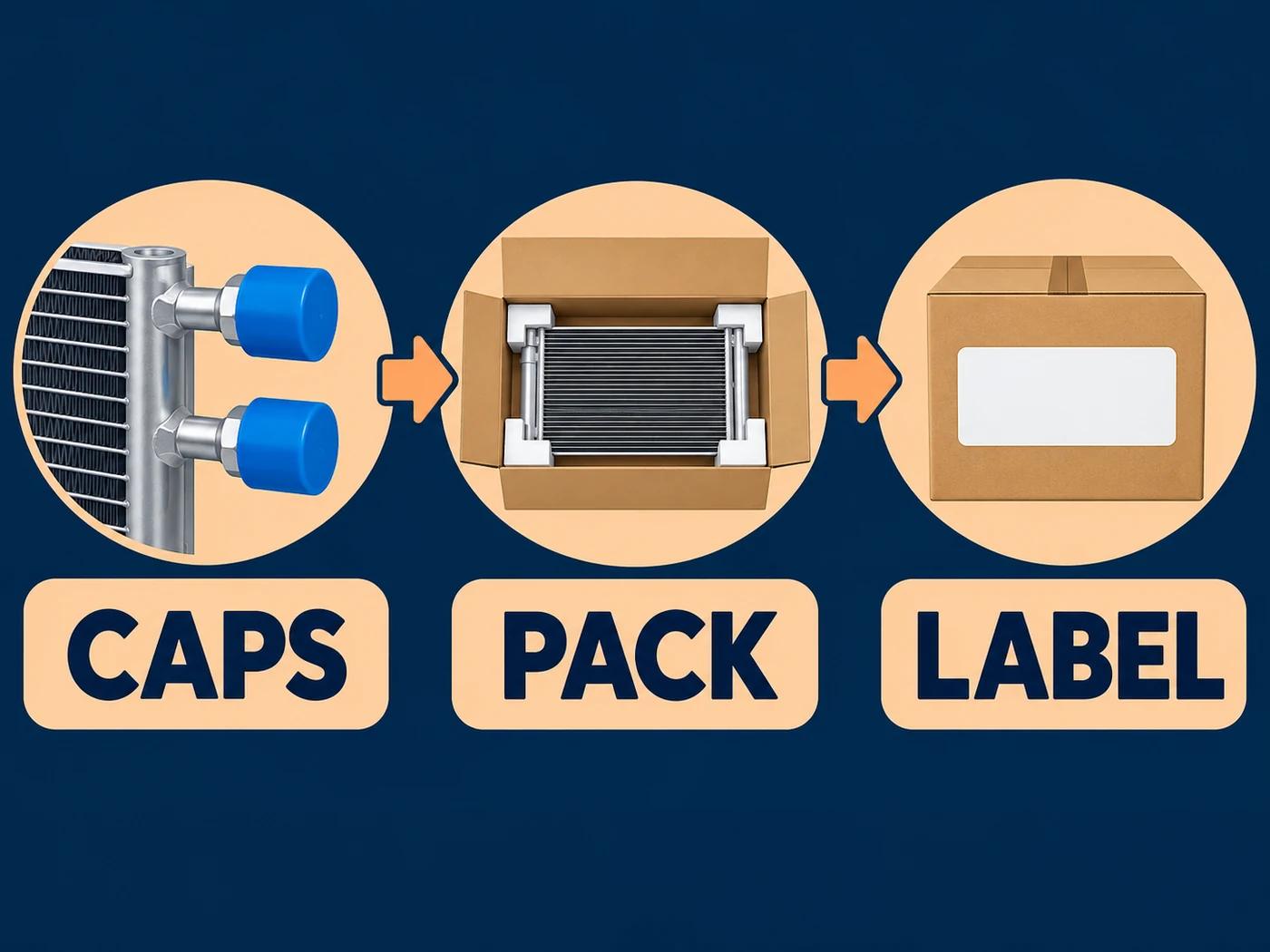
A cap is a barrier, not a laboratory cleanliness certificate. It may have been removed and replaced after inspection, may not seal the opening as intended, or may be absent because the product uses another approved protection method. Record the cap style and condition against the maker's packing specification. Do not infer an internal particle count or dryness result from the visual presence of two caps.
Identify the supplied assembly and its openings
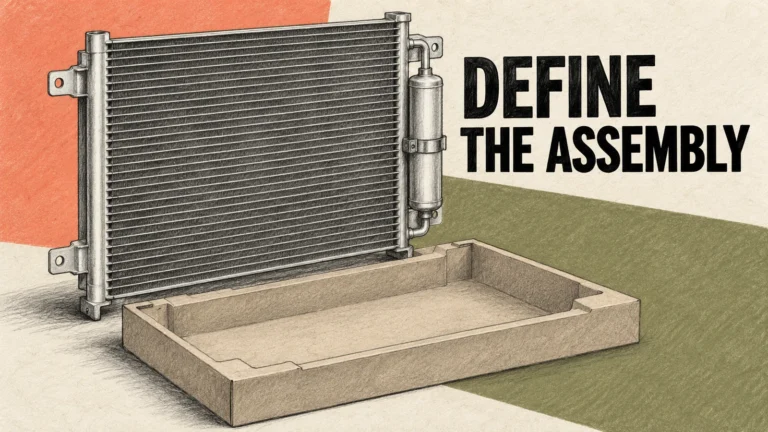
Start with the full manufacturer part number, revision, sample or lot identifier, OE reference and vehicle application. Confirm whether the assembly includes an integrated receiver-drier or a separate cartridge. Valeo describes condenser arrangements with an integrated receiver-drier, and MAHLE illustrates protective caps and drier elements in condenser assemblies. The number and purpose of openings can therefore vary by design.
Ask for a product drawing or controlled photo that labels every connection, service opening and protective closure. Compare that source with the physical sample without removing the closures unnecessarily. A plastic plug in a receiver-drier opening may have a different function from a transport cap on a refrigerant line. An apparently spare opening may be part of a different application or a sealed manufacturing feature; have the maker identify it.
Record the delivered state as a set: unit identifier, caps and seals present, packaging condition, included accessories and any sign of disturbance. A carton label that identifies one part while the enclosed condenser has a different marking is a traceability problem even if the ports are covered. Hold the sample for clarification rather than approving its cleanliness from the intact outer box alone.
Inspect caps and packaging without opening the circuit
At receiving, photograph the unopened carton, internal protection, all connection ends and product marking. Check for torn film, loose caps, visibly damaged seals, exposed openings, bent fins, punctures or liquid staining. Do not remove a protective cap simply to obtain a better photograph of the port. Use the supplier's controlled drawing for connection geometry and let a qualified inspector decide whether an opening must be examined under an approved procedure.
Packaging should prevent the unit from moving and protect connection faces from contact with corrugated board or loose hardware. The sample may need corner supports, a bag, a sleeve or other product-specific protection. A generic cardboard box is not automatically inadequate, but the delivered arrangement should match the supplier's stated packing method. If the record describes a sealed bag and the carton arrives with an open bag, document the difference before repacking conceals it.
Mark each visible exception with its location and photo number. Distinguish a cap that is simply scuffed externally from one that is displaced or broken. A visible particle on the outside of a cap does not prove contamination inside the condenser, just as a clean exterior does not prove the passages are clean. The next step is to request the maker's inspection disposition for the specific unit.
Ask how storage and handling were controlled
Request the supplier's storage and handling instruction for the exact part family. Relevant questions include whether openings remain capped throughout storage, whether bags are resealed after inspection, how long a sample may remain outside its packaging, and what triggers reinspection. Do not invent a universal shelf life or exposure period; the answer depends on the manufacturer's process and component design.
A receiving warehouse should avoid placing uncovered components where dust, water spray or loose packaging debris can contact the ports. Record unusual exposure, such as a wet carton or a sample found uncapped on a shelf, and ask for a disposition. The product may be recoverable under a maker-approved process, but the buyer should not create a cleaning procedure from a blog article or silently return the cap after exposure.
Maintain the original label and packaging relationship when samples move between teams. If a cap is removed by a qualified inspector, note who removed it, why, how long the opening was exposed, and how it was closed afterward. This does not mean every inspection requires an elaborate log; the level of control should match the approved quality plan. The key is to prevent an undocumented handling event from being mistaken for factory-delivered condition.
Read the test record for the actual part
Ask what the supplier means by “cleanliness tested.” A visual check, particle extraction, pressure integrity check and gas fill confirmation answer different questions. A pressure or leak test can show whether a unit holds a specified condition, but it does not by itself quantify debris or moisture inside the passages. Likewise, a cap-presence check documents packaging control rather than internal contamination.
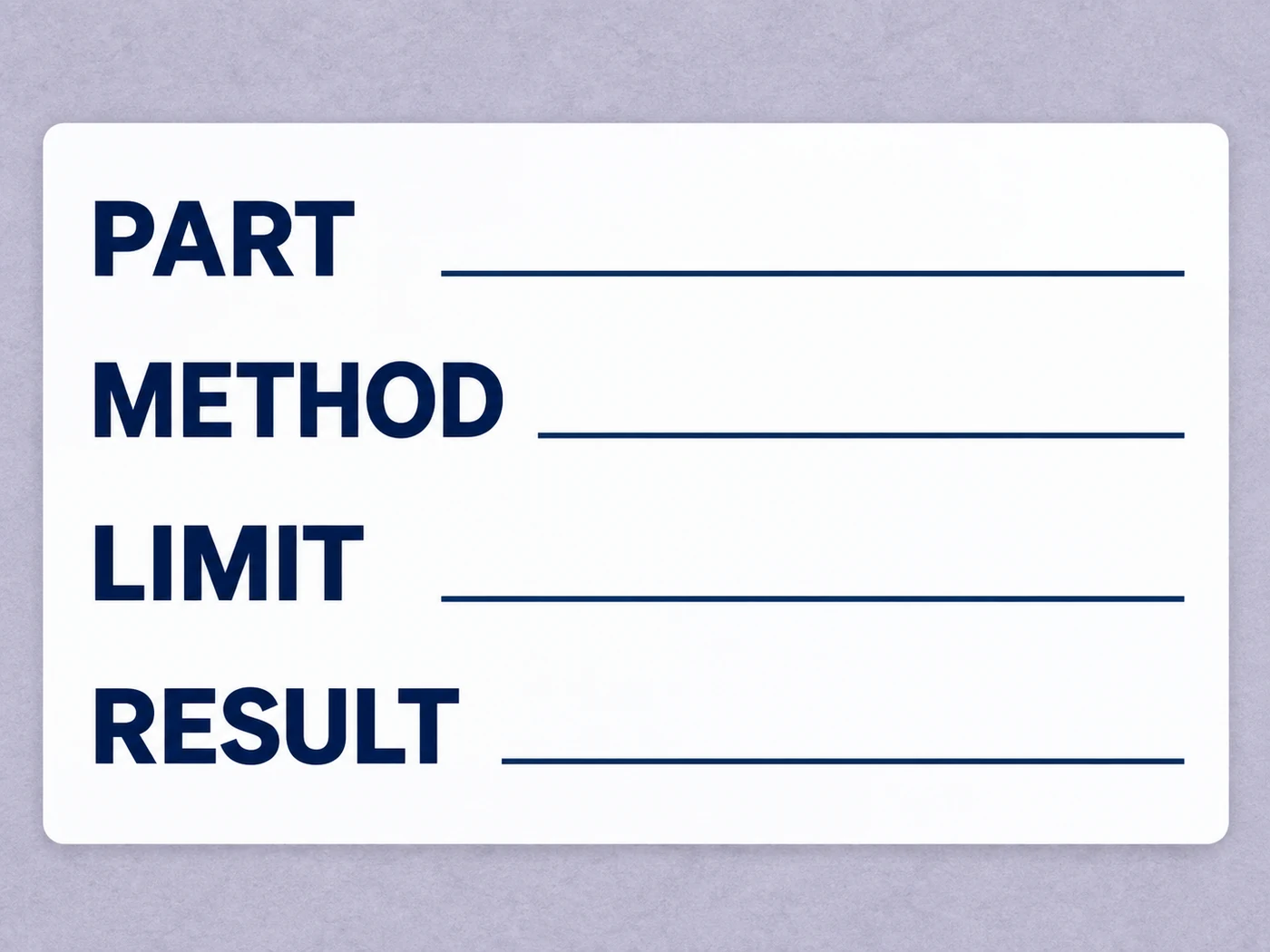
A useful record names the part and revision, sample or lot, method, sampled circuit, acceptance criterion, result, date and responsible reviewer. If a report covers only a design-validation sample, it should not be presented as proof that the shipped lot was inspected under the same method. Ask whether the result is from the supplied unit, a production batch sample or a qualification program and record the limits of that coverage.
Nissens' technical bulletin on condenser internal clogging discusses contamination after compressor failure. That is an in-service system condition and not proof of a new condenser's factory cleanliness. It does show why the history of the vehicle circuit matters when a new part is installed. The buyer's document review should keep factory component evidence separate from a workshop diagnosis of debris already present in the system.
What if the supplier offers only a generic certificate?
Ask for the underlying controlled instruction and a report or declaration tied to the offered part number and lot. A company-wide statement may describe a quality system but does not identify the tested sample, method or criterion. If detailed raw data are proprietary, request at least the procedure reference, inspection scope, limit and traceable pass/fail disposition. Mark the evidence incomplete until the offered assembly can be connected to the claim.
Separate factory evidence from workshop contamination
A clean replacement cannot solve contamination left in the vehicle's AC loop. Nissens advises that after a compressor failure deposits and particles can remain in the system, and certain parallel- or multi-flow condensers may need replacement because thorough flushing is not possible. That guidance is for a qualified service decision under the specific vehicle and component conditions. It is not a reason to reject a sealed new condenser or to publish a universal flushing procedure here.
When a return alleges contamination, collect the unopened state if available, unit identifier, installation date, removed components, workshop findings and photos of the debris source. Determine whether the evidence concerns factory-delivered passages, handling after opening, or the old vehicle circuit. Mixing these stages can lead to an unfair conclusion. If the product was opened for inspection before installation, preserve that record too.
Do not assume a dry-looking port is dry internally. Do not assume a damp-looking carton means moisture reached a sealed passage. Each observation needs an appropriate follow-up method and a controlled disposition. The purchasing team should ask who owns the decision and which test or inspection would resolve it, rather than attempting an improvised bench procedure.
Use a sample-receiving evidence sheet
The table below is a practical review checklist, not a cleanliness specification. Fill it from the actual sample, supplier documents and receiving photos. An empty result cell means the question remains open; it is not a pass by default.
| Field | Evidence to capture | Decision question |
|---|---|---|
| Identity | Full part number, revision, sample or lot | Does the record belong to the delivered unit? |
| Openings | Drawing of ports and protective closures | Are all expected openings protected? |
| Packaging | Unopened carton and inner packing photos | Did the protection arrive intact? |
| Storage | Maker instruction and handling history | Was any exception documented? |
| Method | Cleanliness or inspection procedure reference | What was actually checked? |
| Limit and result | Approved criterion and observed disposition | Can the conclusion be audited? |
| Scope | Sample, batch or design-validation coverage | What does the evidence support? |
If a receiving exception is found, quarantine the sample in its current state and request the supplier's written disposition. A replacement, reinspection or maker-approved rework may be appropriate, but the buyer should not quietly change the package and accept it as originally delivered. For repeat orders, include the expected cap and packing configuration in the purchase specification so both sides know what receiving will check.
Frequently asked buyer questions
Do intact caps prove the inside is clean?
No. They are visible evidence of protection at the time of inspection. Internal cleanliness requires the maker's process and, where specified, an appropriate test record. Confirm cap type and delivered state against the exact part's packing instruction.
Is a leak test the same as a cleanliness test?
No. Leak testing evaluates sealing under stated conditions; cleanliness testing or inspection addresses contamination. The same report can contain several checks, but each needs its own method, limit and result. Do not accept a pressure-test pass as a particle-count result.
What if a cap is missing from a sample?
Record the sample identity, packaging state and exposed opening. Hold the unit and ask the supplier for a part-specific assessment and disposition. Avoid opening more ports or attempting an unapproved cleaning step merely to make the sample look acceptable.
Request part-specific evidence with the quote
For a MAKEXCAR condenser inquiry, send the vehicle application, OE reference, exact candidate part number, quantity and destination. Ask how the unit is capped and packed, what storage instruction applies, whether a receiver-drier is integrated, and what cleanliness or inspection evidence is available for the supplied sample or lot. Browse the published Condensers category for the product family, then contact MAKEXCAR with the evidence request. A clean-looking photo starts the conversation; a traceable record and protected delivered unit complete it.