Begin with the report's exact claim
Copy the supplier's wording into the quotation review. “Tested for a stated duration” identifies an exposure claim. “Accepted against a specified corrosion criterion” adds a result and an evaluation basis. If the statement stops at hours, the buyer still needs to establish what the laboratory observed and what would have counted as an unacceptable result.
Record the control arm reference and quoted configuration alongside the report reference. Check the report's specimen identifier, coating description and revision. When the report covers a coating family or a production process, ask how that coverage applies to the offered part. A product-category name does not provide that link.
A short certificate can be a starting point, but preserve its limits. Ask for the relevant specimen photographs, method identification and result pages rather than treating an isolated pass label as the complete evidence file.
Connect the specimen to the quoted control arm
Use the exact reference in the MAKEXCAR Control Arms category to request corrosion evidence. A product-type label identifies the inquiry; it does not specify a coating, exposure duration or corrosion result. Keep specimen and finish identifiers attached to the offered configuration.
If the report names a coating family or process, ask how its evidence relates to the supplied arm. Preserve the source's own scope rather than assigning it to every item in the category. A specimen reference linked to one quotation may require clarification when the proposed finish or assembly changes.
Record the method and its version
The public abstract for ISO 9227:2022 describes NSS, AASS and CASS salt spray methods. It does not supply a particular product's specimen definition, required exposure duration or result interpretation. The catalog page also lists a 2024 amendment. These identifiers help locate the applicable method; they do not establish that a MAKEXCAR arm was tested under it.
Ask which method and edition the supplied report actually references, including amendments where applicable. Keep the report's named method rather than upgrading it silently to a newer edition. If the quotation asks for a different edition, request an explanation of the mismatch and the evidence needed to resolve it.
The name “salt spray” alone leaves the method unresolved. Record whether the report identifies a continuous exposure or another program, and retain the conditions stated by the author. Do not combine results from differently named programs into a single ranking based only on the number of hours.
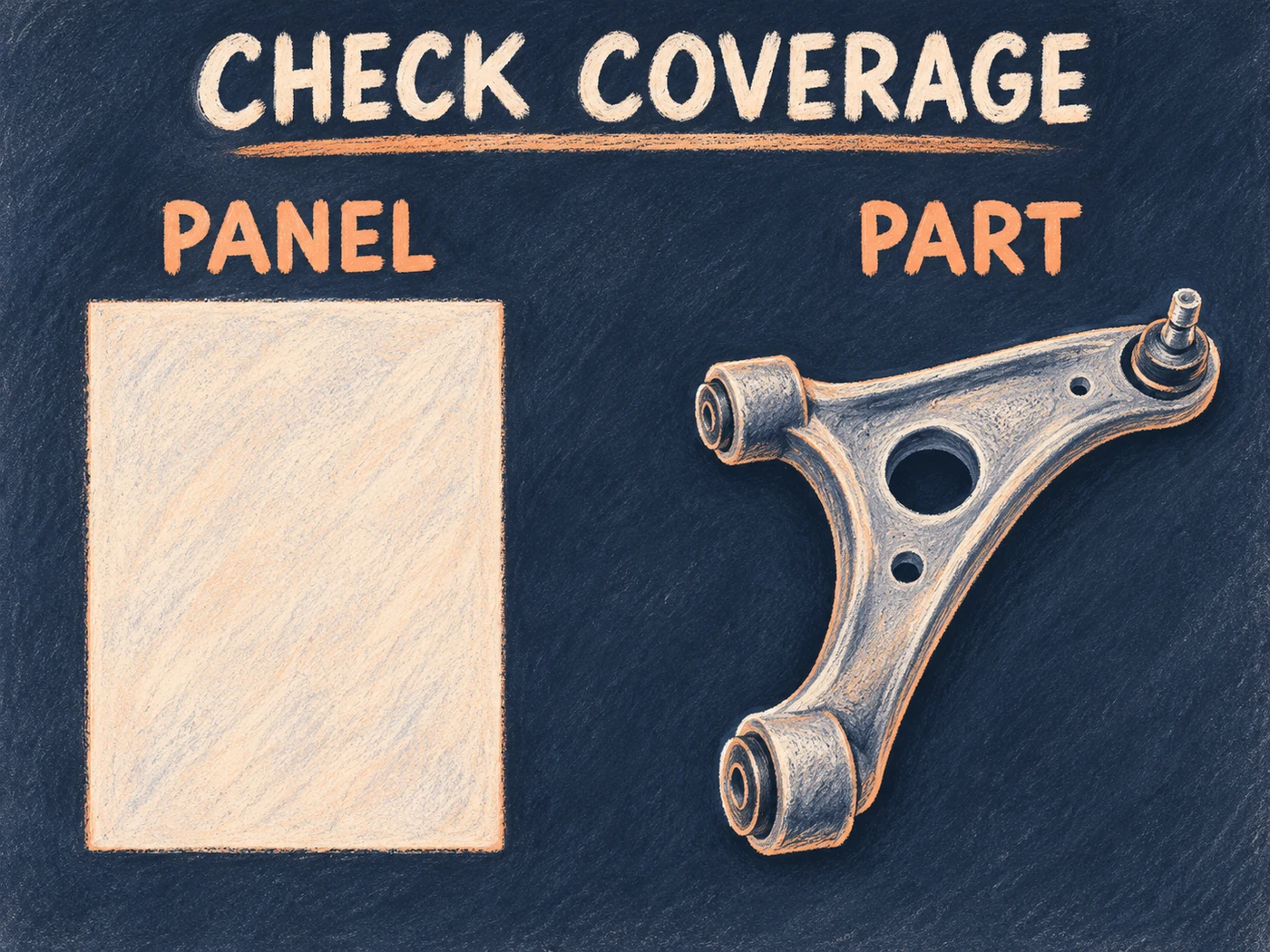
Was the specimen a panel, an arm or an assembly?
Look for a specimen description and images that identify what entered the test. A coated panel, a bare control arm body and an assembled product are different evidence scopes. Ask whether the report includes the surfaces and components relevant to the commercial claim. Do not rewrite “coated test panel” as “complete control arm.”
Check whether the documented specimen received the same stated coating process as the offered configuration. Preserve any differences in substrate, preparation, batch or finish that the supplier identifies. These questions establish the applicability of the evidence; they do not assume that different specimens must produce a particular result.
If only one area of the specimen was evaluated, retain that area description with the conclusion. An accepted observation for a defined face should not expand to every surface, joint or supplied component without supporting coverage.
Define the evaluated area and acceptance rule
Find the specification that defines acceptance. The record should connect the observation to a named area, a stated condition and a decision rule. If the report distinguishes corrosion of the coating from corrosion of the underlying material, preserve that distinction rather than reducing both to the word “rust.”
Ask whether edges, cut marks, intentional damage or masked regions were included or excluded. Use the report's description and photographs; do not invent a scoring boundary from an attractive close-up. Where a rating scale is used, keep its referenced definition and direction so that a larger number is not mistaken for a universally better result.
Request the recorded observations, not just the final pass label. If the acceptance specification is missing, note that the reported decision cannot yet be independently checked against its intended criterion. The buyer can request the missing basis without assigning a new limit.
Use a report worksheet that identifies the missing basis
Keep the exposure number beside the fields that explain its relevance. The next request should identify the missing field rather than ask only for a longer test duration.
| Field | Why it matters | Next request if unresolved |
|---|---|---|
| Specimen and coating revision | Links laboratory scope to the proposed item | Request the sample/arm/assembly mapping and finish specification |
| Method and edition | Identifies the exposure program used | Obtain the named method and version from the actual report |
| Exposure record | Defines the duration and reported observation stages | Request the relevant time record, not a guessed service-life equivalent |
| Evaluated regions/exclusions | Limits where the observation applies | Obtain the assessment views and stated area boundaries |
| Observations and acceptance source | Connects the result to its decision rule | Request result pages and agreed criterion behind any pass label |
A hypothetical hours comparison without a lifespan claim
Imagine two invented quotation summaries. Summary A states an exposure of 240 hours and Summary B states 480 hours. Neither summary supplies a specimen description, coating specification or acceptance criterion. These numbers are teaching examples, not actual results, requirements or ratings for any MAKEXCAR product.
| Illustrative summary | Stated exposure | Equivalent elapsed laboratory days | Missing applicability fields |
|---|---|---|---|
| Hypothetical A | 240 hours | 10 days | Specimen, coating, method and criterion |
| Hypothetical B | 480 hours | 20 days | Specimen, coating, method and criterion |
Dividing hours by 24 converts the stated exposure duration into days. B's stated duration is twice A's and the difference is 240 hours. These arithmetic facts do not establish twice the corrosion resistance, twice the road life or a superior complete arm. The missing evidence fields remain missing after conversion.
Keep laboratory days labelled as laboratory exposure time. Do not relabel ten days as a year outdoors or use a guessed acceleration factor. A larger number can look persuasive in a quotation while still failing to answer the purchasing question.

Keep outdoor service life outside the hours result
ASTM's public B117-26 significance statement cautions that natural-environment performance is not reliably predicted from salt spray results used alone. ISO's public abstract likewise excludes using its salt spray methods to predict long-term corrosion resistance. Those limitations support keeping laboratory exposure evidence separate from a claimed service life.
If a supplier adds a years-of-use statement, request the evidence specific to that statement and its stated environment. Keep the tested product, operating assumptions and exclusions visible. A corrosion report can be useful for its documented purpose without resolving every outdoor durability claim.
A corrosion acceptance conclusion also does not answer whether the arm meets a structural requirement or fits the intended vehicle. Maintain separate evidence for those questions. This prevents a coating result from becoming an unsupported whole-product approval.
Read photographs with the report record
Match each photograph to the specimen identifier, exposure stage and evaluated region. Check whether the image represents the beginning, an intermediate observation or the final recorded condition. A cropped image without those labels is an observation with unresolved context.
Retain captions and the report's explanation of specimen handling. If the supplier sends new photographs separately, ask how they relate to the reported sample and time point. Do not treat a clean catalog image as the laboratory's post-exposure evidence.
Keep amendments with the final report. A corrected exposure duration or specimen description should be traceable to the conclusion that applies to the quotation. When two documents conflict, identify the conflicting fields and request the current authoritative record rather than choosing the more attractive result.
Carry the evidence into the order record
Once the supplier clarifies the report's scope, retain the agreed reference and finish revision in the purchase record. A later quotation amendment should identify whether that evidence still applies. If the offered coating or production configuration changes, ask for the supporting coverage before carrying forward the original result.
For receiving review, compare the delivered identification and supplied documentation with that agreed record. Record discrepancies as identification or documentation questions. Do not turn a delivery inspection into an improvised corrosion test or declare that an untested shipment passed because an earlier sample had an accepted result. The purpose is traceability between the order and its evidence.
Three incomplete corrosion submissions and the buyer response
The report covers a panel but the quote claims the assembled arm passed
Keep the panel result labelled as a panel result. Request the applicability explanation connecting its material, finish and evaluated scope to the offered assembly. Ask which components or surfaces remain outside that evidence. If no mapping is supplied, mark the whole-assembly claim unresolved rather than rewriting the specimen name to match the sales statement.
The certificate says pass but omits the acceptance rule
Request the criterion document and the observation pages used for the decision. Identify the report reference and the missing evaluation fields in the request. A pass statement can be retained as reported while its basis remains unresolved. Do not select a rust percentage, rating threshold or evaluated area after seeing the result to make the record appear complete.
A separate photograph has no time or sample label
Ask for its specimen identity, exposure stage and region mapping. Keep it with the supplied message until the relationship to the report is established. A clean image could describe an initial condition, another sample or a catalog item; the buyer should not label it as post-exposure evidence by assumption. Save the supplier's explanation beside the original photograph.
These are editorial review scenarios, not actual MAKEXCAR test findings or customer incidents. They explain how to request enough evidence for a specific corrosion claim without inventing a laboratory program or translating its hours into road-service years.
Request a report that answers the quotation question
Send MAKEXCAR the exact control arm reference and the statement you need to review. These five fields make the report request specific:
Quoted configuration: [arm reference], [finish specification/revision], [quantity], [application identification].
Specimen mapping: [panel/arm/assembly], [sample identifier], [how it covers the supplied item], [excluded components].
Exposure basis: [method and edition], [reported duration], [observation stages], [report identifier/revision].
Result basis: [evaluated regions/exclusions], [recorded observations], [acceptance criterion/document].
Clarification requested: [claim with missing evidence], [separate service-life/structural/fitment question], [scope affected by quotation changes].
Save the response with the original statement, report and specimen images. A useful corrosion review connects the laboratory observation to its defined area, sample and criterion. It shows what the evidence supports and what remains open without inventing a salt spray rating or vehicle service life.