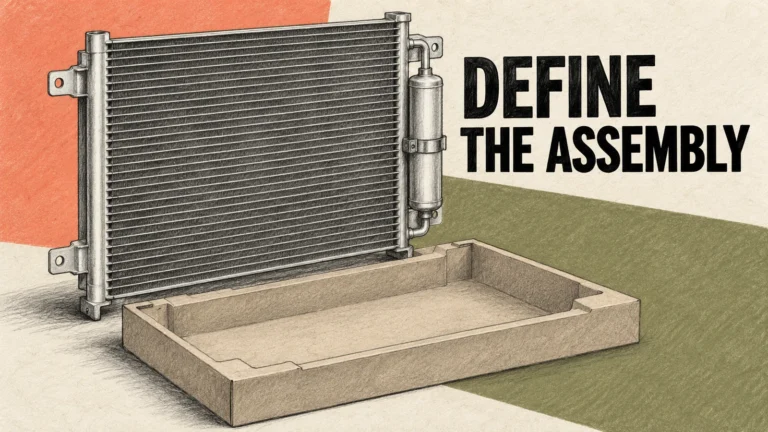
Define the result before comparing the number
Start by asking what the quoted performance actually means. A condenser heat-rejection result concerns the tested component and its stated conditions. Cabin cooling capacity, vent temperature and compressor power describe other quantities or system outcomes. A quotation that simply says “high cooling performance” leaves the buyer without a defined comparison.
Put the quantity name, unit, measurement basis and report revision beside the value. Keep the tested item code and configuration on the same record. If the supplier offers a complete assembly, confirm whether the report covers that assembly or only a different core. The question is about evidence identity before it is about numerical ranking.
This review is for procurement and report interpretation. It does not prescribe refrigerant charging, pressure settings, service procedures or a vehicle diagnosis. Those decisions require the relevant application information and qualified assessment.
Keep the catalog reference attached to the request
Link the reported result to the exact proposed reference and assembly. The MAKEXCAR Condensers category identifies the enquiry destination; its product-reference records do not supply thermal operating points. Keep the item and report revisions on the same comparison row.
Identify whether the quotation supplies a complete assembly or a core and whether the report covers that scope. A familiar vehicle name or photographed core cannot resolve that relationship. The first evidence task is to connect the tested configuration to the proposed supply, before ranking a numerical heat value.
Why the refrigerant state belongs in the evidence
The official HELLA air-conditioning explanation describes compressed gaseous refrigerant entering the condenser, releasing heat and changing to liquid. This explains why an operating-point review needs to identify the refrigerant side, rather than treating the component as an unspecified liquid cooler.
Ask the report owner how the inlet state is defined, which refrigerant was used and how the flow is recorded. If pressure and temperature are reported, keep their labels and measurement positions together. An unlabeled pressure number should not be turned into an application limit or compared with a differently defined pressure entry.
Where the report distinguishes stages or outlet conditions, retain that distinction. A purchaser should not rename one stage's result as the total condenser result. If a term such as subcooling appears, request its definition and reference conditions from the report rather than supplying an assumed target.

Read the air condition as a measured basis
Ask for entering-air temperature, the airflow quantity and the location or method used to establish it. Keep mass flow, volume flow and air velocity under their own labels. A fan description or nominal fan speed is not automatically the same information as documented flow through the tested arrangement.
Check whether the tested condenser was isolated or placed with other components. Retain any stated upstream arrangement, enclosure or airflow distribution condition. A result from one defined arrangement should not silently become a rating for a different vehicle cooling package.
Record the conditions that the report actually gives. If humidity or another air property is included, preserve it; if it is missing, mark the field unresolved instead of inventing a value. The report owner can then explain whether that field matters to the claimed comparison.
Use a worksheet that preserves unresolved fields
Use one record per reported operating point. The fields below preserve the input definitions beside the thermal result; the last column identifies which comparison needs clarification.
| Field | Why it affects comparison | Action when unresolved |
|---|---|---|
| Tested item and assembly revision | Defines which configuration produced the result | Resolve core/complete-assembly scope before assigning the rating |
| Refrigerant identity, state and flow | Defines the refrigerant-side operating basis | Keep unlike or unspecified states outside a numerical ranking |
| Entering-air condition and flow basis | Identifies the other side of the test arrangement | Distinguish measured flow from fan name or nominal speed |
| Result quantity, unit and method | Shows whether the value means heat rejection or another outcome | Correct quantity labels before comparing values |
| Application interpretation and limits | Explains the decision supported by the defined point | Keep all-condition/cabin-performance claims open without matching evidence |
A blank operating field means the comparison lacks that definition. Retain the original unit and result beside any normalized display. The worksheet is an editorial report-reading aid; it does not select a vehicle operating pressure or prescribe a thermal test.
A hypothetical larger result can still be incomparable
Consider two invented report summaries. They demonstrate a review problem, not actual condenser measurements, suitable test conditions or vehicle operating targets. Their refrigerant-side conditions are still unspecified.
| Hypothetical record | Entering air | Air volume flow | Reported heat rejection |
|---|---|---|---|
| A | 30 °C | 600 m³/h | 8 kW |
| B | 35 °C | 750 m³/h | 9 kW |
Report B lists 9 kW instead of 8 kW, but it also lists 750 instead of 600 m³/h airflow and 35 instead of 30 °C entering air. These are different operating-point records. Their numerical differences do not establish an intrinsic product advantage because the inputs are unmatched and refrigerant-side conditions are still unspecified.
The air conditions do not match, and the refrigerant identity, state and flow remain unresolved. A buyer needs an appropriate common basis or an explained comparison from the report owner. Dividing heat by airflow alone would not resolve all those missing conditions.

Separate construction descriptions from measured performance
A supplier may describe the core layout, material or manufacturing approach. Preserve those descriptions as construction information. They do not replace the exact thermal report or establish that every item using the same broad construction has the same rating.
If a quotation includes both a construction claim and a performance figure, ask for evidence for each. Avoid converting “parallel flow,” a photograph or an overall dimension into an unsupported percentage improvement.
A leak result answers a different procurement question
A report about pressure tightness can be relevant to the supplied component, but it is not automatically a heat-rejection measurement. Corrosion results, shipment protection and dimensional checks likewise need their own scope and acceptance criteria.
Keep these records linked to the item while leaving the result types distinct. An approved leakage record should not be placed in the thermal worksheet as if it supplied a missing kW value. A thermal result should not be presented as proof of a pressure limit that the report does not establish.
Respond to three common report gaps
If both reports give heat rejection but use different air conditions, identify the mismatched fields in the worksheet and request an explained comparison on the relevant common basis. Do not divide kW by airflow and treat that ratio as if it removed all refrigerant and arrangement differences.
If one report describes a core while the quotation names a complete assembly, ask the report owner to identify the relationship. The core data may remain useful within its scope, but it does not automatically establish the quoted assembly's performance. Keep the document rather than relabel it as the missing assembly result.
If the response supplies a pressure-tightness report instead of a thermal record, file it against its own requirement and keep the thermal question outstanding. The supplier has supplied evidence for a different characteristic, not a substitute kW measurement. That distinction lets the next request name exactly what is still needed.
Review the report before setting a purchasing conclusion
Confirm whether the reported values are measurements, predictions, nominal labels or a summarized comparison. Ask what repeated observations or uncertainty information is supplied. Do not attach more decimal places or certainty than the underlying record supports.
If only one operating point is available, describe the evidence at that point. Do not turn it into a complete curve, extrapolate it to a hotter environment or announce an all-condition advantage. The proposed application may require more evidence than a single comparison provides.
Record the conclusion with its limits: the references compared, matched and unmatched conditions, remaining questions and the person responsible for application approval. This creates a usable purchasing record without overstating the technical result.
Keep quotation changes connected to the reviewed item
When a revised quotation arrives, check whether the item reference, assembly contents or claimed report has changed. A lower price for a differently defined assembly is not a like-for-like offer simply because the email retains the previous subject line. Keep the accepted evidence attached to the actual order line.
If the supplier changes the proposed reference after the report review, reopen the evidence question for that reference. Record which prior conclusions still apply and which need confirmation. Do not carry a thermal conclusion forward solely because the new item is in the same category.
For the final purchasing file, preserve the supplier's original report, your comparison worksheet and the clarification response together. The worksheet should help locate the evidence, not replace it with a shortened value that loses its operating-point definitions.
Send an RFQ that makes the report identifiable
Send the following fields through the MAKEXCAR contact page with the available report and assembly drawing. Identify the decision needed and the exact unmatched field; avoid an unspecified request for higher cooling power.
| Request field | Buyer information |
|---|---|
| Proposed supply | [Reference, vehicle/application, assembly scope and quantity] |
| Report identity | [Tested item, report/method revision and result quantity] |
| Refrigerant operating point | [Fluid, flow and inlet/outlet definitions] |
| Air-side arrangement | [Entering conditions, flow basis and tested configuration] |
| Comparison and review owner | [Competing record, unresolved input and technical contact] |
The useful response explains which result can be compared and within what conditions. Retain that interpretation with the original report and the final quoted configuration. Reopen affected fields if the proposed item or assembly changes before the order is approved.